

Shah Waliullah Dehlawi (1703–1762) was one of the most influential scholars, theologians, and reformers in the history of South Asian Islam. Born in Delhi during a time of political chaos and spiritual decline, he devoted his life to reviving the faith—intellectually, spiritually, and socially. Through his deep scholarship, reformist vision, and balance between reason and revelation, Shah Waliullah Dehlvi helped lay the foundation for Islamic revival movements that reshaped the Indian subcontinent.
This article explores his life, teachings, and lasting legacy, showing why his work still matters in today’s world. Whether you’re searching for “Shah Waliullah Dehlawi biography,” “Shah Waliullah’s contributions,” “Shah Waliullah books,” “reforms,” or “Qur’an translation,” this guide brings together the key facts, ideas, and influences that defined his role as one of Islam’s great reformers and thinkers.
Early Life and Family Background of Shah Waliullah Dehlawi
Shah Waliullah Dehlawi, born Qutb ud-Din Ahmad ibn Abdur Rahim on February 21, 1703 (1114 AH), was one of the most influential Islamic scholars and reformers in South Asian history. He came from a distinguished family of Islamic scholars in Phulat, near Muzaffarnagar, Uttar Pradesh, India.
His grandfather, Shaykh Wajih al-Din, served as a military officer under the Mughal emperors Shah Jahan and Aurangzeb, earning fame for his bravery, piety, and service to the empire. His father, Shah Abdur Rahim, devoted his life to Islamic education and scholarship. He was among the leading scholars who helped compile al-Fatawa al-Alamgiriyyah—the monumental Islamic legal code commissioned by Emperor Aurangzeb, which remains a reference work in Hanafi jurisprudence.
According to several historians, Shah Waliullah’s lineage traces back to Amir al-Mu’minin Umar ibn al-Khattab (may Allah be pleased with him). His thirteenth ancestor, Shams al-Din, is said to have migrated to India during the early Islamic conquests, establishing religious schools and serving as a mufti, a role that his descendants continued for generations.
Education and Intellectual Development
Shah Waliullah Dehlawi received his early education at al-Madrasah al-Rahimiyyah, the renowned seminary founded by his father in Delhi. By the age of fourteen, he had memorized the Qur’an and achieved fluency in Arabic and Persian, the scholarly languages of his time.
He went on to master advanced texts in Hanafi fiqh (Islamic jurisprudence), theology, logic, philosophy, metaphysics, mysticism (tasawwuf), geometry, and arithmetic, showing a rare combination of traditional scholarship and rational inquiry. At fifteen, he was initiated into the Naqshbandi Sufi order, reflecting his deep spiritual inclination.
Following the death of his father in 1131 AH (1719 CE), Shah Waliullah Muhaddis Dehlawi succeeded him as the head of Madrasah-i Rahimiyyah, where he taught a wide range of Islamic sciences and attracted students from across India. His comprehensive education and balanced approach to both reason and revelation laid the foundation for his later reformist movement in the Indian subcontinent.
For readers searching for “Shah Waliullah Dehlawi’s early life, education, and family background,” this period of Shah Waliullah’s life reflects how a strong foundation in classical learning, combined with intellectual curiosity and spiritual discipline, prepared him for his later role as a leading reformer and thinker in Islamic scholarship.
Journey to Hijaz: Expanding Horizons and Spiritual Visions
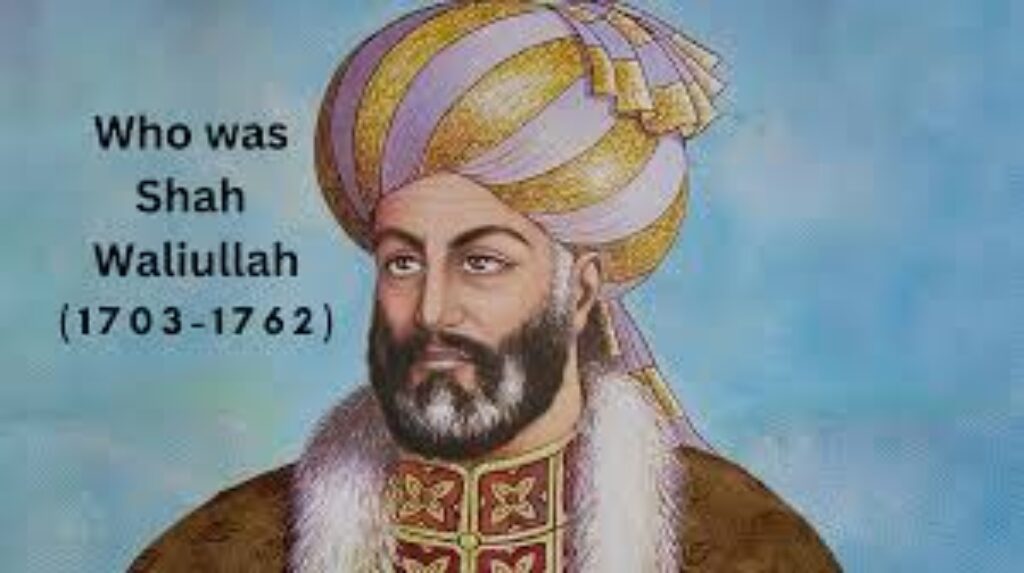
In 1731 CE (1143 AH), at the age of twenty-nine, Shah Waliullah Dehlvi traveled to the Hijaz to perform Hajj, remaining in Mecca and Medina for about fourteen months. During his stay, he studied under several renowned Hadith masters, including Shaykh Abu Tahir al-Kurdi al-Madani and Shaykh Taj al-Din al-Qala’i al-Hanafi. He received ijazahs (scholarly authorizations) in the six canonical Hadith collections (Sihah Sitta) as well as in Imam Malik’s Muwatta, signifying his mastery of Hadith sciences.
Throughout this period, Shah Waliullah Muhaddith Dehlvi experienced a series of spiritual visions, later recorded in his celebrated work Fuyud al-Haramayn (Emanations of the Two Sanctuaries). He mentioned forty-seven visions in total—among them a symbolic moment in which Imam Hasan and Imam Husayn presented him with a pen, representing his inheritance of the Prophet’s spiritual and intellectual legacy.
Upon his return to Delhi in 1732 CE (1144 AH), following a second pilgrimage, Shah Waliullah entered the most productive phase of his life. His journey to the Hijaz profoundly deepened his intellectual and mystical understanding, shaping the reformist vision that defined his later works and influence.
Intellectual Contributions and Major Works: A Legacy of Scholarship
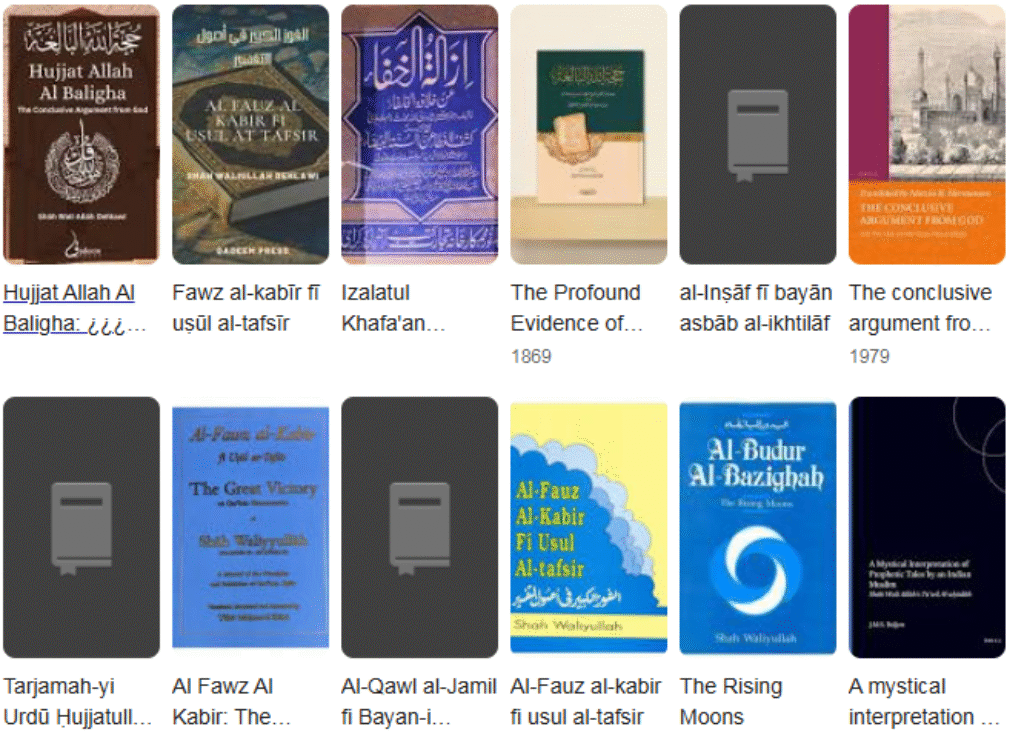
Shah Waliullah Dehlvi authored 50–70 works in Arabic and Persian, spanning theology, mysticism, metaphysics, Quranic exegesis, and more. His writings reconciled diverse traditions, providing rational interpretations to harmonize reason and revelation.
His major works include:
1. Al-Khayr al-Kathir (The Abundant Good)
One of Shah Waliullah Dehlawi’s most profound philosophical works, Al-Khayr al-Kathir, deals with the nature of existence (wujūd), knowledge (ʿilm), and the relationship between God and creation. It explores key metaphysical concepts such as divine attributes, the nature of prophecy (nubuwwah), sainthood (wilayah), and the mystical path to God.
The book harmonizes intellectual philosophy with Ash‘arite theology, presenting a deeply reasoned defense of Islamic metaphysics while upholding orthodox Sunni principles.
Get a copy of Al-Khair Al-Kathir from Amazon.com | Amazon UK
2. Al-Tafhimat al-Ilahiyya (Divinely Inspired Insights)
This two-volume spiritual and mystical compendium records Shah Waliullah Muhaddith Dehlvi’s inner illuminations, spiritual visions, and dialogues on divine mysteries. It includes the famous Maktūb al-Madanī (Madinian Epistle), in which he attempts to reconcile the two great Sufi doctrines — wahdat al-wujūd (Unity of Being) and wahdat al-shuhūd (Unity of Witnessing).
Through these reflections, he presents a balanced Sufi worldview that integrates mysticism with scriptural fidelity, making it a bridge between spiritual experience and theological orthodoxy.
3. Al-Budur al-Bazigha (The Full Moons Rising in Splendour)
A profound treatise on theology, ethics, and social philosophy, Al-Budur al-Bazigha examines the unity of God, the purpose of human life, and the evolution of divine laws across prophetic traditions.
Shah Waliullah Dehlawi discusses how religious laws change to suit societies over time while preserving their divine essence. The work also delves into human psychology, morality, and the need for prophetic guidance — reflecting his vision of Islam as a universal, rational, and morally transformative faith.
Get a copy of Al Budoor Al Bazighah: The Rising Moons from Amazon UK | Amazon.com
4. Izalat al-Khifa’ ‘an Khilafat al-Khulafa (Removing Uncertainty about the Caliphate)
One of his most widely read works, Izalat al-Khifa, is a detailed historical and theological study of the early caliphate. Shah Waliullah Dehlvi defends the legitimacy of the four rightly guided caliphs (Khulafā’ al-Rāshidīn), explaining the political and spiritual dimensions of their leadership.
The book clarifies the nature of legitimate Islamic governance and refutes sectarian misunderstandings regarding succession after the Prophet ﷺ. It became an influential text in shaping Sunni political thought in India and beyond.
Read Izalat al-khifa from Archive.org
5. Sharh Hizb al-Bahr (Commentary on the Litany of the Sea)
In this commentary on the famous Hizb al-Bahr of Shaykh Abu al-Hasan al-Shadhili, Shah Waliullah Dehlawi explores its linguistic subtleties, esoteric meanings, and spiritual benefits. He interprets the supplication not merely as a devotional chant but as a means of spiritual purification and divine protection.
The work reinforced Sufi devotional practices in India and linked Indian Sufism to classical Shadhili traditions of North Africa and the Middle East.
Read it on archive.org
6. Al-Fauz al-Kabir fi Usul al-Tafsir (The Great Success in the Principles of Quranic Commentary)
Perhaps Shah Waliullah Dehlawi’s most famous scholarly manual, Al-Fauz al-Kabir, outlines the essential principles for interpreting the Qur’an. It emphasizes understanding the Qur’an through linguistic precision, theological consistency, and contextual awareness.
The book classifies Qur’anic verses into categories (commands, narratives, parables, etc.) and teaches how to derive meaning in harmony with the Qur’an’s holistic message. This foundational work deeply influenced later tafsir methodology in the subcontinent and remains a key reference for serious students of Qur’anic studies.
Get a copy of Al-Fauze al-kabir fi Usul al-Tafsir from Amazon.com | Amazon.co.uk
7. Tafsir al-Qur’an al-Hakim
One of his monumental works is Tafsir al-Qur’an al-Hakim, a comprehensive commentary on the Qur’an written in Persian. Unlike many previous commentaries, Shah Waliullah Dehlvi emphasized the relevance of the Qur’an to the socio-political context of his time, encouraging practical application of divine laws.
8. Fath-ar Rahman: Translation of the Qur’an into Persian
He was the first major South Asian scholar to translate the entire Qur’an into Persian (the lingua franca of the region then), making the holy text accessible to a wider audience. This translation was accompanied by detailed commentary to elucidate meanings and legal rulings.
Later, his sons (notably Shah Abdul Qadir and Shah Rafiuddin) translated the Quran into Urdu, continuing his legacy.
9. Hujjatullah al-Baligha: His Magnum Opus
His most celebrated work, “Hujjatullah al-Baligha” (The Conclusive Argument from God), provides a deep philosophical explanation of Islamic laws. Muhammad Rashid Rida praised it for explaining “the objectives of the Shari’ah, its wisdom, and secrets. In this work, he:
- Explained the objectives (maqasid) of Shariah.
- Emphasized wisdom (hikmah) behind rituals and rulings.
- Advocated aligning individual behavior with divine will and reason.
This text remains a staple in Islamic seminaries and has influenced generations of scholars.
Check our full review of Hujjatullah al-Baligha or purchase it here.
10. Ta’wil al-Ahadith fi Rumuz Qisas al-Anbiya (Symbolic Interpretation of Prophetic Tales)
In Ta’wil al-Ahadith, Shah Waliullah Dehlawi presents a sophisticated symbolic reading of the stories of the Prophets mentioned in the Qur’an. Rather than treating them solely as historical narratives, he interprets them as timeless spiritual parables that reveal inner truths about the human soul, divine wisdom, and humanity’s moral journey.
The work masterfully blends zahir (exoteric) and batin (esoteric) meanings, demonstrating how prophetic stories contain layered guidance — historical, ethical, and mystical — all harmoniously united within the divine message.
11. Al-Musawwa and Al-Musaffa (Commentaries on Muwatta’ of Imam Malik)
Shah Waliullah Muhaddis Dehlvi authored two celebrated commentaries on Imam Malik’s Muwatta’ — Al-Musawwa in Arabic and Al-Musaffa in Persian. These works aimed to bridge the gap between different Islamic legal schools (madhāhib) by highlighting their shared foundations in hadith and early practice.
Through careful analysis, Shah Waliullah Dehlavi sought to demonstrate that juristic diversity stems from interpretive richness rather than contradiction. These commentaries are not only critical hadith studies but also pioneering efforts in fiqh al-muqaran (comparative jurisprudence), reflecting his vision of legal harmony and intellectual unity in the ummah.
Read it on Archive.org
12. Altaf al-Quds (The Sacred Knowledge)
Altaf al-Quds is one of Shah Waliullah Dehlawi’s most significant mystical and psychological treatises. It delves into the nature of spiritual perception — kashf (unveiling) and ilhām (divine inspiration) — and explores the functions of the human faculties such as the qalb (heart), rūh (spirit), ʿaql (intellect), and nafs (ego).
The book also presents a historical overview of Sufism, tracing its development through early figures like Shaykh Junayd al-Baghdadi. By linking spiritual psychology to divine revelation, Shah Waliullah Dehlvi positions mysticism as an essential complement to theology and law, not a deviation from them.
Purchase Altaf al-Quds from Amazon.com | Amazon UK
13. Sata’at (Manifestations) and Lamahat (Flashes of Lightning)
In these two concise yet profound works, Shah Waliullah Dehlawi systematizes his metaphysical insights on wujūd (existence) and its gradations (tashkīk al-wujūd). He explains how all forms of being are interconnected manifestations of divine reality, varying in intensity but united in origin.
Drawing from both Sufi metaphysics and philosophical reasoning, he harmonizes the views of Ibn ‘Arabi and earlier theologians, presenting a balanced vision that avoids both pantheism and literalism. Sata’at and Lamahat thus stand as luminous expositions of his mature spiritual thought — concise, dense, and intellectually unifying.
For “Shah Waliullah’s books list” or “Shah Waliullah’s major works,” his prolific output revitalized Islamic study, emphasizing direct Quranic engagement.
Buy Sata’at and Lamahat from Amazon.com | Amazon UK
Metaphysical and Cosmological Contributions: Synthesizing Sufism and Rational Thought
Shah Waliullah Dehlawi’s metaphysical views blended Sufi metaphysics (influenced by Ibn Arabi), rational philosophy, and Islamic theology, grounded in the Quran and Sunnah. He reconciled wahdat al-wujud (unity of being)—where beings are manifestations of God’s Absolute Existence descending through tanazzulat al-khamsa (five descents)—and wahdat al-shuhud (unity in conscience)—where creation reflects Divine Names in non-beings. Dismissing these as “verbal controversies” from ambiguous metaphors, he argued for underlying agreement, legitimizing wahdat al-wujud among theologians.
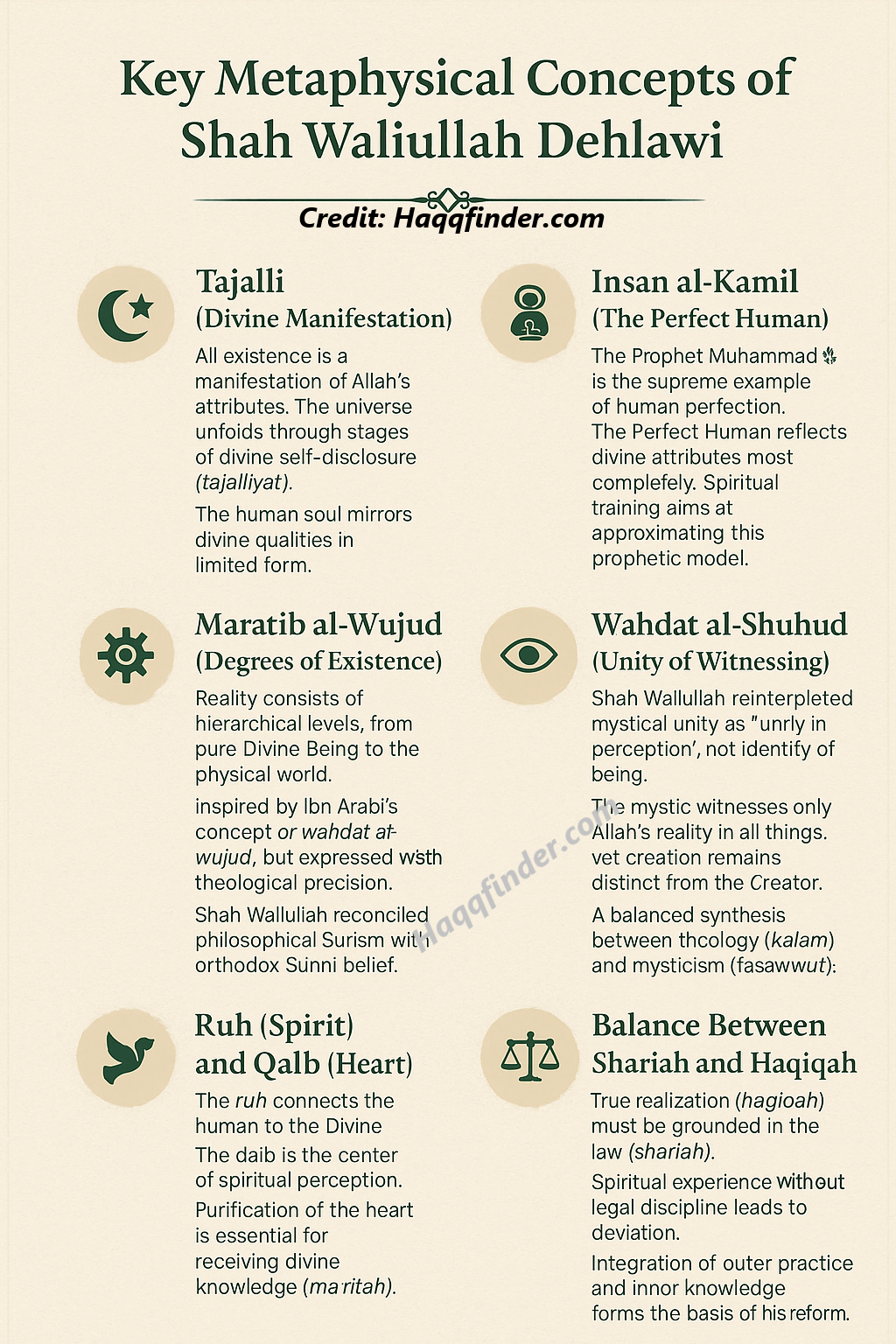
Key Metaphysical Concepts:
1. Tajalli (Divine Manifestation)
Shah Waliullah Dehlvi’s doctrine of Tajalli portrays the universe as a grand reflection of Allah’s divine attributes. Every level of creation — from the material to the celestial and spiritual — represents a manifestation (tajalli) of God’s Names and Qualities (Asma’ wa Sifat). Existence itself is thus a spectrum of divine radiance, structured in hierarchical layers.
This cosmological vision aligns with classical Sufi metaphysics, particularly the understanding that all realities ultimately point back to the One Reality (al-Haqq), whose light sustains and organizes the cosmos.
2. Latifas (Subtle Centers of the Soul)
Central to Shah Waliullah Dehlvi’s spiritual psychology is the concept of Latā’if (subtle centers). These are spiritual faculties — such as the qalb (heart), rūh (spirit), ʿaql (intellect), sirr (inner secret), and nafs (ego) — that mediate between the physical and spiritual dimensions of human existence.
In Altaf al-Quds, he explains how purification (tazkiyah) and remembrance (dhikr) refine these centers, enabling the seeker to ascend toward divine nearness. The proper balance and enlightenment of these latifas represent the human journey from self-awareness to God-consciousness.
3. Epistemology: The Harmony of Reason and Revelation
Shah Waliullah Muhaddis Dehlvi’s epistemology bridges divine illumination and rational thought. He argues that authentic knowledge (ʿilm) originates from two sources: ʿIlm Ladunni (God-given intuitive knowledge) and ʿAql (reason).
In Al-Khayr al-Kathir, he describes how revelation perfects intellect, while intellect interprets and applies revelation to worldly life. True understanding, therefore, arises from synthesizing spiritual insight with rational reflection — both guided by divine revelation.
4. Rational-Mystical Synthesis
For Shah Waliullah Dehlavi, the rational sciences (ʿulum al-ʿaqliyyah) and the mystical sciences (ʿulum al-dhawqiyyah) are not contradictory but complementary. He saw the study of the physical universe and the exploration of inner spiritual realities as two dimensions of one truth. This synthesis, reflected across his works, advocates a balanced pursuit of knowledge — where philosophy deepens faith, and mysticism illuminates reason. Through this integration, he sought to restore intellectual harmony between the mind and the soul, which he believed had been lost in later scholastic traditions.
5. Scriptural Foundations: Qur’an and Hadith as Dual Layers of Meaning
Shah Waliullah Dehlawi consistently grounded his metaphysical and philosophical reflections in the Qur’an and Hadith. In Al-Fauz al-Kabir fi Usul al-Tafsir and Hujjatullah al-Baligha, he emphasizes that the sacred texts operate on multiple layers — the zahir (outer meaning) that guides practical law and the batin (inner meaning) that unveils cosmic and spiritual truths. This hermeneutical depth allows the Qur’an to function simultaneously as a book of law, ethics, and metaphysical wisdom. This living revelation connects the divine, the natural, and the human realms.
For “Shah Waliullah metaphysics” or “Shah Waliullah wahdat al-wujud,” his works, such as Sata’at, Lamahat, and Al-Budur al-Bazigha, emphasize the gradation of being and divine-human interconnectedness, influencing later metaphysical thought.
Views on Divine Attributes and Theology: An Ash’ari Approach
As an Ash’ari, Shah Waliullah Muhaddith Dehlvi permitted ta’wil (alternative interpretation) of Divine Attributes within limits for clarity, stating in Hujjatullah al-Balighah: “It is our right to interpret them in senses more easy to comprehend… for clarity’s sake.” He opposed excessive kalam, defending the early Athari creed against speculative theologians who labeled them corporealists, calling their contempt “unfounded” and affirming no consensus mandates specific interpretations.
Unifying Islamic Schools of Thought: Bridging Divisions
Shah Waliullah Dehlawi aimed to unify the ummah by reconciling the Hanafi and Shafi’i schools, emphasizing valid ikhtilaf on secondary issues. In Tahfimat al-Ilahiyya, he stressed unity for Indian revival, aligning positions with Imam al-Shafi’i and rebuking Hanafi fanaticism. He defined Sunni Islam broadly, including four madhahib, Ahl al-Hadith (Athari), and Ahl al-Ra’y (Maturidi, Ash’ari), as those following the Quran and Sunnah per Sahaba and Tabi’in.
Criticism of Social and Religious Deviations: A Call for Purification
Shah Waliullah Dehlvi condemned bid’ah (innovations), Sufi excesses, social injustices like casteism and tax exploitation, and blind imitation (taqlid). He urged a return to pure monotheism (tawhid) and prophetic Sunnah, critiquing moral/administrative failures in Mughal rulers.
Reformist Vision and Social Impact: Reviving Islam
Perceiving Muslim decline due to ignorance and divisions, Shah Waliullah Dehlawi’s “Back to the Qur’an” movement translated the Quran into Persian. He advocated educational reform, societal purification from cultural distortions, and unity against threats. His efforts bridged Sufis and ulama, appreciating Sufi spirituality while building harmony.
Pedagogical Reforms: Revamping Islamic Education
Educated under the Dars-e-Nizami system—covering logic (mantiq), rhetoric (balagha), philosophy (falsafa), theology (kalam), and texts like Hidayah (Hanafi law), Jalalayn (tafsir), Mishkat al-Masabih (Hadith), and Sharh al-Aqa’id (theology)—Shah Waliullah enriched it by adding the Sihah Sitta and Muwatta’. This ensured ulama maintained a spiritual (ruhāni) and scholarly (ilmī) link to the Prophet, addressing queries like “Shah Waliullah Dars-e-Nizami.”
His reforms:
- Hadith Transmission: Revived study of major Hadith collections, preserving chains (asanid). Shaykh Abdul Fattah Abu Ghuddah credited him with preventing the loss of Hadith chains in Arab and non-Arab lands.
- Holistic Curriculum: Integrated metaphysics, cosmology, and spiritual training, emphasizing interconnected physical-spiritual worlds.
- Influence on Deoband: Darul Uloom Deoband adopted his methodology, with founder Mawlana Qasim Nanautawi introducing written exams, inspired by Delhi College’s standardized practices.
For “Shah Waliullah educational reforms” or “Shah Waliullah Hadith transmission,” his efforts ensured a robust, spiritually enriched Islamic education system.
Learn more about “The Salaf’s Warnings on Speculative Theology (ʿIlm al-Kalām)
Socio-Political Context and Impact: Navigating Mughal Decline
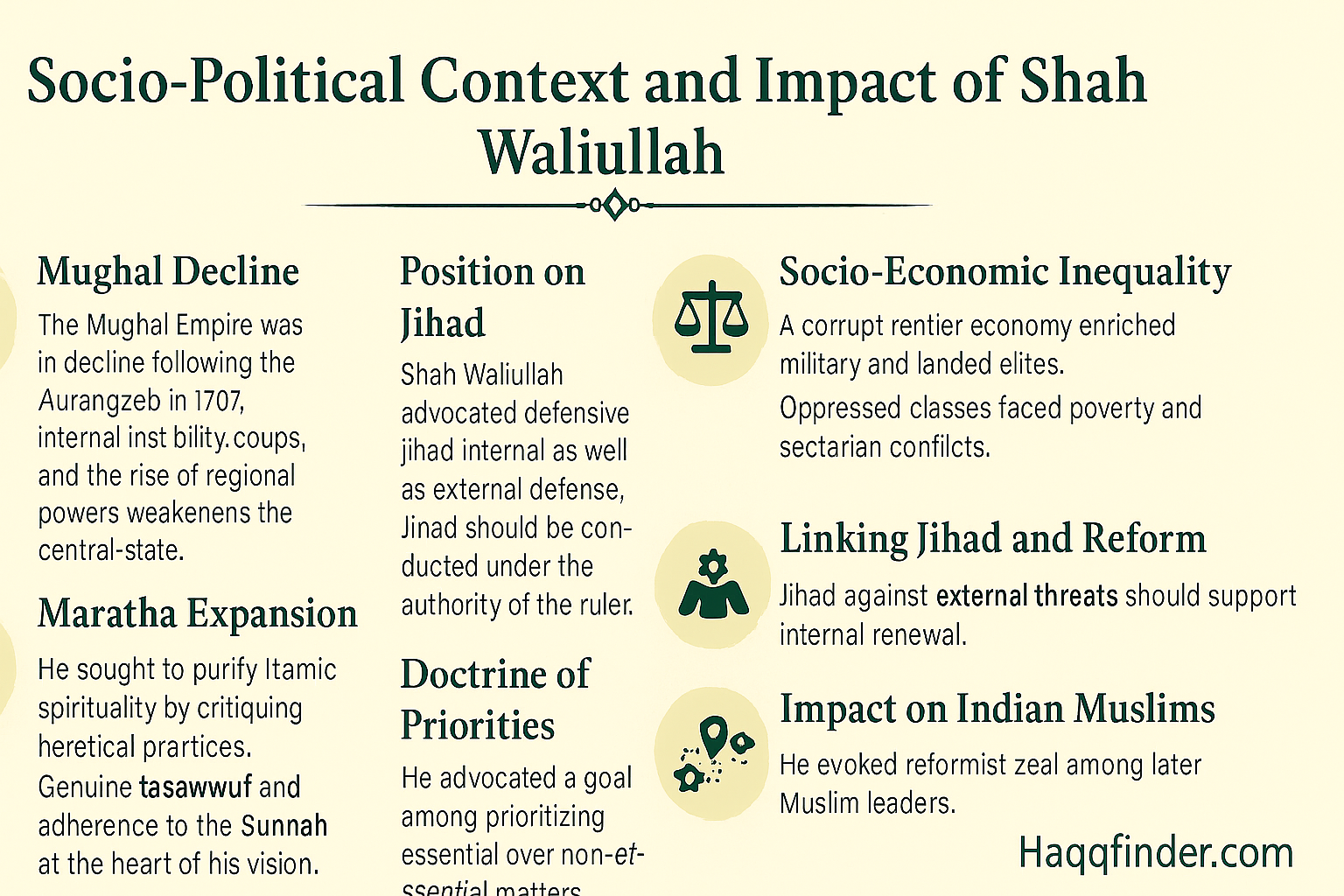
Shah Waliullah Dehlvi lived during the Mughal Empire’s decline, marked by challenges from Marathas, Sikhs, Jats, and British colonial encroachment, particularly in Bengal. Socially, Islamic practices waned, and moral decay grew. Named “Shah” due to his family’s Mughal connections, he leveraged his intellectual and moral authority to address instability.
Engagement with Mughal Administration
- Advisory Role: Guided rulers on state, law, and governance, advocating justice and integrity.
- Critique and Reform: Criticized Mughal moral/administrative failures, urging reform.
His correspondence shaped alliances, notably his letter to Ahmad Shah Durrani (Abdali), urging intervention against the Marathas, culminating in the Third Battle of Panipat (1761), temporarily restoring Muslim power. For “Shah Waliullah’s political thought” or “Shah Waliullah’s Battle of Panipat,” his strategic activism protected Muslim interests.
Stance on Non-Muslims and Shi’a
In Fuyooz-ul Haramain, he expressed concerns about non-Muslims, describing a dream where “the king of the infidels” overtook Muslim lands. In a letter, he urged banning public non-Muslim ceremonies (e.g., Holi, Ganges bathing) and moderating Shi’a practices (e.g., tabarra, cursing the first three caliphs) to avoid offense, considering them Muslims. For “Shah Waliullah’s views on Shi’a” or “Shah Waliullah’s non-Muslims,” he prioritized community boundaries.
Advocacy for Arab Culture
Shah Waliullah Muhaddis Dehlvi advocated immersion in Arabic Islamic culture, urging Muslims to avoid Ajam (non-Arab) and Indian customs, stating: “Beware! The rich intend to adopt the ways of strangers and non-Arabs.” He promoted jihad to strengthen Muslim identity.
Final Wasiyyah: Adherence to Hanafi Madhhab
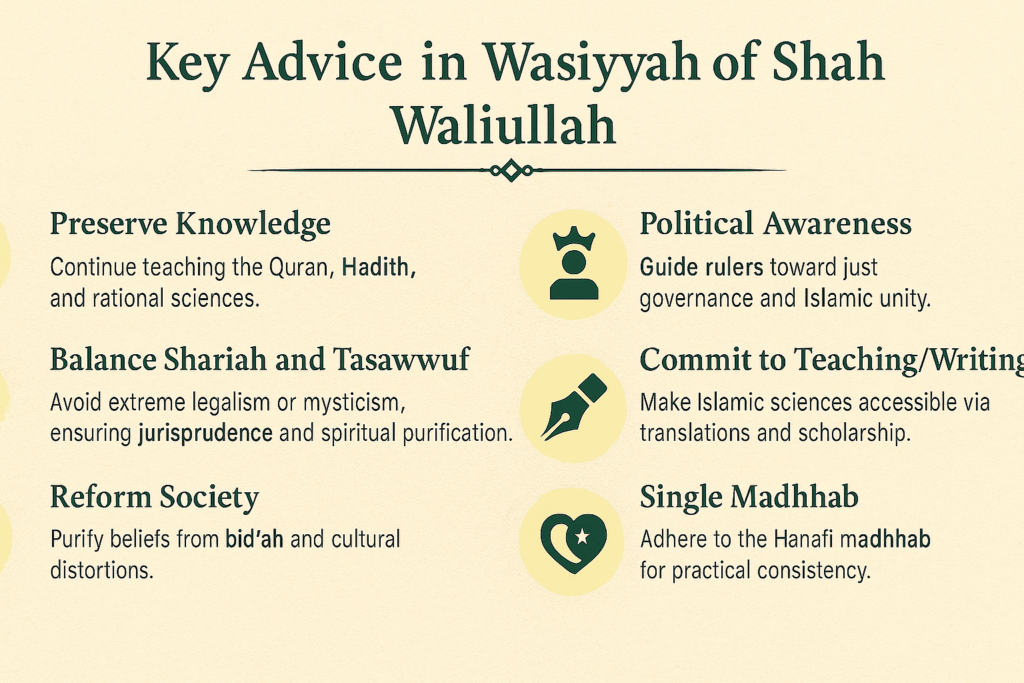
Initially, Shah Waliullah Dehlawi sought to bridge the Hanafi and Shafi’i schools for scholarly unity. However, in his final wasiyyah to his sons, particularly Shah Abdul Aziz Dehlvi, he advised strict adherence to the Hanafi madhhab, recognizing that ijtihad mutlaq (absolute independent reasoning) was zamani (time-bound) to the era of the four Imams (Abu Hanifa, Malik, Shafi’i, Ahmad ibn Hanbal).
This era, designated taqdiran (by divine decree) and takwinan (by divine formation), offered unique proximity to the Sahaba, Tabi’un, and revelation. Later scholars, including himself, operated within these frameworks, not reconstructing them.
Key Advice in Wasiyyah
- Preserve Knowledge: Continue teaching the Quran, Hadith, and rational sciences.
- Balance Shariah and Tasawwuf: Avoid extreme legalism or mysticism, ensuring jurisprudence and spiritual purification.
- Reform Society: Purify beliefs from bid’ah and cultural distortions.
- Political Awareness: Guide rulers toward just governance and Islamic unity.
- Commit to Teaching/Writing: Make Islamic sciences accessible via translations and scholarship.
- Single Madhhab: Adhere to the Hanafi madhhab for practical consistency.
For “Shah Waliullah wasiyyah” or “Shah Waliullah Hanafi madhhab,” his pragmatic shift ensured jurisprudential stability, with Shah Abdul Aziz upholding this legacy.
Influence on Future Movements: Architect of Revival
Shah Waliullah Dehlvi’s ideology founded numerous efforts:
- Syed Ahmad Shaheed’s Jihad Movement (1786–1831): Established Islamic governance, resisting Sikh/colonial powers.
- Deobandi Movement (1866): Emphasized Hadith, political awareness.
- Ahl-e-Hadith and Jamaat-e-Islami: Inspired by tawhid, anti-bid’ah, and governance revival.
Challenges and Opposition
Despite his towering intellect and reformist zeal, Shah Waliullah Dehlawi faced criticism from conservative religious scholars who viewed his ideas as controversial. His push to question blind adherence to madhabs and to reinterpret Islamic teachings was met with resistance. Nevertheless, his persistence helped transform Islamic thought in the region.
Literary Legacy: Prolific Writings
Over 50 books, including Ta’wil al-Ahadith fi Rumuz Qisas al-Anbiya (Symbolic Interpretation of Prophetic Tales), Al-Akidatul Hasanah, and Majmua Rasail Imam Shah Wali Ullah. His Persian Quran translation popularized the study; his sons’ Urdu version continued this.
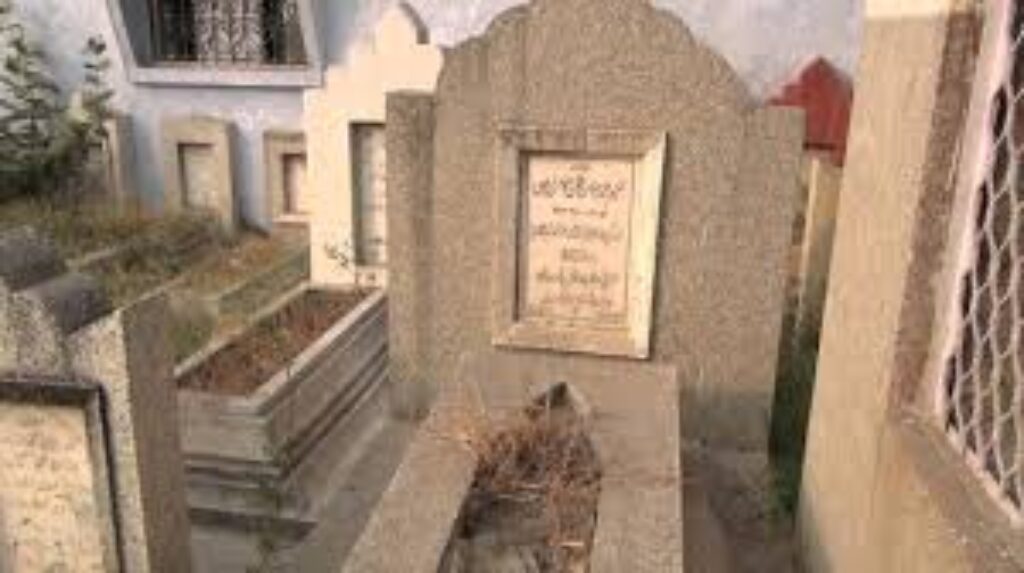
Death and Burial
Shah Waliullah Dehlawi passed away in 1762 CE (1176 AH) in Delhi. He was buried near his father at the Madrasa Rahimiya grounds. His sons—Shah Abdul Aziz, Shah Rafiuddin, and Shah Abdul Qadir—carried his mission forward.
Quotes by Shah Waliullah Dehlvi: Timeless Wisdom
- “The disease of the Muslim Ummah is ignorance. The medicine is knowledge.”
- “An unjust ruler is the greatest calamity upon the people. Reforming governance is a religious obligation.”
- “Beware! The rich intend to adopt the ways of strangers and non-Arabs… tries to mix and be like them.”
Scholarly Praise: Acclaimed by Peers and Successors
Shah Waliullah Dehlawi’s intellectual brilliance and spiritual stature were recognized by numerous leading scholars, both during his lifetime and in later generations. The following testimonials from his teachers, contemporaries, and later authorities illustrate his exceptional rank among the scholars of Islam.
Shaykh Abu Tahir al-Kurani, one of Shah Waliullah Dehlawi’s distinguished teachers in the Hijaz, described him in his ijazah (certification) as:
“The singular scholar, the most esteemed thinker, the master whose prowess in profound discourse is unmatched, the erudite who holds the foremost position in the fields of explanation and elaboration, inheritor of the perfections from his honorable ancestors, attaining in his youth what the aged could not.”
Another of his eminent teachers, Muhammad Wafadullah, similarly praised him in his ijazah:
“The righteous young man, the successful scholar, the lineage of noble saints, the elite of the eminent righteous, combining the shari’ah (Islamic law) and haqiqah (mysticism), proficient in all exalted and real sciences, adorned with the secret of his name in every portion, who is successful and correct in every endeavor, our beloved and cherished one.”
His own son, Shah Abdul Aziz Dehlawi, honored him in Bustan al-Muhaddithin with the words:
“Our teacher and guide in all sciences and matters, Shaykh Waliullah al-Dehlawi.”
Similarly, Shah Rafiuddin Dehlawi, in al-Takmeel, described his father as:
“My father, the accomplished gnostic and the perfect erudite.”
In al-Yani‘ al-Jani, Muhsin al-Tahrati exalted him in highly reverential terms:
“Our Imam, our master, our proof, our exemplar, the model of the nation, the foremost of the imams, he is the interpreter, the hadith scholar, the jurist, the knower of truths and knowledge, the chief of hadith scholars, the delight of prominent jurists, the foremost of imams, the proof of the nation, proficient in sciences, excavator and decipherer of them, a gatherer of all good traits who brought joy with his virtues.”
The celebrated scholar ‘Abd al-Hayy al-Laknawi, in al-Ta‘liq al-Mumajjad, attested to Shah Waliullah’s balance and mastery:
“His writings all indicate that he was one of the illustrious nobles and great scholars, blessed by God with guidance and fairness, avoiding bias and oppression, proficient in religious sciences, deeply versed in hadith discussions.”
Similarly, Sadiq Hasan Khan, in Abjad al-‘Ulum, referred to him simply yet profoundly as:
“The eminent scholar of the time.”
Shah Nazeer Hussain Dehlawi, in his ijazah to ‘Ali Abu Wadi, mentioned him with great reverence:
“The most noble, the most complete, the perfect, the remainder of the predecessors, the proof of the successors.”
In the Al-Manar journal, reformist scholar Muhammad Rashid Rida recognized Shah Waliullah’s far-reaching reformist impact:
“The renewer of the twelfth century Hijri in India through his call, guidance, upbringing, teaching, and writings, and through the prominent scholars from his sons, students, and followers. He combined traditional and rational sciences, philosophy, and mysticism; as known from his famous book ‘Hujjat Allah al-Baligha,’ which he authored to explain the objectives of the Shari’ah, its wisdom, and secrets.”
The historian ‘Abd al-Hayy al-Hasani, in Nuzhat al-Khawatir, exalted his status as follows:
“The eminent Imam, the proof of God among mankind, the leader of the imams, the exemplar of the nation, the scholar of scholars, the inheritor of prophets, the last of the mujtahids (independent jurists), the unique scholar of religion, the leader of those well-versed in carrying the burdens of the strong Shari’ah, the reviver of the Sunnah, and through whom God has bestowed great favor upon us.”
In the introduction to Ithaf al-Nabih, Muhammad ‘Ata Allah Hanif al-Fujiyani noted:
“He was one of the illustrious scholars, the great scholars, proficient in religious sciences, deeply versed in hadith discussions.”
Finally, Shaykh Muhammad Nasir al-Din al-Albani, in Ahkam al-Jana’iz, ranked him among the foremost scholars of independence and insight:
“Among the major scholars known for their independence in understanding, deep jurisprudence from God and His Messenger, and one of the virtuous ones.”
These accolades collectively underscore Shah Waliullah Dehlawi’s towering influence in the realms of Islamic scholarship, theology, and reform. His mastery of diverse disciplines—ranging from Hadith and Fiqh to philosophy, mysticism, and social thought—made him a bridge between the classical and modern worlds of Islamic learning.
His writings continue to shape contemporary Islamic thought, serving as core references in seminaries, universities, and intellectual circles across the Muslim world. To this day, scholars and students alike study, quote, and honor his works for their depth, balance, and timeless wisdom—affirming Shah Waliullah’s status as one of the most enduring intellectual and spiritual architects of the Islamic revival in South Asia and beyond.
Modern Relevance: Addressing Contemporary Issues
In today’s identity crises and spiritual confusion, Muhaddis Shah Waliullah Dehlvi’s teachings remain vital: Reviving authentic knowledge, promoting unity, and challenging injustice. His emphasis on Quran/Sunnah, ijtihad, and cultural purity inspires movements worldwide.
Conclusion
Muhaddis Shah Waliullah Dehlawi was a visionary who fused knowledge, spirituality, and political wisdom. His legacy endures in South Asian Islamic revival, from Deoband to modern movements. His call remains profound:
👉 Return to the Quran and Sunnah
👉 Reform self and society
👉 Resist injustice and uphold divine law
Through his scholarship, reforms, and strategic activism, he reshaped Muslim destiny, earning his place as the intellectual architect of Islamic revival.
Frequently Asked Questions (FAQs) About Shah Waliullah Dehlawi
Who was Shah Waliullah Dehlawi?
A leading 18th-century Islamic scholar, reformer, and mujaddid known for intellectual contributions and revival efforts.
What are Shah Waliullah Dehlvi’s major works?
Hujjatullah al-Baligha, Quran Persian translation, Al-Tafhimat al-Ilahiyya, Al-Fauz al-Kabir, Izalat al-Khifa’, Sharh Hizb al-Bahr, Al-Budur al-Bazigha.
What was Muhaddis Shah Waliullah Dehlvi’s view on Islamic unity?
He reconciled Hanafi-Shafi’i schools and emphasized valid ikhtilaf on secondary issues, defining Sunni Islam broadly.
What was Shah Waliullah Muhaddis Dehlvi’s final wasiyyah?
He advised adhering strictly to the Hanafi madhhab, recognizing ijtihad mutlaq as time-bound to the four Imams’ era.
How did Shah Waliullah Dehlavi influence modern movements?
He inspired Deobandi, Ahl-e-Hadith, Jamaat-e-Islami, and Syed Ahmad Shaheed’s Jihad Movement through tawhid and reform.
What was Shah Waliullah’s political role?
He wrote to Ahmad Shah Abdali, leading to the 1761 Battle of Panipat, to restore Muslim power.
References
- Khan, Hafiz A. Ghaffar. Shah Wali Allah (Qutb al-Din Ahmad al-Rahim) (1703-62), Muslimphilosophy.com
- Ansari, Moinuddin. Shah Waliullah and His Times
- Nadwi, Abul Hasan Ali. Saviours of Islamic Spirit
- Metcalf, Barbara. Islamic Revival in British India
- Smith, W.C. The Muslim Response to the West
- Qureshi, I.H. The Muslim Community of the Indo-Pakistan Subcontinent
- Ahmed, Haroon. Shah Waliullah and His Contributions to Islamic Knowledge and Pedagogy, Ilmgate.org
- Wikipedia. “Shah Waliullah Dehlawi”
- Waliullah, Shah. Hujjatullah al-Baligha