

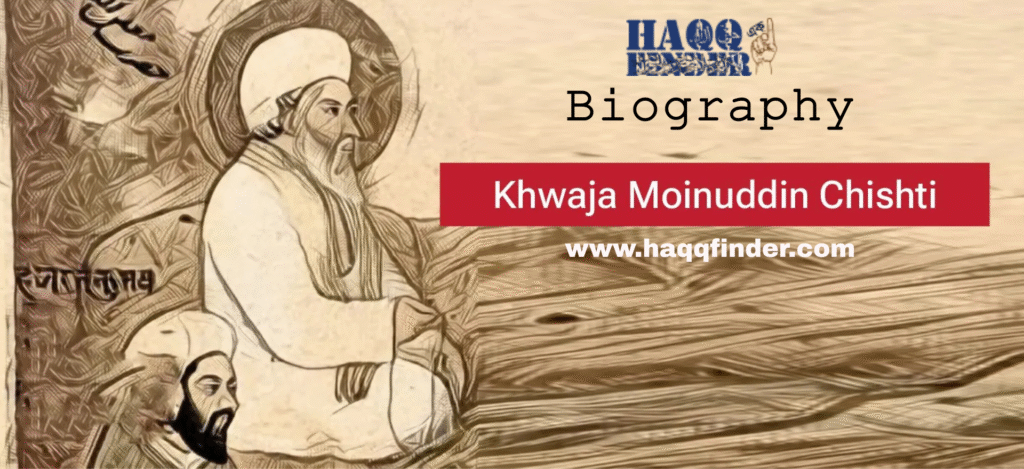
Moinuddin Chishti, also known as Khwaja Moinuddin Chishti, Khwaja Gharib Nawaz (Benefactor of the Poor), or Sultan-e-Hind (Emperor of India), was a Persian Sunni Muslim preacher, ascetic, religious scholar, philosopher, and mystic who played a pivotal role in introducing and establishing the Chishti Order of Sufism in the Indian subcontinent. Born in the 12th century, his life bridged the mystical traditions of Central Asia and Persia with the diverse cultural and religious landscape of India.
This comprehensive biography explores his early life, education, extensive travels, establishment in Ajmer, reported miracles, core teachings, contributions to Sufism and society, family lineage, the history of his dargah, and his enduring legacy. Drawing from historical sources such as hagiographical accounts, Sufi texts, and modern scholarship, this article provides an in-depth narrative of his life and impact.
Moinuddin Chishti’s journey from a young seeker in Sistan to a revered saint in Ajmer exemplifies the essence of Sufism: a path of love, humility, and service to humanity. His arrival in India during the turbulent era of the Delhi Sultanate marked a spiritual revolution that emphasized unity, tolerance, and devotion, influencing millions across religions. As the founder of the Chishti silsila (spiritual chain) in India, he laid the foundation for one of the most influential Sufi orders, producing luminaries like Nizamuddin Auliya and Amir Khusrau.
His dargah in Ajmer Sharif remains one of the most visited pilgrimage sites in South Asia, attracting devotees seeking blessings and spiritual solace. This expanded guide incorporates additional details from various sources, including insights from educational resources like Testbook, to offer a thorough account of his life, the history of Ajmer Sharif, and his contributions to cultural and religious syncretism.
Historical Context: Sufism and the Chishti Order in the 12th Century
To understand Moinuddin Chishti’s life, it’s essential to grasp the historical and spiritual context of Sufism during the 12th century. Sufism, or Tasawwuf, emerged as the mystical dimension of Islam, emphasizing inner purification, love for God (Ishq-e-Haqiqi), and detachment from material pursuits. By Moinuddin’s time, Sufism had evolved from early ascetics like Hasan al-Basri (d. 728 CE) into organized orders or tariqas, with spiritual transmission chains (silsila) tracing back to the Prophet Muhammad through Ali ibn Abi Talib.
The Chishti Order, named after the village of Chisht in Herat (modern Afghanistan), was founded by Khwaja Abu Ishaq Shami (d. 940 CE) and gained prominence under Khwaja Abu Ahmad Abdal Chishti (d. 966 CE). It emphasized poverty (faqr), humility, and service to humanity, distinguishing itself from more aristocratic orders like the Suhrawardiyya. The 12th century was a period of turmoil: the Abbasid Caliphate was declining, the Seljuk Turks dominated Persia, and India was fragmented into kingdoms like the Ghaznavids and Rajputs, with Hinduism and Buddhism predominant.
Moinuddin Chishti’s era coincided with the Ghurid invasions of India, led by Muhammad of Ghor, who defeated Prithviraj Chauhan in 1192 CE, paving the way for the Delhi Sultanate. Sufis like Moinuddin acted as spiritual ambassadors, converting hearts rather than conquering lands. His migration to India aligned with a wave of Persian mystics fleeing Mongol threats, bringing Persianate culture, poetry, and mysticism that enriched Indian Islam. Sources like Fawa’id al-Fu’ad by Amir Hasan Sijzi and Siyar al-Aqtab by Allah Diya Chishti provide hagiographical insights, blending fact with legend to emphasize his divine mission.
The 12th century saw Sufism adapt globally. In Persia, it intertwined with poetry through figures like Attar and Sanai, influencing Moinuddin’s literary inclinations. In India, the Bhakti movement was rising with saints like Ramanuja and Basava, creating a receptive ground for Sufi ideas. Moinuddin’s arrival bridged these, paralleling Bhakti’s emphasis on personal devotion. The Mongol invasions (beginning 1219 CE) accelerated Sufi migrations, with Moinuddin among the first to settle permanently, establishing a model for non-violent cultural influence. His khanqah became a neutral space for dialogue, fostering harmony amid political upheaval.
Early Life of Moinuddin Chishti: Birth and Formative Years
Moinuddin Chishti was born on February 1, 1143 CE (536 AH) in Sanjar, Sijistan (Sistan), a region in present-day eastern Iran near Afghanistan. Some sources place his birth in 1141–42 CE, but the 1143 date is widely accepted based on dargah inscriptions and Siyar al-Arifin by Jamali. Sistan, part of the greater Khorasan region, was a fertile area known for its scholarly and Sufi traditions.
His full name was Mu’in al-Din Hasan Sijzi Chishti, with “Sijzi” denoting his birthplace. He was born into a Sayyid family, claiming descent from the Prophet Muhammad through Imam Hussain. His father, Khwaja Ghiyasuddin Hasan, was a pious landowner with orchards and a mill, and his mother, Bibi Mah Noor (also known as Bibi Ummal Wara), came from a respected family. Legends suggest Ghiyasuddin had a vision foretelling his son’s spiritual greatness.
Moinuddin’s childhood was marked by piety and detachment. According to Akhbar al-Akhyar by Abdul Haq Muhaddith Dehlavi, he preferred solitude and prayer, often sharing food with the poor. At around 9 years old, he met a majzub (ecstatic saint) named Ibrahim Qandozi at their orchard. Offering grapes, Moinuddin received a piece of oiled bread and a blessing, awakening his spiritual inclination—his first Sufi initiation.
Around 1156 CE, at age 15, political unrest in Sistan led to the loss of the family’s property. Ghiyasuddin and Mah Noor died soon after, leaving Moinuddin an orphan. He sold his inheritance, distributing the proceeds to the poor, and embraced asceticism. This hardship shaped his emphasis on reliance on God (tawakkul) and service to humanity (khidmat-e-khalq).
Sistan’s cultural milieu, with Zoroastrian and Buddhist influences, exposed Moinuddin to pluralism, foreshadowing his inclusive approach in India. Family traditions emphasized charity, with Ghiyasuddin’s mill as a communal resource, instilling economic equity—a theme later amplified through langar. Orphanhood, a common Sufi motif, symbolized detachment (zuhd), aligning with ascetic trends seen in Rumi’s early life. By his late teens, Moinuddin became a wandering dervish, seeking knowledge and enlightenment.
Education and Spiritual Training of Moinuddin Chishti
After losing his family, Moinuddin embarked on a quest for knowledge, traveling to Persia and Central Asia’s learning centers. His education combined formal Islamic studies with intensive Sufi training, shaping him into a scholar-mystic.
He journeyed to Bukhara and Samarkand, renowned for their madrasas. In Bukhara, under the Karakhanid dynasty, he mastered fiqh (jurisprudence), hadith (prophetic traditions), tafsir (Quranic exegesis), and kalam (theology), adopting Hanafi jurisprudence. He visited the shrines of Imam Bukhari and Abu Mansur al-Maturidi, drawing inspiration. In Samarkand, he studied Arabic and Persian literature, essential for Sufi poetry. Siyar al-Aqtab notes he earned the title “Mu’in al-Din” (Helper of the Faith) for his scholarly prowess, practicing asceticism with extensive fasting and prayer.
In Nishapur, around 1165 CE, he met Khwaja Usman Harooni, a Chishti master. Impressed by Moinuddin’s devotion, Usman accepted him as a murid (disciple). For over 20 years, Moinuddin served humbly, carrying Usman’s belongings during travels. This bay’ah (oath of allegiance) initiated him into the Chishti silsila, emphasizing faqr (poverty), tawakkul (trust in God), and sama (devotional music).
Under Usman, Moinuddin learned dhikr (remembrance of God), muraqaba (meditation), and chilla (40-day seclusion). Anis al-Arwah describes him performing chilla in caves, experiencing visions of the Prophet. Usman taught that the path to God was through the heart, emphasizing love over fear. Moinuddin also met Abdul Qadir Jilani and Najmuddin Kubra, enriching his understanding of Qadiri and Kubrawi orders. By 1185 CE, Usman granted him khilafat (spiritual succession).
His studies in Bukhara included advanced hadith chains, making him a muhaddith, per Akhbar al-Akhyar. In Samarkand, he debated rationalism vs. intuition with al-Ghazali’s followers. Under Usman, he mastered the Chishti’s “four stations”: repentance (tawba), abstinence (wara), renunciation (zuhd), and poverty (faqr). This 40-year phase transformed him into a master ready for India.
Travels and Spiritual Journey of Moinuddin Chishti
Moinuddin’s travels, spanning decades across Persia, Central Asia, the Middle East, and India, embodied the Sufi ideal of safar (journey) as spiritual ascent. Detailed in Siyar al-Awliya by Mir Khwurd, these were purposeful quests for knowledge and divine guidance.
With Usman Harooni, he visited Mecca and Medina multiple times for Hajj and Umrah. In Mecca, legends in Dalil al-Arifin claim he received a divine command at the Kaaba: “O Moinuddin, you are the helper of my religion. Go to Hindustan and spread my message.” They traveled to Baghdad, meeting Abdul Qadir Jilani, learning sharia-tariqa balance, and to Tabriz and Astrabad, encountering mystics like Abu Said Tabrizi. In Herat, they visited Chishti shrines.
From Persia, they journeyed to Balkh, Samarkand, and Bukhara, engaging with Kubrawi and Yasawi mystics, exploring silent dhikr to ecstatic sama. In Lahore, they meditated at Data Ganj Bakhsh’s (Ali Hujwiri) shrine, connecting Moinuddin to India’s spiritual heritage.
Arriving in India around 1192 CE, after Muhammad of Ghor’s victory over Prithviraj Chauhan, Moinuddin visited Delhi, meeting Qutbuddin Bakhtiar Kaki, whom he appointed successor. Facing resistance from local rulers and ulema, he settled in Ajmer, then under Rajput control. Legends describe him converting locals through miracles, like sweetening a lake or defeating spirits.
His 50-year travels, often on foot, covered thousands of miles, embodying detachment. They culminated in Ajmer, where he established the Chishti khanqah, attracting disciples from all faiths. His Hajj debates honed interfaith skills, and Baghdad’s Qadiri zikr influenced Chishti practices.
Establishment in Ajmer: Founding the Chishti Khanqah
Moinuddin’s arrival in Ajmer around 1192–1200 CE marked the Chishti Order’s establishment in India, transforming Ajmer into a spiritual hub. A Rajput stronghold under Prithviraj Chauhan’s influence, Ajmer’s lakes and hills symbolized cultural confluence.
Settling at Ana Sagar Lake, Moinuddin meditated and served the poor. Facing opposition from local priests, Siyar al-Aqtab describes miracles resolving conflicts, like his prayer mat floating on the lake. He founded a khanqah near the lake, open to all. Hagiographies note his langar (communal kitchen) attracted Hindus, Muslims, and tribals. His marriage to a local woman and children rooted him in Indian society.
By 1206 CE, with the Delhi Sultanate’s rise, Moinuddin gained Iltutmish’s patronage. The khanqah hosted sama sessions and teachings, drawing disciples like Bakhtiar Kaki. It symbolized Sufism’s indigenization, blending Persian mysticism with Indian bhakti, fostering harmony amid upheaval. Daily routines included dawn prayers, dhikr, and evening sama, with teachings in Persian and local dialects.
Miracles and Karamat of Moinuddin Chishti
Moinuddin’s life is replete with karamat (miracles), documented in Anis al-Arwah and Dalil al-Arifin, symbolizing his spiritual authority. The “floating prayer mat” in Ajmer resolved lake access disputes. He revived a widow’s cow, showing compassion, and turned bitter lake water sweet, quenching thousands. During Hajj, he conversed with the Prophet in a vision, earning “Gharib Nawaz.” In India, he tamed a tiger, symbolizing ego control, and predicted Iltutmish’s victories.
Other miracles include multiplying bread for famine victims and healing the blind (Siyar al-Aqtab). Critics see these as metaphors, but devotees view them as divine signs, inspiring Ajmer Sharif pilgrimages.
Teachings and Philosophy of Moinuddin Chishti
Moinuddin’s teachings, preserved in Fawa’id al-Fu’ad, emphasize divine love (Ishq-e-Haqiqi), transcending rituals. He taught service to humanity (khidmat-e-khalq) as worship, exemplified by langar, and humility (tawadu): “Be like earth, bearing all burdens.” He advocated sama for spiritual ecstasy, composing poetry like “Shah-e-Mardan Sher-e-Yazdan.”
Tolerance was core: “Love all, hate none,” promoting interfaith harmony. He stressed zikr, meditation, and poverty (faqr). His philosophy influenced bhakti saints like Kabir, fostering unity. Discourses include parables on ego: “The ego is a thief; guard your heart.” He emphasized women’s spiritual equality, appointing female disciples.
Family Tree and Genealogy of Moinuddin Chishti
Moinuddin, a Sayyid, descended from Imam Hussain via his father, Khwaja Ghiyasuddin Hasan, and mother, Bibi Mah Noor, per Siyar al-Aqtab. Earlier ancestors are sparsely documented, but hagiographies assert a line through Persian scholars. In Ajmer, he married twice: Bibi Umm al-Wara bore Khwaja Fakhruddin, Khwaja Hisamuddin, and Bibi Hafiza Jamal; a Rajput convert’s daughter bore Bibi Asmat. Fakhruddin continued the silsila. Descendants, known as Khadims, manage Ajmer Sharif.
Legacy of Moinuddin Chishti: Influence on Sufism and Society
Moinuddin’s legacy endures as the Chishti Order’s founder in India. Dying on March 15, 1236 CE (6th Rajab, 633 AH), his dargah in Ajmer, a UNESCO tentative site, attracts millions. The order spread through disciples like Qutbuddin Bakhtiar Kaki, Nizamuddin Auliya, and Baba Farid, with khanqahs in Delhi and Pakpattan. Mughal emperors, from Akbar (who walked to Ajmer, donating cauldrons) to Aurangzeb, patronized the shrine, blending Sufism with governance.
Culturally, his sama emphasis shaped qawwali, with Amir Khusrau’s “Aaj Rang Hai.” His teachings promoted equality, aiding conversions among lower castes and dialogue with bhakti saints like Ramananda. Socially, langar reduced caste barriers, inspiring modern charity.
The annual Urs festival (6th Rajab) features qawwali, prayers, and charity, drawing global pilgrims. Controversies include commercialization, but his message of love remains relevant. In Pakistan and Bangladesh, Chishti branches thrive, and globally, he’s a universal saint inspiring peace initiatives. His influence reached the Deccan and Bengal via Gesu Daraz, shaping regional Islam.
| Legacy Aspect | In India | In Pakistan/Bangladesh | Global |
|---|---|---|---|
| Spiritual | Ajmer Sharif pilgrimage; Chishti silsila | Local dargahs; Sufi festivals | Universal Sufi icon; interfaith symbol |
| Cultural | Qawwali, poetry influence | Bhakti-Sufi syncretism | Music and mysticism studies |
| Social | Harmony promotion | Equality teachings | Peace advocacy |
| Political | Mughal patronage legacy | National Sufi heritage | Diplomacy tool |
History and Significance of Ajmer Sharif Dargah
The Ajmer Sharif Dargah, Moinuddin’s tomb since 1236 CE, evolved from a simple grave into a grand complex via Mughal patronage. Its significance lies in symbolizing India’s composite culture, bridging Hindu, Muslim, and Jain communities. The Buland Darwaza, built by Sultan Mahmud Khilji, and the marble-adorned tomb reflect Mughal contributions. Akbar donated cauldrons for langar, Jahangir added a mosque, and Shah Jahan and Aurangzeb expanded it, with later additions by Hyderabad’s Nizam. Today, it hosts millions, including dignitaries, symbolizing unity.
Contributors to Ajmer Sharif Dargah’s Structure
- Moinuddin Chishti (d. 1236 CE): Burial site formed the core.
- Sultan Mahmud Khilji (15th century): Built Buland Darwaza.
- Emperor Akbar (16th century): Donated cauldrons, initiated expansions.
- Emperor Jahangir: Added mosque, enhanced aesthetics.
- Emperor Shah Jahan: Contributed marble domes and courtyards.
- Hyderabad’s Nizam (19th century): Funded repairs, added structures.
- Khadims and devotees: Ongoing maintenance via donations.
Frequently Asked Questions (FAQ)
When was Khwaja Moinuddin Chishti born, and where?
Moinuddin Chishti was born on February 1, 1143 CE (536 AH) in Sanjar, Sijistan (Sistan), present-day eastern Iran, near Afghanistan.
What is the Chishti Order and what are its key teachings?
The Chishti Order, a Sufi tariqa from Chisht, Afghanistan, emphasizes love for God (Ishq-e-Haqiqi), humility (tawadu), service to humanity (khidmat-e-khalq), poverty (faqr), and devotional music (sama). Moinuddin taught “Love all, hate none,” promoting tolerance and spiritual purity.
What is the historical importance of the Ajmer Sharif Dargah of Khwaja Moinuddin Chishti?
The Ajmer Sharif Dargah, his tomb since 1236 CE, symbolizes India’s composite culture, fostering Hindu-Muslim unity and influencing cultural syncretism.
What is ‘Urs’ in the context of Khwaja Moinuddin Chishti’s shrine?
Urs (“wedding”) commemorates Moinuddin’s death (March 15, 1236 CE) as union with God. Held annually on 6th Rajab, it features qawwali, prayers, and langar, drawing millions.
How did Khwaja Moinuddin Chishti’s life influence religious and cultural syncretism in medieval India?
His teachings of tolerance and service bridged Sufism and Bhakti, influencing saints like Kabir. His khanqah and langar promoted interfaith harmony [4].
What is the family tree/genealogy of Khwaja Moinuddin Chishti?
A Sayyid, he descended from Imam Hussain via his father, Ghiyasuddin Hasan, and mother, Bibi Mah Noor. He had four children: Fakhruddin, Hisamuddin, Hafiza Jamal, and Bibi Asmat, with Fakhruddin continuing the silsila.
Are there authentic, real photos of Khwaja Moinuddin Chishti?
No authentic photos exist, as he lived before photography. Artistic depictions, based on hagiographies, show him in robes with a serene expression.
What is the history of Khwaja Moinuddin Chishti’s Dargah (Ajmer Sharif)?
Established post-1236 CE, it grew from a grave to a complex with Mughal patronage. Akbar, Jahangir, and Shah Jahan added structures, making it a spiritual hub.
Who built the Ajmer Sharif Dargah, or contributed majorly to its structure?
Contributors include Sultan Mahmud Khilji (Buland Darwaza), Akbar (cauldrons), Jahangir (mosque), Shah Jahan (domes), Hyderabad’s Nizam, and Khadims.
Who was Moinuddin Chishti (Khwaja Gharib Nawaz)?
Moinuddin Chishti was a 12th-century Persian Sufi saint who founded the Chishti Order in India, spreading love, tolerance, and mysticism.
What was Moinuddin Chishti’s early life like?
Born in 1143 CE in Sistan, he lost his parents young, sold his inheritance, and embraced a spiritual quest, showing early piety.
Where did Moinuddin Chishti receive his education?
He studied in Bukhara and Samarkand, mastering Islamic sciences, and trained under Khwaja Usman Harooni in Nishapur.
What were Moinuddin Chishti’s major travels?
He visited Mecca, Medina, Baghdad, Tabriz, Herat, Balkh, Lahore, Delhi, and settled in Ajmer, meeting mystics and performing Hajj.
How did Moinuddin Chishti establish himself in Ajmer?
Around 1192 CE, he founded a khanqah in Ajmer, overcoming opposition through miracles and service, making it a Sufi center.
What miracles are associated with Moinuddin Chishti?
Miracles include a floating prayer mat, reviving animals, sweetening water, and prophetic visions, symbolizing divine favor.
What were Moinuddin Chishti’s key teachings?
He emphasized divine love, service, humility, zikr, sama, and tolerance, teaching “Love all, hate none.”
What is Moinuddin Chishti’s legacy?
He founded Chishti Sufism in India, influencing culture, music, and social harmony; his dargah remains a symbol.
How accurate are sources on Moinuddin Chishti?
Hagiographies like Siyar al-Aqtab blend fact and legend; modern scholarship views them as inspirational narratives.
What economic/social changes did Moinuddin Chishti bring?
His langar promoted equality; teachings fostered harmony, influencing lower castes and interfaith relations.
Conclusion
Moinuddin Chishti’s life stands as a testament to spiritual enlightenment and human compassion, transcending time and borders. From his humble beginnings in Sistan to his transformative role in Ajmer, he embodied Sufism’s ideals of love and service, bridging cultures and faiths in medieval India. His teachings on humility, tolerance, and divine love continue to inspire in a divided world, while his dargah in Ajmer Sharif draws millions as a beacon of unity. As the Chishti Order’s founder in India, his legacy shaped South Asian Islam, influencing art, music, and society. The history of Ajmer Sharif, enriched by Mughal patronage, underscores its enduring impact. Moinuddin Chishti reminds us that true greatness lies in selflessness, leaving an eternal imprint on the human spirit.
References
- Siyar al-Arifin by Jamali, translated by Carl Ernst, 1997.
- Fawa’id al-Fu’ad by Amir Hasan Sijzi, translated by Bruce Lawrence, 1992.
- Ain-i-Akbari by Abul Fazl, translated by H. Blochmann, 1873.
- Siyar al-Aqtab by Allah Diya Chishti, translated by Raziuddin Aquil, 2009.
- Akhbar al-Akhyar by Abdul Haq Muhaddith Dehlavi, translated by Zameeruddin Ahmad, 2005.
- Dalil al-Arifin attributed to Moinuddin Chishti, compiled by disciples, 14th century.
- Anis al-Arwah by Usman Harooni, translated by Paul Jackson, 1988.
- Al-Hind: The Making of the Indo-Islamic World by André Wink, Brill, 1990.
- “Khwaja Moinuddin Chishti,” Testbook, accessed 2025.
- “Sufism in India,” Encyclopaedia Iranica, edited by Ehsan Yarshater, 2011.