

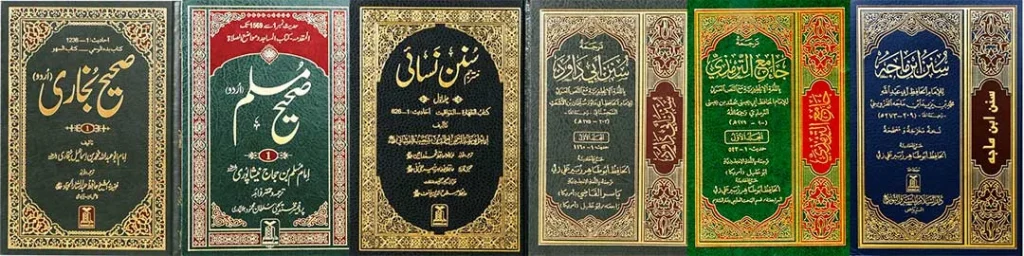
In the study of Islamic jurisprudence and theology, Hadith—the recorded sayings, actions, and approvals of the Prophet Muhammad (peace be upon him)—play a crucial role in shaping religious beliefs and practices. Among the vast compilations of Hadith, the Sihah Sitta (Six Authentic Collections) hold a place of paramount importance within Sunni Islam. These six major Hadith collections—Sahih al-Bukhari, Sahih Muslim, Sunan al-Nasa’i, Sunan Abu Dawood, Jami` at-Tirmidhi, and Sunan ibn Majah—are revered for their rigorous compilation methods and are considered the most reliable sources after the Qur’an.
Table of Contents
ToggleHowever, the question arises: Are all the Hadith within the Sihah Sitta truly authentic? While these collections are esteemed for their meticulous verification processes, it is essential to recognize that not every single Hadith within them holds the same level of authenticity. Islamic scholars have long engaged in detailed analyses of individual Hadith, evaluating factors such as the chain of narrators (isnad), the textual consistency (matn), and the contextual relevance to determine their reliability.
In this article, we will delve into the issue regarding the authenticity of the six hadith books named as “Kutub Al-Sittah”.
What Is Hadith?
Definition
A Hadith can be defined as a report concerning the sayings and actions of the Prophet Muhammad (PBUH) transmitted through a chain of narrators. The Quran describes the Prophet as the Muallim (teacher) of Allah’s Book and its Wisdom, and his sayings and actions serve as an exposition of the Quranic teachings. This means that no Prophetic saying or action can contradict the Quran, as the Prophet would never go against the Message he was divinely sent to convey.
what happens if certain Hadiths seem to contradict the Quran?
In such cases, it is essential to question and thoroughly examine their authenticity. Throughout history, scholars have rejected numerous Hadiths when they found inconsistencies or contradictions with the Quran. This process does not diminish the Prophet’s status or teachings but ensures that only reliable reports are accepted as genuine.
Therefore, rejecting questionable Hadiths is not a rejection of the Prophet Muhammad (PBUH) himself; rather, it is a rejection of reports falsely attributed to him. This careful examination preserves the integrity of both the Quran and the authentic Sunnah.
Classification of Ahaadith: Aahad and Mutawaatir
Ahaadith are broadly categorized based on their Isnaad (chain of narrators) into two main categories: Aahad and Mutawaatir.
- Aahad Hadith:
- An Aahad Hadith is one that has been transmitted by a single narrator or up to four narrators, depending on the opinion of some scholars. This means that when the Prophet Muhammad (PBUH) spoke, only a limited number of people, sometimes just one, were present to hear and transmit his words. Therefore, the authenticity of an Aahad Hadith depends on the reliability and memory of that individual or small group of narrators.
- Mutawaatir Hadith:
- A Mutawaatir Hadith, on the other hand, is one that has been transmitted by a large number of narrators. Some scholars consider this to be at least 40 narrators, while others say more than 70. Due to the sheer number of people narrating the same event or saying, the likelihood of them all conspiring to fabricate a Hadith is negligible. This makes Mutawaatir Hadiths the most reliable of all, as they provide an almost irrefutable chain of transmission.
According to scholars, only a small percentage of Hadiths in the Sihah Sitta (the six most authentic Hadith collections) are Mutawaatir, while the majority are Aahad. The various classifications of Hadith—such as Sahih (authentic), Hasan (good), Da’if (weak), Mursal, Shadh, Mawdu’ (fabricated), and Muallaq—are generally applied to Aahad reports. Mutawaatir Hadiths, due to their high level of reliability, are considered Sahih by default.
In summary, while Aahad Hadiths can vary in authenticity, Mutawaatir Hadiths are unanimously considered Sahih due to the strength and number of their narrators.
Examples of Mutawaatir and Aahad Ahaadith
Mutawaatir Ahaadith:
- One of the prime examples of Mutawaatir Ahaadith is the tradition concerning the five daily prayers and the number of rak’ahs (units) in each prayer. Since these practices have been narrated by a large number of companions and transmitted through numerous narrators across generations, they are considered Mutawaatir. For this reason, there has historically been no dispute among scholars or schools of thought regarding the obligatory five daily prayers and their respective number of rak’ahs. All Muslim groups agree on these fundamental aspects of prayer.
Aahad Ahaadith:
- In contrast, certain practices related to prayer, such as:
- Raf’ul Yadain (raising the hands before and after bowing),
- Saying Ameen aloud after Surah Al-Fatiha in congregational prayer,
- The recitation of Surah Al-Fatiha after the Imam in congregational prayers,
- The exact timings for the daily prayers,
These are derived from Aahad Hadith, meaning they were reported by a limited number of narrators. Due to this, interpretations of these practices differ across the various schools of thought in Islam (such as Hanafi, Shafi’i, Maliki, and Hanbali). These differences in understanding Aahad reports have even led to significant disagreements among scholars and followers, sometimes even resulting in tensions over which practices are considered correct.
Key Points Regarding Classification of Ahaadith:
- Ahaadith are not classified based on content (matn):
- The classification of Ahaadith as Mutawaatir or Aahad is based solely on the number of narrators in the chain (isnaad) and the reliability of those narrators, not on the content or subject matter of the Hadith itself. This means that even if an Aahad Hadith is classified as Sahih (authentic) based on its chain of narrators, there is still the possibility that the lone or few narrators involved may have made an unintentional mistake in transmitting the Prophet’s (PBUH) words or actions.
- The Quran as the ultimate criterion:
- Even if a Hadith is classified as Sahih due to the reliability of its narrators, if the Hadith contradicts the teachings, principles, or spirit of the Quran, it must be rejected. Muslim scholars emphasize that the Quran is the ultimate source of guidance, and any Hadith—no matter how authentic its Isnaad might seem—must be evaluated against the Quran. If a Hadith contradicts the Book of Allah, it is to be discarded, regardless of the collection it appears in.
Examples of Doubtful Aahaadith
1. Humans Made in the Image of God
A Hadith from Sahih Muslim, narrated by Abu Huraira in Kitab-as-Sifat al-Jannah (Book of the Description of Paradise), states:
“Allah’s Messenger (may peace be upon him) said: Allah, the Exalted and Glorious, created Adam in His own image (‘ala soorathihi) with His length of sixty cubits (about 30 meters)…“_
This Hadith has led to theological debates, as it seems to suggest that Allah has a physical form similar to human beings, which contradicts Islamic teachings of Allah’s transcendence. The phrase “in His own image” echoes a verse from the Bible (Genesis 1:27: “God created man in His own image”). Islamic scholars, including Ibn Hajar al-Asqalani, have critiqued this Hadith. Some interpret “image” metaphorically, arguing that it refers to qualities like knowledge and wisdom rather than physical form. Nonetheless, the Hadith has been a source of contention because it seems to imply anthropomorphism, a belief rejected by mainstream Islamic theology.
2. The Missing Verse
This example comes from Sahih Muslim, in the Kitab al-Rada’a (Book of Fosterage), narrated by Aisha:
“Aisha narrated that it had been revealed in the Quran that ten sucklings make marriage unlawful. Then it was abrogated and substituted by five sucklings, and the Messenger of Allah died while it was still being recited from the Quran.”
The issue with this Hadith arises because the verse about five sucklings mentioned by Aisha does not exist in the current Quran. If it was truly part of the Quran, how could it have gone missing without any instructions from the Prophet (PBUH) to remove it? This Hadith has led to confusion and raises questions about the authenticity of this specific report, as it conflicts with the well-established belief that the Quran has been preserved in its entirety without omission or loss.
3. Will Allah Put His Foot in Hell?
The Hadith that describes Allah putting His Foot over Hell to stop its insatiable hunger is indeed a point of theological debate and concern for many Muslims. The Hadith in question, narrated by Abu Huraira in Sahih Bukhari, presents an anthropomorphic image of Allah, which raises questions about its compatibility with the central Islamic teaching that Allah is beyond any physical likeness to His creation.
The Hadith in Sahih Bukhari:
“The Prophet said: ‘Paradise and Hell argued, and Hell said, “I have been given the privilege of receiving the arrogant and tyrants.” Paradise said, “What is wrong with me that only the weak and humble enter me?” Allah said to Paradise, “You are My Mercy, which I bestow on whom I will of My servants.” Then Allah said to Hell, “You are My punishment, with which I punish whom I will of My servants, and both of you will be full.” As for Hell, it will not be full until Allah puts His Foot over it, and it will say, “Enough, enough,” at which point it will be full.'” (Sahih Bukhari, Book of Tafsir)
Theological Issues with This Hadith:
-
Anthropomorphism: The description of Allah placing His Foot in Hell has led to concerns about whether this narration implies anthropomorphic attributes to Allah, which goes against the Islamic principle of Tanzih — that Allah is utterly unique and beyond comparison to His creation. Any attempt to liken Allah to human beings or physical entities is considered problematic and contrary to Islamic theology, which asserts that Allah is without form, space, or body.
-
Metaphorical Interpretation: Some scholars have attempted to resolve this issue by interpreting the Hadith metaphorically, suggesting that “Foot” is symbolic of Allah’s power, authority, or control over Hell. This interpretation seeks to align the Hadith with the broader Islamic belief that Allah is beyond any physical form while preserving the essence of the narrative.
-
Questioning the Authenticity: Prominent scholars like Ibn Hajar al-Asqalani and Dr. Muhammad Zubayr Siddiqi have critically evaluated such Hadiths, acknowledging that even in the most reliable collections like Sahih Bukhari and Sahih Muslim, weak or forged narrations have made their way in. Ibn Hajar, for example, critiques anthropomorphic narrations like this one, emphasizing that such reports should not be taken literally.
Other Doubtful Aahaadith:
The issue of questionable Aahaadith extends beyond the example of Allah’s Foot in Hell. Dr. Muhammad Zubayr Siddiqi and other scholars have highlighted several examples of problematic narrations, such as the claim that the Prophet was affected by magic for six months. This is in direct contradiction to the Quran, which refutes the idea that the Prophet (PBUH) could be influenced by sorcery:
“And they say: ‘You, [O Muhammad], are but affected by magic.’ Say, ‘My Lord is most knowing of what is in the heavens and the earth.'” (Quran 17:47)
Shamz Pirzada, in his commentary, argues that any Hadith that contradicts the essential attributes of Prophethood, including invulnerability to magic, must be rejected, regardless of whether it is found in collections like Bukhari or Muslim. He stresses the importance of using the Quran as the ultimate criterion in evaluating the authenticity of Hadith.
The Quran’s Stance:
The Quran itself warns against the blind following of “idle tales” (lahwal Hadith), which could lead believers astray:
“But there are, among men, those who purchase idle tales (lahwal hadith) without knowledge, to mislead people from the Path of God and to ridicule [His verses]. For such there will be a humiliating penalty.” (Quran 31:6)
The phrase lahwal Hadith used here is particularly noteworthy as it describes idle or dubious narratives, possibly cautioning Muslims to critically evaluate the authenticity and value of narrations attributed to the Prophet (PBUH), especially when they seem to contradict the core tenets of Islam.
the principles of Hadith methodology
In Usool-al-Hadith (the principles of Hadith methodology), scholars traditionally focused on evaluating narrators (Isnaad) rather than examining the content (Matn) of the Hadith in detail. This methodology is important but has limitations, particularly when assessing whether the content of a Hadith aligns with the principles of Islam.
Isnad Evaluation
The Five Conditions for Authenticating Hadiths:
-
Ittisaal (Continuity): The chain of narration (Isnaad) must be unbroken. Every narrator in the chain must have received the Hadith directly from the person preceding them, ensuring the transmission’s integrity.
-
Adl (Integrity): The narrator must be a person of good character and behavior (Aadil). This means that narrators must not be disbelievers, sinners (faasiq), or mentally unfit. Additionally, they should not be involved in activities or behaviors that undermine their credibility.
-
Zabt (Accuracy): The narrator must possess a strong memory and precision in narration. A narrator is considered Zaabith if their memory is reliable, ensuring they can accurately convey what they heard without alteration.
-
Adamus Shuzooz (Non-Contradiction): The Hadith must not contradict other authentic reports. If two narrations are in conflict, scholars will prioritize the one from the more reliable (Siqa) narrator. A narration that conflicts with a more reliable report is termed shaaz and is generally rejected.
-
Adamul Illath (Absence of Hidden Defects): The Hadith must be free from hidden defects or inconsistencies in its transmission. This could include subtle issues in the chain of narrators or hidden errors in the transmission that might undermine its reliability.
Focus on Isnaad Rather Than Matn (Content):
In traditional Hadith sciences, the primary focus has been on evaluating the Isnaad (chain of narrators) using the five conditions outlined above. However, this approach has been critiqued for not giving enough importance to the Matn (text or content) of the Hadith.
Importance of Matn Analysis:
While the Isnaad-based criteria are important for determining the external reliability of a Hadith, it is equally important to evaluate the Matn based on the following principles:
-
Alignment with the Quran: The Matn must not contradict the Quran, which is the ultimate and unaltered source of Islamic law and guidance. A Hadith that goes against Quranic principles should be rejected, even if its chain of transmission is strong.
-
Commonsense and Reason: The content of a Hadith must align with human reasoning, common sense, and universal ethical principles. Islam emphasizes rationality and justice, so any narration that seems unreasonable or unethical may be questioned.
-
Universal Human Values: Hadiths that contradict well-established human values—such as fairness, mercy, and justice—should be scrutinized, as Islam strongly upholds these principles.
-
Established Facts: A Hadith should not contradict established facts or realities. For example, a narration that conflicts with proven scientific facts may be problematic.
Balancing Isnaad and Matn Analysis:
The methodology of Usool-al-Hadith should include both Isnaad and Matn analysis. Focusing solely on the narrators without considering the content can lead to accepting reports that go against the essence of Islamic teachings. As pointed out, rejecting a Hadith based on these broader considerations (such as contradictions with the Quran, reason, or common sense) does not equate to rejecting the Prophet (PBUH). Instead, it means rejecting what may have been incorrectly attributed to him.
The Prevalence of Weak Hadith in Early Islamic History
Bukhari is said to have collected over 600,000 hadith, yet only accepted around 7,400. After eliminating duplicates, only about 2,700 unique hadith made it into Sahih Bukhari, representing just 1% of the hadith he examined. This points to the significant number of weak or fabricated hadith circulating during the third century of Islam, a period marked by political and ideological turmoil among various sects, including Kharijites, Shi’ites, Mutazilites, and Sunnis. The fabrication of hadith likely served to support these competing views.
The Role of the Quran in Evaluating Hadith
The ongoing debate around hadith authenticity highlights the importance of holding firmly to the Quran as the supreme authority, free from skepticism among Muslims of all ideologies. Any hadith that contradicts the Quran should be rejected.
A Testament from Allah
Allah, in Surah Al-Hijr (15:9), affirms that He has revealed the Quran and will safeguard it against corruption. The verse reads –
It is We (Allah), Who has sent down this Remembrance (the Al-Quran), and We will assuredly guard it against corruption.In Surah Isra (17:88), He challenges humanity and the jinn –
Declare this! ‘Even if human beings and the jinns should co-operate with one another to bring forth a book like the Quran, they would never be able to bring anything like it, even though they all helped one another!”The Quran stands as the only divine book without errors or contradictions, preserved exactly as it was revealed to the Prophet Muhammad (PBUH), and will remain untouched and authentic until the end of time.
The six authentic books of Hadith (Al-Kutub al-Sittah)
The Al-Kutub al-Sittah refers to the six major hadith collections in Sunni Islam, compiled around 200 years after the death of Prophet Muhammad (Salla’Allahu ‘alayhi wa-sallam). These are regarded as the most authentic sources of hadith and include:
Sahih Bukhari
Sahih al-Bukhari is widely recognized as the most authentic collection of Hadith, second only to the Glorious Qur’an in terms of its significance in Islam. Compiled by the esteemed scholar Imam Abu Abdillah Muhammad ibn Ismail ibn Ibrahim ibn al-Mughirah ibn Bardizbah al-Ju`fi al-Bukhari, this monumental work has shaped Islamic teachings and jurisprudence for centuries.
Compilation Process
Imam al-Bukhari meticulously selected 9,082 narrations from an extensive pool of approximately 600,000. When repetitions are excluded, the compilation consists of around 2,062 unique Hadiths. The book is organized thematically, with headings that cover various aspects of Islamic life, beliefs, and practices. Many of the entries are supported by verses from the Qur’an, while others are derived from different Hadith sources.
Strict Criteria for Authenticity
What sets Sahih al-Bukhari apart is the rigorous methodology employed by Imam al-Bukhari in his selection process. He established stringent conditions for including a Hadith in his collection, such as:
- Character and Integrity: Each narrator must have an exemplary moral character, accuracy, trustworthiness, and a high standard of memory.
- Documented Connections: There must be clear evidence of interactions, learning, and teaching among the narrators to ensure the reliability of the transmission.
This meticulous attention to detail ensures that the Hadiths included in Sahih al-Bukhari are as authentic as possible.
Sahih Muslim
Sahih Muslim is widely regarded as the second most authentic collection of Hadith after Sahih al-Bukhari. Some scholars even consider it to be equal to or superior to Bukhari’s compilation. This esteemed work focuses on recording only those Ahadith that have garnered unanimous agreement regarding their authenticity, thereby ensuring its reliability and significance in Islamic scholarship.
Focus and Authenticity
While Sahih Muslim does not primarily focus on legal rulings, its strength lies in its meticulous attention to the concepts of mutaba`at (conformance) and shawahid (supporting evidence). This careful scrutiny of narrations has solidified its reputation for authenticity among scholars and believers alike.
Sunan Abi Dawud
Sunan Abi Dawud is recognized as one of the most significant and comprehensive collections of Hadith, particularly in the realm of legal traditions attributed to the Prophet Muhammad (saw). The compilation includes approximately 4,800 Hadiths selected from an extensive pool of around 500,000 narrations. This meticulous curation makes it a valuable resource for scholars and practitioners seeking guidance on Islamic jurisprudence.
Structure and Focus
The author, Abu Dawud Sulayman ibn Ashath ibn Ishaq al-Sijistani, strategically included just one or two Hadiths in each chapter to enhance usability and accessibility. This thoughtful organization allows readers to easily reference legal rulings and Prophetic traditions, making it a practical guide for understanding Islamic law.
Jami` al-Tirmidhi
Jami` al-Tirmidhi is a significant Hadith compilation, encompassing a total of 3,956 traditions organized into 50 distinct sub-books (kitab). Completed in 270 AH, this work stands out for its systematic approach and thorough examination of Prophetic traditions, making it an essential reference in Islamic scholarship.
Key Features
Jami` al-Tirmidhi is distinguished by three notable features:
-
Systematic Organization: The Prophetic traditions are meticulously categorized, allowing readers to easily navigate through various topics and subjects.
-
Legal Opinions: The book incorporates the legal opinions of early Islamic scholars regarding the subjects of the Hadiths. This context enriches the reader’s understanding of the practical implications and interpretations of the traditions.
-
Grading and Assessment: Each tradition is evaluated for its quality, indicating whether it is authentic, good, or weak. Additionally, any defects or inconsistencies within the narrations are discussed, ensuring that readers are well-informed about the reliability of the Hadiths.
Sunan al-Nasai
Sunan al-Nasai is a distinguished Hadith collection renowned for its meticulous approach to documenting the variances in different narrations and chains of Hadith. The author, Abu Abd al-Rahman Ahmad ibn Shuayb al-Khurasani al-Nasa`i, dedicated his work to correcting errors made by narrators, which adds a unique layer of authenticity to the traditions included in this compilation.
Key Features
One of the defining characteristics of Sunan al-Nasai is its emphasis on documenting divergences between various versions of Hadith. This critical examination allows readers to understand the nuances in narration and helps to highlight the importance of reliable transmission. Additionally, al-Nasai’s focus on correcting mistakes committed by narrators ensures that only the most accurate accounts of the Prophet Muhammad’s (saw) sayings and actions are preserved.
Sunan Ibn Majah
Sunan Ibn Majah is a notable Hadith compilation that consists of 32 sub-books, 1,500 chapters, and a total of 4,341 narrations. While it is recognized as having the lowest grade of authenticity among the six major Hadith collections, its unique structure and careful organization make it a significant work in Islamic literature.
Structure and Content
The arrangement of Sunan Ibn Majah is one of its distinguishing features. The book is thoughtfully organized into sub-books and chapters, allowing readers to navigate through various topics with ease. Notably, it contains very little repetition, setting it apart from other collections. Of the narrations included, 3,002 have also been recorded by the authors of the other five major Hadith books, emphasizing the interconnectedness of Hadith literature.
Authenticity and Reception
Sunan Ibn Majah is often regarded as the least authentic of the six major Hadith collections. However, it still holds importance for its unique contributions and perspectives on various Islamic topics. Scholars appreciate its diverse content and the additional narrations it provides, which may not be found in other collections.
Balanced Approach To Investigate Any Hadith Authenticity
When examining ahadith, we categorize them into four main groups based on their authenticity.
- Sahih (Authentic) represents the most reliable type of Hadith. Strict rulings are only derived from Sahih Hadith, which possesses a confirmed chain of narrators and are narrated by trustworthy individuals.
- Hasan (Medium) is considered with less weight. Haram and Halal rulings are promptly dismissed if they originate from Hasan Hadith, which often have gaps. For instance, a narrator may relay a Hadith from someone who passed away 50 years before the original narrator, indicating a missing link. Such Hadith is considered unreliable.
- The third category is Daif (Weak) Hadith, which are largely rejected by Muslims and cannot be used in arguments. They are typically mentioned with a cautionary note and are at the highest risk of being fabricated.
- The fourth and lowest grade is Fabricated Hadith (Grade F), which is never utilized as it is concocted by deceitful individuals, often seeking societal recognition. The Prophet (S.A.W) warned in a Sahih Hadith that whoever fabricates his statements will face consequences in Hellfire.
Muslims are encouraged to adopt a balanced approach—carefully investigating each Hadith’s authenticity rather than blindly accepting or rejecting them. Here are some guidelines to assess the genuineness of a Hadith:
Alignment with the Quran: Any Hadith that contradicts the Quran will be rejected, as it is inconceivable that the Prophet (saw) would say or do anything against its teachings. The Quran certifies the Prophet (saw) as a model for believers.
Consistency with Established Sunnah: If a Hadith contradicts established practices of the Prophet (saw), it will not be accepted. For example, a narration stating that the Prophet (saw) prayed four rakahs for Maghrib prayer would be rejected.
Foundation of Islam: Any Hadith that contradicts the fundamental tenets of Islam will be dismissed. For instance, a narration suggesting that the Prophet (saw) invoked an idol would directly oppose the concept of Tawheed (the oneness of God).
Common Sense: Hadiths that defy basic logic or common sense will also be rejected. For example, a narration claiming that a man spoke to a tree that then walked away would not be credible.
An Analysis On The Authenticity of Sihah Sittah
The Authenticity and Precision of Sahih Al-Bukhari
The Sahih of Imam Abu ‘Abd-Allaah Muhammad ibn Ismaa’eel al-Bukhaari is widely regarded as the most authentic collection of hadith, second only to the Book of Allah (the Qur’an). Scholars of hadith (muhaddithoon) and hafizes (those who memorize hadith) have testified to its precision and authenticity. Al-Haafiz Abu ‘Amr ibn al-Salaah, quoting Imam al-Haramayn al-Juwayni, said that if a man swore on his marriage that everything in the books of al-Bukhaari and Muslim was authentically attributed to the Prophet (peace be upon him), his oath would be considered valid, and divorce would not occur if he was wrong. This underscores the unanimous agreement among Muslim scholars on the soundness of these collections.
Imam al-Bukhaari’s meticulous approach, such as praying two rak’ahs (units of prayer) and seeking divine guidance before including each hadith in his book, further exemplifies his commitment to accuracy. While some scholars have raised minor criticisms about a few hadiths, these critiques are generally considered insignificant.
There are several key points supporting the validity of Sahih al-Bukhaari:
Scholarly Consensus: Most scholars and muhaddithoon agree that Imam al-Bukhaari’s choices are correct, and criticisms often lack substantial evidence. Al-Haafiz Ibn Hajar addressed these criticisms in his famous work Fath al-Baari, especially in the introduction called Hadiy al-Saari, and provided detailed responses.
Minimal Criticisms: The total number of hadiths in Sahih al-Bukhaari, including repetitions, is 7,563. Of these, fewer than twenty have been criticized, mostly related to issues like the isnaads (chains of narration), minor textual variations, or specific words. Criticisms affecting the matn (text) of the hadiths are extremely rare and involve only a handful of narrations.
Imam al-Nawawi and Shaykh al-Islam Ibn Taymiyah both affirmed that the two collections, Sahih al-Bukhaari and Sahih Muslim, are unanimously accepted as authentic, and it is obligatory to follow their hadiths. Ibn Taymiyah even stated that no book under the heavens, after the Qur’an, is more authentic than these two.
Responding to the criticisms of Sahih al-Bukhaari, al-Haafiz Ibn Hajar explained that al-Bukhaari and Muslim were superior to others in identifying sound hadiths and distinguishing them from faulty ones. This was acknowledged by their peers, including ‘Ali ibn al-Madeeni and Muhammad ibn Yahya al-Dhuhali, who were recognized authorities on ‘ilal al-hadeeth (defects in hadiths). Al-Bukhaari, before including a hadith in his collection, would ensure there were no defects, either by verifying its chain or corroborating it with other reports.
The criticisms of individual hadiths in Sahih al-Bukhaari can generally be categorized as follows:
Differences in the Isnaad: Some critics point to variations in the chains of narrators. If al-Bukhaari used a longer chain, and the critic argued for a shorter one, or vice versa, al-Bukhaari’s judgment was typically based on corroborating evidence that supported his choice.
Changes in Narrators’ Names: Minor changes in the names of narrators do not necessarily undermine a hadith’s authenticity.
Additional Narrations: Some narrations include extra information, which does not necessarily weaken the hadith unless it directly contradicts the original text.
Weak Narrators: While some hadiths in Sahih al-Bukhaari are transmitted by narrators considered weak by later scholars, these instances are rare and supported by other evidence.
Confused Narrators: In a few cases, narrators were known to be confused, but this rarely affected the overall reliability of the hadiths.
Variations in Text: Differences in wording across narrations do not automatically mean the hadith is faulty, especially if the variations can be reconciled.
In conclusion, while minor criticisms of Sahih al-Bukhaari exist, they are generally insignificant and do not detract from the overall authenticity of the collection. Scholars have consistently upheld the integrity of the book, and it remains a cornerstone of Islamic scholarship.
Check our In-depth analysis about the authenticity of Sahih Bukhari: –
The Authenticity of Sahih Muslim
Sahih Muslim, compiled by Imam Muslim ibn al-Hajjaj, stands as one of the most authentic collections of hadith, second only to Sahih al-Bukhari and highly regarded in the Islamic tradition. Alongside Sahih al-Bukhari, Sahih Muslim forms the core of the “Sihah Sittah” (the Six Authentic Books of Hadith) and enjoys widespread acceptance among scholars and muhaddithoon (hadith scholars). Its precision and authenticity have made it a cornerstone of Islamic scholarship and a source of guidance for Muslims around the world.
The scholarly consensus on Sahih Muslim’s reliability is almost as strong as that for Sahih al-Bukhari. Imam al-Nawawi, a prominent scholar, emphasized the high status of Sahih Muslim, stating that it is universally accepted and its hadiths are obligatory to follow. He further pointed out that both Sahih al-Bukhari and Sahih Muslim are unanimously agreed upon by scholars as being authentic, with any criticisms considered minor.
Imam Muslim’s methodology in compiling his collection was meticulous and thorough. He carefully scrutinized each hadith before including it, ensuring that the chain of narrators (isnaad) was reliable and that the content (matn) was free from inconsistencies. Like Imam al-Bukhari, Imam Muslim also avoided including hadiths from narrators who were known to have defects or who were deemed unreliable by the standards of hadith science.
Several points highlight the validity and importance of Sahih Muslim:
Scholarly Approval:
Muslim scholars have long upheld Sahih Muslim as an authentic and reliable source of hadith. Al-Haafiz Ibn Hajar, in his works, often refers to Sahih Muslim alongside Sahih al-Bukhari, underscoring its prominence. Imam al-Dhahabi and other scholars have commented that Sahih Muslim, while containing fewer hadiths than Sahih al-Bukhari, is more precise in its organization, as Imam Muslim grouped similar narrations together, which facilitates easier understanding of variations in wording and context.
Minor Criticisms:
While Sahih Muslim has faced minor criticisms, these are considered negligible compared to the overall reliability of the book. The total number of hadiths in Sahih Muslim, including repetitions, is approximately 7,500, and out of these, only a very small fraction has been questioned. Most criticisms are related to minor issues, such as variations in the names of narrators, differences in the chains of transmission, or slight textual discrepancies. However, none of these critiques significantly impact the authenticity of the hadiths.
Responses to Criticism:
Criticism of Sahih Muslim typically falls into the following categories:
1. Variations in the Isnaad: Some critics point out that Imam Muslim occasionally uses different chains of narration for the same hadith. However, these variations are often supported by additional evidence and do not detract from the authenticity of the hadith.
2. Narrator Names: Some hadiths in Sahih Muslim may have slight variations in the names of narrators or titles. However, these minor differences are easily reconciled and do not undermine the reliability of the collection.
3. Additional Narrations: Sahih Muslim includes additional versions of some hadiths that contain more detail. These extra narrations generally do not contradict the primary text and are viewed as complementary rather than contradictory.
4. Weak Narrators: While Imam Muslim’s collection is renowned for its reliability, there are a few instances where narrators later classified as weak appear in the chain. However, these instances are rare, and when they do occur, the narrations are supported by other strong reports that uphold their authenticity.
Imam Muslim’s Methodology:
Imam Muslim was known for his rigorous approach to hadith collection. He avoided including narrations that had even the slightest defect or ambiguity in the chain of transmission. Before including a hadith in his collection, he would carefully verify the integrity of the chain, cross-referencing it with other narrations to ensure its authenticity. This strict methodology contributed to the high regard in which Sahih Muslim is held by scholars.
Comparisons to Sahih al-Bukhari:
Though Sahih Muslim is slightly less comprehensive than Sahih al-Bukhari, scholars like Ibn Taymiyah and al-Nawawi have pointed out that Sahih Muslim is still regarded as equally authentic. In some cases, Sahih Muslim’s organization and grouping of similar narrations are considered superior to Sahih al-Bukhari’s, as it allows for a clearer understanding of variations in hadith wording and transmission.
In conclusion, Sahih Muslim remains one of the most respected and authentic collections of hadith in the Islamic world. The minor criticisms it has faced do not detract from the overall integrity and reliability of the book. Scholars throughout history have upheld Sahih Muslim as a cornerstone of hadith scholarship, and it continues to serve as an essential source for understanding the teachings of the Prophet Muhammad (peace be upon him). Its meticulous compilation and the scholarly consensus on its authenticity ensure that it retains its esteemed position alongside Sahih al-Bukhari as one of the most trusted sources of Islamic knowledge.
Check our detailed analysis about the authenticity of Sahih Muslim: –
The Authenticity of Jami At Tirmidhi
Jami‘ at-Tirmidhi, compiled by Imam Abu ‘Isa Muhammad ibn ‘Isa at-Tirmidhi, is one of the six canonical collections of hadith (Sihah Sittah) and holds a unique position in Islamic scholarship. While not ranked on the same absolute level of authenticity as Sahih al-Bukhari and Sahih Muslim, Jami‘ at-Tirmidhi is valued for its careful methodology, distinctive features, and insightful commentary on the status of each hadith. It is widely respected and has been a central reference for scholars and students of hadith for centuries.
One of the notable aspects of Jami‘ at-Tirmidhi is that it does not merely present hadith; Imam at-Tirmidhi often includes the opinions of the Companions, Successors, and leading jurists, as well as his own grading of the narrations. This makes his work both a hadith collection and a concise reference on early Islamic jurisprudential thought.
Scholarly Approval
Scholars such as Imam al-Dhahabi, Ibn Hajar al-‘Asqalani, and al-Nawawi have praised Imam at-Tirmidhi’s diligence in gathering narrations from reliable sources. Al-Hafiz Ibn Kathir noted that Jami‘ at-Tirmidhi combines authenticity with practical utility, as it often clarifies whether a hadith is sahih (authentic), hasan (good), or da‘if (weak), and mentions scholarly consensus or disagreement.
Its place among the Sihah Sittah is well-established, and it is particularly valued for its “hasan” category of hadith — a classification that Imam at-Tirmidhi helped to popularize and standardize in hadith sciences.
Minor Criticisms
While highly regarded, Jami‘ at-Tirmidhi has faced certain scholarly observations:
Some narrations graded as hasan by Imam at-Tirmidhi are considered da‘if (weak) by later scholars, due to differences in the evaluation of certain narrators.
It contains a higher proportion of narrations from narrators with minor weaknesses compared to Sahih al-Bukhari and Sahih Muslim.
Certain hadiths, although included for jurisprudential discussion, are not intended to be definitive proofs in isolation.
Despite these points, the vast majority of scholars agree that the book is indispensable for understanding both hadith and early Islamic legal reasoning.
Responses to Criticism
Critiques of Jami‘ at-Tirmidhi often fall into these categories:
Inclusion of Weak Narrators: Imam at-Tirmidhi sometimes includes narrations from narrators whose reliability is debated. However, he frequently notes these concerns himself, and such narrations are usually supported by stronger reports elsewhere.
Grading Discrepancies: Later hadith critics sometimes disagreed with Imam at-Tirmidhi’s grading, but this is due to evolving standards and differing assessments of narrators, not a flaw in his methodology.
Hasan Classification: Some later scholars re-examined his hasan category, occasionally upgrading or downgrading narrations, but the category remains a valuable middle ground between sahih and da‘if.
Legal Discussions: A few narrations are included primarily to illustrate differing juristic views rather than to establish the most authentic chain. Imam at-Tirmidhi is transparent in clarifying this.
Imam at-Tirmidhi’s Methodology
Imam at-Tirmidhi’s methodology combined narrator scrutiny with jurisprudential utility. His distinctive contributions include:
Stating the authenticity status of each hadith in his own view.
Recording the practice of the scholars of his time and earlier generations.
Gathering multiple chains for the same hadith to strengthen its authenticity or illustrate variations.
Being among the first to give a clear and consistent definition of the hasan category.
This approach made Jami‘ at-Tirmidhi a hybrid between a hadith collection and a concise fiqh manual, bridging the gap between raw hadith transmission and applied Islamic law.
Comparisons to Other Hadith Collections
Compared to Sahih al-Bukhari and Sahih Muslim, Jami‘ at-Tirmidhi contains a broader range of narrator strengths, including some weaker ones, but offers richer commentary and legal context. Scholars like al-Sakhawi and Ibn Taymiyyah have noted that this makes it particularly valuable for students of both hadith sciences and Islamic jurisprudence.
In terms of organization, Jami‘ at-Tirmidhi is arranged thematically, covering acts of worship, transactions, manners, and virtues, with detailed notes on how different scholars acted upon or interpreted each hadith.
Check our detailed analysis about the authenticity of Jami At-Tirmidhi: –
The Authenticity of Sunan an-Nasā’ī
Sunan an-Nasā’ī, compiled by Imam Ahmad ibn Shu‘ayb an-Nasā’ī, is one of the six canonical collections of hadith (Sihah Sittah) and is widely praised for its precision and reliability. Among the Sihah Sittah, it is often regarded as being among the most authentic after Sahih al-Bukhari and Sahih Muslim. Many scholars have even placed Sunan an-Nasā’ī above the Sunan works of Abu Dawud and Ibn Majah in terms of authenticity, due to Imam an-Nasā’ī’s exceptionally strict standards in selecting narrations.
Imam an-Nasā’ī’s methodology was meticulous, and his work is sometimes referred to as al-Mujtaba or al-Sunan as-Sughra, which is a refined version of his larger compilation, as-Sunan al-Kubra. He selected the most authentic narrations for al-Mujtaba, ensuring that it would serve as a highly reliable reference for Islamic scholars and students.
Scholarly Approval
Renowned scholars such as Ibn Hajar al-‘Asqalani, al-Dhahabi, and al-Nawawi have consistently praised Sunan an-Nasā’ī for its accuracy and careful selection of narrations. Al-Dhahabi noted that Imam an-Nasā’ī had some of the strictest conditions for accepting hadith, second only to al-Bukhari and Muslim. Ibn Taymiyyah also acknowledged that Sunan an-Nasā’ī contains fewer weak narrations compared to most other Sunan works.
Its thematic arrangement and focus on legal rulings make it a vital source for jurists and hadith scholars, and it has been relied upon for centuries as a primary text in the study of prophetic traditions.
Minor Criticisms
While Sunan an-Nasā’ī enjoys high scholarly esteem, some observations have been made:
A small number of narrations have been classified as weak by later scholars, though these are rare.
Like other Sunan works, it occasionally includes narrations for jurisprudential completeness rather than absolute authenticity.
Some chapters contain multiple isnād routes with varying strength, which can require detailed scholarly examination.
However, these minor points do not diminish its overall reliability and scholarly value.
Responses to Criticism
Criticism of Sunan an-Nasā’ī usually falls into the following categories:
Inclusion of Weaker Narrators: While rare, some narrations involve narrators whose reliability is debated. In most cases, Imam an-Nasā’ī explicitly points out the narrator’s status, allowing readers to assess the chain critically.
Legal Completeness: Some narrations were included to represent the full spectrum of opinions among early scholars, even if their chains were slightly weaker. This approach reflects his goal of providing a complete jurisprudential resource.
Multiple Versions of a Hadith: Like other compilers, Imam an-Nasā’ī sometimes included different chains for the same hadith. These versions usually complement one another and add valuable context.
Grading Differences: Later scholars occasionally reassessed the grading of certain narrations, but this is part of the natural scholarly process and not a fault in Imam an-Nasā’ī’s methodology.
Imam an-Nasā’ī’s Methodology
Imam an-Nasā’ī was known for his exceptionally rigorous criteria. His strengths include:
Avoiding narrations from narrators accused of lying or having major defects.
Frequently commenting on the reliability of narrators and the strength of chains.
Producing two major collections — the comprehensive Sunan al-Kubra and the refined al-Mujtaba — with the latter focusing almost entirely on reliable narrations.
Organizing the work by jurisprudential topics makes it easy for scholars to access rulings supported by hadith evidence.
His approach ensured that Sunan an-Nasā’ī maintained a very high level of authenticity, often ranking just below Sahih al-Bukhari and Sahih Muslim.
Comparisons to Other Hadith Collections
When compared to Abu Dawud, Ibn Majah, and even at-Tirmidhi, Sunan an-Nasā’ī generally contains fewer weak narrations. Scholars like al-Suyuti and al-Sakhawi have pointed out that its strictness in selection makes it one of the most reliable Sunan works. While it may not include as much legal commentary as at-Tirmidhi, it surpasses others in its overall hadith quality.
Its organization by fiqh topics, coupled with the author’s attention to narrator status, makes it an essential bridge between raw hadith transmission and legal application.
The Authenticity of Sunan Abi Dawud
Sunan Abī Dāwūd, compiled by Imam Abu Dawud Sulayman ibn al-Ash‘ath al-Sijistani, is one of the six canonical hadith collections (Sihah Sittah) and is renowned for its focus on narrations related to Islamic law (ahkam). Among the Sunan works, it is often considered second only to Sunan an-Nasā’ī in authenticity and is a primary reference for jurists from all four major Sunni schools of thought.
Abu Dawud’s aim was not to compile only the most authentic narrations, but rather to gather hadith that formed the basis of legal rulings, even if some were slightly weaker in chain strength, provided they were free from serious defects. This deliberate focus made his collection an essential resource for scholars concerned with applied jurisprudence.
Scholarly Approval
Prominent scholars such as al-Dhahabi, Ibn Hajar al-‘Asqalani, and al-Nawawi praised Sunan Abī Dāwūd for its careful arrangement and utility in fiqh. Abu Dawud himself famously stated that if a hadith in his collection was weak, he would usually clarify its weakness, and if he remained silent about a narration, it was generally suitable for use in legal contexts.
Ibn al-Qayyim noted that Sunan Abī Dāwūd contains the bulk of the foundational hadiths upon which Islamic law is built. This is why jurists across the centuries have relied on it so heavily, despite its inclusion of some narrations below the level of sahih.
Minor Criticisms
While Sunan Abī Dāwūd is respected for its methodological transparency, scholars have raised a few observations:
It contains more weak narrations than Sahih al-Bukhari, Sahih Muslim, and Sunan an-Nasā’ī, since its aim was to cover a broad range of legal issues.
Some chains include narrators of disputed reliability.
A few narrations, while included for legal completeness, are not strong enough to be used independently as proof without supporting evidence.
Nevertheless, the vast majority of hadith in Sunan Abī Dāwūd are either authentic or hasan, and the weaker ones are typically flagged by Abu Dawud himself.
Responses to Criticism
Common critiques of Sunan Abī Dāwūd fall into these categories:
Inclusion of Weak Hadith: Abu Dawud’s purpose was comprehensive coverage of legal narrations, even if some had mild weaknesses, provided they were not fabricated and could be strengthened by supporting evidence.
Grading Variations: Later scholars sometimes reassessed his silence on certain hadith, reclassifying them as weaker than Abu Dawud implied, though this reflects differences in scholarly evaluation rather than a flaw in methodology.
Unmarked Weakness: In a small number of cases, Abu Dawud did not explicitly mark a weak narration, leaving it to later scholars to point it out. However, these cases are rare compared to the overall content.
Broad Inclusion Criteria: His slightly more flexible approach to narrator reliability, compared to al-Bukhari and Muslim, was intentional to preserve a wide scope of legal evidence.
Imam Abu Dawud’s Methodology
Abu Dawud was known for combining authenticity standards with practical juristic application. His methodology included:
Prioritizing hadith with strong chains but including weaker ones when necessary for jurisprudential completeness.
Clarifying the reliability of narrators when possible, and generally signaling when a narration was unsuitable for use as proof.
Arranging narrations by fiqh topics, covering worship, transactions, punishments, manners, and more.
Relying heavily on cross-checking multiple chains to strengthen a hadith’s status.
This approach ensured that Sunan Abī Dāwūd became a vital bridge between pure hadith transmission and the development of Islamic law.
Comparisons to Other Hadith Collections
Compared to Sunan an-Nasā’ī, Abu Dawud’s collection contains a slightly higher proportion of weaker narrations, but it also covers a broader range of legal topics. Scholars have often ranked it above Sunan Ibn Majah in authenticity, but slightly below Sunan an-Nasā’ī in terms of hadith quality.
Its value lies in its legal comprehensiveness — for many rulings in Islamic law, Sunan Abī Dāwūd is one of the first references consulted by scholars.
The Authenticity of Sunan Ibn Majah
Sunan Ibn Mājah, compiled by Imam Muhammad ibn Yazid Ibn Mājah al-Qazwini, is one of the six canonical hadith collections (Sihah Sittah). While it holds an important place in the hadith tradition, scholars generally rank it below the other five books in terms of overall authenticity due to its higher proportion of weak narrations.
Despite this, Sunan Ibn Mājah is valued for the unique narrations it contains — around one-third of its hadith are not found in the other five collections. This distinctive content makes it an important supplementary source for scholars and students seeking a broader picture of the Prophet’s traditions.
Scholarly Approval
Many scholars, including Ibn Hajar al-‘Asqalani, al-Dhahabi, and al-Suyuti, have recognized the significance of Sunan Ibn Mājah. Its inclusion in the Sihah Sittah was championed by scholars like Ibn Tahir al-Maqdisi, who highlighted its additional narrations as a major reason for its canonical status.
While its authenticity level is not on par with Sahih al-Bukhari or Sahih Muslim, it remains a key reference work, especially for narrations related to virtues, manners, and historical events that are not found elsewhere in the canonical collections.
Minor Criticisms
Scholars have noted certain issues in Sunan Ibn Mājah:
It contains a higher proportion of weak and even very weak narrations compared to other Sunan works.
A small number of narrations have been judged fabricated (mawdu‘) by later critics.
Some chains rely on narrators whose reliability is strongly disputed.
Nonetheless, many of these narrations are on topics of secondary importance, and Ibn Mājah’s inclusion of them was often for the sake of completeness or to preserve rare chains.
Responses to Criticism
Critiques of Sunan Ibn Mājah generally fall into these categories:
Weak Narrators: The book includes narrations from individuals later judged as weak or unreliable. However, these often appear in chapters where stronger reports exist elsewhere, and the weaker narrations serve to preserve variant wordings or additional details.
Fabricated Reports: A very small portion of narrations have been declared fabricated, but these are few and identifiable by scholars. They do not undermine the value of the work as a whole.
Redundancy and Uniqueness: While many narrations overlap with other collections, Ibn Mājah’s unique hadith often provides valuable supplementary evidence and historical insight.
Legal Relevance: Despite its weaker chains, Sunan Ibn Mājah is still cited in legal discussions when its narrations are supported by other authentic reports.
Imam Ibn Mājah’s Methodology
Ibn Mājah’s approach to compilation included:
Gathering narrations not found in the other major collections, even if their chains were less than fully sound.
Covering a broad thematic range, including worship, transactions, manners, and eschatology.
Providing variant chains and wordings for well-known hadith.
Preserving historical and moral narrations that might otherwise have been lost.
His intent was to offer a comprehensive hadith reference, even if it meant including weaker reports for the sake of completeness.
Comparisons to Other Hadith Collections
Compared to Sunan an-Nasā’ī and Sunan Abī Dāwūd, Sunan Ibn Mājah contains more weak narrations, which is why some early scholars did not originally include it in the Sihah Sittah. However, it remains valued for its unique content — without it, certain prophetic traditions would be absent from the canonical record.
For students of hadith, it serves both as a source of supplementary material and as a training ground for identifying and assessing weaker chains.
Conclusion: Uniting the Ummah through the Quran
To reconcile the Muslim ummah and overcome ideological divisions, we must prioritize the Quran as the ultimate authority, using it to evaluate hadith. This approach does not entail rejecting hadith altogether but rather allowing the Quran to be the first point of reference. Science and historical facts should also be employed to verify hadith, helping to unify the ummah and bridge ideological divides.
As Imam Al-Shafi’i wisely stated, “God has ordained His book to be the only perfect book.” Muslims should hold fast to the Quran and resist division, as commanded in Surah Al-Imran (3:103): “And hold firmly to the rope of Allah all together and do not become divided.“