


In the Name of Allah, the Most Compassionate, the Most Merciful.
Table of Contents
ToggleAllah’s promise in Qur’an 15:9 ensures the preservation of both the Qur’an and the Sunnah. The Sunnah serves as a practical guide for implementing Qur’anic principles, making both interdependent for proper understanding.
Allah preserved the Sunnah through the memorization and documentation by the Companions and later scholars. When the integrity of this knowledge was at risk, skilled scholars emerged to discern authentic narrations from those compromised by errors or fabrications. This rigorous evaluation led to the establishment of hadith sciences, detailing terminology and classifications essential for understanding.
Introduction
Muslims universally recognize the Sunnah of Prophet Muhammad (peace be upon him) as the second most significant source of Islamic guidance after the Qur’an. The Sunnah is documented within the vast Hadith literature,1 where each Hadith consists of two key components: the matn (text) and the isnad (chain of narrators). The isnad plays a crucial role in ensuring the authenticity of a Hadith. Scholars like Abdullah b. al-Mubarak emphasized its importance, stating that without it, anyone could make unfounded claims. The process of validating isnad arose during early Islamic history to preserve the integrity of Hadith as sects began fabricating narrations to support their views.2
In the time of the Prophet’s companions (Sahabah), Hadiths were directly transmitted from the Prophet (peace be upon him), while the generation after them, the Successors (Tabi’un), either quoted through the Sahabah or skipped intermediaries, forming what is known as mursal (a Hadith with a missing link). Imam Malik noted that Ibn Shihab al-Zuhri was the first to formalize the use of isnad for verifying reports.3
As fabrications became more common, especially during periods of political turmoil and sectarianism, scholars, like Ibn Sirin, began scrutinizing the narrators to ensure authenticity. This helped differentiate reliable Hadiths from those produced by people with ulterior motives, preserving the integrity of Islamic teachings.4
Components Of Hadith
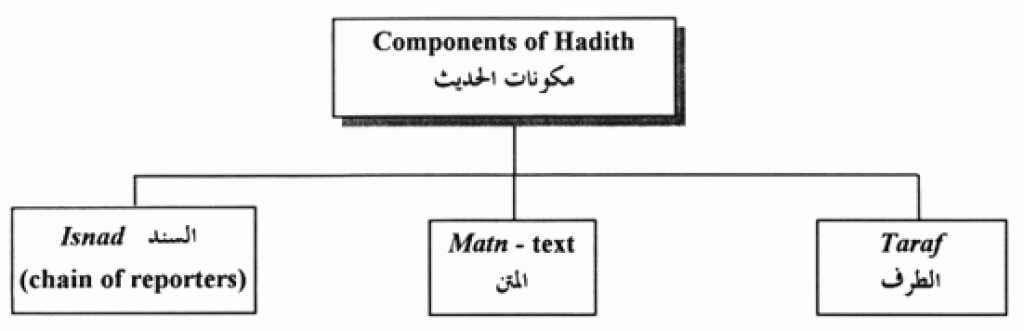
The components of a hadith can be detailed as follows:
Matn (Text): This is the core content of the hadith, conveying the actual message or teaching. It includes the sayings, actions, or approvals of the Prophet Muhammad (PBUH) and serves as the foundation of the hadith’s meaning and significance.
Isnad (Chain of Transmission): The isnad is crucial for validating the authenticity of a hadith. It consists of the list of narrators who transmitted the hadith from the Prophet to later scholars. Each individual in the chain must be reputable and trustworthy, ensuring the reliability of the narration.
Taraf (Introduction): The taraf is the introductory part of the hadith, usually summarizing the context or the specific action being reported. It often refers to the Prophet’s engagement with the issue at hand, providing a link to the subject matter discussed in the matn.
Understanding these components is essential for scholars and students of hadith to assess the credibility and reliability of Islamic teachings.
A Brief History of Mustalah al-Hadith: The Classification of Hadith
As time progressed, the number of narrators involved in each isnad increased, necessitating a rigorous approach to the acceptance of hadith. The guidelines that regulate this discipline are collectively known as Mustalah al-Hadith, or the Classification of Hadith.
Among the early traditionists, known as muhaddithin, the criteria for studying Hadith were established with meticulous care. However, terminology sometimes varied, and while their principles began to be documented, these writings were often scattered across various texts. Notable early works include Al-Risalah by al-Shafii (d. 204), the introduction to the *Sahih* of Muslim (d. 261), and the *Jami* of al-Tirmidhi (d. 279). Many criteria established by early scholars, such as al-Bukhari, were later inferred from a careful analysis of accepted and rejected isnads.
One of the earliest comprehensive works on Mustalah was authored by al-Ramahurmuzi (d. 360), which sought to standardize terminology. The next significant contribution came from al-Hakim (d. 405) with his Ma’rifah `Ulum al-Hadith, which detailed fifty classifications of Hadith but left some topics unexplored. Abu Nu’aim al-Isbahani (d. 430) later addressed these gaps.
Subsequent works included Al-Kifayah fi Ilm al-Riwayah* by al-Khatib al-Baghdadi (d. 463), which became a vital resource for later scholars. The influential *Ulum al-Hadith by Abu Amr Uthman Ibn al-Salah (d. 643), also known as Muqaddimah Ibn al-Salah, emerged as a definitive reference for scholars and students alike, compiled during his tenure at the Dar al-Hadith across several cities in Syria.
Numerous later works drew from Ibn al-Salah’s framework, including:
- Al-Irshad by al-Nawawi (d. 676), which he later summarized in Taqrib.
- Tadrib al-Rawi by al-Suyuti (d. 911), a valuable commentary on al-Nawawi’s work.
- Ikhtisar `Ulum al-Hadith by Ibn Kathir (d. 774).
- Al-Khulasah by al-Tibi (d. 743).
- Al-Minhal by Badr al-Din b. Jama’ah (d. 733).
- Al-Muqni` by Ibn al-Mulaqqin (d. 802).
- Mahasin al-Istilah by al-Balqini (d. 805).
Additional commentaries include:
- Al-Nukat by al-Zarkashi (d. 794).
- Al-Taqyid wa ‘l-Idah by al-`Iraqi (d. 806).
- Al-Nukat by Ibn Hajar al-`Asqalani (d. 852).
Notably, Alfiyyah al-Hadith by al-`Iraqi rewrote Muqaddimah in poetic form, spawning several commentaries, including two by the author himself, Fath al-Mughith by al-Sakhawi (d. 903), Qatar al-Durar by al-Suyuti, and Fath al-Baqi by Shaykh Zakariyyah al-Ansari (d. 928).
Other important treatises on Mustalah include:
- Al-Iqtirah by Ibn Daqiq al-‘Id (d. 702).
- Tanqih al-Anzar by Muhammad b. Ibrahim al-Wazir (d. 840), which features a commentary by al-Amir al-San`ani (d. 1182).
- Nukhbah al-Fikr by Ibn Hajar al-
Asqalani, which has inspired numerous commentaries, including one by the author himself and others by his son Muhammad,Ali al-Qari (d. 1014),Abd al-Ra'uf al-Munawi (d. 1031), and Muhammad b.Abd al-Hadi al-Sindi (d. 1138).
Additionally, Alfiyyah al-Hadith by al-Suyuti stands out as one of the most comprehensive poetic works in the field.
Key Contributions:
- Al-Manzumah by al-Baiquni, expanded upon by al-Zurqani (d. 1122) and Nawab Siddiq Hasan Khan (d. 1307).
- Qawa’id al-Tahdith by Jamal al-Din al-Qasimi (d. 1332).
- Taujih al-Nazar by Tahir al-Jaza’iri (d. 1338), summarizing al-Hakim’s Ma’rifah.
This rich history of Mustalah al-Hadith reflects the dedication of scholars throughout the centuries to maintain the authenticity and integrity of Hadith literature in Islamic scholarship.
Understanding The Mustalah al-Hadith: The Classification of Hadith
- Reference to Authority: This classification is based on the authority from whom the Hadith originates:
- Marfu` (Elevated): Refers to Hadith attributed directly to the Prophet Muhammad (may Allah bless him and grant him peace).
- Mauquf (Stopped): Refers to Hadith attributed to a Companion of the Prophet.
- Maqtu` (Severed): Refers to Hadith attributed to a Successor of the Companions.
- Isnad Links: This classification focuses on the chain of reporters:
- Musnad (Supported): An uninterrupted chain.
- Muttasil (Continuous): A continuous chain with no breaks.
- Munqati (Broken): An interrupted chain.
- Mu`allaq (Hanging): Hadith with missing links in the chain.
- Mu`dal (Perplexing): Hadith with multiple missing links.
- Mursal (Hurried): Hadith where a Successor reports directly from the Prophet without mentioning the Companion.
- Number of Reporters: Based on the number of reporters at each stage of the isnad:
- Mutawatir (Consecutive): Hadith reported by a large number of people at each level.
- Ahad (Isolated): Reported by fewer individuals, further divided into:
- Gharib (Scarce): Rare reports.
- `Aziz (Rare): Relatively strong but not widespread reports.
- Mash’hur (Famous): Well-known reports.
- Manner of Reporting: This classification relates to how the Hadith is reported:
- Mudallas (Concealed): Hadith where a narrator conceals the identity of a source.
- Musalsal (Uniformly-Linked): Hadith reported with a specific phrase consistently.
Note: In the quotations of isnads within this context, a single broken line (—) denotes the first mode of narration, while a double line (===) represents direct transmissions.
- Nature of the Matn and Isnads:
- Ziyadatu Thiqah: An additional narration by a reliable reporter.
- Shadhdh (Irregular): Opposition by a lesser authority to a more reliable one.
- Munkar (Denounced): Hadith containing objectionable content or errors, rejected outright.
- Mudraj (Interpolated): Texts with additions made by a reporter.
- Hidden Defects: Some Hadith may contain hidden issues:
- Mu`allal (Defective Hadith): A separate category that highlights defects in the isnad or text.
- Maqlub (Overturned): A Hadith with elements flipped in the chain.
- Mudtarib (Shaky): A Hadith with conflicting accounts.
- Mu`allal (Defective Hadith): A separate category that highlights defects in the isnad or text.
- Reliability of Reporters: The final judgment on the authenticity of a Hadith heavily relies on the reliability and memory of its reporters:
- Sahih (Sound): Authentic Hadith.
- Hasan (Good): Acceptable Hadith, slightly less reliable than Sahih.
- Da`if (Weak): Not sufficiently reliable.
- Maudu` (Fabricated): Invented or forged reports.
Understanding these classifications is crucial for scholars and students of Hadith as it aids in distinguishing authentic narrations from weak or fabricated ones, thus preserving the integrity of Islamic teachings.
Rijal al-Hadith: The Study of Hadith Reporters
Mustalah al-Hadith is closely linked to Rijal al-Hadith, the study of hadith narrators. Evaluating narrators involves expert-authenticated or disparaging remarks. These range from high praise like “Imam” (leader) or “Hafiz” (preserver), down to critiques like “Weak”, “Abandoned”, or “Liar”5 (one who fabricates hadith). These classifications help determine the strength of the isnad (chain of transmission). Hadiths transmitted by reliable narrators can be classified as Sahih, while those from weak or fabricating narrators are deemed Da’if or Maudu’.
Narrators unanimously praised with terms like “Imam” or “Hafiz” often contribute to a Sahih (sound) isnad. If a narrator is labeled a liar or fabricator, the isnad becomes Da’if jiddan (very weak) or Maudu’ (fabricated). Reporters described with middle-tier terms like “makes mistakes” might weaken the isnad, although multiple corroborating narrations can raise the hadith to Hasan (good).
When remarks about a hadith reporter conflict, scholars carefully assess various factors, including the reasons for criticism, the severity of each critique, and the critic’s level of strictness or leniency. Early evaluations of narrators, dating back to the Successors and continuing through the period of the six canonical traditionists (spanning the first three centuries of Islam), play a critical role in this analysis. Detailed names and examples are provided in the thesis Criticism of Hadith Among Muslims with Reference to Sunan Ibn Majah, specifically in chapters IV, V, and VI.
Among the foundational texts in the study of hadith reporters are:
- Ta’rikh by Ibn Ma’in (d. 233)
- Tabaqat by Khalifa b. Khayyat (d. 240)
- Ta’rikh by al-Bukhari (d. 256)
- Kitab al-Jarh wa ‘l-Ta’dil by Ibn Abi Hatim (d. 327)
- Tabaqat by Muhammad b. Sa’d (d. 320)
These works laid the groundwork for understanding the reliability of hadith narrators. Various traditionists have made significant contributions to compiling information on the reporters of the five major collections of hadith:
- Sahih al-Bukhari (d. 256)
- Sahih Muslim (d. 261)
- Sunan Abu Dawud (d. 275)
- Jami` al-Tirmidhi (d. 279)
- Sunan al-Nasa’i (d. 303)
One of the earliest comprehensive works that included the reporters of Sunan Ibn Majah (d. 273) is Al-Kamal fi Asma’ al-Rijal by al-Hafiz `Abd al-Ghani al-Maqdisi (d. 600), which spans ten volumes.
Later, Jamal al-Din Abu ‘l-Hajjaj Yusuf b. `Abd al-Rahman al-Mizzi (d. 742) created an edited and abridged version of this work, detailing the origins of the reporters, titled Tahdhib al-Kamal fi Asma’ al-Rijal, consisting of twelve volumes.
Additionally, one of al-Mizzi’s prominent students, Shams al-Din Abu Abdullah Muhammad b. Ahmad b. Uthman b. Qa’imaz al-Dhahabi (d. 748), summarized this work and produced two abridgements: a longer version called Tahdhib al-Tahdhib and a shorter one named Al-Kashif fi Asma’ Rijal al-Kutub al-Sittah.
Ibn Hajar (d. 852) made significant contributions to the study of hadith reporters by creating a comprehensive yet abridged version of al-Mizzi’s work. His text, titled Tahdhib al-Tahdhib, spans twelve shorter volumes, with roughly one-third of the original content omitted for brevity. He later further condensed this material into a more concise two-volume work known as Taqrib al-Tahdhib.
Al-Dhahabi’s contributions also received attention from other scholars. Al-Khazraji (Safi al-Din Ahmad b. `Abdullah, d. after 923) provided a summary of al-Dhahabi’s work, enhancing it with valuable insights, which resulted in his own publication titled Khulasah.
Numerous additional works focus specifically on either reliable reporters or those deemed unreliable. For instance, Kitab al-Thiqat by al-Ijli (d. 261) and **Tadhkirah al-Huffaz** by al-Dhahabi are dedicated to trustworthy narrators. Conversely, **Kitab al-Duafa’ wa al-Matrukin** by al-Nasa’i and Kitab al-Majruhin by Muhammad b. Hibban al-Busti (d. 354) focus solely on narrators who have been criticized.
Moreover, two important texts that encompass a wide range of reporters, both reputable and disparaged, are Mizan al-I’tidal by al-Dhahabi and Lisan al-Mizan by Ibn Hajar.
Mustalah Al Hadith: The Classification of Hadith
A. Reference to Authority
In the study of hadith, understanding the classification of narrations is essential for interpreting Islamic teachings accurately. The principal types of hadith based on their authority are as follows:
1. Marfu` (Elevated)
Abdullah b. al-Zubair === Sufyan === Yahya b. Said al-Ansari === Muhammad b. Ibrahim al-Taymi === ‘Alqamah b. Waqqas al-Laithi, who reported:
“I heard `Umar b. al-Khattab say, while on the pulpit, ‘I heard Allah’s Messenger (may Allah bless him and grant him peace) say: The reward of deeds depends on the intentions, and every person will get the reward according to what he has intended; so whoever emigrated for worldly benefits or for a woman to marry, his emigration was for what he migrated.'”This classification helps to ensure that the teachings attributed to the Prophet are authentic and reliable.
2. Mauquf (Stopped)
- “We were commanded to …”
- “We were forbidden from …”
- “We used to do …”
- “We did not use to mind such-and-such…”
- “It is from the Sunnah to …”
- “It was revealed in the following circumstances: …”
3. Maqtu` (Severed)
A Maqtu hadith is attributed to a Successor (Tabiun), who narrates it without a direct link to the Prophet. For instance, Muslim reports in the introduction to his Sahih that Ibn Sirin (d. 110) stated, “This knowledge (i.e., Hadith) is the Religion, so be careful from whom you take your religion.”
The authenticity of each type of hadith—Marfu, Mauquf, and Maqtu—depends on various factors, including the reliability of its reporters and the strength of the chain of narration. This classification is particularly valuable in distinguishing the sayings of the Prophet from those of the Companions or Successors, which is essential during discussions on Islamic jurisprudence (Fiqh).
Distribution of Hadith in Collections
- 600 Marfu` ahadith
- 613 Mauquf ahadith
- 285 Maqtu` ahadith
- 228 Mursal ahadith
This totals 1726 ahadith.6
In other collections, particularly Al-Musannaf by Ibn Abi Shaibah (d. 235) and Al-Musannaf by Abd al-Razzaq (d. 211), as well as the Tafsirs of Ibn Jarir (d. 310), Ibn Abi Hatim (d. 327), and Ibn al-Mundhir (d. 319), there is a relatively higher presence of Mauquf and Maqtu ahadith.7
B. Isnad Links
1. Musnad
Definition
“A hadith which a traditionist reports from his shaikh from whom he is known to have heard (ahadith) at a time of life suitable for learning, and similarly in turn for each shaikh, until the isnad reaches a well-known Companion, who in turn reports from the Prophet (may Allah bless him and grant him peace).“8This definition emphasizes the importance of a continuous and reliable chain of narration, starting from the traditionist to the Companion of the Prophet. Notably, an ordinary Muttasil hadith (one with an uninterrupted isnad) is excluded from being categorized as Musnad if it only reaches a Companion or a Successor. Similarly, a Marfu` hadith (one attributed directly to the Prophet) is excluded if it has an interrupted isnad.
Example of a Musnad Hadith
We reported from Abu Amr Uthman b. Ahmad al-Sammak al-Baghdadi === Al-Hasan b. Mukarram === Uthman b. Amr === Yunus — al-Zuhri — Abdullah b. Kab b. Malik — his father, who asked Ibn Abi Hadrad for payment of a debt he owed to him, in the mosque. During the ensuing argument, their voices were raised until heard by the Messenger of Allah (Pbuh), who eventually lifted the curtain of his apartment and said, “O Ka`b! Write off a part of your debt” – he meant remission of half of it. So he agreed, and the man paid him.Al-Hakim further remarks that
“Now, my hearing from Ibn al-Simak is well- known, as is his from Ibn Mukarram; al- Hasan’s link with `Uthman b. `Amr and the latter’s with Yunus b. Zaid are known as well; Yunus is always remembered with al-Zuhri, and the latter with the sons of Ka`b b. Malik, whose link to their father and his companionship of the Prophet (may Allah bless him and grant him peace) are well-established.”.9
Collections of Musnad Hadith
- Yahya b. `Abd al-Hamid al-Himmani (d. 228) in Kufah.
- Musaddad b. Musarhad (d. 228) in Basrah.
2. Muttasil
Definition
A Muttasil hadith is defined as a narration that has a continuous and uninterrupted chain of transmission (isnad) from the narrator back to the Prophet Muhammad (may Allah bless him and grant him peace) or a Companion. This means that every individual in the chain is known to have heard the hadith directly from the person preceding them, with no missing links.
The characteristics of a Muttasil hadith include:
Uninterrupted Isnad: Each narrator has a direct relationship with the person from whom they received the hadith, ensuring that the transmission is intact.
Reliable Narrators: The narrators in the chain are typically considered trustworthy and have a good reputation for accuracy and integrity in reporting hadith.
Authenticity: Muttasil hadiths are generally regarded as strong and reliable forms of evidence for Islamic teachings and jurisprudence, provided that the narrators are confirmed to be trustworthy.
Example of a Muttasil Hadith
Narrated by Al-Bukhari from Yahya b. Bukayr who heard from Al-Layth who heard from ‘Uqayl who heard from Ibn Shuhab al-Zuhri who reported from ‘Urwah b. al-Zubayr who narrated from ‘Aisha (may Allah be pleased with her): “The Prophet (may Allah bless him and grant him peace) said, ‘Whoever introduces something into this matter of ours (i.e., Islam) that is not part of it, it will be rejected.’”
In this example, each person in the chain of narrators (isnad) has a direct connection to the person from whom they received the hadith, with no missing links, making it a Muttasil hadith. The reliability of the narrators further strengthens its authenticity.
Collections of Muttasil Hadith
Some notable collections that include Muttasil hadith are:
Sahih al-Bukhari: Compiled by Imam Muhammad ibn Ismail al-Bukhari, this collection is one of the most authentic sources of hadith in Islam. Many of the hadiths are Muttasil, as Bukhari meticulously ensured that all narrators in his chain were trustworthy and that the transmission was continuous.
Sahih Muslim: Compiled by Imam Muslim ibn al-Hajjaj, this collection is also considered one of the most authentic. Like Sahih al-Bukhari, it features numerous Muttasil hadiths with reliable chains of transmission.
Sunan Abu Dawood: Compiled by Imam Abu Dawood al-Sijistani, this collection contains various hadiths, some of which are Muttasil, particularly those dealing with legal rulings and practices.
Jami
at-Tirmidhi: Compiled by Imam AbuIsa at-Tirmidhi, this collection includes a mix of authentic and weaker hadiths, with many Muttasil narrations present throughout.Sunan an-Nasa’i: Compiled by Imam Ahmad ibn Shu’ayb an-Nasa’i, this collection includes a significant number of Muttasil hadiths, particularly concerning jurisprudential matters.
Musnad Ahmad: Compiled by Imam Ahmad ibn Hanbal, this collection is structured by the names of the Companions, and it contains many Muttasil hadiths that are highly regarded for their authenticity.
Al-Muwatta: Compiled by Imam Malik ibn Anas, this collection includes Muttasil hadiths, particularly regarding the practices and traditions of the people of Medina, which were known for their reliability.
3. Mursal
Definition
A hadith is termed Mursal when a Successor reports a saying of the Prophet (may Allah bless him and grant him peace) without naming the Companion from whom he heard it. The missing link between the Successor and the Prophet raises questions about the authenticity, but if the Successor is reliable, the hadith may still be considered acceptable.
Example of a Mursal Hadith
A well-known example of a Mursal hadith is narrated by al-Hasan al-Basri, a prominent Successor. He reported that the Prophet Muhammad (may Allah bless him and grant him peace) said:
“The deeds are judged by intentions, and everyone will get what they intended.”
In this narration, al-Hasan does not mention any Companion through whom he heard this saying of the Prophet. Instead, he simply states, “The Prophet said…” This omission of the intermediary (the Companion) classifies the hadith as Mursal.
Despite its classification as Mursal, many scholars regard this hadith as authentic due to its widespread acceptance and corroboration by other sources.
Authenticity of Mursal Hadith
The authenticity of Mursal hadith (plural: Marasil) has been a topic of extensive debate among scholars. This discussion primarily revolves around the possibility that a Successor may have omitted the names of both an elder Successor and a Companion, rather than just a single Companion.
When a Successor is known to have omitted only the name of a Companion, the hadith is generally regarded as authentic. This is because a Successor can only report from the Prophet (may Allah bless him and grant him peace) through a Companion, and the omission of the Companion’s name does not compromise the integrity of the isnad. This perspective is supported by Qur’anic injunctions and the Prophet’s sayings, which affirm the reliability and trustworthiness of all Companions.
However, opinions diverge regarding instances where the Successor may have left out two authorities. Not all Successors are deemed equally reliable in matters of hadith, leading to differing scholarly views:
- Marasil of Elder Successors: The Marasil from elder Successors such as Sa
id b. al-Musayyab (d. 94) andAta’ b. Abi Rabah (d. 114) are generally accepted. This acceptance stems from the understanding that their Marasil have been scrutinized and found to originate from Companions only. - Marasil of Younger Successors: In contrast, the Marasil from younger Successors are accepted only if the identities of their immediate authorities can be corroborated through other sources. If this verification is lacking, these hadith are typically rejected.
Another viewpoint suggests that the Marasil from Successors and their reporters are acceptable without any further investigation. This stance is particularly supported by the Kufi school of traditionists but faces considerable criticism from the majority of scholars.
To clarify the different perspectives regarding Mursal hadith, we will delve into the opinions of key Islamic scholars:
- Imam Malik and Maliki Jurists: Imam Malik and all Maliki scholars assert that the Mursal hadith of a trustworthy individual is valid as evidence and justification for a practice, akin to a Musnad hadith.13 This position has evolved to the extent that some Malikis even argue that the Mursal is superior to the Musnad. Their reasoning is that while a Musnad hadith provides the names of its narrators for further examination, a Mursal hadith narrated by a knowledgeable and trustworthy person has already undergone scrutiny. Hence, it saves the listener from additional research.14
- Imam Abu Hanifah: Imam Abu Hanifah (d. 150) shares a similar stance to that of Imam Malik, accepting Mursal hadith regardless of whether it is corroborated by other hadith.15
- Imam al-Shafii: Imam al-Shafii (d. 204) addresses the issue comprehensively in his work, Al-Risalah. He outlines specific conditions that must be fulfilled for a Mursal hadith to be accepted:
- Narrative Conditions:
- The hadith should also be reported as Musnad through a different isnad.
- Its contents should be corroborated by another reliable source through a different isnad.
- The meaning of the hadith should align with the statements of some Companions.
- A consensus among most scholars on the issue presented in the Mursal hadith is necessary.
- Narrator Conditions:
- The narrator must be an elder Successor.
- If the narrator mentions the missing person elsewhere, they should not typically name an unknown individual or someone unsuitable for narration.
- The narrator should not contradict a reliable individual when they share a narration.16
Based on these criteria, al-Shafi
i validates the Irsal of Said b. al-Musayyab, one of the elder Successors. For instance, he references the issue of selling meat in exchange for a living animal, stating that Malik informed him, citing Zaid b. Aslam, who narrated from Ibn al-Musayyab that the Messenger of Allah (may Allah bless him and grant him peace) forbade such transactions. Al-Shafi`i concludes, “This is our opinion, for the Irsal of Ibn al-Musayyab is sound.”17 - Narrative Conditions:
- Imam Ahmad b. Hanbal (d. 241): Imam Ahmad accepts Mursal and certain Da’if (weak) hadith, provided that no opposing evidence exists for a particular issue. He prioritizes these over qiyas (analogical deduction). For Imam Ahmad, Da’if refers to hadith that are not severely weak (like Batil, Munkar, or Maudu). He categorized hadith as either Sahih or Da’if, distinguishing them from the more common classification of Sahih, Hasan, and Da’if adopted by later scholars.18 Thus, the Da’if category in his view includes many hadith that others classify as Hasan, leading to misunderstandings about his position on Da’if hadith in Fiqh rulings and matters of Fada’il al-A’mal (virtues of acts of worship).
- Ibn Hazm (d. 456): Ibn Hazm firmly rejects Mursal hadith, asserting that it is unacceptable regardless of the narrator, even if it comes through well-known Successors like Sa`id b. al-Musayyib or al-Hasan al-Basri.19
- Abu Dawud (d. 275): Abu Dawud accepts Mursal hadith under two conditions: either no Musnad hadith exists on the issue, or if a Musnad hadith is present, it must not contradict the Mursal.20
- Ibn Abi Hatim (d. 327): While Ibn Abi Hatim does not provide a definitive stance on Mursal hadith, he compiled an anthology titled Kitab al-Marasil, which includes 469 hadith reporters whose narratives were scrutinized due to Irsal.
- Al-Hakim (d. 405): Al-Hakim (d. 405) was cautious about accepting Mursal hadith, with the exception of those narrated by elder Successors. He quotes Yazid b. Harun, who linked the role of Ahl al-Hadith (scholars of hadith) to this verse, indicating that authentic knowledge is what is heard directly, not transmitted without a complete chain. He emphasized that knowledge should be based on what is heard directly, citing the Qur’anic verse from Surah At-Tawbah (9:122) as evidence.21 This verse highlights the value of scholars who seek knowledge and then teach others22, implying that direct transmission of knowledge holds more weight than reports via Irsal (omission of the intermediary).23 Al-Hakim, thus, favored directly heard hadith over indirect reports.
- Al-Khatib al-Baghdadi (d. 462): Al-Khatib al-Baghdadi (d. 462) was a strong opponent of accepting Mursal hadith, except if narrated by an elder Successor. He argued that Irsal introduces ambiguity regarding the reliability of the missing link in the isnad. Al-Khatib believed that only narrations from known trustworthy reporters should be accepted.24
Al-Khatib al-Baghdadi presents an example of a hadith reported through both Musnad and Mursal isnads, demonstrating that a narrative can be accepted if the isnad is uninterrupted. He uses the hadith “No marriage is valid except by the consent of the guardian” to illustrate this. While one chain (Sufyan al-Thauri and Shu`bah) is Mursal, another chain through Yunus b. Abi Ishaq adds the name of Abu Musa, the Companion. Al-Khatib shows that the presence of Abu Musa strengthens the reliability of the hadith.25
- Ibn al-Salah (d. 643): Ibn al-Salah agrees with al-Shafi`i, rejecting Mursal hadith unless it can be proven to have a Musnad route.26
- Ibn Taimiyyah (d. 728): Ibn Taimiyyah classifies Mursal hadith into three categories:
- Acceptable,
- Unacceptable,
- Those requiring further investigation. He stipulates that if a reporter narrates from reliable authorities, their report is accepted. However, if they narrate from both reliable and unreliable sources, further scrutiny is needed. Mursal hadith contradicting reliable reports will be completely rejected.27
- Al-Dhahabi (d. 748): Al-Dhahabi regards the Mursal hadith of younger Successors, including al-Hasan al-Basri, al-Zuhri, Qatadah, and Humaid al-Tawil, as the weakest category of Mursal.28
Later scholars such as Ibn Kathir (d. 744), al-`Iraqi (d. 806), Ibn Hajar (d. 852), al-Suyuti (d. 911), Muhammad b. Ibrahim al-Wazir (d. 840), Jamal al-Din al-Qasimi (d. 1332), and Tahir al-Jaza’iri (d. 1338) have extensively examined the topic of Mursal hadith. However, their conclusions largely align with the opinions already outlined by earlier scholars.
These later scholars have not presented significantly different views, reinforcing the established perspectives on the acceptance and authenticity of Mursal hadith within the framework of Islamic jurisprudence. Their discussions often reiterate the complexities surrounding the reliability of narrators and the conditions under which Mursal hadith may be deemed acceptable or rejected.
4. Munqati'
Definition
A hadith is Munqati’ if there is a missing link anywhere before the Successor in the isnad, making it “broken.” Even if the isnad appears to be continuous, if any reporter is known to have never heard from their immediate authority, it renders the hadith Munqati’.
The term Munqati refers to a hadith that has a break in its chain of transmission, meaning that one or more narrators in the isnad are missing or unidentifiable. When a reporter states, “a man narrated to me…” without specifying the name of the individual who narrated the hadith, this creates a gap in the chain, rendering the hadith Munqati.
Example of a Munqati' Hadith
An example of a Munqati hadith can be found in the report of Al-Hakim, who narrates from Muhammad b. Musab through al-Auza’i, continuing through Shaddad Abu ‘Ammar, and finally Umm al-Fadl bint al-Harith. She recounted her experience with the Messenger of Allah (may Allah bless him and grant him peace), stating, “Last night, I saw in a vision as if a part of your body was cut out and placed in my lap.” The Prophet replied, “You have seen something good. If Allah wills, Fatimah will give birth to a boy who will be in your lap.“
This prophecy came to pass when Fatimah gave birth to al-Husain, who indeed became a beloved figure in Umm al-Fadl’s life. On another occasion, she placed al-Husain in the Prophet’s lap, and as he looked at the child, he began to shed tears. He explained, “Jibril came to me and informed me that my Ummah will kill this son of mine and brought me some of the reddish dust from the place where this tragedy will occur.”
Al-Hakim classified this narration as Sahih according to the criteria of the two renowned scholars, Al-Bukhari and Muslim, despite the fact that they did not include it in their collections. However, Al-Dhahabi challenged this classification, pointing out that the hadith is Munqati and Da’if because Shaddad never met Umm al-Fadl, and the reliability of Muhammad b. Mus`ab is questionable.11
5. Mu'dal
Definition
If there are multiple consecutive missing reporters in the isnad, the hadith is called Mu’dal. This term implies that the chain is perplexing due to the complexity of missing narrators.
Example of a Muttasil Hadith
Ali b. Asim, followed by Said, Qatadah, and finally Ubayy b. Kab.
In this narration, Ubayy b. Ka`b reports that
the Messenger of Allah (may Allah bless him and grant him peace) conveyed the following message: “After Adam had tasted from the tree, he ran away, but the tree caught his hair. It was proclaimed: O Adam! Are you running away from Me? He replied: No, but I feel ashamed before You. The proclamation continued: O Adam! Depart from My neighborhood, for by My Honour, no one who disobeys Me can dwell near Me; even if I were to create a multitude of people like you to fill the earth, and they disobeyed Me, I would place them in a dwelling of sinners.”Ibn Kathir notes that this hadith is categorized as Gharib (strange) due to its unique nature. He points out that there is a break in the chain, or inqita’, and even a Mudal aspect, specifically between Qatadah and Ubayy b. Kab, may Allah be pleased with both of them.12
6. Mu'allaq
Definition
A Mu’allaq Hadith is a type of hadith where the chain of narrators (isnad) is incomplete at the beginning. The term “mu’allaq” means “hanging” or “suspended,” as the isnad starts with the compiler or another narrator without mentioning the preceding narrators back to the Prophet (peace be upon him). This can result in the hadith being considered weak due to the missing portion of the chain. However, some compilers, like Imam Bukhari, might later provide a complete chain elsewhere in their collections.
Example of a Mu'allq Hadith
An example of a Mu’allaq hadith can be found in Sahih al-Bukhari. For instance, Bukhari writes:
“The Prophet (may Allah bless him and grant him peace) said: ‘Whoever cheats is not one of us.'”
In this example, Bukhari doesn’t provide a full isnad, making it Mu’allaq. The complete chain of narration is missing from the beginning, with Bukhari only quoting the text of the hadith itself. However, Bukhari often includes the full isnad for the same hadith elsewhere in his collection.
C. Number Of Reporters
1. Mutawatir
A Mutawatir hadith is one that is reported by a sufficiently large number of individuals at every level of the chain, making it impossible for them to collectively agree on a falsehood.29 Scholar Al-Ghazali (d. 505) emphasizes that the large number of reporters must be consistent at the beginning, middle, and end of the chain.30 This stipulation ensures that certain narrations or concepts, even if widely accepted, do not meet the criteria for being Mutawatir unless they genuinely possess a large and reliable number of reporters throughout the chain.
While there is no strict numerical threshold to define a “large number,” various figures such as four, five, ten, or even seventy have been suggested. However, the key factor is the improbability of accidental agreement or organized deception among the narrators.31
Examples of Mutawatir Practices
Practices considered Mutawatir include the five daily prayers, fasting during Ramadan, paying zakat, performing Hajj, and the recitation of the Qur’an. A notable example of a verbal Mutawatir hadith is: “Whoever invents a lie and attributes it to me intentionally, let him prepare his seat in the Fire,” reported by at least sixty-two Companions of the Prophet Muhammad (may Allah bless him and grant him peace).
Additional examples of verbal Mutawatir ahadith encompass topics like the description of the Haud Kauthar (the Basin of Abundant Goodness in the Hereafter), the practice of raising hands during prayer, and the prohibition of intoxicants.32
2. Ahad
An Ahad hadith, or khabar wahid, is one that is narrated by fewer reporters than a Mutawatir hadith. Ahad can be further categorized into three classifications:
i. Gharib Hadith
A hadith is termed Gharib (meaning “scarce” or “strange”) when it has only one reporter at any stage of its isnad. For instance, consider the saying of the Prophet Muhammad (may Allah bless him and grant him peace):
“Travel is a piece of punishment.”
In this case, the isnad comprises a single reporter at each level: Malik → Yahya b. Abi Salih → Abu Hurairah → the Prophet (may Allah bless him and grant him peace). Although this particular hadith is deemed Sahih (authentic), most Gharib ahadith tend to be weak. The scholar Ahmad b. Hanbal cautioned against recording Gharib ahadith, stating, “Do not write these Gharib ahadith because they are unacceptable, and most of them are weak.”33
ii. Fard Hadith
- Similar to Gharib: Only one person narrates it from a well-known Imam.
- Local Narration: The hadith is known only within a specific locality.
- Inter-Local Narration: Narrators from one area report the hadith from narrators in another area, such as the people of Makkah narrating from those of Madinah.34
iii. Aziz Hadith
If a hadith has only two reporters at any point in the isnad, it is classified as `Aziz (meaning “rare” or “strong”). For example, Anas reported that the Messenger of Allah (may Allah bless him and grant him peace) said:
“None of you (truly) believes until I become more beloved to him than his father, his son, and all the people.”
In this case, two reporters, Qatadah and Abdul Aziz b. Shu’aib, narrate the hadith from Anas, with additional narrators from each of them: Shu’bah and Said report from Qatadah, while Ismail b. Ulayyah and Abd al-Warith narrate from Abdul `Aziz, followed by a larger group reporting from them.35
iv. Mash'hur Hadith
A hadith reported by more than two narrators is known as Mash’hur (meaning “famous”). Some scholars argue that any narrative widely known, regardless of its authenticity, falls into this category. A Mash’hur hadith may start with only one or two reporters but can gain widespread recognition over time. In contrast, Gharib or `Aziz hadiths maintain their low number of reporters throughout history.
For instance, if only one or two reporters narrate a hadith from a trusted authority like al-Zuhri or Qatadah, it will remain classified as Gharib or `Aziz. However, if many people later narrate it, it will be categorized as Mash’hur.36
v. Dual Classification of Hadith
Interestingly, as noted by the scholar al-‘Ala’i (Abu Said Khalil Salah al-Din, d. 761), a hadith can simultaneously be classified as both Aziz and Mash’hur. This occurs when a hadith retains only two narrators at one stage of its isnad while enjoying a larger number of narrators at other stages. For example, the saying of the Prophet (may Allah bless him and grant him peace):
“We are the last but (will be) the foremost on the Day of Resurrection.”
Initially classified as `Aziz since it is reported only by Hudhaifah b. al-Yaman and Abu Hurairah, it later becomes Mash’hur as seven individuals report it from Abu Hurairah.
These classifications are essential for scholars to evaluate the authenticity and reliability of hadith, ensuring that Islamic teachings are founded on solid evidence.37
D. Manner of Reporting
In the realm of hadith transmission, various reporting methods, such as “he narrated to us,” “he informed us,” “I heard,” and “on the authority of,” indicate how a reporter obtained the information. The first three phrases suggest direct hearing from a shaikh, while the fourth can imply either direct listening or reporting through another narrator.
1. Mudallas Hadith
A Mudallas hadith refers to a narration that is weakened due to uncertainty stemming from tadlis (the act of concealing). Tadlis occurs when a reporter obscures the identity of his shaikh. According to Ibn al-Salah, there are two primary types of tadlis:
- Tadlis al-Isnad: In this form, a narrator reports from a shaikh they met but did not hear from, or from a contemporary they did not meet, presenting it as if they had directly heard the hadith. A mudallis often employs phrases like “on the authority of” or “he said” to mislead regarding the isnad.
- Tadlis al-Shuyukh: Here, the reporter does mention their shaikh but uses a less common name, nickname, or title to hide the true identity of the shaikh.38
Al-`Iraqi (d. 806) adds a third type of tadlis:
- Tadlis al-Taswiyyah: This occurs when an isnad features a trustworthy shaikh narrating from a weak authority, who, in turn, reports from another reliable shaikh. The reporter omits the intermediate weak link, creating the appearance of a chain consisting solely of credible narrators. The use of “on the authority of” can further obscure this connection, making the isnad appear sound to an unsuspecting student. This practice has been attributed to narrators like Baqiyyah b. al-Walid, Walid b. Muslim, al-A’mash, and al-Thauri and is considered the most problematic form of tadlis.39
Categories of Mudallisin
Ibn Hajar categorizes those who engage in tadlis into five groups in his work Tabaqat al-Mudallisin:
- Occasional Practitioners: Narrators known to commit tadlis occasionally, such as Yahya b. Sa`id al-Ansari.
- Generally Accepted: These narrators are either well-regarded with few instances of tadlis (e.g., Sufyan al-Thauri) or report solely from authentic authorities (e.g., Sufyan Ibn ‘Uyainah).
- Frequent Practitioners: These individuals practice tadlis extensively, and while some of their narrations are accepted when they explicitly state direct hearing, others, like Abu ‘l-Zubair al-Makki, remain controversial.
- Rejection Without Explicit Hearing: Similar to the previous group, these narrators are rejected unless they clearly indicate they heard the narration directly, such as Baqiyyah b. al-Walid.
- Disparaged for Other Reasons: These narrators’ ahadith are dismissed even if they admit to direct hearing due to other weaknesses, such as Ibn Lahi’ah, whose weakness is of a lesser degree.40
Tadlis, particularly from the last three categories, is heavily criticized. The scholar Shu`bah (d. 170) remarked, “Tadlis is the brother of lying,” asserting a strong disdain for this practice.41
2. Musalsal Hadith
- Use of the phrase sami’tu (I heard).
- An instruction such as, “Stand and pour water for me so that I may illustrate the way my shaikh performed ablution.”
- The expression haddathana (he narrated to us).
- The command amarani (he commanded me).
- Holding one’s beard during narration.
- Demonstrating by counting on five fingers.
- The phrase “I testify that …”.
- Interlocking fingers.42
E. Nature of Matn and Isnads
1. Shadhdh Hadith
According to Imam al-Shafi`i, a Shadhdh (“irregular”) hadith is defined as one that is reported by a trustworthy narrator but contradicts the narration of someone who is more reliable. Importantly, this definition does not apply to hadith that is unique in its content and has no other sources.43
For example, the famous hadith “Actions are (judged) according to their intentions” is not classified as Shadhdh. It has been narrated through a reliable chain by Yahya b. Said al-Ansari from Muhammad b. Ibrahim al-Taimi, through 'Alqamah, ultimately tracing back to Umar. Each of these narrators is considered trustworthy, even though they are the sole reporters at their respective stages.44
Example of Shadhdh Hadith
An illustrative case of a Shadhdh hadith is one reported by Abu Dawud and al-Tirmidhi, which follows this chain:
`Abdul Wahid b. Ziyad — al-A’mash — Abu Salih — Abu Hurairah === the Prophet (may Allah bless him and grant him peace): “When one of you offers the two rak’ahs before the Dawn Prayer, he should lie down on his right side.“
Al-Baihaqi notes that “`Abdul Wahid has contradicted a significant number of narrators who reported this action as a practice of the Prophet (may Allah bless him and grant him peace), rather than attributing it as a direct saying. He is the only one among the trustworthy students of al-A’mash to narrate this statement.“45
This distinction is crucial for understanding how hadith classifications help in evaluating their authenticity and reliability within Islamic tradition.
2. Munkar Hadith
Insights from Scholars
“Some ahadith have a light like that of day, which we recognise; others have a darkness like that of night which makes us reject them.”Similarly, al-Auza’i (d. 157) remarked:
“We used to listen to ahadith and present them to fellow traditionists, just as we present forged coins to money-changers: whatever they recognise of them, we accept, and whatever they reject of them, we also reject.”48These quotes reflect the careful scrutiny that scholars applied to hadith to discern their authenticity.
Example from Ibn Kathir
- Acceptable Hadith:
- Chain: Ahmad === Abu Mu’awiyah === Hisham b. ‘Urwah — Fatimah bint al-Mundhir — Asma’ bint Abi Bakr.
- Content: Asma’ reported, “My mother came (to Madinah) during the treaty Quraish had made, while she was still a polytheist. So I came to the Prophet (may Allah bless him and grant him peace) and said to him, ‘O Messenger of Allah, my mother has come willingly: should I treat her with kindness?’ He replied, ‘Yes! Treat her with kindness.'”
- Munkar Hadith:
- Chain: Al-Bazzar ===
Abdullah b. Shabib === Abu Bakr b. Abi Shaibah === Abu Qatadah al-'Adawi --- al-Zuhri --- 'Urwah ---A’ishah and Asma’. - Content: The report states that “Our mother came to us in Madinah while she was a polytheist during the peace treaty between the Quraish and the Messenger of Allah (may Allah bless him and grant him peace). So we said, ‘O Messenger of Allah, our mother has come to Madinah willingly: do we treat her kindly?’ He said, ‘Yes! Treat her kindly.'”
- Chain: Al-Bazzar ===
Ibn Kathir explains that the latter hadith is considered Munkar because it incorrectly identifies the mother of `A’ishah as someone who was a polytheist during this period, when in fact she, Umm Ruman, was a Muslim emigrant.49
3. Ziyadatu Thiqah
“I asked the Messenger of Allah (may Allah bless him and grant him peace), ‘Which action is the most virtuous?’ He said, ‘The Prayer at its due time.'”Two narrators, Al-Hasan b. Makdam and Bindar, reported an addition: “… at the beginning of its time.” This addition was deemed Sahih by both Al-Hakim and Ibn Hibban, illustrating how reliable additions can enhance the understanding of authentic narrations.51
4. Mudraj (Interpolated) Hadith
Example of Mudraj
Al-Khatib provides an example of Mudraj through the following chain:
- Chain: Abu Qattan and Shababah — Shu`bah — Muhammad b. Ziyad — Abu Hurairah — The Prophet (may Allah bless him and grant him peace).
- Hadith Text: “Perform the ablution fully; woe to the heels from the Fire!”
Al-Khatib explains that the phrase “Perform the ablution fully” is attributed to Abu Hurairah, whereas “Woe to the heels from the Fire!” is directly from the Prophet (may Allah bless him and grant him peace).53 This distinction is crucial for understanding the authenticity of the narration. Al-Bukhari’s narration clarifies this by indicating that Abu Hurairah stated:
“Complete the ablution, for Abu ‘l-Qasim (may Allah bless him and grant him peace) said: Woe to the heels from the Fire!“
Characteristics of Mudraj
- Placement of Additions: Additions can occur at the beginning, middle, or end of a narration, often serving to clarify a term or concept.
- Idraj in Isnad: While interpolation is primarily found in the text of the hadith, there are rare instances where additions are made within the isnad itself, such as grafting parts of one isnad into another.
Acceptance of Mudraj
- Intentional vs. Unintentional Idraj: Reporters who are known to intentionally practice idraj are generally deemed unreliable and considered liars.54 However, traditionists are more forgiving towards those who may incorporate additions out of forgetfulness or to clarify difficult terminology.
- Impact on Authenticity: The presence of Mudraj can complicate the assessment of a hadith’s authenticity, making it crucial for scholars to distinguish between the original narration and any later interpolations.
Understanding Mudraj is important for the study of hadith, as it underscores the necessity of critical examination of narrations and the context in which they were transmitted.
F. Hidden Defects
1. Mudtarib (Shaky) Ahadith
Example of Mudtarib in Isnād
One example involves a narration attributed to Abu Bakr, where he remarks to the Prophet (may Allah bless him and grant him peace), “O Messenger of Allah! I see you getting older.” The Prophet replies, “What made me old are Surah Hud and its sister surahs.“
Al-Daraqutni points out that this hadith is considered Mudtarib due to the existence of ten different opinions regarding its isnad.56
Some report it as Mursal, while others classify it as Muttasil or as Musnad of different companions. Since all these reports carry comparable weight, it is challenging to determine which is definitive.
Example of Mudtarib in Text
An example related to the text involves Rafi’ b. Khadij, who is said to have reported on the prohibition of renting land. Different reporters relay varying statements from him:
- Some say renting for gold and silver is permissible.
- Others state the Prophet forbade renting land entirely.
- Yet another version indicates that ownership implies either cultivation or gifting the land to someone else for cultivation.
Due to these conflicting narrations, Ahmad b. Hanbal concluded that the ahadith reported by Rafi’ regarding land rental are Mudtarib and should not be accepted, especially since they contradict established hadith from Ibn `Umar regarding land management.57
2. Maqlub (Reversed) Ahadith
Maqlub refers to hadith where the isnad is incorrectly attached to a different text or the order of statements in the text is reversed.
Example of Mudtarib in Text
Example of Maqlub in Isnād
A notable incident involving Imam al-Bukhari occurred when he was tested by scholars in Baghdad. They presented him with ten hadiths, each mixed with the isnad of another. Al-Bukhari skillfully identified and corrected each hadith, reinforcing his credibility and expertise among traditionists.59
Additional Cases of Maqlub include:
- Substituting the name of one reporter for another.
- Reversing the order of a reporter’s name, such as mentioning Walid b. Muslim instead of Muslim b. Walid.60
3. Ma`lul (Defective) Ahadith
A Ma`lul hadith is one that appears sound on the surface but contains hidden defects upon thorough investigation. These defects can include:
- Incorrectly labeling a hadith as Musnad when it is actually Mursal or Marfu when it is Mauquf.
- Attributing a hadith to a companion when it actually originates from another source.61
Ibn al-Salah articulates that such defects can often only be uncovered by collating all isnads of a specific hadith. Ibn al-Madini emphasized this methodology, providing a list of Companions from whom various Successors, like al-Hasan al-Basri, claimed to have received ahadith.62
Examples of Ma`lul Hadith
“Allah created the land on Saturday; He created the mountains on Sunday; He created the trees on Monday; He created the things entailing labor on Tuesday; He created the light (or fish) on Wednesday; He scattered the beasts in it on Thursday; and He created Adam after the afternoon of Friday.”63Ibn Taymiyyah notes that scholars such as al-Bukhari and Yahya b. Ma’in criticized this narration, arguing it was not a saying of the Prophet but attributed to Ka’b al-Ahbar.64
G. Reliability of Reporters
1. Sahih (Sound) Hadith
For a hadith to be deemed Sahih, it must meet stringent criteria, as outlined by scholars like Al-Shafi`i and Ibn al-Salah:
- Trustworthiness: Each reporter in the isnad must be trustworthy in their religion and known for truthfulness.
- Understanding and Verbatim Reporting: Reporters should comprehend what they narrate, understanding how variations in wording can change meanings, and must report the hadith verbatim.
- Memory and Preservation: They must have good memorization skills if narrating from memory, or be careful preservers if narrating from texts.
- Agreement with Leading Authorities: Their narrations should align with those of established authorities (huffaz).
- Continuous Isnād: The isnad must be unbroken and go back to the Prophet (may Allah bless him and grant him peace) or an authority below him without any interruptions.66
Ibn al-Salah further refines this definition to state that a Sahih hadith has a continuous isnad made up of reporters with trustworthy memory, free from irregularities or defects.
Key Points on Sahih Hadith
- All forms of weak hadith, including Munqati
, Mudal, Mudtarib, Maqlub, Shadhdh, Munkar, Ma`lul, and those involving a Mudallis, are excluded from being classified as Sahih. - Al-Bukhari and Muslim are particularly revered for their rigorous collection methods focusing solely on Sahih hadith.
- The more trustworthy and well-remembered the reporters, the higher the authenticity of the hadith.
The "Golden Isnād"
i to Malik to Nafi to Abdullah b. Umar to the Prophet (may Allah bless him and grant him peace) is referred to as a “golden isnad” due to the esteemed status of its reporters.67 Comparative Acceptance of Collections
Grading of Sahih Hadith
- Transmitted by both Al-Bukhari and Muslim.
- Transmitted by Al-Bukhari only.
- Transmitted by Muslim only.
- Those not in the above collections but meet both Al-Bukhari and Muslim’s criteria.
- Those that meet Al-Bukhari’s criteria only.
- Those that meet Muslim’s criteria only.
- Those declared Sahih by other traditionists.69
2. Hasan (Good) Hadith
According to Al-Tirmidhi, a Hasan hadith is one that is neither Shadhdh (irregular) nor contains any disparaged reporters in its isnad. Additionally, it should be reported through multiple routes of narration.70
Al-Khattabi provides a concise definition: a Hasan hadith is one where its source is known and its reporters are unambiguous. This means that the narrators should not be of doubtful reliability, as found in Mursal or Munqati` hadith, or those involving a Mudallis.
Ibn al-Salah's Classification
Ibn al-Salah further categorizes Hasan hadith into two subcategories:
- Mastur Reporter: This type includes a reporter who is somewhat obscure (masṭūr) but not careless in their reporting, provided that a similar text is reported through another isnad.
- Reliable but Slightly Less Preserved: This category contains a reporter who is known to be truthful and reliable but has a lesser degree of preservation or memory compared to reporters of Sahih hadith.
In both cases, Ibn al-Salah emphasizes that the hadith must be free of any shudhudh (irregularities).71
Al-Dhahabi's View
- Bahz b. Hakam — his father — his grandfather
Amr b. Shuaib — his father — his grandfather- Muhammad b. `Amr — Abu Salamah — Abu Hurairah
Examples of Hasan Hadith
One notable example of a Hasan hadith is reported by Malik, Abu Dawud, Al-Tirmidhi, and Al-Hakim through the isnad of Amr b. Shuaib to the Prophet (may Allah bless him and grant him peace), stating:
“A single rider is a devil (i.e., disobedient), two riders are two devils, but three makes a travelling party.”74
Al-Tirmidhi classifies this hadith as Hasan based on the aforementioned isnad, which does not meet the criteria for a Sahih hadith.
Supporting Weak Ahadith
Several weak ahadith can support each other to elevate their status to Hasan. In this context, we refer to these as Hasan li ghairihi (Hasan due to others), distinguishing them from Hasan li dhatihi (Hasan in itself). Conversely, multiple Hasan ahadith on the same topic may elevate a hadith to Sahih li ghairihi, which contrasts with Sahih li dhatihi.
However, if the weakness of the hadith is severe (e.g., if a reporter is accused of lying or the hadith is Shadhdh), then such weak ahadith will not support one another and will remain classified as weak. A case in point is the hadith stating, “He who preserves forty ahadith for my Ummah will be raised by Allah on the Day of Resurrection among the men of understanding.” Most traditionists have classified this hadith as Da`if, despite its transmission through several routes.75
3. Da`if (Weak) Hadith
A hadith is classified as Da`if when it fails to achieve the status of Hasan. This classification typically arises from weaknesses in the isnad (chain of narrators) or from the character of one or more narrators.
Types of Weakness
- Discontinuity in the Isnād: This is often the primary reason for a hadith being labeled Da`if. The discontinuity can manifest in various forms, such as:
- Mursal: A narration that lacks a complete isnad, typically missing the companion who reported it.
- Mu`allaq: A hadith that has missing links in its chain, often starting with a narrator who does not mention their source.
- Mudallas: When a narrator misrepresents the identity of their source, creating ambiguity.
- Munqati`: A hadith with an interrupted chain, where one or more narrators are missing.
- Mu`dal: A hadith that contains two or more consecutive missing narrators.
- Character Defects of Reporters: A hadith may also be deemed Da`if due to issues surrounding the character or reliability of its narrators, such as:
- Lying: If a narrator is known to have lied.
- Excessive Mistakes: A history of frequent errors in reporting.
- Contradiction: When a narrator’s account opposes the narrations of more reliable sources.
- Innovation: Involvement in practices or beliefs considered innovations in Islam.
- Ambiguity: Uncertainty surrounding the reliability or identity of a narrator.
Severity of Weakness
The degree of weakness in a Da’if hadith can vary. The fewer and less significant the defects, the less severe the weakness. Conversely, a hadith with multiple serious defects is more likely to be classified as Maudu (fabricated).76
Some Daif ahadith may fall just below the threshold of Hasan or be at the upper limit of the Daif category. Notable narrators often placed in this category include:
- `Abdullah b. Lahi’ah: A judge from Egypt, known for having some reliability but also facing criticism.
- `Abd al-Rahman b. Zaid b. Aslam: Noted for being weak due to his erratic reporting.
- Abu Bakr b. Abi Maryam al-Himsi: Considered weak by many scholars.
- Faraj b. Fadalah: His narrations are often viewed with caution.
- Rishdin b. Sa’d: Similarly viewed as unreliable by some traditionists.
4. Maudu` (Fabricated) Hadith
Characteristics of Maudu` Hadith
- Contradictory Content: The text of a Maudu` hadith often contradicts established teachings of Islam or the principles of the Prophet’s sayings.
- Inclusion of Liars: These ahadith may feature narrators known for their deceitful behavior or false reporting. An example of such a fabricated collection is the Wad’aniyyah, which claims to report sayings attributed to `Ali al-Rida, the eighth Imam of the Ithna ‘Ashari Shi’ah.78
- Acknowledgment of Fabrication: Some fabricators of ahadith openly admitted to their deceit. For instance:
- External Evidence of Discrepancy: Sometimes, fabricated ahadith can be recognized by inconsistencies in their narratives, particularly related to known historical events.81 For example, when
Umar b. al-Khattab was presented with a document allegedly from the Prophet exempting the Jews of Khaibar from the jizyah tax, he rejected it because it contained claims that were chronologically impossible. Sa'd b. Muadh had died before the event, and Mu’awiyah embraced Islam after it.82
Causes of Fabrication
- Political Differences: Disputes among various political factions leading to the creation of misleading ahadith to support their agendas.
- Creed-Based Factions: Different sects or groups fabricating ahadith to bolster their specific beliefs or positions.
- Enemies Within (Zanadiqah): Individuals hostile to Islamic teachings who attempt to introduce heretical ideas through fabricated ahadith.
- Storytellers: Those who invent narratives for entertainment or moral instruction, mistakenly attributing them to the Prophet.
- Ignorant Ascetics: Individuals who, in their piety, fabricate ahadith thinking they are promoting good deeds or practices.
- Prejudice: Bias toward a particular town, race, or religious leader, resulting in the fabrication of ahadith that favor their views.
- Personal Motives: Individuals fabricating ahadith for personal gain or to achieve a specific outcome.
- Proverbs Turned into Ahadith: Common sayings or proverbs misattributed to the Prophet, turning them into fabricated religious teachings.
Isra'iliyat (Israelite Traditions)
H. Further Branches Of Mustalah & Rijal al-Hadith
The classification of ahadith is essential for determining the authenticity of narrations. Ibn al-Salah outlines sixty-five categories in his work, of which twenty-three have been discussed here. Additionally, two categories not included by Ibn al-Salah—Mu`allaq and Mutawatir—are addressed from other sources. Below is a brief overview of the remaining forty-two types, which aid in further distinguishing among various narrations.
Key concepts in hadith studies include:
- I’tibar: The process of evaluating a hadith by seeking supporting evidence. Traditionists aim to find corroborative narrations for hadith reported by a single source. If no supporting narration exists, it is termed fard mutlaq (absolutely singular) or gharib. For example, if a hadith has the isnad Hammad b. Salamah — Ayyub — Ibn Sirin — Abu Hurairah — the Prophet (may Allah bless him and grant him peace), researchers would check for another trustworthy reporter who narrated it from Ayyub. If found, it is termed mutaba’ah tammah (full follow-up); if not, they would look for another reporter narrating from Ibn Sirin, resulting in mutaba’ah qasirah (incomplete follow-up). While mutaba’ah focuses on the isnad, a narration that supports the meaning of the original hadith—regardless of the isnad—is referred to as a shahid (witness).85
- Afrad: The term Afrad in hadith studies refers to singular narrations, where a hadith is transmitted through a single chain of narrators. These narrations lack corroborating chains or supporting evidence from other reliable sources. Due to their solitary nature, Afrad narrations require careful scrutiny to verify their authenticity. Scholars analyze these narrations by examining the reliability of the narrators, their chain of transmission, and any potential conflicts in the narration, making this classification important in the authentication process of hadith.
- Character of Reporters: The essential traits required for an acceptable reporter.
- Method of Hearing: Different methods of acquiring ahadith.
- Writing and Punctuation: How ahadith are documented and the punctuation used.
- Reporting Style: The manner in which a hadith is conveyed.
- Traditionist Etiquette: The expected conduct of traditionists.
- Students Etiquette: The expected conduct of the students of hadith.
- Isnad Knowledge: Understanding higher and lower isnads (with fewer or more reporters, respectively).
- Words Knowledge: Familiarity with difficult words.
- Terminology Knowledge: Familiarity with altered words in ahadith texts or isnads
- Contradictions: Awareness of contradictory ahadith.
- Abrogation: Awareness of abrogated ahadith.
- Additions to Isnads: Recognizing cases where additional reporters are inserted into the isnad.
- Mursal Hadith: Understanding concealed types of mursal hadith.
- Companions: Knowledge of the Companions.
- Successors: Knowledge of the successors.
- Generational Reporting: Generational reporting refers to how narrations are transmitted across different generations of narrators. This concept is crucial for understanding the reliability and credibility of hadith chains (isnad). Scholars examine the age, relationship, and transmission style between narrators of various generations—such as elders reporting from younger narrators or vice versa—to verify the continuity and authenticity of the hadith. The accuracy of transmission between generations helps determine if a narration is valid or contains potential weaknesses..
- Familial Relationships: Awareness of familial ties among reporters, including brothers and sisters.
- Chronological Considerations: Understanding the significance of the dates of death of reporters, especially when comparing those who reported from the same authority at different life stages.
- Unique Reporting Instances: Identifying authorities from whom only one person reported.
- Variations in Names: Recognizing reporters known by multiple names or titles, including unique names among the Companions.
- Nicknames and Kunyah: Knowledge of by-names (kunyah) and nicknames (alqab) of traditionists.
- Name Variations: Familiarity with mu’talif and mukhtalif (similarly written but differently pronounced names) and muttafiq and muftariq (similar names referring to different individuals).
- Family Attribution: Understanding names attributed differently based on familial connections or maternal lineage.
- Ambiguity in Reporting: Identifying ambiguous reporters and understanding their names.
- Biographical Knowledge: Awareness of reporters’ birth and death dates, including their trustworthiness.
- Confusion in Later Life: Recognizing trustworthy reporters who may have become confused in old age.
- Contemporary Reporters: Identifying reporters active in the same period.
- Freed Slaves (Mawali): Knowledge of the status of reporters as freed slaves.
- Origins of Reporters: Understanding the homelands and hometowns of reporters.86
This comprehensive understanding aids traditionists in evaluating and classifying ahadith effectively.
The science of hadith is vital for preserving the teachings and practices of Islam by ensuring the authenticity of the Prophet Muhammad’s (PBUH) statements and actions. It helps distinguish between genuine and fabricated narrations, thus safeguarding the integrity of Islamic teachings. This discipline provides a systematic approach to evaluating narrators and their chains of transmission, allowing scholars to maintain a reliable foundation for Islamic law and ethics.
References
01. The term Sunnah in Arabic means “way,” “path,” “tradition,” or “example.” For a detailed explanation of the significance of the Sunnah, refer to Suhaib Hasan’s “An Introduction to the Sunnah” from the Understanding Islam Series no. 5, which explores Qur’anic evidence of revelation beyond the Qur’an, the importance of the Sunnah, and a concise history of Hadith collection. For further insights into the legal authority of the Sunnah, see Imam al-Shafi’i’s “Al-Risalah”, particularly pages 109–116 of the English translation.
02. The reference related to Imam Muslim’s introduction to his Sahih can be summarized as follows:
Imam Muslim’s Sahih, as edited by M.F. Abdul Baqi (Cairo, 1374/1955), contains an important introduction (vol. 1:15) also discussed in *Sahih Muslim bi Sharh an-Nawawi* (Cairo, 1349). This introduction, however, is not included in the widely available English translation by Abdul Hamid Siddiqi, despite its significant value.
03. Ibn Abi Hatim al-Razi’s work Al-Jarh wa l-Ta’dil (a key source for Islamic biographical evaluation of narrators) was published in eight volumes in Hyderabad between 1360 and 1373. The specific citation in question refers to volume 1, page 20.
04. For more on this statement by Ibn Sirin, see Sahih Muslim, vol. 1, p. 15. Additionally, refer to Suhaib Hasan’s work, Criticism of Hadith Among Muslims with Reference to Sunan Ibn Maja (Ta Ha Publishers/Al-Qur’an Society, London, 1407/1986), specifically pages 15-17, for an in-depth discussion of this topic.
05. Comments of this nature represent exceptions to the fundamental Islamic prohibition of backbiting (ghibah) against fellow Muslims, even when the statements made are factual. Such exceptions may be permissible or even obligatory in specific circumstances where the general welfare of the Muslim community is at risk, particularly regarding the identification of authentic ahadith. For further elaboration on the justification for certain forms of backbiting, refer to the Riyad al-Salihin of al-Nawawi, specifically the chapter on backbiting.
06. Muhammad Adib Salih, Lamahat fi Usul al-Hadith (2nd ed., al-Maktab al-Islami, Beirut, 1389), p. 143.
07. Tahir b. Ahmad al-Jaza’iri, Taujih al-Nazar ila Usul al-Nazar (Maktaba ‘Ilmiyyah, Madinah, N.D.), p. 68.
08. Muhammad b. `Abdullah al-Hakim, Ma’rifah `Ulum al-Hadith (ed. Mu’azzam Husain, Cairo, 1937), p. 17.
09. ibid.
10. Jalal al-Din al-Suyuti, Tadrib al-Rawi (ed. A.A. Latif, 1st ed., Cairo, 1379/1959), 1:197
11. Al-Dhahabi, Talkhis al-Mustadrak (printed with Mustadrak al-Hakim, 4 vols., Hyderabad), 3:176.
12. Abu ‘l-Fida’ ‘Imad al-Din Ibn Kathir, Tafsir al-Qur’an al-Azim (4 vols., Cairo, N.D.), 1:80.
13. Yusuf b. `Abdullah Ibn `Abdul Barr, Tajrid al-Tamhid lima fi l-Muwatta’ min al-Asanid (Cairo, 1350), 1:2.
14. ibid
15. al-Suyuti, 1:198
16. For a detailed discussion on the Mursal hadith, refer to Al-Risalah by al-Shafii (ed. Ahmad Shakir, Cairo, 1358/1940, pp. 461-470). The English translation by M. Khadduri (2nd ed., Islamic Texts Society, Cambridge, 1987, pp. 279-284) refers to the Mursal hadith as "interrupted tradition." This section outlines the conditions under which al-Shafii accepted Mursal narrations, emphasizing the importance of corroborative Musnad or similar traditions.
17. al-Suyuti, 1:199; Muhammad b. Mustafa al- Ghadamsi, Al-Mursal min al-Hadith (Darif Ltd., London, N.D.), p.71
18. Ibn al-Qayyim, I’lam al-Muwaqqi’in (2nd ed., 4 vols. in 2, Dar al-Fikr, Beirut, 1397/1977), 1:31
19. Ibn Hazm, Al-Ihkam fi Usul al-Ahkam (Matba’ah al-Sa’adah, Cairo, 1345), 2:135
20. Al-Hazimi, Shurut al-A’immah al-Khamsah (ed. M.Z. al-Kauthari, Cairo, N.D.), p. 45
21. Regarding the verse in question (Qur’an 9:122), different interpretations suggest that “they” could either refer to those who stay behind to study the religion or to those who go forth to engage in jihad. The verse can be understood in two ways: either emphasizing the importance of religious learning for those who remain or acknowledging the role of those who return after an expedition to share their knowledge with others. This distinction has implications for how the verse is applied to different contexts of seeking knowledge and religious duties.
22. al-Hakim, p. 26
23. ibid.
24. Al-Khatib al-Baghdadi, Al-Kifayah fi `Ilm al-Riwayah (Hyderabad, 1357), p. 387
25. ibid., pp. 411-413.
26. Zain al-Din al-`Iraqi, Al-Taqyid wa ‘l-Idah Sharh Muqaddimah Ibn al-Salah (al-Maktabah al- Salafiyyahh, Madinah, 1389/1969), p. 72
27. Ibn Taymiyyah, Minhaj al-Sunnah an-Nabawiyyah fi Naqd Kalam al-Shi’ah wa ‘l-Qadariyyah (al- Maktabah al-Amiriyyah, Bulaq, 1322), 4:117
28. Al-Dhahabi, Al-Muqizah (Maktab al-Matbu’at al- Islamiyyah, Halab, 1405), p. 40.
29. al-Jaza’iri, p. 33
30. ibid
31. Ibn Hajar al-`Asqalani, Sharh Nukhbah al-Fikr (ed. M. ‘Aud & M.G. Sabbagh, Damascus, 1410/1990), pp. 8-9
32. al-Jaza’iri, p. 49; Muhammad b. Isma`il al-Amir al-San`ani, Taudih al-Afkar (2 vols. ed. M.M. `Abdul Hamid, Cairo, 1366), 2:405
33. al-San`ani, 2:409
34. al-Hakim, pp. 96-102
35. al-San`ani, 2:455
36. al-`Iraqi, p. 268.
37. al-San`ani, 2:406
38. al-`Iraqi, p. 96
39. ibid.
40. Ibn Hajar, Tabaqat al-Mudallisin (Cairo, 1322), p. 7f.
41. al-`Iraqi, p. 98.
42. al-Hakim, pp. 30-34
43. ibid., p. 119
44. Ibn Kathir, Ikhtisar `Ulum al-Hadith (ed. Ahmad Shakir, 2nd imp., Cairo, 1951), p. 57.
45. al-Suyuti, 1:235; M. A. Salih, p. 260
46. al-San`ani, 2:3
47. ibid., 2:6
48. al-Khatib, p. 431
49. Ibn Kathir, Tafsir, 4:349
50. Ibn Kathir, Ikhtisar, p. 62
51. al-Suyuti, 1:248.
52. al-Hakim, p. 39
53. al-`Iraqi, p. 129f
54. al-Suyuti, 1:274
55. Ibn Kathir, Ikhtisar, p. 72
56. ibid.
57. Ibn `Abdul Barr, Al-Tamhid, 3:32, as quoted by Luqman al-Salafi, Ihtimam al-Muhaddithin bi Naqd al-Hadith, p. 381f
58. Ibn Kathir, Ikhtisar, p. 88
59. ibid., p. 87.
60. Shams al-Din Muhammad b. `Abd al-Rahman al-Sakhawi, Fath al-Mughith Sharh Alfiyyah al-Hadith li ‘l-`Iraqi (Lucknow, N.D.), 1:278
61. `Uthman b. `Abd al-Rahman al-Dimashqi Ibn al-Salah, `Ulum al-Hadith (commonly known as Muqaddimah, ed. al-Tabbakh, Halab, 1350), p. 116
62. In Kitab al-‘Ilal, p. 58, Ali b. Abdullah b. Jafar Ibn al-Madini states that Ibn Hajar al-Asqalani reported a consensus among the leading scholars of Hadith, agreeing that al-Hasan al-Basri never directly heard anything from `Ali ibn Abi Talib.
63. Sahih Muslim, 4:2149 (English transl., IV:1462, Sharh Nawawi, 17:133)
64. In Majmu’ Fatawa (vol. 18, p. 18), Ibn Taimiyyah mentions that Imam Muslim’s authentication of a particular hadith is supported by scholars like Abu Bakr al-Anbari and Ibn al-Jauzi, while al-Baihaqi sided with those who criticized it. Al-Albani notes that Ibn al-Madini criticized the hadith, whereas Ibn Ma’in did not, and both were known to be stringent. Al-Albani argues the hadith is authentic and aligns with the Qur’an, as it refers specifically to the creation of the earth, unlike the Qur’anic account of the creation of the heavens and earth.
65. al-Dhahabi, p. 27.
66. al-Shafi’i, p. 370f (Eng. trans., pp. 239- 240)
67. al-Dhahabi, p. 24
68. al-Nawawi, Muqaddimah, p. 14
69. al-Tibi, al-Husain b. `Abdullah, Al-Khulasah fi Usul al-Hadith (ed. Subhi al-Samarra’i, Baghdad, 1391), p. 36
70. ibid., p. 38
71. al-Nawawi, Muqaddimah, p. 43.
72. al-Dhahabi, p. 26
73. ibid., pp. 32-33
74. al-Albani, Silsilah al-Ahadith al-Sahihah, no. 62
75. al-Jaza’iri, p. 149
76. al-Sakhawi, 1:99
77. al-Dhahabi, pp. 33-34
78. ibid., p. 36.
79. al-Sakhawi, 1:264.
80. ibid., 1:275
81. al-Nawawi, Taqrib, 1:275
82. In Al-Manar al-Munif, Ibn al-Qayyim discusses more than ten signs of the forgery of a particular document that the Jews repeatedly tried to use to deceive the Muslims. Each time, a hadith scholar intervened to expose the falsehood. Scholars such as Ibn Jarir al-Tabari, al-Khatib al-Baghdadi, and Ibn Taimiyyah played a role in debunking this forgery, with Ibn Taimiyyah even reportedly spitting on the document when it was revealed. For more details, see Al-Manar al-Munif, pp. 102-105 (ed. A.F. Abu Ghuddah, Lahore, 1982).
83. Suhaib Hasan, Criticism of Hadith, pp. 35-44.
84. The Prophet (may Allah bless him and grant him peace) permitted the narration of certain traditions from previous scriptures, provided they do not contradict Islamic teachings. Such narrations, however, are neither to be fully affirmed nor rejected unless the Qur’an or authentic Sunnah confirm or deny them. This is a principle explained by Ibn Taimiyyah, emphasizing caution when considering these traditions. For a detailed discussion, refer to An Introduction to the Principles of Tafseer by Ibn Taimiyyah (pp. 56-58, trans. M.A.H. Ansari, 1993).
85. ibid., p. 156
86. see Muqaddimah, Ibn al-Salah