

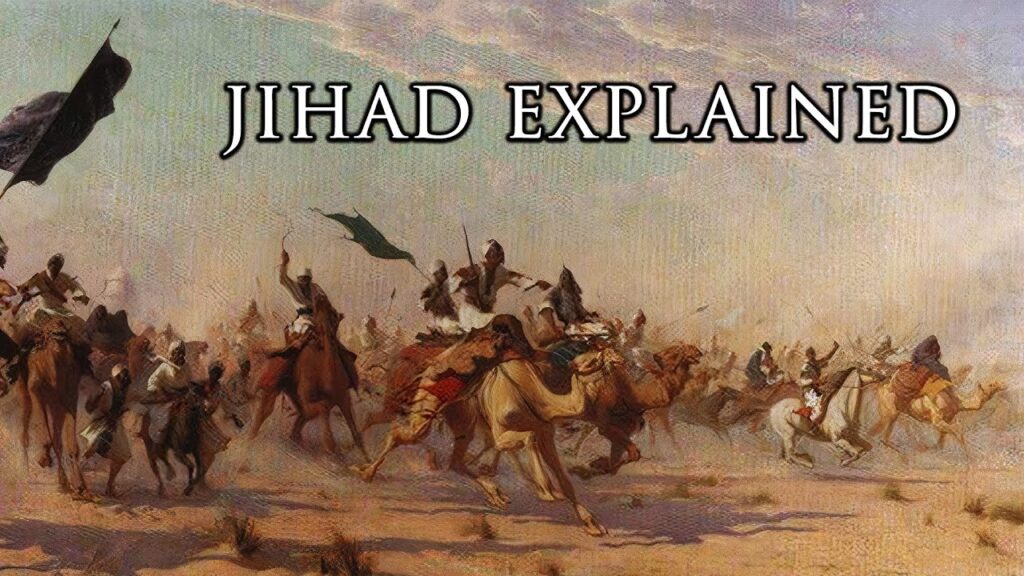
Jihad in Islam is a profound yet often misunderstood concept. Derived from the Arabic root “jahada,” meaning to strive, struggle, or exert effort, jihad encompasses a wide array of actions aimed at aligning one’s life with Allah’s will. Far from being synonymous with “holy war” or terrorism, as often misrepresented in the media, jihad in its authentic Islamic context includes personal spiritual growth, moral effort, da’wah (inviting to Islam), social justice, and, under strict conditions, defensive armed struggle.
This comprehensive guide merges authentic Islamic teachings from the Quran, Sahih Hadith collections, and scholarly works to explore jihad’s true meaning, its types, rules, and ethics, historical development, Quran verses, authentic Hadith quotes, misconceptions, scholarly views, women’s role, and modern interpretations. Whether you’re searching for “jihad meaning in Islam,” “types of jihad in Quran,” “Hadith on jihad,” or “rules of jihad in Islam,” this SEO-optimized article offers a balanced, evidence-based perspective drawing from sources like Sahih Bukhari, Sahih Muslim, Ibn Taymiyyah, Al-Ghazali, and contemporary fatwas.
Jihad is a force for peace, justice, and self-improvement. The Prophet Muhammad (peace be upon him) emphasized its multifaceted nature, prioritizing internal purification and ethical striving. This article clarifies jihad’s role in promoting balance, mercy, and justice for a global audience.
The True Meaning of Jihad in Islam: Beyond Misconceptions
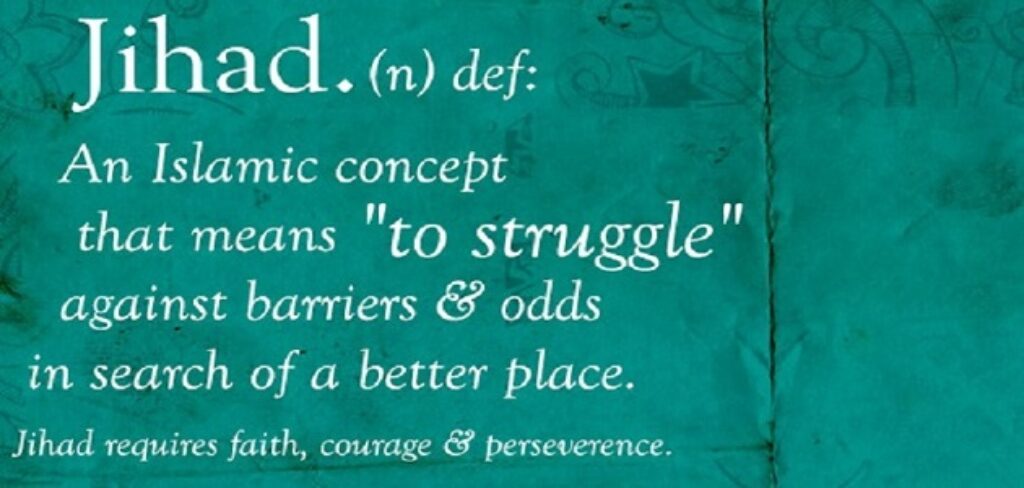
The word jihad translates to “striving” or “exerting effort” in Arabic. In Islamic theology, it refers to any struggle undertaken for Allah to uphold truth, establish justice, and purify the self. According to classical scholars like Ibn al-Qayyim in Madarij al-Salikin, jihad is not limited to military action but includes intellectual, spiritual, and social efforts to improve oneself and society.
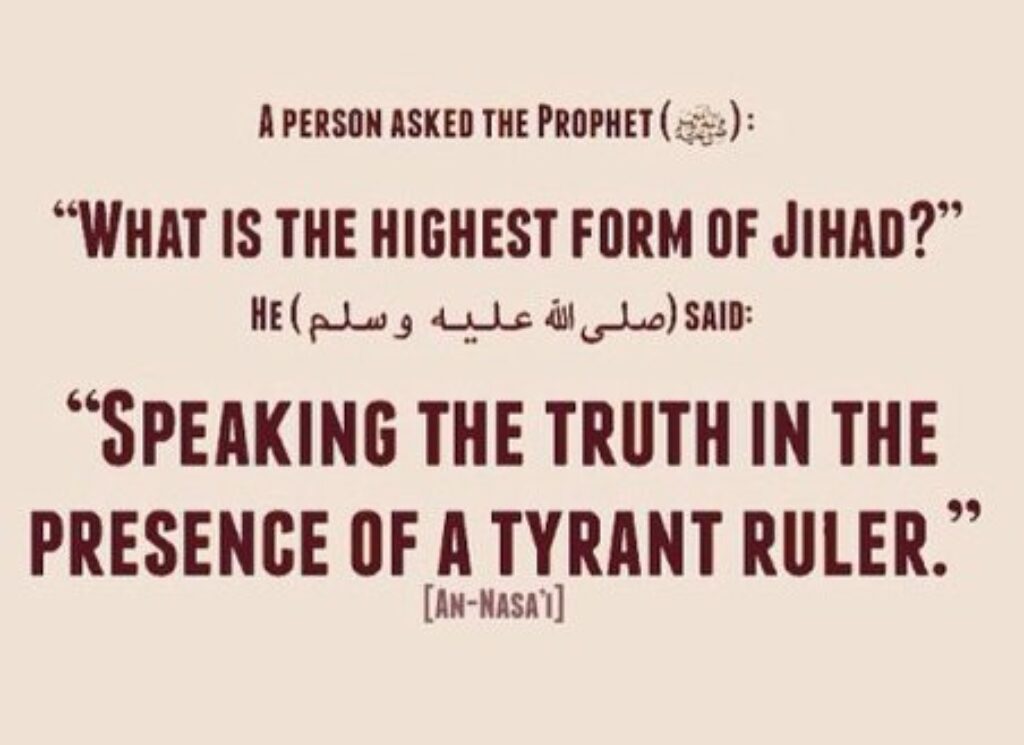
A common misconception is that jihad means “holy war” aimed at forced conversions or aggression. Authentic Islamic teachings emphasize that jihad is primarily ethical and, when involving combat, is defensive and governed by strict rules. The Prophet Muhammad (ﷺ) defined jihad in ways that prioritize non-violent striving. In a Hadith narrated in Sunan Abi Dawud (4344, graded Sahih), he said: “The best jihad is to speak a word of truth to a tyrant ruler.” This highlights jihad’s role in advocating justice, not violence.
Islam’s emphasis on peace is clear in the Quran: “There is no compulsion in religion” (Quran 2:256). Jihad cannot coerce belief, as faith must be voluntary. Scholars like Shaykh Abdul Aziz ibn Baz clarified that jihad’s goal is to remove barriers to religious freedom, not conquest for conquest’s sake. The Quran instructs Muslims to pursue peace: “But if they incline towards peace, then incline towards it [also]” (Quran 8:61).
The Prophet explained jihad in multiple dimensions: internal struggle (jihad al-nafs) against desires and sins; striving with words to promote truth; striving with wealth to support Islamic causes; and striving with arms only under legitimate authority and in defense. Jihad is thus a lifelong mission encompassing spiritual and social dimensions.
Historically, jihad emerged in response to the early Muslim community’s persecution in Mecca (610–622 CE). Initially, the Prophet was commanded to preach patiently without fighting (Quran 16:125: “Invite to the way of your Lord with wisdom and good instruction”). Only after migration to Medina and ongoing attacks from Meccan polytheists was defensive jihad permitted (Quran 22:39-40). This sets jihad as a last resort for self-defense and protecting religious freedom.
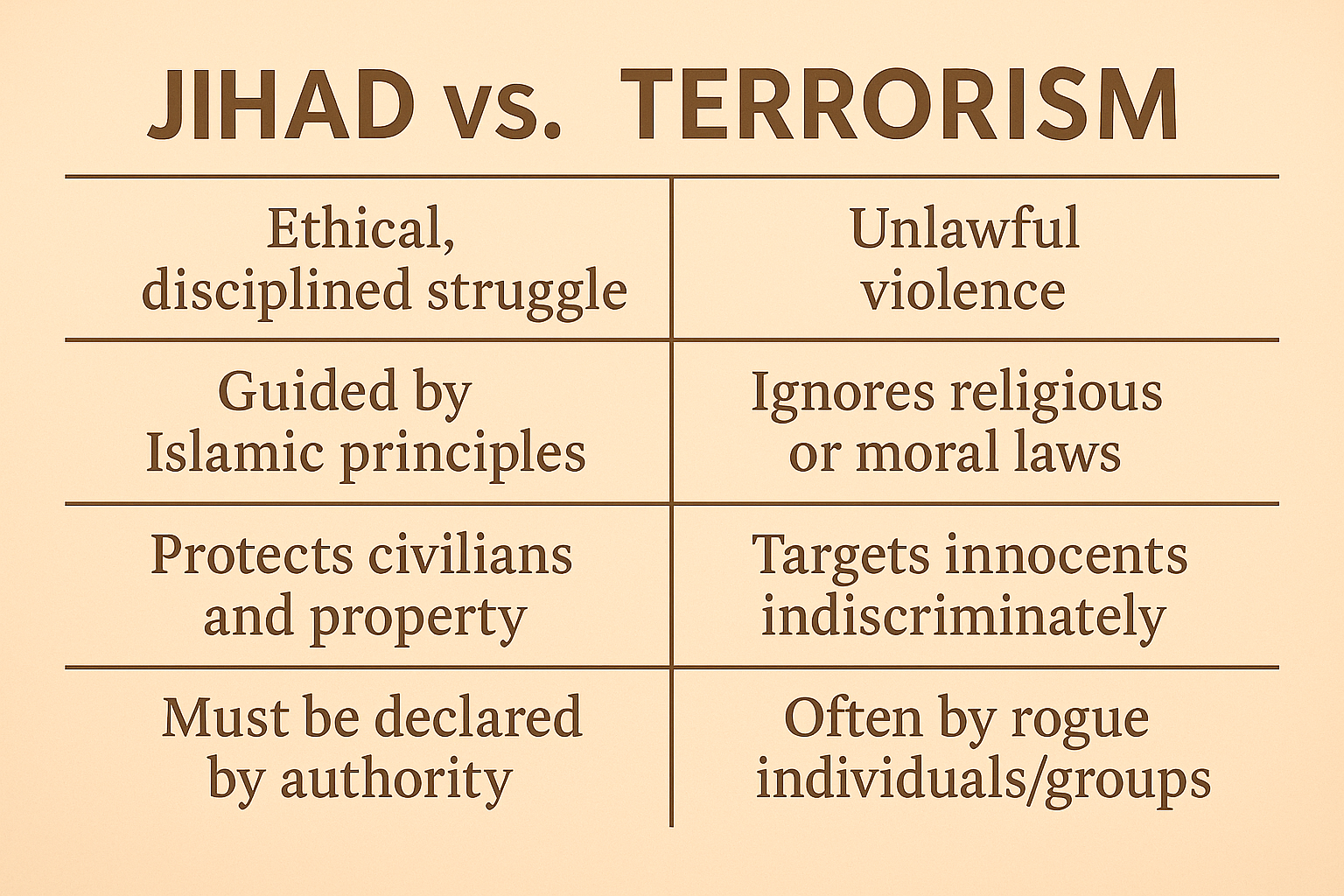
In modern times, extremist groups like ISIS have distorted jihad to justify terrorism, but mainstream scholars condemn this as un-Islamic. The International Islamic Fiqh Academy has reiterated that jihad must adhere to Sharia rules, prohibiting attacks on civilians. Understanding jihad’s true meaning combats Islamophobia and fosters interfaith dialogue.
Types of Jihad in Islam: Spiritual and External Striving
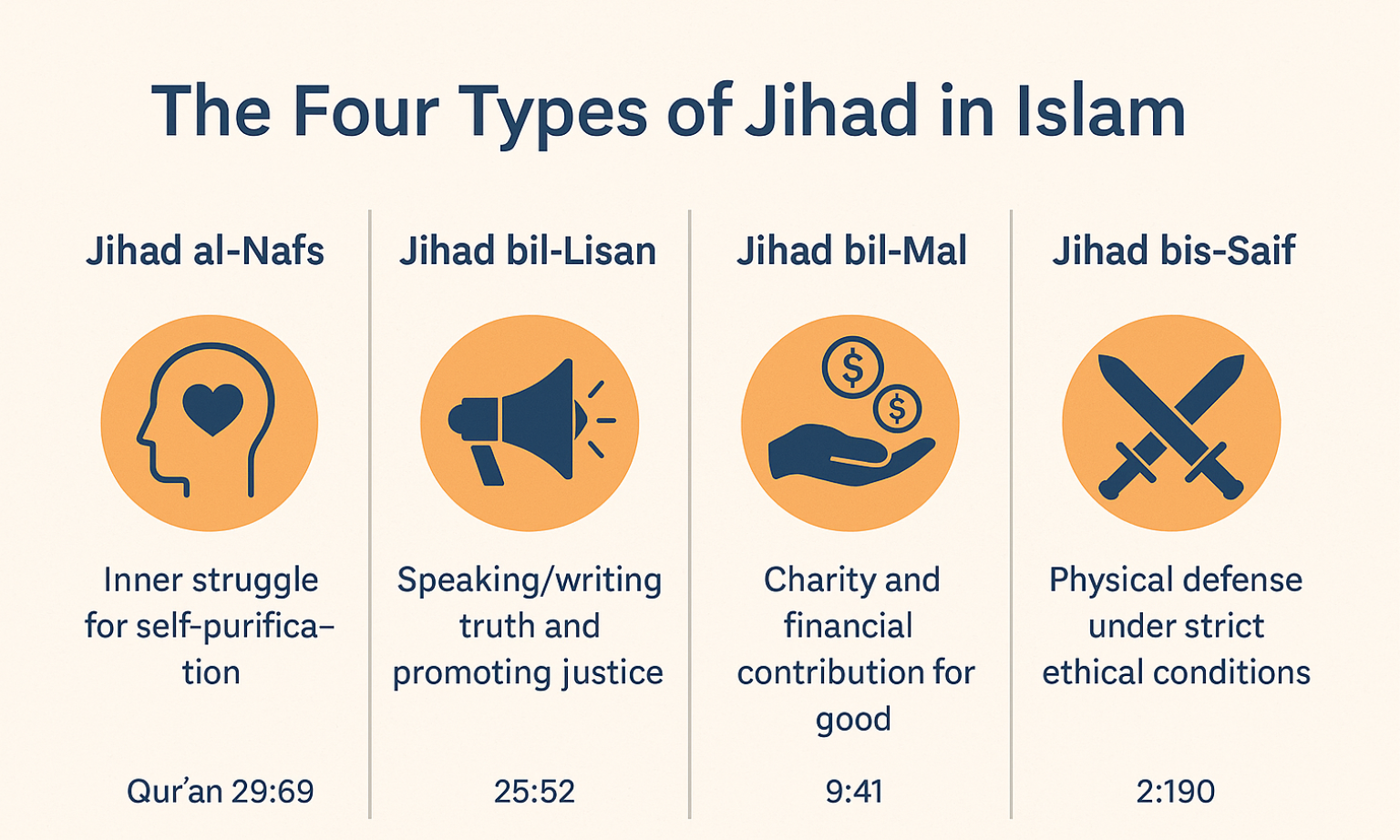
Islamic tradition classifies jihad into various forms, primarily distinguished by their focus on internal or external efforts. Scholars like Al-Ghazali in Ihya Ulum al-Din emphasize that striving against one’s lower self (nafs) is foundational, while external efforts range from preaching to, in rare cases, armed defense. The Quran and Hadith provide clear guidance on these types, ensuring ethical application.
1. Jihad Against the Self (Jihad al-Nafs)
The struggle against one’s lower desires, ego, and temptations (nafs) is a core, obligatory form of jihad for every Muslim. The Quran urges this inner purification: “And whoever strives only strives for [the benefit of] himself. Indeed, Allah is free from need of the worlds” (Quran 29:6). This jihad is considered paramount because it underpins all other forms of striving.
Sub-types include:
- Struggle Against Sins: Combating greed, anger, lust, and other vices. The Prophet said: “The mujahid is he who strives against his own soul in obedience to Allah” (Sunan Ibn Majah, Hadith 4197, graded Sahih).
- Struggle Against Satan (Jihad al-Shaytan): Resisting whispers of doubt and evil. Quran: “Indeed, Satan is an enemy to you; so take him as an enemy” (Quran 35:6).
- Daily Striving: Acts like seeking knowledge, maintaining patience, or fulfilling family duties. For example, serving parents is jihad: “Shall I participate in jihad?” The Prophet replied: “Are your parents living? Do jihad for their benefit” (Sahih Bukhari 5972).
This form of jihad is emphasized in Sufism, where scholars like Rumi viewed it as the path to divine love. Al-Ghazali argued that without conquering the self, external efforts lose meaning. In modern contexts, this aligns with self-improvement practices, relevant for Muslims facing stress, addiction, or moral dilemmas in modern times.
2. External Jihad
External jihad involves efforts to promote Islam and justice outwardly, subdivided into non-violent and violent forms.
a. Non-Violent External Jihad
- Jihad of the Tongue/Pen (Da’wah): Preaching Islam with wisdom. Quran: “Invite to the way of your Lord with wisdom and good instruction, and argue with them in a way that is best” (Quran 16:125). This includes writing, teaching, or advocating justice, as in the Hadith: “The best jihad is to speak a word of truth to a tyrant ruler” (Sunan Abi Dawud 4344, Sahih).
- Jihad with Wealth: Supporting Islamic causes financially, like charity or building mosques. Quran: “Go forth, whether light or heavy, and strive with your wealth and your lives in the cause of Allah” (Quran 9:41).
b. Violent External Jihad (Jihad al-Sayf)
This is the military form of jihad, further classified as:
- Defensive Jihad: Obligatory when Muslims are attacked or oppressed. Quran: “Fight in the way of Allah those who fight you but do not transgress” (Quran 2:190). This is fard ‘ayn (individual duty) if one’s homeland is invaded.
- Offensive Jihad: Historically, to remove barriers to da’wah or protect oppressed Muslims, but only under a legitimate authority and with strict ethical rules. Scholars like Ibn Taymiyyah in Majmu’ al-Fatawa argue it’s fard kifayah (collective duty) and must aim for justice, not conquest. In contemporary views, offensive jihad is rare and must comply with international law, as per the International Islamic Fiqh Academy.
The Prophet forbade harming non-combatants: “Do not kill women or children or non-combatants and do not destroy buildings or livestock” (Sahih Muslim 1744). Defensive jihad protects religious freedom for all: “If Allah did not check one set of people by means of another, monasteries, churches, synagogues, and mosques, wherein the name of Allah is mentioned much, would surely have been pulled down” (Quran 22:40).
Conditions for Armed Jihad:
- Must be declared by a legitimate ruler/state.
- Must be defensive or to protect the oppressed.
- Must not harm civilians, women, children, clergy, or the environment.
- Must cease if the enemy seeks peace.
Quran Verses on Jihad: Authentic Quotes and Explanations
The Quran mentions jihad or its derivatives approximately 41 times, mostly in the context of striving for Allah’s cause. Below are key verses with Sahih International translations and explanations, supported by Tafsir from scholars like Ibn Kathir and Al-Tabari:
- Defensive Nature: “Permission [to fight] has been given to those who are being fought, because they were wronged. And indeed, Allah is competent to give them victory. [They are] those who have been evicted from their homes without right – only because they say, ‘Our Lord is Allah'” (Quran 22:39-40). Revealed after the Hijrah, this verse permitted self-defense against Meccan persecution, emphasizing the protection of all places of worship.
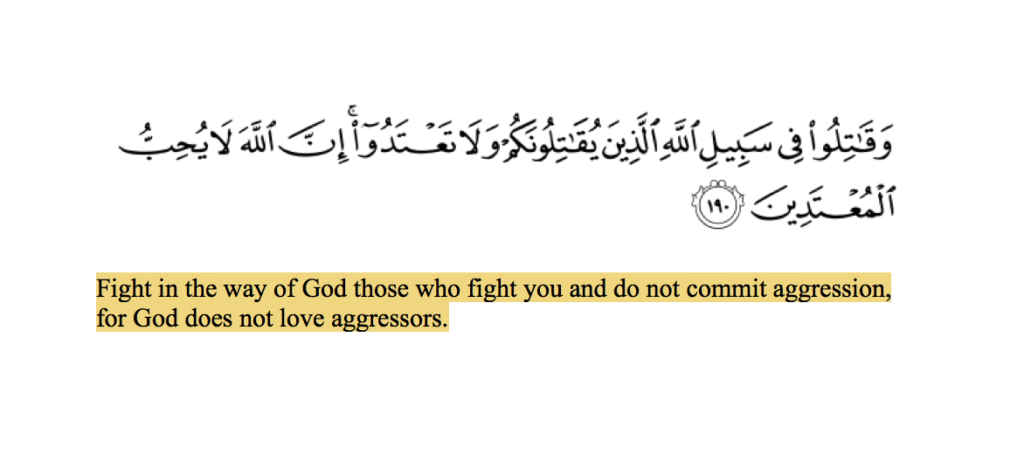
- No Aggression: “Fight in the way of Allah those who fight you but do not transgress. Indeed, Allah does not like transgressors” (Quran 2:190). Ibn Kathir’s Tafsir explains that “transgress” means avoiding harm to civilians, women, children, or property.
- Peace Preference: “But if they incline toward peace, then incline toward it [also]. And rely upon Allah; indeed, it is He who is the Hearing, the Knowing” (Quran 8:61). This verse from Surah Al-Anfal promotes de-escalation, even during conflict.
- Striving with Wealth and Self: “Go forth, whether light or heavy, and strive with your wealth and your lives in the cause of Allah. That is better for you, if you only knew” (Quran 9:41). This highlights non-violent jihad, like financial support.
- Inner Striving: “And those who strive for Us – We will surely guide them to Our ways. And indeed, Allah is with the doers of good” (Quran 29:69). This underscores jihad as seeking guidance and righteousness.
- Against Oppression: “And why do you not fight in the cause of Allah and [for] the oppressed among men, women, and children who say, ‘Our Lord, take us out of this city of oppressive people and appoint for us from Yourself a protector and appoint for us from Yourself a helper?'” (Quran 4:75). This justifies defensive jihad to liberate the oppressed.
- Striving Due to Allah: “And strive for Allah with the striving due to Him. He has chosen you and has not placed upon you in the religion any difficulty” (Quran 22:78). This emphasizes jihad as a balanced, purposeful effort.
These verses establish jihad’s ethical framework. Al-Tabari’s Tafsir notes that early jihad was defensive, evolving only as needed for protection. The Quran’s warnings against transgression ensure jihad remains just.
Hadith on Jihad: Authentic Quotes from Sahih Collections
The following Hadith, sourced from Sunnah.com, are all sahih (authentic) or hasan (good) to ensure reliability:
- Best Jihad: “The best jihad is to speak a word of truth to a tyrant ruler” (Sunan Abi Dawud 4344, graded Sahih). This promotes non-violent resistance against injustice.
- Jihad as Service: “Shall I participate in jihad?” The Prophet replied: “Are your parents living? Do jihad for their benefit” (Sahih Bukhari 5972). Serving parents is a form of jihad.
- Rules of War: “Do not kill women or children or non-combatants and do not destroy buildings or livestock” (Sahih Muslim 1744). This emphasizes humanitarian rules.
- Reward for Jihad: “The gates of Paradise are under the shades of the swords” (Sahih Muslim 1910). The context is defensive jihad under legitimate authority.
- Women in Jihad: “We consider jihad as the best deed. Should we not fight?” The Prophet: “The best jihad for women is Hajj mabrur” (Sahih Bukhari 1520, 2784).
- Intention in Jihad: “Whoever fights so that Allah’s word is superior is in the cause of Allah” (Sahih Bukhari 123). Intention must be pure.
- Striving Against the Self: “The mujahid is the one who strives against his own soul in obedience to Allah” (Sunan Ibn Majah 4197, graded Sahih).
These Hadith, from the most authentic collections (Sahih Bukhari, Sahih Muslim, Sunan Abi Dawud, Sunan Ibn Majah), illustrate jihad’s diversity. Imam Nawawi’s commentary on Sahih Muslim stresses that physical jihad requires legitimate authority and just cause.
Historical Development of Jihad in Islam
Jihad in the Prophet’s Era
- Meccan Period (610–622 CE): Jihad was non-violent, focusing on patience and da’wah despite persecution. The Quran instructed: “Invite to the way of your Lord with wisdom” (Quran 16:125).
- Medinan Period (622–632 CE): After migration to Medina and ongoing Meccan attacks, defensive jihad was permitted (Quran 22:39–40). Key battles like Badr (624 CE), Uhud (625 CE), and Khandaq (627 CE) were defensive responses to aggression. The Treaty of Hudaybiyyah (628 CE) prioritized peace over conflict.
After the Prophet (ﷺ)
- Abu Bakr (r. 632–634 CE): Fought the Ridda Wars to preserve Muslim unity against tribes rejecting zakat post-Prophet.
- Umar (r. 634–644 CE): Oversaw expansions into Persia and Byzantium, but ensured protection for non-Muslims via jizya (tax for religious freedom). Quran 9:29 allowed jizya, not forced conversion.
- Salahuddin Ayyubi (12th Century): Reclaimed Jerusalem during the Crusades with justice, sparing civilians, unlike the Crusader massacres.
Modern History
During the colonial era, jihad was invoked against European occupation (e.g., in India, Algeria). In the 20th century, extremist groups misused jihad for terrorism, condemned by mainstream scholars. The International Islamic Fiqh Academy and Al-Azhar have issued fatwas against such distortions, emphasizing jihad’s ethical boundaries.
Rules and Ethics of Jihad in Islam
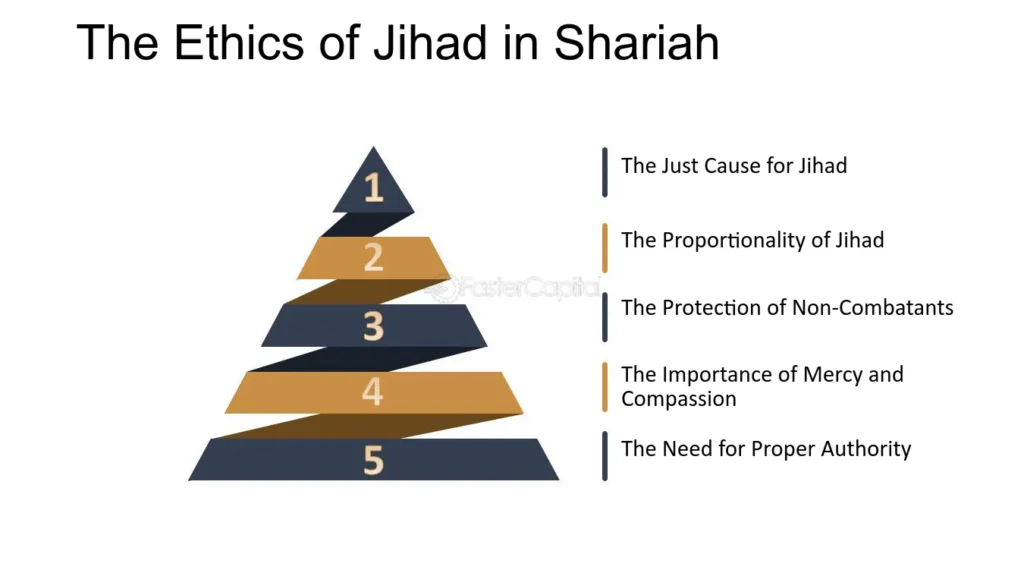
Islam sets strict regulations to prevent abuse of jihad:
- Legitimate Authority: Only a recognized state leader or caliph can declare jihad, not individuals or rogue groups (Ibn Taymiyyah, Al-Siyasa al-Shar’iyya).
- Right Intention: Must be for Allah’s sake, not politics, revenge, or personal gain (Sahih Bukhari 123).
- Just Cause: Defensive against aggression or to protect the oppressed (Quran 2:190, 4:75). Offensive jihad, historically to remove da’wah barriers, requires legitimate authority and minimal harm.
- Proportionality and Ethics: Prohibited actions include targeting civilians, women, children, clergy, or the environment (Sahih Muslim 1731, 1744). “Do not mutilate, do not be treacherous, do not kill children.”
- No Compulsion: “There is no compulsion in religion” (Quran 2:256). Captives must be treated kindly or ransomed (Quran 47:4).
- Fard Ayn vs. Kifayah: Defensive jihad is an individual duty (fard ‘ayn) during invasion; offensive is collective (fard kifayah).
The Amman Message (2004), endorsed by over 500 scholars, condemns terrorism as non-jihad, reinforcing these rules.
Women and Jihad in Islam
Women are generally exempt from armed jihad but participate in other forms:
- Hajj as Jihad: The Prophet said, “The best jihad for women is Hajj mabrur” (Sahih Bukhari 1520, 2784).
- Family and Patience: Raising families and enduring trials are forms of jihad (Sahih Bukhari 5972).
- Support Roles: Historical examples like Umm Ayman and Nusaybah bint Ka‘b show women supported defensive battles (e.g., providing water, nursing) during emergencies.
Misconceptions About Jihad: Debunking Myths
- Jihad = Terrorism ❌ False. Terrorism violates Quran 5:32: “Whoever kills a soul… it is as if he killed all mankind.”
- Jihad = Holy War ❌ Islam does not recognize “holy war.” Jihad means striving in Allah’s path.
- Jihad = Forced Conversions ❌ Quran: “There is no compulsion in religion” (2:256).
- All Muslims Must Fight ❌ Most jihad is non-violent (e.g., study, prayer, da’wah).
- Women Cannot Do Jihad ❌ Women’s jihad includes Hajj, family duties, and support roles.
- Jihad = Offensive Conquest for Empire ❌ Authentic jihad aims for justice, not land. Extremists like Sayyid Qutb’s “permanent revolution” are rejected by mainstream scholars.
Scholarly Views on Jihad
- Imam Al-Ghazali (Ihya Ulum al-Din): Emphasized jihad against the self as primary; physical jihad is secondary and conditional.
- Ibn Taymiyyah (Majmu’ al-Fatawa): Armed jihad is only defensive or to protect oppressed Muslims, requiring legitimate authority.
- Ibn al-Qayyim (Madarij al-Salikin): Jihad includes knowledge, speech, wealth, and, as a last resort, the sword.
- Modern Scholars (e.g., Yusuf al-Qaradawi, Amman Message): Condemn terrorism and misuse of jihad, advocating ethical striving.
- Critique of Extremism: Sayyid Qutb’s idea of perpetual jihad is rejected as un-Islamic by mainstream scholars like those in the Amman Message.
Jihad in the Modern World: Interpretations and Applications
In today’s world, jihad focuses on:
- Education and Da’wah: Organizations like CAIR promote “jihad against ignorance” through knowledge.
- Social Justice: Charity and advocacy for the oppressed align with Quran 4:75.
- Defensive Jihad: Applies to conflicts like Palestine but must follow Sharia rules (no civilians, legitimate authority).
- Integration and Counter-Extremism: Scholars like Tariq Ramadan advocate “jihad of integration” in the West, fostering ethical citizenship.
Jihad counters modern challenges like materialism, secularism, and digital distractions by:
- Grounding identity in Tawhid (oneness of Allah).
- Promoting ethical behavior in a globalized world.
- Encouraging mindfulness through Ihsan (excellence in worship).
Comparisons to just war theory show similarities: proportionality, last resort, and legitimate authority. Extremist misuse (e.g., by ISIS) has damaged jihad’s reputation, but true jihad remains a force for peace, justice, and self-improvement.
Jihad’s Role in Personal and Societal Development
Jihad against the self fosters self-discipline, enhancing mental health and moral integrity. External jihad promotes justice, as seen in historical anti-colonial struggles and modern advocacy for human rights.
Table: Comparison of Jihad Types
| Aspect | Jihad Against Self | External Jihad |
|---|---|---|
| Definition | Internal struggle against nafs | External effort for faith/justice |
| Obligation | Fard Ayn (individual) | Fard Kifayah (collective) |
| Examples | Overcoming sins, seeking knowledge | Da’wah, defensive war, charity |
| Quran Reference | 29:69 (striving for Allah) | 2:190 (fight those who fight) |
| Hadith | “Strive against your soul” (Ibn Majah 4197) | “Best jihad is Hajj for women” (Bukhari 1520) |
Conclusion: Embracing the True Spirit of Jihad
Jihad in Islam is a noble concept of striving for truth, justice, and self-purification. It encompasses spiritual growth, da’wah, social reform, and, in rare and legitimate cases, defensive armed struggle. When understood correctly, jihad reveals Islam’s vision of balance, mercy, and justice. Its misuse by extremists must be rejected, and its true meaning embraced as a path toward peace, discipline, and harmony with Allah.
References
- Quran (Sahih International translation).
- Sahih Bukhari, Sahih Muslim, Sunan Abi Dawud, Sunan Ibn Majah (Sunnah.com).
- Ihya Ulum al-Din (Al-Ghazali).
- Majmu’ al-Fatawa (Ibn Taymiyyah).
- Madarij al-Salikin (Ibn al-Qayyim).
- Tafsir Ibn Kathir, Tafsir Al-Tabari.
- Amman Message (2004).
- International Islamic Fiqh Academy resolutions.
- IslamQA.info and scholarly fatwas.
One Response
Very academic and clearly explained. Thanks a lot for such a good work!