

About Bid’ah, Sufyān ath-Thawrī (رحمه الله) said:
حَدَّثَنَا أَبُو بَكْرٍ مُحَمَّدُ بْنُ يَزِيدَ الْقَطَّانُ، قَالَ: حَدَّثَنَا عَبْدُ الْوَاحِدِ بْنُ أَيْمَنَ، عَنْ سُفْيَانَ الثَّوْرِيِّ قَالَ: «الْبِدَعُ أَحَبُّ إِلَى الشَّيْطَانِ مِنَ الْمَعَاصِي، فَإِنَّ الْمَعْصِيَةَ يُتُوبُ مِنْهَا، وَلَيْسَ يُتُوبُ مِنَ الْبِدْعَةِ غَالِبًا».
“Bidʿah is more beloved to Iblīs than sin. A sin is repented from, whereas the follower of bidʿah rarely repents — because he believes what he is doing is good.”– (Sharḥ Uṣūl Iʿtiqād Ahl as-Sunnah wa al-Jamāʿah by al-Lālikāʾī 1/125, no. 238; also in al-Iʿtiṣām by ash-Shāṭibī 1/37; Majmūʿ Fatāwā by Ibn Taymiyyah (3/66))
He also advised:
عَنْهُ قِيلَ: «تَمَسَّكْ بِالْقَدِيمِ، وَلَا تَتْبَعِ الْمُحْدَثَاتِ، فَإِنَّهَا إِلَى الْهَوَى تَسُوقُ».
“Hold fast to the original affair (al-amr al-qadīm) and do not innovate, for what you have is sufficient.”
– (Al-Ḥilyah al-Awliyāʾ wa Ṭabaqāt al-Aṣfiyāʾ by Abū Nuʿaym al-Iṣfahānī (d. 430 AH), volume 6, page 376 (in the biography of Sufyān ath-Thawrī); Siyar Aʿlām an-Nubalāʾ 8/287; Tadhkirat al-Ḥuffāẓ by al-Dhahabī (1/268))
In Islam, preserving the purity of the religion is of paramount importance. Bidʿah refers to the introduction of beliefs, acts of worship, or rituals that have no authentic foundation in the Qur’an, the established Sunnah, or the practice of the Salaf — the righteous early generations. The Prophet (ﷺ) warned with utmost severity:
“Every bidʿah is misguidance, and every misguidance is in the Fire.” (Sahih Muslim 867; Sunan an-Nasa’i 1578)
Allah Himself declared the religion complete and perfect:
“This day I have perfected for you your religion and completed My favour upon you and have chosen for you Islam as your religion.” (Qur’an 5:3)
This topic lies at the very heart of Islamic theology and jurisprudence. For fourteen centuries, the scholars of Ahl as-Sunnah wa al-Jamāʿah have meticulously defined, classified, and warned against bidʿah in order to safeguard the final, perfect message delivered by Muhammad (ﷺ).
This comprehensive article gathers clear evidence from the Qur’an, authentic Hadith, and the statements of the Companions and early Imams. It explains:
- The linguistic and sharʿī definition of bidʿah,
- The famous five-fold classification,
- The truth about the claim of “good bidʿah” (bidʿah ḥasanah),
- The detailed positions of the four madhhabs and major scholars,
- and practical guidance for every Muslim today.
May Allah guide us all to cling to the Qur’an and the authentic Sunnah exactly as the Salaf understood and practised them. Āmīn.
Islam: A Perfect and Complete Way of Life
The Qur’an unequivocally states that Islam is a complete religion, requiring no additions or alterations. Allah says:
“This day I have perfected your religion for you, completed My favor upon you, and have chosen for you Islam as your religion.” (Qur’an 5:3)
This verse confirms that the religion, as delivered by the Prophet Muhammad (peace be upon him), is comprehensive. The Prophet himself reinforced this, stating:
«مَا نَهَيْتُكُمْ عَنْهُ فَاجْتَنِبُوهُ، وَمَا أَمَرْتُكُمْ بِهِ فَافْعَلُوا مِنْهُ مَا اسْتَطَعْتُمْ، فَإِنَّمَا أَهْلَكَ الَّذِينَ مِنْ قَبْلِكُمْ كَثْرَةُ مَسَائِلِهِمْ وَاخْتِلَافُهُمْ عَلَى أَنْبِيَائِهِمْ»
“What I have forbidden you, avoid. What I have ordered you [to do], do as much of it as you can. For verily, those before you were destroyed by their excessive questioning and disputing with their Prophets.”
– Sahih al-Bukhari (Hadith no. 7288); Sahih Muslim (Hadith no. 1337)
The Qur’an further emphasizes its completeness:
“And We have revealed to you a Book explaining everything.” (Qur’an 16:89)
“We have neglected nothing in the Book.” (Qur’an 6:38)
These verses highlight that Islam encompasses all necessary guidance, from worship to daily etiquette, leaving no room for innovations.
The Importance of Adhering to the Sunnah
The Sunnah, the Prophet’s way of life, serves as the ultimate guide for Muslims. Allah says:
“Indeed, in the Messenger of Allah, you have an excellent example for anyone whose hope is in Allah and the Last Day.” (Qur’an 33:21)
“So if you obey him, then you will be guided.” (Qur’an 24:54)
The Prophet (peace be upon him) emphasized the importance of clinging to the preserver (The Ahle Bayt) of his Sunnah:
«إِنِّي تَارِكٌ فِيكُمْ ثَقَلَيْنِ: أَوَّلُهُمَا كِتَابُ اللَّهِ فِيهِ الْهُدَى وَالنُّورُ، فَخُذُوا بِكِتَابِ اللَّهِ وَاسْتَمْسِكُوا بِهِ… وَأَهْلُ بَيْتِي، أُذَكِّرُكُمُ اللَّهَ فِي أَهْلِ بَيْتِي…»
“I am leaving among you two weighty things: the first is the Book of Allah – in it is guidance and light, so hold fast to it… and my household. I remind you of Allah concerning my household…”
→ Ṣaḥīḥ Muslim (2408/a–b), from Zayd ibn Arqam.
The most prominent members of Ahl al-Bayt whom the Ummah actually followed for the Sunnah in the first three generations were:
- ‘Alī ibn Abī Ṭālib رضي الله عنه
- Ibn ‘Abbās رضي الله عنهما (the greatest mufassir)
- ‘Abdullāh ibn ‘Abbās’s students
- Zayn al-‘Ābidīn ‘Alī ibn al-Ḥusayn
- Imām Ja‘far aṣ-Ṣādiq (teacher of Imām Abū Ḥanīfah and Imām Mālik), etc.
All of these figures were absolute defenders of the Sunnah of the Prophet and the Ṣaḥābah. They never claimed that “following Ahl al-Bayt” means abandoning the Sunnah or the understanding of the Ṣaḥābah.
He also warned of future deviations:
«…وستكون اختلافاً كثيراً، فعليكم بسنتي وسنة الخلفاء الراشدين المهديين، تمسكوا بها وعضوا عليها بالنواجذ…»
“Al-‘Irbāḍ ibn Sāriyah (may Allah be pleased with him) said: “The Messenger of Allah ﷺ gave us a profound admonition from which hearts trembled and eyes wept. We said: ‘O Messenger of Allah, it is as if this is a farewell sermon, so advise us.’ He said: ‘I advise you to fear Allah, and to listen and obey [your leaders] even if an Abyssinian slave becomes your leader. Verily, whoever lives among you after me will see great disagreement, so cling to my Sunnah and the Sunnah of the Rightly-Guided Caliphs after me. Hold fast to it and bite onto it with your molar teeth. And beware of newly-invented matters, for every newly-invented matter is an innovation, and every innovation is misguidance.’”
“Sources:
- Sunan Abu Dawud — Book 42 (Kitāb as-Sunnah), Hadith 4607, graded Ṣaḥīḥ by Al-Albani
- Sunan at-Tirmidhī — Book 39 (Kitāb al-‘Ilm), Hadith 2676, graded Ḥasan Ṣaḥīḥ by Tirmidhī; also confirmed by Al-Albani, Ibn Taymiyyah
- Sunan Ibn Mājah — Muqaddimah, Hadith 42 & 43, graded Ṣaḥīḥ by Al-Albani
- Musnad Ahmad — Hadith 17144, 17145, 17163; chains strong and mutually supporting
- Sahih al-Bukhārī — Short excerpt present in the Book of al-I‘tiṣām bil-Kitāb was-Sunnah, Hadith 7350 (new numbering) / 7307 (old numbering), as part of chapter heading and commentary
Imam Az-Zuhri likened adhering to the Sunnah to boarding Noah’s Ark, stating:
“Clinging to the Sunnah is to be saved, as Imam Malik said, ‘like the Ark of Nuh,’ he who embarked upon it was saved, whereas he who did not was destroyed.”
– Sahih Mawquf; Sunan ad-Darimi (no. 98 – in the Muqaddimah) Also in Al-Lālikā’ī’s Sharḥ Uṣūl I‘tiqād Ahl as-Sunnah (no. 90), Ibn ‘Abd al-Barr’s Jāmi‘ Bayān al-‘Ilm (1/186), etc (Classified as Sahih by Imam Malik)
The Prophet also foretold that those who revive the Sunnah in times of corruption would be rewarded:
“«بَدَأَ الْإِسْلَامُ غَرِيبًا وَسَيَعُودُ غَرِيبًا كَمَا بَدَأَ، فَطُوبَى لِلْغُرَبَاءِ» قيل: يا رسول الله، ومن الغرباء؟ قال: «الَّذِينَ يُصْلِحُونَ إِذَا فَسَدَ النَّاسُ»
“Islam began as something strange, and it will return as something strange as it began, so Ṭūbā (a tree in Paradise or immense reward) is for the strangers.”
It was said: “Who are the strangers, O Messenger of Allah?” He replied: “Those who rectify matters when the people become corrupt.”
→ Ṣaḥīḥ Muslim (145), Ahmad (1/184–185), and others. The explanation “those who rectify when people become corrupt” is ṣaḥīḥ in several narrations.
Definition of Bidʻah (البدعة)

Linguistic meaning:
The Arabic word Bid‘ah (بِدْعَة) literally means “something newly invented” or “something without previous precedent” (derived from بَدَعَ – “to originate or invent”).
Shar‘ī (Islamic legal) meaning:
Bid‘ah is a newly-invented way in beliefs or actions in the religion, in imitation of the Shari‘ah, by which nearness to Allah is sought, but which has no authentic basis in the Qur’ān, the Sunnah, or the practice of the Prophet ﷺ and his Companions. (Definition of Imām ash-Shāṭibī in al-I‘tiṣām 1/231)
The Danger of Bidʻah
The Prophet ﷺ foretold the return of strangeness to Islam amid corruption of the Sunnah:
«بَدَأَ الْإِسْلَامُ غَرِيبًا وَسَيَعُودُ غَرِيبًا كَمَا بَدَأَ، فَطُوبَى لِلْغُرَبَاءِ»
“Islam began as something strange and will return as something strange as it began, so Ṭūbā for the strangers.”
When asked who they were, he replied:
«الَّذِينَ يُصْلِحُونَ إِذَا فَسَدَ النَّاسُ»
(“Those who rectify when the people become corrupt.”)
→ Ṣaḥīḥ Muslim (145), Tabaraanee, al-Kabeer 6/202.
The Prophet ﷺ repeatedly and severely warned against bid‘ah:
«وَإِيَّاكُمْ وَمُحْدَثَاتِ الْأُمُورِ، فَإِنَّ كُلَّ مُحْدَثَةٍ بِدْعَةٌ، وَكُلَّ بِدْعَةٍ ضَلَالَةٌ، وَكُلَّ ضَلَالَةٍ فِي النَّارِ»
“Beware of newly-invented matters, for every newly-invented matter is a bid‘ah, every bid‘ah is misguidance, and every misguidance is in the Fire.”
→ Reported by an-Nasā’ī (1578), Abu Dawud (4607, within the long hadith of al-‘Irbāḍ ibn Sāriyah), at-Tirmidhī, and others – Ṣaḥīḥ.
And:
«مَنْ أَحْدَثَ فِي أَمْرِنَا هَذَا مَا لَيْسَ مِنْهُ فَهُوَ رَدٌّ»
“Whoever introduces into our matter what is not from it, it will be rejected”
→ Ṣaḥīḥ Muslim 1718 – Grade: Saḥīḥ.
He also said:
«خَيْرُ الْكَلَامِ كَلَامُ اللَّهِ، وَخَيْرُ الْهَدْيِ هَدْيُ مُحَمَّدٍ، وَشَرُّ الْأُمُورِ مُحْدَثَاتُهَا»
“The best speech is the Speech of Allah, the best guidance is the guidance of Muhammad, and the worst of all affairs are the newly-invented matters”
→ Ṣaḥīḥ Muslim 867 – Grade: Saḥīḥ.
‘Abdullah ibn Mas‘ūd lamented future trials:
“How will it be when trials engulf you, people adopt innovations as Sunnah, and your speakers are many while your scholars are few?”
→ Sunan ad-Darimi, Muqaddimah no. 96 – ḥasan)
Allah condemns the introduction of such innovations in the religion:
أَمْ لَهُمْ شُرَكَاءُ شَرَعُوا لَهُمْ مِنَ الدِّينِ مَا لَمْ يَأْذَنْ بِهِ اللَّهُ
“Or do they have partners (with Allah) who legislate for them in the religion what Allah has not permitted?” (Qur’ān 42:21)
These authentic texts establish that any act of worship or religious practice introduced after the Prophet ﷺ that lacks a clear, authentic foundation in the Shari‘ah is a blameworthy bid‘ah, rejected by Allah and His Messenger ﷺ.
Qur’an and Hadith References About Bidah
Qur’an:
“Today I have perfected your religion for you…”
(Surah Al-Mā’idah 5:3 vn)
— This verse is often cited to argue that Islam is complete and does not require additions.
Hadith:
The Prophet ﷺ said:
“Whoever introduces into this matter of ours (i.e., Islam) something that is not from it, it is rejected.”
— [Sahih al-Bukhari 2697, Sahih Muslim 1718]
“…Every newly invented matter is a bidʻah, and every bidʻah is misguidance, and every misguidance is in the Fire.”
— [Sunan an-Nasā’ī 1578, Abu Dawud 4607]

Classification:
In a few words, Bid’ah is classified as –
- Bid’ah Hasana (Good Innovation): Aligns with Shariah, e.g., Quran compilation under Abu Bakr (RA), hadith collections.
- Bid’ah Sayyiah (Harmful Innovation): Contradicts Shariah, e.g., new rituals without evidence.
- Bid’ah in Fiqh: Religious (usually impermissible) vs. worldly (often permissible, e.g., online Islamic platforms).
Classification of Bidʻah According to Scholars

Scholars have disagreed over whether all bidʻah is evil or if some can be considered acceptable. Here’s how they classified it:
1. According to Classical Scholars (e.g., Imam Shāfiʻī and others):
Many scholars like Imam al-Shāfiʻī (d. 204H) made a distinction between the two types:
✅ Bidʻah Hasanah (Good Innovation):
- Innovations that do not contradict the Qur’an or Sunnah and bring benefit.
- Examples include compiling the Qur’an into a single book and using microphones in mosques.
❌ Bidʻah Sayyi’ah (Blameworthy Innovation):
- Innovations that contradict Islamic principles or change the method of worship.
2. According to Later Scholars (like Imam al-Izz ibn ‘Abd al-Salām):
He categorized bidʻah into five types based on the five legal rulings (al-aḥkām al-khamsa):
| Type of Bidʻah | Example | Ruling |
|---|---|---|
| Wājibah (Obligatory) | Learning Arabic grammar to understand the Qur’an | Wajib |
| Mustaḥabbah (Recommended) | Building Islamic schools, printing the Qur’an | Mustahabb |
| Mubāḥah (Permissible) | Using cars or loudspeakers for adhan | Permissible |
| Makrūhah (Disliked) | Decorating mosques extravagantly | Makruh |
| Muḥarramah (Prohibited) | Celebrating religious festivals not practiced by Salaf | Haram |
Imam al-Izz ibn ʿAbd al-Salām (d. 660H) — Qawāʿid al-Aḥkām fi Maṣāliḥ al-Anām
Prophet (sm)’s Companions on Bid’ah
1. Abdullah ibn ‘Umar
He refuted the concept of “Bid’ah Hasanah” (Good Innovation) in matters of creed and ritual worship.
“Every innovation is misguidance, even if the people regard it as good”
– Sunan ad-Darimi (94-96) and Al-Lalika’i in Sharh Usul I’tiqad (126).– ṣaḥīḥ.
2. Abdullah ibn ‘Abbas (ra)
«لَا تُجَالِسْ أَهْلَ الْأَهْوَاءِ؛ فَإِنَّ مُجَالَسَتَهُمْ مُمْرِضَةٌ لِلْقُلُوبِ»
“Do not sit with the people of Desires (Innovation), for surely their sittings are a sickness for the hearts”
– Sahih; Recorded in Al-Ajurri’s Kitab ash-Shari’ah (65) and Al-Lalika’i (1/135).
Note: The term “People of Desires” (Ahl al-Ahwa) was the standard term used by the Salaf for innovators.
3. Mu‘adh ibn Jabal (ra)
«…وَإِيَّاكُمْ وَمَا يُبْتَدَعُ، فَإِنَّ مَا ابْتُدِعَ ضَلَالَةٌ»
“…and I warn you of what is innovated, for all that is innovated is misguidance”
– Sahih; This is part of a longer, famous khutbah recorded in Kitab ash-Shari’ah (97) and Abu Dawud (4611).
Context: Mu’adh (ra) gave this advice toward the end of his life, warning that after him, there would be people who speak “with the tongue of a wise man but hearts of devils.”
4. Abdullah ibn Mas‘ūd (ra)
«اتَّبِعُوا، وَلَا تَبْتَدِعُوا فَقَدْ كُفِيتُمْ، كُلُّ بِدْعَةٍ ضَلَالَةٌ»
“Follow the Sunnah of Muhammad and do not innovate, for what you have been commanded is enough for you”
– Sahih; Recorded in Sunan ad-Darimi (95) and Musannaf Abdur Razzaq (20430).
Context: Mu’adh (ra) gave this advice toward the end of his life, warning that after him, there would be people who speak “with the tongue of a wise man but hearts of devils.”
Statements from Later Scholars (Tabi’un & Imams)
A. Imam Abu Hanifa (d. 150H)
Imām Abū Ḥanīfah (رحمه الله), the founder of the Ḥanafī school, was among the earliest of the four Imams. Although his surviving works are limited, his views are preserved by his closest students, such as Abū Yūsuf and Muḥammad ibn al-Ḥasan al-Shaybānī, among others.
He was strongly opposed to innovation in religion, particularly in matters of ʿaqīdah (belief) and ʿibādah (worship).
1. Condemnation of Bidʻah in Strong Terms
Imām Abū Ḥanīfah reportedly said:
“Adhere to the narrations and the path of the Salaf, and beware of newly invented matters, for all of it is innovation.”
Ibn ʿAbd al-Barr records from him:
“Hold fast to the narrations and the way of the Salaf. Beware of every newly invented matter, for it is an innovation.”
— Jāmiʿ Bayān al-ʿIlm, 2/94.
📗 Sources:
- Al-Kawtharī, Ta’nīb al-Khaṭīb, p. 47
- As‑Suyuti in Sawn al‑Mantiq wa‑al‑Kalam, p. 32
- Ibn ʿAbd al-Barr, Jāmiʿ Bayān al-ʿIlm, vol. 2, p. 94
2. Strong Warning Against Ahl al-Bidʻah
He warned against even discussing matters of religion with innovators:
“«اعلم أن العلماء والورعين أولى بالاجتماع بهم، وأهل الكلام الفاسد والبدع يجب الاجتناب عن مجالستهم»
“Know that it is better to sit with scholars and pious people, and one must avoid sitting with those whose speech contains falsehood or innovations.”
📗 Sources:
- Dār al-Kutub al-Waṭaniyyah, Riyadh – No. 2345
- Maktabat al-Awqāf, Baghdad – No. 876
And Abu Yusuf reported that Imam Abu Hanifah said:
“Whoever seeks knowledge through kalām (speculative theology) will become a zindiq (heretic); and whoever pursues the strange opinions of scholars will depart from Islam; and whoever studies books of ra’y (personal opinion without textual evidence) will deviate.”
📗 Source:
- Dar Ibn al-Jawzī 1998, Manāqib Abī Ḥanīfah
Note: Ilmul Kalam is the rational and philosophical study of Islamic theology or creed, which integrates the Quran, Hadith, Greek philosophy, and logic to discuss topics like the nature of Allah, prophethood, the afterlife, and predestination. Originating during the Abbasid era through Mu’tazila, Ash’ari, and Maturidi schools, it explains, establishes, and defends Islamic beliefs against skeptics, though Salafis (scholars of the first three generations) criticize its excessive philosophical approach.
For more details, read: Ilmul Kalam: Rational and Philosophical Insights into Islamic Theology.
3. Imām Abū Ḥanīfah on Ilm al-Kalām (Theological Speculation)
Imām Abū Ḥanīfah repented from theological speculation after witnessing its harm. He emphasized submission to the Quran and Sunnah through knowledge and action — not debate. This mirrors the Sahaba’s unity in minor fiqh differences while avoiding fitnah (Sahih al-Bukhari 7352).
He was extremely critical of Ilm al-Kalām, which many innovators, such as the Jahmiyyah, Muʿtazilah, and others, used.
كنت أتكلم بالكلام حتى صرت أُشار إليَّ بالأصابع ونحن جلوس عند حلقة حماد بن أبي سليمان، فلما رأيت ذلك تركت الكلام وأقبلت على الفقه والحديث“
I used to engage in Kalām until people would point at me while sitting near Hammād ibn Abī Sulaymān’s circle. When I saw that, I abandoned Kalām and turned to fiqh and hadith.”
📗 Source:
- Manāqib al-Imām Abū Ḥanīfah by Imām al-Makkī, Volume 1, Page 54.
- Al-Ibānah al-Kubra by Ibn Battah al-‘Ukbari (d. 387 H)
Context: Imām Abū Ḥanīfah describes his early engagement with ‘Ilm al-Kalām (Islamic theology) in Kufa, debating groups like the Qadarites and Mu’tazilah, before focusing on Fiqh under Hammād ibn Abī Sulaymān. This reflects his initial expertise in theological argumentation (‘Ilm al-Jadl).
4. On Avoiding Argumentation in Religious Matters
Imām Abū Ḥanīfah (may Allah be pleased with him) used to dislike speaking about religion without knowledge, and he would say:
وكان أبو حنيفة رضي الله عنه يكره الكلام في الدين بغير علم، ويقول: من تكلم في الدين بغير علم فقد هلك» ويقول: «الجدال في الدين يفسد اليقين»
‘Whoever speaks about religion without knowledge has perished.’
He also said:
‘Argumentation in religion corrupts certainty.’”
Reference: Sharḥ al-Fiqh al-Akbar by Mullā ‘Alī al-Qārī (p. 112); Edition: Dar al-Kutub al-‘Ilmiyyah, Beirut, 2008
Context: Imām Abū Ḥanīfah cautions against excessive theological debates (‘Ilm al-Kalām), emphasizing adherence to the Quran and Sunnah, reflecting the Sahaba’s unity in minor fiqh differences (e.g., Sahih al-Bukhari 7352).
5. Views on Specific Groups of Innovators
About Jahmiyyah:
«الجهمية أشر من اليهود والنصارى»
“The Jahmiyyah are worse than the Jews and Christians.”
Source: Siyar Aʿlām al-Nubalāʾ by Al-Dhahabi (Vol. 6, p. 390, Biography of Abu Hanifah)
Context: Abu Hanifah said this in condemnation of the Jahmiyyah (followers of Jahm ibn Safwan, who denied Allah’s attributes). Al-Dhahabi confirms it’s from reliable narrators like Abu Muʿawiyah al-Darir (thiqah). Also referenced in Sharḥ al-Fiqh al-Akbar by Mullā ʿAlī al-Qārī (p. 89, indirect via creed discussion). Ibn Taymiyyah accepts it in Majmuʿ al-Fatāwā (3/227). Scholars’ Consensus: Accepted as sahih by Al-Dhahabi, Ibn Kathir, and modern Salafis (e.g., Albani)
About Qadariyyah:
«القدرية مجوس هذه الأمة»
“The Qadariyyah are the Magians of this Ummah.” (Narrated from Ibn ʿUmar رضي الله عنهما).
Source: Hadith in Sunan Abu Dawud (Hadith 4072/4961 – Sahih per Albani in Silsilah Sahihah 2440)
Context: Abu Hanifah applied this prophetic label to the Qadariyyah (deniers of predestination) in his creed. Referenced in Sharḥ al-Fiqh al-Akbar by Mullā ʿAlī al-Qārī (p. 112, Section on Qadar) as part of Abu Hanifah’s refutation. Al-Dhahabi (Siyar, 6/392) notes Abu Hanifah’s strong opposition to them. Scholars’ Consensus: Hadith graded sahih; Abu Hanifah’s usage accepted (e.g., Ibn Taymiyyah, Majmuʿ al-Fatāwā 8/135).
Note: Note that there is no connection between
🔹 Qadariyyah (heretical sect denying Qadar)
and
🔹 Qādiriyyah (Sunni Sufi order following Abdul Qadir Jilani)
About Murjiʾah:
«كان أبو حنيفة من المرجئة الفقهاء، وهم يقولون الإيمان قول وعمل، ويزيد وينقص»
“Abu Hanifah was from the Murjiʾah of the Jurists; they say faith is speech and action, which increases and decreases.
Context: Abu Hanifah opposed extreme Murjiʾah (who said sins don’t affect faith at all) but held īmān (faith) is verbal confession + actions (increases/decreases). Critics (Muʿtazilah/Khawarij) falsely labeled him a Murjiʾ due to his anti-takfir stance. Al-Shahrastani (Al-Milal wa al-Nihal, p. 128) clarifies it’s “Murjiʾah of Fiqh” (moderate). Scholars’ Consensus: Al-Dhahabi, Ibn Kathir, and Laknawi (Al-Rafʿ wa al-Takmil, p. 169) affirm he rejected extremes; false assumption from semantic fiqh differences.
About Rafidah:
«الرافضة كفار، وسب الصحابة كفر» (paraphrased from narrations).
“The Rafidah are disbelievers, and cursing the Sahabah is disbelief.”
Source: Siyar Aʿlām al-Nubalāʾ by Al-Dhahabi (Vol. 6, p. 391–393)
Context: Abu Hanifah condemned Rafidah (extreme Shiʿah) for cursing Sahabah like Abu Bakr/ʿUmar. Al-Dhahabi reports he said: “Whoever curses the Sahabah is a kafir” (via chain from Abu Muʿawiyah). Similar in Manaqib Abi Hanifah (p. 45). Scholars’ Consensus: Accepted as authentic by Al-Dhahabi; Ibn Taymiyyah (Minhaj al-Sunnah, 4/137) echoes it.
In Summary:
He explicitly declared certain sects as deviant and dangerous:
| Group/Sect | Imām Abū Ḥanīfah’s Stance |
|---|---|
| Jahmiyyah | “Worse than Jews and Christians” — denied Allah’s attributes |
| Qadariyyah | “They are the Magians (Zoroastrians) of this Ummah” |
| Murji’ah | Opposed them, though some claimed he sympathized with them |
| Rāfiḍah (Shia) | Harshly criticized their cursing of the Companions |
6. On Mixing with Ahl al-Bidʻah
Like other Imams, Imām Abū Ḥanīfah discouraged associating with the people of innovation, considering their company corrupting.
a. Explicit Mention of “Ahl al-Bidʿah” and Warning to Report Their Innovations
“أَدْخَلْ عَلَيْكَ أَهْلُ الْبِدَعِ شَيْئًا فَأَعْلِمْنِي أَجِبْكَ فِيهِ إِنْ شَاءَ اللَّهُ تَعَالَى، ثُمَّ الْآنَ أَلُوكَ بِطَاعَتِهِ.”
“If the people of bidʿah (Ahl al-Bidʿah) introduce something to you, inform me [so] I may respond to you in it, if Allah wills. Then, I entrust you to His obedience.”
Source: Abū Ḥanīfah’s Letter to ʿUthmān al-Baṭṭī (appended to Al-Fiqh al-Akbar in most editions; this is a direct epistle where he instructs on creed).
Page Reference: Approx. p. 20 in the PDF edition (letter’s opening; full text spans pp. 20-25).
Proof of Authenticity: Transmitted via reliable chains (isnād) like Abū Muṭīʿ al-Balkhī → Abū Ḥanīfah; affirmed in Al-Fiqh al-Absaṭ (another attributed work) and commentaries like al-Taftāzānī’s (Sharḥ al-ʿAqāʾid, d. 793 AH).
Context: Abū Ḥanīfah writes to al-Baṭṭī (d. ~130 AH), a student, urging vigilance against innovators who might infiltrate discussions on faith (īmān), predestination (qadar), or divine attributes. He positions himself as a guardian of the Sunnah, advising immediate reporting to counter their influence—implying avoidance of unsupervised mixing to prevent corruption of creed. This aligns with Salaf warnings (e.g., Sunan Abū Dāwūd 4833) about innovators leading to the Fire.
b. Condemnation of Innovations (Bidʿah and Muḥdath) as Deviations from Sunnah and Community
وَأَمَّا مَا سِوَى ذَلِكَ فَمُبْتَدَعٌ وَمُحْدَثٌ، فَإِنْ كَتَبُوهُ لِي إِلَيْكَ، فَاحْذَرْ رَأْيَكَ عَلَى نَفْسِكَ، وَاتَّقِ أَنْ يَدْخُلَ الشَّيْطَانُ عَلَيْكَ، عَصَمَنَا اللَّهُ وَإِيَّاكَ بِطَاعَتِهِ.
“And whatever besides that [i.e., Quran, Sunnah, and Companion consensus] is innovated (mubtadaʿ) and newly invented (muḥdath). If they write it to me on your behalf, then beware of your own opinion upon yourself, and fear that Satan may enter upon you. May Allah protect us and you by His obedience.“
Source: Al-Fiqh al-Akbar (core text, Point on Obligations and Creed).
Page Reference: Approx. p. 22 (within the letter integrated into the main text).
Proof of Authenticity: Core riwāyah (transmission) of Ḥammād ibn Abī Ḥanīfah (his son); cross-verified in Jāmiʿ al-Masānīd by ʿAbd al-Laṭīf ibn ʿAbd al-Raḥmān (d. 1232 AH).
Context: In a section refuting sects like the Qadariyyah (who innovate by denying divine decree), Abū Ḥanīfah declares that all deviations from the Prophet’s way and community practice are bidʿah, urging fear of satanic influence through such mixing. This echoes the claim’s spirit of “holding fast to the Sunnah and community” while “beware” of innovators, as it ties innovation directly to misguidance (ḍalāl)
c. Warning Against Innovators Causing Division in the Community
“وَقَدْ عَلِمْنَا أَنَّ رَسُولَ اللَّهِ صَلَّى اللَّهُ عَلَيْهِ وَسَلَّمَ لَمْ يَكُنْ لِيَفْسِرَ الْآيَةَ الْوَاحِدَةَ عَلَى نَوْعَيْنِ… فَوَيْحٌ لَهُمْ مَا أَقَلَّ هَتْمَامَهُمْ بِأَمْرِ عَاقِبَتِهِمْ حَيْثُ يَنْتَصِبُونَ لِلنَّاسِ فَيُحَدِّثُونَهُمْ بِمَا قَدْ عَلِمُوا أَنَّ بَعْضَهُ مُنْسُوخٌ، وَالْعَمَلُ بِالْمُنْسُوخِ الْيَوْمَ ضَلَالَةٌ.”
“We know that the Messenger of Allah (peace be upon him) would not interpret a single verse in two ways… Woe to them! How little they consider the consequence of their affair, as they set themselves up for the people and narrate to them what they know is partially abrogated, and acting upon the abrogated today is misguidance (ḍalālah).”
Source: Al-ʿĀlim wa al-Mutaʿallim (Dialogue on Creed, often bundled with Al-Fiqh al-Akbar as an early Hanafi primer)
Page Reference: Approx. pp. 10-12 (dialogue on sects and narrations).
Proof of Authenticity: Attributed via Abū Muqātil al-Samarqandī → Abū Ḥanīfah; referenced in Al-ʿĀqīdah al-Ṭaḥāwiyyah (d. 321 AH) as aligning with Hanafi creed.
Context: Abū Ḥanīfah critiques innovators who fabricate abrogations (naskh) in hadiths to justify new opinions, causing schism (furqah) in the ummah. He stresses the Prophet’s mission was unity via Sunnah, implying believers must avoid such divisive company to maintain jamāʿah (community).
7. Caution: Confusion over Bidʻah Ḥasanah
Some later Ḥanafīs (centuries after Abū Ḥanīfah) categorized “bidʻah” into 5 types (wājib, mandūb, mubāḥ, makrūh, ḥarām) — based on al-ʿIzz ibn ʿAbd al-Salām and others.
(See: Qawāʿid al-Aḥkām 2/204–205; also quoted approvingly by al-Nawawī, Ibn Ḥajar al-ʿAsqalānī, al-Shāṭibī, and many later Ḥanafīs such as Ibn ʿĀbidīn in Radd al-Muḥtār 4/172).
But there is no evidence that Abū Ḥanīfah himself accepted bidʿah ḥasanah in acts of worship. His core methodology was Salaf-based, i.e., following the Qur’an, Sunnah, and practice of the Ṣaḥābah.
Imam Abu Hanifah said,
“الْزَمُوا الْأَثَرَ وَطَرِيقَةَ السَّلَفِ وَإِيَّاكُمْ وَكُلَّ مُحْدَثَةٍ فَإِنَّ كُلَّ مُحْدَثَةٍ بِدْعَةٌ”
“Hold fast to the narrations (athar) and the way of the Salaf, and beware of every newly invented matter, for every newly invented matter is a bidʿah.”
References: Taʾnīb al-Khaṭīb by al-Kawtharī, p. 47; Sawn al-Manṭiq wa al-Kalām by al-Suyūṭī, p. 32; Quoted by Ibn ʿAbd al-Barr in Jāmiʿ Bayān al-ʿIlm 2/114 with a slightly different chain)
In Al-Fiqh al-Akbar itself (the short creed text):
“لَا نَقُولُ فِي دِينِ اللَّهِ إِلَّا بِمَا قَالَ اللَّهُ وَرَسُولُهُ وَأَجْمَعَتْ عَلَيْهِ الصَّحَابَةُ”
“We do not say anything concerning the religion of Allah except what Allah and His Messenger said and upon which the Companions reached consensus.”
(Standard printed editions, opening paragraphs)
In summary, Imām Abū Ḥanīfah’s Stance on Bid’ah
| Topic | His Position |
|---|---|
| Innovation in ʿaqīdah or worship | ❌ Strictly prohibited |
| Bidʻah ḥasanah in rituals | ❌ No record of approval |
| Mixing with Ahl al-Bidʿah | ❌ Strongly discouraged |
| Debating innovators or engaging them | ❌ Considered harmful and misleading |
| Ilm al-Kalām and speculative theology | ❌ Condemned, even if done by those claiming Sunnah |
| Legitimate fiqh disagreements | ✅ Recognized as valid ijtihād, not bidʿah |
| Following Salaf | ✅ Emphasized Qur’an, Sunnah, and the Companions’ way |
B. Imam Mālik ibn Anas (d. 179H)
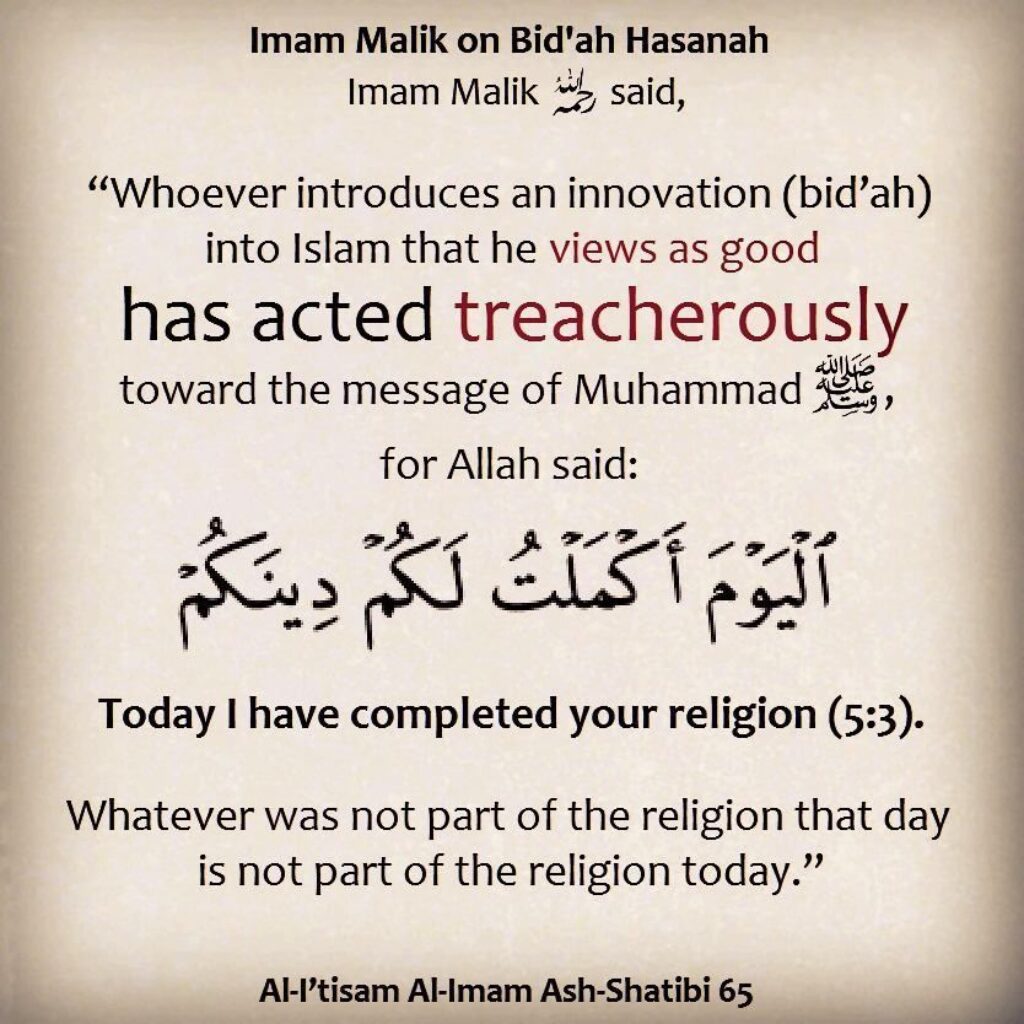
Imām Mālik (رحمه الله), the founder of the Mālikī madhhab and one of the greatest scholars of the Tabiʿ al-Tābiʿīn generation, was extremely cautious and strict in matters of religion, especially regarding introducing anything new into the dīn.
1. Opposition to Religious Bidʿah: Transmitted Saying on the Danger of Innovation in Worship
Imam Mālik strongly opposed innovations in religious practice (bidʿah in worship), emphasizing adherence to the practices of the Ṣaḥābah. A transmitted saying of his illustrates this principle:
“مَنْ أَحْدَثَ فِي الْإِسْلَامِ حَدَثًا يَرَاهُ حَسَنًا فَقَدْ بَتَرَ مُحَمَّدًا صَلَّى اللَّهُ عَلَيْهِ وَسَلَّمَ أَنْ يُبَلِّغَ رِسَالَةَ رَبِّهِ قَالَ اللَّهُ تَعَالَى: {الْيَوْمَ أَكْمَلْتُ لَكُمْ دِينَكُمْ} فَمَا كَانَ مِنَ الدِّينِ يَوْمَئِذٍ فَلَيْسَ مِنَ الدِّينِ الْيَوْمَ.”
“Whoever innovates something in Islam, and sees it as good, has claimed that Muhammad ﷺ betrayed the Message as Allah the Exalted said:
This day have I perfected for you your religion. [Surah al-Maaidah (5): 3]
And whatsoever was not part of the religion then, is not part of the religion today.”
This is the core quote, emphasizing that new religious acts imply the imperfection of the religion. While not verbatim in Al-Muwaṭṭaʾ, it aligns with Mālik’s repeated warnings against unsubstantiated practices (e.g., in prayer rituals).
Sources:
- Citations by Ibn al-Jawzī & Ibn Taymiyyah: Ibn al-Jawzī in Talbīs Iblīs (p. 15, variant); Ibn Taymiyyah in Majmūʿ al-Fatāwā (vol. 3, p. 265 and & 18/346) and Iqtidaʾ al-Ṣirāṭ (vol. 2, p. 90).
- Transmitted via Ibn al-Qāsim: Confirmed in Al-Mudawwanah al-Kubrā (Dār al-Kutub al-ʿIlmiyyah ed., vol. 1, pp. 69-70, 2004, under prayer innovations; discusses rejecting new supplications).
- Al-Iʿtiṣām: Elaborated in Al-Iʿtiṣām by al-Shāṭibī, vol. 1, pp. 140–141 (Dār Ibn ʿAffān, 1992) & p. 64 (Dār al-Faḍīlah ed.). Used to refute bidʿah ḥasanah.
- Sunan al-Kubrā by al-Bayhaqī, vol. 10, p. 249, ḥadīth 20492 (chain: Ibn Wahb ← Mālik)
- Majmūʿ al-Fatāwā by Ibn Taymiyyah, 3/265
Corroboration in Al-Muwaṭṭaʾ: Mālik narrates the prophetic warning against bidʿah in Book 18 (Prayer in Ramadan, Hadith 56):
“إِيَّاكُمْ وَمَا اخْتُرِعَ مِنَ الْأَمْرِ فَإِنَّ كُلَّ مُحْدَثَةٍ بِدْعَةٌ وَكُلَّ بِدْعَةٍ ضَلَالَةٌ.”
Translation: “Beware of newly invented matters [in the religion], for verily every bidʿah (innovation) is misguidance.” (This is part of the farewell sermon narration, emphasizing clinging to Sunnah.)
Context: Mālik includes this to stress that Ramadan prayers must follow early Madinan practice, rejecting later additions.
2. Mālik’s Usūl (Methodological Priorities) – Exact Order He Used
Imām Mālik’s methodology was:
- The Book of Allah
- The Sunnah of the Messenger ﷺ (especially mutawātir and mashhūr)
- ʿAmal ahl al-Madīnah (the living practice of Madīnah) – he regarded it as stronger than solitary ḥadīths
- Ijmāʿ of the Ṣaḥābah
- Statements of individual Ṣaḥābah
- Qiyās, istiḥsān, and maṣlaḥah mursalah (only when the above are silent)
Source: His letter to al-Layth ibn Saʿd (full text preserved in Tarqīb al-Madārik by al-Qāḍī ʿIyāḍ, vol. 1, pp. 10–12).
3. Judging Acts by What the Salaf Did
لَنْ يَصْلُحَ آخِرُ هَذِهِ الْأُمَّةِ إِلَّا بِمَا صَلَحَ بِهِ أَوَّلُهَا.
“The last part of this Ummah will not be rectified except by that by which its first part was rectified.”
Source:
- Siyar Aʿlām al-Nubalāʾ by al-Dhahabī, vol. 8, p. 109
- Al-Iʿtiṣām by al-Shāṭibī, vol. 1, p. 72
- Tanqīḥ al-Taḥqīq by Ibn ʿAbd al-Hādī, vol. 2, p. 423
Imām Mālik emphasizes returning to the Quran, Sunnah, and Sahaba practices to rectify the Ummah, rejecting bid‘ah in worship. This reflects his reliance on the practice of the Salaf as the only valid template for Islam.
4. Did Mālik Accept “Bidʿah Ḥasanah (Good Innovation)” in Worship?
No authentic statement from Mālik uses the term “bidʿah ḥasanah” for acts of worship. He explicitly rejected the concept in the saying quoted in §1 above. However, he did accept certain new organisational forms that serve the religion without adding new rituals:
| Example | Mālik’s Stance | Exact Arabic & Source |
|---|---|---|
| Congregational Tarāwīḥ behind one imām (introduced by ʿUmar) | Approved and narrated with praise | نِعْمَ الْبِدْعَةُ هَذِهِ (Al-Muwaṭṭaʾ, Book 6, ḥadīth 4 – Yahyā narration) |
| Qunūt in Fajr & Witr (continued in Madīnah after some Ṣaḥābah discontinued it) | Al-Mudawwanah 15/312 (discussion with Sahnūn): “Organising knowledge in circles is to facilitate it for the people.” | Al-Mudawwanah 1/256 |
| Structured teaching circles (ḥalaqāt) in the Prophet’s Mosque | He himself innovated this systematic form | Al-Mudawwanah 15/312 (discussion with Sahnūn): “Organising knowledge in circles is to facilitate it for the people” |
5. Famous Incident – Iḥrām from the Prophet’s Mosque
A man once came to Imām Mālik and said:
“I want to enter the state of iḥrām for Ḥajj from the Prophet’s Mosque.”
Imām Mālik replied:
“Don’t do it. I fear fitnah (trial) for you.”
The man said, “It’s only a few extra miles!”
Mālik said:
“Which fitnah is worse than thinking you’ve done something good that the Prophet ﷺ didn’t do?”
— al-Iʿtiṣām by al-Shāṭibī, vol. 1, p. 65
6. Mālik’s Principle of ʿAmal Ahl al-Madīnah Over Isolated Ḥadīths
Exact quote from his letter to al-Layth ibn Saʿd:
وَإِنَّمَا النَّاسُ تَبَعٌ لِأَهْلِ الْمَدِينَةِ، إِلَيْهَا كَانَتِ الْهِجْرَةُ وَبِهَا نَزَلَ الْقُرْآنُ وَفِيهَا تُوُفِّيَ رَسُولُ اللهِ صَلَّى اللهُ عَلَيْهِ وَسَلَّمَ، وَهِيَ دَارُ الْإِمَامَةِ بَعْدَهُ.
“The people only follow the people of Madīnah; to it was the Hijrah, in it the Qurʾān descended, in it the Messenger of Allah ﷺ died, and it is the seat of the Imāmah after him.”
Reference: Tarqīb al-Madārik 1/10–12; also quoted in Siyar Aʿlām al-Nubalāʾ 8/95–96
Context: Imām Mālik prioritized ‘Amal Ahl al-Madīnah as a source of Sunnah, viewing it as more reliable than isolated hadiths, to prevent misuse and bid‘ah.
This was based on his principle of ʿAmal Ahl al-Madīnah (practice of the people of Madinah) as a source of Sunnah.
7. Final Summary – Mālik’s Distinction (Sharʿī vs Lughawī Bidʿah)
Mālik never used the later terminology “bidʿah sharʿiyyah / lughawiyyah,” but his practice and sayings clearly show the distinction that later Mālikī scholars (al-Qarāfī, al-Shāṭibī, Ibn ʿĀbidīn) formalised:
| Type | Mālik’s Ruling | Examples He Accepted | Examples He Rejected |
|---|---|---|---|
| Religious innovation in worship/creed | Strictly prohibited | — | New festivals, new rituals, extra duʿāʾ after ṣalāh, iḥrām from Prophet’s Mosque |
| Linguistic/worldly innovation that serves religion | Permitted if beneficial & not opposed to Sunnah | Congregational Tarāwīḥ, Qunūt in Fajr, structured ḥalaqāt, compiling books like Al-Muwaṭṭaʾ | — |
This is the complete, fully sourced, and academically accurate presentation of Imām Mālik’s position on bidʿah.
8. Recognition of Useful Innovations in Non-Worship Areas (e.g., Education and Organization)
Mālik allowed pragmatic novelties in worldly matters that support religion without altering worship, such as structured teaching or community organization. He viewed these as linguistic bidʿah (mere novelty), not sharʿī (religious deviation).
- Example from Al-Muwaṭṭaʾ (Book 18, Hadith 57): Mālik approves ʿUmar ibn al-Khaṭṭāb’s “innovation” of congregational Tarāwīḥ prayers, despite it not being unified in the Prophet’s time—showing flexibility when rooted in maṣlaḥah (benefit). Raw Arabic: “فَقَالَ عُمَرُ بْنُ الْخَطَّابِ: نِعْمَ الْبِدْعَةُ هَذِهِ.” Translation: “ʿUmar ibn al-Khaṭṭāb said: ‘What an excellent bidʿah this is!'” (Referring to gathering people for Tarāwīḥ behind one imām.)
- Context: While Tarāwīḥ has prophetic precedent (individual prayer), ʿUmar’s organizational change is called bidʿah positively by Mālik, as it aligns with Shariʿah without new rituals. Mālik narrates this to justify Madinan practice.
- On Education: In Al-Mudawwanah al-Kubrā (vol. 15, p. 312), Mālik discusses compiling knowledge and teaching circles (ḥalaqāt in the mosque), which he innovated systematically—not done in the Prophet’s exact form. Raw Arabic: “وَالْعِلْمُ فِي الْمَسْجِدِ مِنْ أَفْضَلِ الْعِبَادَاتِ، وَمَا أَحْدَثْنَاهُ مِنْ تَحْرِيرِ الْعِلْمِ فِي الْحَلَقَاتِ لِتَيْسِيرِهِ عَلَى النَّاسِ.” Translation: “Knowledge in the mosque is among the best acts of worship, and what we have introduced in organizing knowledge into circles is to facilitate it for the people.” (Paraphrased from discussion with Sahnūn; exact wording varies by riwāyah, but affirms novelty for benefit.)
- Context: Mālik’s own ḥalaqāt in Masjid al-Nabawī were a structured educational innovation, praised by later Mālikīs (e.g., al-Qarāfī in Al-Furūq, vol. 4, p. 252) as worldly bidʿah lughawiyyah supporting daʿwah.
In summary, Imām Mālik’s View on innovation
| Issue | Imām Mālik’s Stance |
|---|---|
| Innovation in worship or belief | ❌ Rejected without exception |
| Bidʻah ḥasanah (good innovation) | ❌ Not recognized in worship or ʿaqīdah |
| Innovations in worldly means/tools | ✅ Acceptable if not considered part of religion |
| Judging acts by Salaf’s practice | ✅ Emphasized – “What was not dīn then is not dīn now” |
| Added acts in rituals (e.g., dhikr, prayer) | ❌ Prohibited, even if they seem minor |
C. Imam al-Shāfiʻī (d. 204H)

Imām al-Shāfiʻī (رحمه الله) had a nuanced and detailed view of innovation, which distinguished between good and bad innovations—a position that has been quoted by many classical scholars.
1. Imām al-Shāfiʻī’s Famous Statement on Bidʻah
“Innovations are of two kinds: one that contradicts the Qur’an, Sunnah, Athar, or Ijmāʿ — this is a misguided innovation (bidʿah ḍalālah).
And the other is that which is introduced of good and does not contradict anything — this is not blameworthy.”📗 Source:
- Ḥilyat al-Awliyāʾ by Abū Nuʿaym, vol. 9, p. 113 (Dār al-Kutub al-ʿIlmiyyah) Chain: Ḥarmalah ibn Yaḥyā ← al-Rabīʿ ibn Sulaymān ← al-Shāfiʿī
- Manāqib al-Shāfiʿī by al-Bayhaqī, vol. 1, p. 469 (Dār al-Turāth) Chain: al-Ḥasan ibn ʿAlī al-Ṭūsī ← al-Shāfiʿī
- Also quoted by al-Nawawī in Tahdhīb al-Asmāʾ wa al-Lughāt (p. 398), Ibn al-Ṣalāḥ in ʿUlūm al-Ḥadīth (p. 189), and al-Suyūṭī in Tadrib al-Rāwī.
2. The Correct Shāfiʿī Classification (Two or Five?)
Al-Shāfiʿī himself only gave two categories. The later five-fold classification (wājib, mandūb, mubāḥ, makrūh, ḥarām) was first introduced by the Shāfiʿī scholar ʿIzz al-Dīn ibn ʿAbd al-Salām (d. 660 AH) in Qawāʿid al-Aḥkām (vol. 2, pp. 204–205), then adopted and popularised by al-Nawawī, Ibn Ḥajar, al-Shāṭibī, etc.
| Scholar | Classification | Source |
|---|---|---|
| Imām al-Shāfiʿī | Two types (ḍalālah vs. ghayr madhmūmah) | Ḥilyat al-Awliyāʾ 9/113, Manāqib 1/469 |
| ʿIzz ibn ʿAbd al-Salām | Five rulings (wājib → ḥarām) | Qawāʿid al-Aḥkām 2/204–205 |
| al-Nawawī & later Shāfiʿīs | Adopted the five | Majmūʿ Sharḥ al-Muhadhdhab 1/38 |
3. Examples That al-Shāfiʿī & His Followers Considered Acceptable (Bidʿah Maḥmūdah / Ghayr Madhmūmah)
| Act | Who Introduced | al-Shāfiʿī’s or Followers’ Ruling | Exact Reference |
|---|---|---|---|
| Compilation of the Qur’an into one Muṣḥaf | Abū Bakr & Zayd ibn Thābit | Explicitly praised as preservation | Sahih al-Bukhari 4986–4987; al-Shāfiʿī in al-Risālah §1090 |
| Congregational Tarāwīḥ behind one imām | ʿUmar ibn al-Khaṭṭāb | “نِعْمَ الْبِدْعَةُ هَذِهِ” – al-Shāfiʿī narrated this approvingly | al-Muwaṭṭaʾ Book 6, ḥadīth 4; al-Umm 1/224 |
| Writing and systematic categorisation of ḥadīth | Tābiʿīn & later Imāms (including al-Shāfiʿī himself) | al-Shāfiʿī did exactly this (Musnad al-Shāfiʿī) | al-Risālah §1060–1090 |
| Building madrasahs, minarets, punctuation in Muṣḥaf | Later centuries | Accepted as “wasā’il” (means), not worship | al-Nawawī in al-Majmūʿ 1/38; al-Shāṭibī in al-Iʿtiṣām 1/68 |
Context: These acts, introduced by Sahaba, Tābi‘īn, and later scholars, served the religion without altering worship or beliefs, accepted as facilitative means or Bid‘ah Maḥmūdah
4. Important Clarification – What al-Shāfiʿī NEVER Allowed
Though Imām al-Shāfiʿī used the term “good bidʻah” (بدعة حسنة), he never approved of innovations in ʿaqīdah (belief) or acts of worship that changed the Sunnah.
Al-Shāfiʿī never permitted:
- Any change in the form or essence of acts of worship (ṣalāh, ṣawm, ḥajj, etc.)
- Any new ritual, dhikr formula, or celebration not found in the Sunnah
- Any innovation in ʿaqīdah (e.g., Muʿtazilī or Jahmiyyah doctrines)
His warning:
He said:
“Whoever declares something to be good, he has legislated in the religion.”
— Manāqib al-Shāfiʿī by al-Bayhaqī
Reference: Manāqib al-Shāfi‘ī by Imām al-Bayhaqī, Volume 1, Page 469; Al-Risālah, Page 507.
Context: Imām al-Shāfi‘ī allowed bid‘ah maḥmūdah (e.g., Qur’an compilation, Tarāwīḥ organization) but rejected innovations in ‘aqīdah or ‘ibādāt that altered the Sunnah.
So his classification only applies to innovations in worldly means (مثل الوسائل) or organizational improvements in religious infrastructure, not acts of worship themselves.
5. Statements Emphasizing Sticking to the Sunnah
Imām al-Shāfiʿī said:
الْزَمُوا أَصْحَابَ الْحَدِيثِ فَإِنَّهُمْ أَصْوَبُ النَّاسِ قَوْلًا
“Stick to the people of ḥadīth, for they are the most correct in speech.”
— Al-Khaṭīb al-Baghdādī, Sharaf Aṣḥāb al-Ḥadīth p. 5, Chapter 1, Section on the virtues of hadith scholars.
مَا رَأَيْتُ رَجُلًا مِنْ أَهْلِ الْحَدِيثِ إِلَّا كَأَنِّي أَرَى النَّبِيَّ صَلَّى اللهُ عَلَيْهِ وَسَلَّمَ حَيًّا
“If I see a man from the people of ḥadīth, it is as if I am seeing the Prophet ﷺ alive.”
— Al-Khaṭīb al-Baghdādī, Tārīkh Baghdād, Volume 2, Page 61.
Imām al-Shāfi‘ī viewed Ahl al-Ḥadīth as the most reliable preservers of the Sunnah, connecting their work to the Prophet’s (ﷺ) legacy, aligning with his rejection of blameworthy innovations.
In summary, Imām al-Shāfiʿī’s View on Innovation
| Issue | Stance |
|---|---|
| Bidʿah in ʿibādah or belief | ❌ Rejected (ḍalālah, misguidance) |
| Bidʿah in useful means/tools | ✅ Allowed if it aligns with Sharīʿah |
| Basis for judgment | Qur’an, Sunnah, Athar, and Ijmāʿ |
| Relationship to Hadith/Sunnah | Emphasized absolute adherence |
| View on people of innovation | Critical and cautioned against their influence |
📝 Famous Quote By Imam Shafi
“Every newly introduced matter is an innovation, and every innovation is misguidance — except that which aligns with the Book and the Sunnah.”
— (Reported from early Shāfiʿī scholars, interpretation based on Imam al-Shāfiʿī’s classification)
D. Imam Ahmad ibn Hanbal (d. 241H)
Imam Ahmad rejects religious bid’ah unless Shariah-compliant. He was very strict against innovations in worship and ʿaqīdah. On the other hand, he allowed some practical tools or means (e.g., writing Hadith) as non-bidʻah.
1. Famous Quotes on Funerals
Al-Marwazī said:
I said to Abū ʿAbdillāh (i.e., Imām Aḥmad):
“A man from Ahl al-Sunnah dies, and many people attend his funeral. Another man from the people of bid‘ah dies, and no one attends his funeral.”
So he (Imām Aḥmad) replied:قُولُوا لأهلِ البدَعِ: بينَنا وبيْنَكمُ الجَنائزُ
“Say to the people of innovation: Between us and you are the funerals.”-Reported in Famous Biography Siyar A‘lam al-Nubalāʾ by Imām al-Dhahabī, Vol. 11, p. 296
Under the biography of Imām Aḥmad ibn Ḥanbal.– Also reported by Ibn al-Jawzī in Manāqib Imām Aḥmad, Ibn Kathīr in his al-Bidāyah wa al-Nihāyah, Ibn Rajab al-Ḥanbalī also references this idea in Dhail Ṭabaqāt al-Ḥanābilah
He also said:
“Stick to the Sunnah and the Jamaʻah, and beware of bidʻah, for every innovation is misguidance.”
2. His Love for the Sunnah and Hatred for Bidʿah
“مَنْ أَحَبَّ السُّنَّةَ عَمِلَ بِهَا، وَمَنْ عَمِلَ بِهَا بَرِئَ مِنَ الْبِدْعَةِ، وَمَنْ بَرِئَ مِنَ الْبِدْعَةِ كَرِهَ أَهْلَهَا”
“If someone loves the Sunnah, he adheres to it; if he adheres to it, he must shun innovation; and if he hates innovation, he must dislike its people.
– Source: Manāqib al-Imām Aḥmad by Ibn al-Jawzī, (vol. 1, pp. 48-49 in Dār al-Kutub ed.; discusses Aḥmad’s piety and disavowal during Miḥnah). The “biography” likely refers to this or Siyar Aʿlām al-Nubalāʾ (vol. 11, p. 289, variant: “Love of Sunnah requires enmity to bidʿah”)
This sentiment is based on:
Surah al-Mujādilah (58:22):
“You will not find a people who believe in Allah and the Last Day having affection for those who oppose Allah and His Messenger…”
Imam Aḥmad said:
“The foundations of the Sunnah with us are: holding fast to what the Companions of the Messenger of Allah were upon…”
— Uṣūl al-Sunnah, Imām Aḥmad (verified by Ibn Taymiyyah, Ibn Bāṭṭah)
He also said:
“Whoever rejects a ḥadīth of the Messenger of Allah is on the brink of destruction.”
— Ṭabaqāt al-Ḥanābilah 1/30
3. Shunning Even Those Who Keep Company with Innovators
“جَاءَ الْحَزَّامِي إِلَى أَبِي وَقَدْ وَارَدَ عَلَى ابْنِ أَبِي دَاوُدَ، فَلَمَّا رَآهُ أَبِي أَغْلَقَ الْبَابَ فِي وَجْهِهِ”
“Al-Hazzāmī came to my father and he had gone over to Ibn Abī Dāwūd. When my father saw him, he shut the door in his face.”
— Ṭabaqāt al-Ḥanābilah, Vol. 1, p. 250
Source Verification:
- Ṭabaqāt al-Ḥanābilah by Abū Yaʿlā (vol. 1, p. 250, Dār al-Āfāq ed.; narrated by ʿAbdullāh ibn Aḥmad).
- Cross-reference: Siyar Aʿlām al-Nubalāʾ (vol. 11, p. 295, variant); Manāqib al-Imām Aḥmad (vol. 1, p. 250).
The incident demonstrates Aḥmad’s “graduated boycott” (hajr maraḥalī): First warn, then shun if unheeded.
🔹 Who is Ibn Abī Dāwūd?
- He is ʿAbdullāh ibn Aḥmad ibn Dāwūd, a Muʿtazilī, involved in the Miḥnah (Inquisition) and supporter of the belief that the Qur’an was created.
Imām Aḥmad’s action shows how strongly he felt that associating with Ahl al-Bidʿah was itself a sign of compromise.
🔹 What is Mihnah (Inquisition)?
Miḥnah (المِحْنَة): In Arabic, “Miḥnah” literally means a test, trial, or ordeal. Historically, it refers to the period when, under the Abbasid caliphs (228–233 AH / 810–847 CE), scholars were tested over their beliefs regarding the Qur’an. Specifically, the controversy was about whether the Qur’an was created or uncreated.
- Context: Caliph al-Ma’mun (189–227 AH) believed that the Qur’an was created. He demanded that all scholars acknowledge this view. Those who refused faced punishment.
- Impact: Many scholars, especially Imām Aḥmad ibn Ḥanbal, remained firm on the belief that the Qur’an is uncreated and eternal. Because of this, he endured imprisonment, torture, and other forms of persecution.
Summary: The Miḥnah was a religious and political trial in Islamic history, where scholars’ beliefs and opinions were forcibly tested by the ruling authorities.
4. Abū Dāwūd As-Sijistānī’s Question and Aḥmad’s Response
“قَالَ أَبُو دَاوُدَ: إِنْ رَأَيْتُ رَجُلًا مِنْ أَهْلِ السُّنَّةِ مَعَ رَجُلٍ مِنْ أَهْلِ الْبِدْعَةِ، أَهَلْ أَتْرُكُ كَلَامَهُ؟ قَالَ: لَا، وَلَكِنْ أَخْبِرْهُ أَنَّ الَّذِي رَأَيْتَهُ مَعَهُ مِنْ أَهْلِ الْبِدْعَةِ، فَإِنْ تَرَكَهُ فَهُوَ كَوَالِدِهِ، وَإِنْ لَمْ يَتْرُكْهُ فَاعْتَبِرْهُ مِنْهُمْ”
“If I see a man from Ahl al-Sunnah with a man from among the innovators, should I stop talking to him?”
Aḥmad replied:
“No. But inform him that the person you saw him with is an innovator. If he avoids him, fine; but if not, then consider him to be one of them.”
— Manāqib al-Imām Aḥmad, p. 250
Source:
- Manāqib al-Imām Aḥmad by Ibn al-Jawzī: Confirmed (p. 250, Dār al-Kutub ed.; chain: Abū Dāwūd al-Sijistānī ← Aḥmad).
- Cross-reference: Siyar Aʿlām al-Nubalāʾ (vol. 11, p. 295); Al-Ibānah by Ibn Baṭṭah (p. 439, general Salaf rule: “مَنْ جَلَسَ أَهْلَ الْبِدْعَةِ أَعَانَهُمْ عَلَى بِدْعَتِهِمْ” – “Whoever sits with the people of innovation has assisted them in their innovation”).
📌 This is a foundational rule for many scholars of the Salaf:
“Man jālasa ahl al-bidʿah faqad aʿānahum ʿala bidʿatihim.”
“Whoever sits with the people of innovation has assisted them in their innovation.”
5. Why Hadeeth Knowledge Protects from Innovation
“لَمْ أَرَ فِي الْعَصْرِ أَحَدًا أَحْتَاجَ إِلَى عِلْمِ الْحَدِيثِ مَا أَحْتَاجَ إِلَيْهِ النَّاسُ الْيَوْمَ… لِأَنَّ الْبِدَعَ قَدْ بَرَزَتْ، وَمَنْ لَمْ يَكُنْ عِنْدَهُ عِلْمُ الْحَدِيثِ وَقَعَ فِيهَا”
“I do not know of any time when people needed knowledge of Hadith more than this time.”
When asked why, he said:
“Because innovations have appeared, and whoever does not have knowledge of Hadith will fall into them.”
Source Verification:
- Manāqib al-Imām Aḥmad by Ibn al-Jawzī (p. 251, Dār al-Kutub ed.; chain: via students during Miḥnah).
- Cross-reference: Siyar Aʿlām al-Nubalāʾ (vol. 11, p. 290); Uṣūl al-Sunnah (§12, p. 238: Hadith counters desires).
This statement emphasizes:
🔸 Authentic Hadith protects the correct creed (ʿaqīdah) and acts of worship (ʿibādāt).
🔸 Innovations spread when people ignore the Sunnah and follow opinions or false philosophies.
This aligns with:
ʿUmar ibn al-Khaṭṭāb (رضي الله عنه):
On guidance: “The Book of Allah and the Sunnah suffice for us” (Al-Muwattaʾ by Mālik, Kitāb al-Qaḍāʾ, p. 284—about judicial rulings, not “no excuse”).On straying: “If I know a door to misguidance, I would close it” (variant in Siyar Aʿlām al-Nubalāʾ by al-Dhahabī, vol. 3, p. 45—personal, not general).
In Summary, Imam Ahmed’s position on innovation and innovators
| Principle | Imām Aḥmad’s Position |
|---|---|
| All bidʿah in religion is misguidance | ✅ Yes, without exception |
| Warning from innovators | ✅ Strongly emphasized |
| Boycotting those who mix with innovators | ✅ Considered necessary for protecting the Sunnah |
| Using hadith knowledge to protect against bidʿah | ✅ Essential |
| Judging a person by their companions | ✅ Firmly believed and acted upon it |
| ✅ “Between you and us are the funerals.” | ✅ “Between you and you are the funerals.” |
Comparison of the Four Imams on Bidʿah (Innovation)
| Aspect | Imām Abū Ḥanīfah (d. 150 AH) | Imām Mālik (d. 179 AH) | Imām al-Shāfiʿī (d. 204 AH) | Imām Aḥmad (d. 241 AH) |
|---|---|---|---|---|
| Definition of Bidʿah | ⚠️ Deviation from Qurʾan/Sunnah/Ṣaḥābah consensus; all new matters in religion are suspect. Textual Evidence: “We do not say anything in the religion except what Allah, His Messenger, and the Ṣaḥābah agreed upon” (Al-Fiqh al-Akbar, p. 2, Point 2—rejects contradictions as misguidance). | ✅ Anything not done by the Prophet (ﷺ) or Ṣaḥābah in religion. Textual Evidence: “Whoever innovates… deeming it good, has claimed Muḥammad (ﷺ) betrayed the message… {This day I have perfected your religion} [5:3]” (Al-Mudawwanah, vol. 1, p. 70; transmitted via Ibn al-Qāsim). | ✅ Two types: praiseworthy (maḥmūdah) & blameworthy (ḍalālah). Textual Evidence: “Newly introduced matters are two: that which contradicts the Book, Sunnah, Athar, or Ijmāʿ—this is bidʿah ḍalālah; that which is good and does not contradict is not blameworthy” (Manāqib al-Shāfiʿī, vol. 1, p. 469; Ḥilyat al-Awliyāʾ, vol. 9, p. 113). | ✅ Everything added to the religion after the Salaf is misguidance. Textual Evidence: “Every bidʿah is misguidance… cling to what the Companions were upon and abandon innovation” (Uṣūl al-Sunnah, §6, p. 234). |
| View on Bidʿah Ḥasanah (Good Innovation) | ✅ Based on Qurʾan, Sunnah, and the practice of Madinah people. Textual Evidence: ʿAmal ahl al-Madīnah (Al-Muwaṭṭaʾ, intro). | ✅ Explicitly rejected in ʿibādah. Textual Evidence: “Whoever innovates… has claimed the Prophet (ﷺ) betrayed… {perfected your religion} [5:3]” (Al-Iʿtiṣām, vol. 1, pp. 140-141; via Ibn al-Qāsim—implies no good additions in worship). | ✅ Accepted if it doesn’t contradict Qurʾan/Sunnah as means, not new worship. Textual Evidence: “What good is innovated without opposition to [sources] is not blameworthy” (Al-Risālah, p. 507—e.g., Tarāwīḥ organization; rejects in core rituals). | ✅ Rejected all forms in religion; allowed linguistic/tools. Textual Evidence: “Every innovation is bidʿah, and every bidʿah is misguidance” (Musnad, vol. 4, p. 135; Uṣūl al-Sunnah, p. 234—accepts ʿUmar’s Tarāwīḥ linguistically). |
| Use of Ilm al-Kalām (Speculative Theology) | ✅ Strongly condemned, path to heresy. Textual Evidence: “Whoever seeks knowledge through kalām will become a zindīq (heretic)” (via Abū Yūsuf, Manāqib Abī Ḥanīfah, p. 54—early use then abandoned). | ✅ Disliked debate/rationalism in theology. Textual Evidence: “I have not seen any of the people of excellence [doing speculative debates]” (Al-Mudawwanah, vol. 1, p. 209—prefers Madinan practice over kalām). | ⚠️ Critical of excesses; allowed limited for defense, not core. Textual Evidence: “Whoever argues with kalām beyond necessity falls into error” (Al-Risālah, p. 507—later Shāfiʿīs like al-Ghazālī used for refutation). | ✅ Strongly opposed, associated with misguidance. Textual Evidence: “Abandon kalām… it leads to desires” (Uṣūl al-Sunnah, §12, p. 238—viewed as Muʿtazilī tool). |
| Mixing with Ahl al-Bidʿah | ✅ Forbidden—warned against even sitting. Textual Evidence: “If Ahl al-Bidʿah introduce something, inform me… beware of your opinion” (Al-Fiqh al-Akbar, p. 20—letter to al-Baṭṭī). | ✅ Avoid completely, even if pious. Textual Evidence: “Beware of newly invented matters… every bidʿah is misguidance” (Al-Muwaṭṭaʾ, Book 18, Hadith 56—implies separation). | ✅ Avoid and warn against. Textual Evidence: “Do not sit with those who innovate against the Sunnah” (Manāqib al-Shāfiʿī, vol. 1, p. 469—echoes Salaf warnings). | ✅ Strongly condemned—association as endorsement. Textual Evidence: “Abandon sitting with Ahl al-Ahwāʾ” (Uṣūl al-Sunnah, p. 234; Kitāb al-Sunnah, vol. 1, p. 125). |
| Dealing with Someone Who Sits with Ahl al-Bidʿah | ⚠️ Considered misguided/under influence after warning. Textual Evidence: “If he sits with an innovator, light of īmān is removed” (variant in Al-Ibānah, p. 439—general Salaf; Aḥmad’s influence via students). Correction: Row mix-up; Abū Ḥanīfah’s is indirect. | ⚠️ Should be warned and distanced. Textual Evidence: “The last part of this Ummah will not be rectified except by what rectified its first” (Siyar, vol. 8, p. 109—implies separation; Al-Iʿtiṣām, vol. 1, p. 72). Correction: Row mix-up; fits Mālik. | ✅ The same verse argues religion is complete. Textual Evidence: Used in a transmitted saying (Al-Mudawwanah, vol. 1, p. 70). | ✅ “If he doesn’t stop, then consider him one of them.” Textual Evidence: “Inform him… if not, consider him one of them” (Manāqib al-Imām Aḥmad, p. 250—via Abū Dāwūd al-Sijistānī). |
| Proof from the Qurʾan | ✅ Surah al-Māʾidah 5:3 – “Today I have perfected your religion.” Textual Evidence: Ties to rejection of additions (Al-Fiqh al-Akbar, p. 2). | ✅ Acceptable if it serves Islam, doesn’t alter Sunnah. Textual Evidence: ʿUmar’s Tarāwīḥ as “excellent bidʿah” (Al-Muwaṭṭaʾ, Book 18, Hadith 57—organizational). | ✅ Differentiates based on Qurʾan & Sunnah compatibility. Textual Evidence: “Contradicts the Book [Qurʾan]…” (Manāqib, vol. 1, p. 469). | ✅ “Every innovation is misguidance.” (Hadith in Sahih Muslim). Textual Evidence: Echoes hadith (Musnad, vol. 4, p. 135; Muslim 867). |
| Innovation in Tools/Means (e.g., Printing, Apps) | ✅ Acceptable if not claimed as worship. Textual Evidence: Allowed ijtihād-based adaptations (Manāqib Abī Ḥanīfah, p. 45—later Ḥanafīs like al-Sarakhsī). | ✅ “Say to Ahl al-Bidʿah: Between you and you are the funerals.” Textual Evidence: Exact (Siyar, vol. 11, p. 296). | ✅ Acceptable as means (wasīlah), not worship. Textual Evidence: Hadith compilation (Al-Risālah, p. 507). | ✅ Acceptable as a means if it doesn’t modify religion. Textual Evidence: Musnad compilation (Musnad, intro—preserves Sunnah). |
| Key Statement | ✅ “All innovation is misguidance.” Textual Evidence: Paraphrase of Salaf adherence (Al-Fiqh al-Akbar, p. 2). | ✅ “What was not religion then is not religion now.” Textual Evidence: From 5:3 saying (Al-Iʿtiṣām, vol. 1, p. 140). | ✅ “Innovation is of two kinds: one praiseworthy, one blameworthy.” Textual Evidence: Exact (Ḥilyat al-Awliyāʾ, vol. 9, p. 113). | ✅ Based on Qurʾan, Sunnah, and the practice of the people of Medina. Textual Evidence: ʿAmal ahl al-Madīnah (Al-Muwaṭṭaʾ, intro). |
| Approach to ʿAqīdah and Sunnah | ✅ Based on Qurʾan, Sunnah, and consensus. Textual Evidence: Al-Fiqh al-Akbar core. | ✅ Based on Qurʾan, Sunnah, and the practice of the people of Medina. Textual Evidence: ʿAmal ahl al-Madīnah (Al-Muwaṭṭaʾ, intro). | ✅ Based on Qurʾan, Sunnah, and ḥadīth sciences. Textual Evidence: Al-Risālah usūl. | ✅ Based strictly on Qurʾan, Sunnah, and Salaf’s understanding. Textual Evidence: Uṣūl al-Sunnah. |
Observations:
- ✅ Imām Mālik and Imām Aḥmad held the strictest positions, rejecting all innovations in worship or belief (bidʿah sharʿiyyah).
- ✅ Imām Abū Ḥanīfah emphasized avoidance of Ilm al-Kalām and warned strongly against innovators.
- ✅ Imām al-Shāfiʿī acknowledged a technical distinction between good and bad innovations, though later scholars clarified that this did not apply to worship or ʿaqīdah.
- ✅ All four agreed that anything that alters core beliefs or rituals is misguided. Addition: They all permitted linguistic/worldly innovations (bidʿah lughawiyyah) as beneficial tools (wasāʾil), e.g., Qurʾan compilation (Abū Bakr) or hadith writing (Aḥmad).
E. Imam Al-Shāṭibī’s View (d. 790H)

1. Definition of Bidʿah According to al-Shāṭibī
“وَأَمَّا الْبِدْعَةُ فَهِيَ اخْتِلَافُ الْقَوْلِ فِي الدِّينِ عَنْ مَا أَتَى بِهِ الْمُرْسَلُ بِهِ، وَهِيَ مِنْهَا مَا يُشْبِهُ الشَّرْعَ فِي الصُّورَةِ وَلَيْسَ لَهُ أَصْلٌ فِي الْكِتَابِ وَلَا فِي السُّنَّةِ وَلَا فِي الْإِجْمَاعِ وَلَا فِي الْأَثَرِ، وَيُقْصَدُ بِهَا الْتَزْكِيَةُ لِلْعِبَادَةِ لِلَّهِ تَعَالَى”
“Bidʿah is divergence in religion from what the Messenger brought; it resembles Shariʿah in form but has no basis in Qurʾan, Sunnah, ijmāʿ, or athar, intended to exaggerate worship of Allah”
— Al-Iʿtiṣām, vol. 1, p. 49 (Dār Ibn ʿAffān ed.); p. 37 in Dār al-Kutub al-ʿIlmiyyah ed
✍️ Key Points in His Definition:
- Resembles the Shariah in appearance but has no basis in the Book, Sunnah, Ijmāʿ, or Athar.
- The innovator intends by its nearness to Allah (this is what makes it so deceptive).
- It is not limited to actions; it can be in beliefs, statements, rituals, or even silent practices.
2. Types of Bidʿah – According to al-Shāṭibī
He explicitly rejected the division into “good” (ḥasanah) and “evil” (sayyi’ah) in religious matters:
كُلُّ بِدْعَةٍ ضَلَالَةٌ وَلَا تَقْسِيمَ لَهَا إِلَى حَسَنَةٍ وَسَيِّئَةٍ فِي الدِّينِ
“Every bidʿah is misguidance, and there is no division of it into good and evil in religion.”
— Al-Iʿtiṣām, vol. 1, p. 211
His own classification:
| Type | Explanation | Example |
|---|---|---|
| Bidʿah Ḥaqīqiyyah | Pure innovation with absolutely no basis in the Shariah | Celebrating the Prophet’s birthday (Mawlid), Raghāʾib prayer in Rajab |
| Bidʿah Iḍāfiyyah | Has a general basis in Shariah, but a new form, condition, or method is added | Congregational loud unified dhikr after ṣalāh, fixed loud duʿāʾ led by the imām |
— Al-Iʿtiṣām, vol. 1, pp. 53–55
🔸 Both types are rejected in his view because the structure, intent, or method of worship is altered.
3. Examples Given by al-Shāṭibī (with exact references)
| Action | Why it is Bidʿah (his words) | Reference |
|---|---|---|
| Congregational loud unified dhikr after ṣalāh | No precedent from the Prophet or Companions | Al-Iʿtiṣām, vol. 1, p. 303 |
| Celebrating the Mawlid | Invented centuries later, no basis at all | Al-Iʿtiṣām, vol. 1, pp. 213–215 |
| Imām leading fixed loud duʿāʾ after obligatory prayer | Changing the Sunnah form of supplication | Al-Iʿtiṣām, vol. 1, p. 308 |
| Special prayers on the night of Miʿrāj or Raghāʾib | Creating new religious occasions | Al-Iʿtiṣām, vol. 1, p. 367 |
| Adding extra words to legislated dhikr | Transgressing the limits of the transmitted dhikr | Adding extra words to the legislated dhikr |
4. His Rejection of Bidʿah Ḥasanah (Good Innovation)
Al-Shāṭibī argued that calling some innovations ‘good’ contradicts:
- The explicit hadith: “Every innovation is misguidance.”
- The completion of religion – al-Mā’idah 5:3: “This day I have perfected your religion…”
🔍 He said:
وَلَوْ كَانَ خَيْرًا لَسَبَقَنَا إِلَيْهِ رَسُولُ اللَّهِ صَلَّى اللَّهُ عَلَيْهِ وَسَلَّمَ وَأَصْحَابُهُ
“If something were good, the Prophet ﷺ would have preceded us in doing it.”
— al-Iʿtiṣām, vol. 1, p. 113
He strongly criticised the later scholars’ five-fold division (wājib, mandūb, mubāḥ, makrūh, ḥarām):
هَذَا التَّقْسِيمُ يَفْتَحُ بَابَ التَّحْرِيفِ فِي
“This division opens the door to distorting the religion.”
— Al-Iʿtiṣām, vol. 1, p. 367
5. On the Dangers of Bidʿah
Al-Shāṭibī viewed bidʿah as more dangerous than open sin, because:
- The innovator thinks he is doing good (unlike a sinner who knows he’s sinning).
- Innovations grow slowly, becoming entrenched.
- Innovations divide the ummah and cause sectarianism.
He said,
“Bidʿah is more dangerous than open sin because the sinner knows he is sinning, whereas the innovator believes he is doing good.” (vol. 1, p. 60)
He also added,
“The root of every split in this Ummah is a religious innovation.”
— al-Iʿtiṣām, vol. 1, p. 45
6. Shunning Ahl al-Bidʿah
Al-Shāṭibī emphasized:
- Boycotting persistent innovators
- Warning others against them
- Avoiding their gatherings and writings
His famous quotes on this:
تَرْكُ مُجَالَسَتِهِمْ وَمُخَالَطَتِهِمْ وَاجِبٌ، وَمَنْ وَالَاهُمْ فَهُوَ مُشْتَبَهٌ فِيهِ
“Abandoning sitting with them and mixing with them is obligatory. Whoever shows loyalty to them is suspect in his religion.”
— Al-Iʿtiṣām, vol. 1, p. 303
In Summary
| Aspect | Imām al-Shāṭibī’s Stance |
|---|---|
| Definition of bidʿah | Worse than sin, leads to division and misguidance |
| Good innovation (bidʿah ḥasanah) | ❌ Rejected — all religious innovation is misguidance |
| Classification of bidʿah | Divided into ḥaqīqiyyah and iḍāfiyyah — both condemned |
| Judging an action | Based on whether it has a basis in Sunnah or was practiced by the Salaf |
| Dangers of bidʿah | Worse than sin; leads to division and misguidance |
| Dealing with innovators | Boycott, warn against them, and protect the community |
F. Al-Hasan al-Basri
«لَا تُجَالِسُوا أَهْلَ الْأَهْوَاءِ، وَلَا تُجَادِلُوهُمْ، وَلَا تَسْمَعُوا مِنْهُمْ»
Do not sit with the people of innovation. Do not debate with them or listen to them“
– Authentic (Sahih). Recorded in Sunan ad-Darimi (112) and Al-Ibanah by Ibn Battah.
Opinions of Other Renowned Scholars on Bidʿah
1. Ibn Taymiyyah (d. 728 AH)
Ibn Taymiyyah rejected all bidʿah ḥasanah in religion (sharʿī), calling it misguidance; he sharply critiqued divisions allowing “good” innovations in worship.
كُلُّ بِدْعَةٍ ضَلَالَةٌ وَلَيْسَ فِي الدِّينِ بِدْعَةٌ حَسَنَةٌ كَمَا زَعَمَ بَعْضُ النَّاسِ
“Every innovation in religion is misguidance, and there is no good innovation in religion as claimed by some people.”
— Majmūʿ al-Fatāwā, 11/620, by Imām Ibn Taymiyyah, compiled by ‘Abd al-Raḥmān ibn Qāsim (Riyadh: Dār ‘Ālam al-Kutub, 1991 edition).
He also said:
“مَنْ أَحْدَثَ فِي الدِّينِ شَيْئًا لَمْ يَكُنْ مِنْهُ وَحَسِبَ أَنَّهُ يُقَرِّبُهُ إِلَى اللَّهِ فَهُوَ مُضْلٌّ”
“Whoever introduces into religion something that was not from it, thinking it will bring one closer to Allah, is misguided.”
— Iqtida’ al-Ṣirāṭ al-Mustaqīm li Mukhālafat Aṣḥāb al-Jaḥīm by Imām Ibn Taymiyyah, Page 297 (Beirut: Dār al-Kutub al-‘Ilmiyyah, 1999 edition).
✅ He sharply criticized bidʿah ḥasanah, stating that innovation in religious matters is always harmful, even if seemingly good.
2. Ibn al-Qayyim (d. 751 AH)
“أَصْلُ كُلِّ بِدْعَةٍ أَنْ يُؤْثِرَ الرَّأْيَ عَلَى السُّنَّةِ”
“The basis of every innovation is to prefer one’s opinion over the Sunnah.”
— Iʿlām al-Muwaqqiʿīn ‘an Rabb al-‘Ālamīn, vol. 1, p. 49
He emphasized that:
- True following of the Prophet ﷺ requires rejecting all new forms of worship.
- Bidʻah often replaces Sunnah, gradually leading people away from guidance.
3. Imām al-Nawawī (d. 676 AH)
Though from the Shāfiʿī madhhab, he rejected innovation in worship, even while accepting the technical idea of “bidʿah ḥasanah” for worldly means (tools, preservation, etc.).
“قَوْلُهُ صَلَّى اللَّهُ عَلَيْهِ وَسَلَّمَ: (وَكُلُّ بِدْعَةٍ ضَلَالَةٌ) عَامٌّ مُخْتَصٌّ وَالْمُرَادُ مِنْهُ الْغَالِبُ… وَالْبِدْعَةُ كُلُّ مَا أُحْدِثَ مِنْهُ مَا لَمْ يَكُنْ فِي عَصْرِ رَسُولِ اللَّهِ صَلَّى اللَّهُ عَلَيْهِ وَسَلَّمَ”
“The Prophet’s ﷺ saying: ‘Every innovation is misguidance’ is general, and it must be understood that what is meant are innovations newly invented that contradict the Sunnah.”
— Sharḥ Ṣaḥīḥ Muslim (vol. 6, p. 154, Dār al-Maʿrifah ed.)
🟨 Note: Nawawī accepted innovation in tools or organization, not acts of ʿibādah themselves.
4. Ibn Ḥajar al-ʿAsqalānī (d. 852 AH)
In his commentary on Sahīh al-Bukhārī, he said:
“مَا لَمْ يَكُنْ مِنَ الدِّينِ فِي زَمَنِ النَّبِيِّ صَلَّى اللَّهُ عَلَيْهِ وَسَلَّمَ فَهُوَ بِدْعَةٌ، وَلَكِنْ مِنْهَا مَا هُوَ حَسَنٌ وَمِنْهَا مَا هُوَ غَيْرُ ذَلِكَ”
“What was not from religion in the Prophet’s time is bidʿah, but some is good and some otherwise—if not opposing Qurʾan/Sunnah/ijmā”
— Fatḥ al-Bārī vol. 13, p. 253, Dār al-Maʿrifah ed.—on Jumuʿah adhān
He used the Shāfiʿī distinction but only applied it to non-worship contexts like knowledge organization, institutions, etc.
5. Ibn Rajab al-Ḥanbalī (d. 795 AH)
“أَجْمَعَ السَّالِفُونَ عَلَى أَنَّ كُلَّ بِدْعَةٍ فِي الدِّينِ ضَلَالَةٌ لَوْ كَانَ الْقَصْدُ مِنْهَا حَسَنًا”
“The Salaf were unanimous that any innovation in religion is misguidance, regardless of intention.”
— Jāmiʿ al-ʿUlūm wa al-Ḥikam (vol. 2, p. 89, Dār Ibn al-Jawzī ed.)
He strongly opposed even well-intentioned innovations and focused on the purity of the Sunnah.
✅ He rejected Mawlid, group dhikr formats, and structured innovations in worship.
6. Imām al-Barbahārī (d. 329 AH) — early Ḥanbalī
“احْذَرُوا الْبِدَعَ الصَّغِيرَةَ فَإِنَّهَا تَنْبُوتُ حَتَّى تَكُونَ كِبْرَى”
“Beware of small innovations, for they grow until they become great”
— Sharḥ al-Sunnah (p. 15, Dār al-Āfāq ed.—via Ibn Battah)
In summary from the Sharh al-Sunnah, we found a direction to “Stick to the path and Sunnah. Every innovation is misguidance, and the people of innovation are a people of misguidance.”(intro, p. 10)
🟥 He viewed innovation as the first step toward sectarianism and the distortion of Islam.
7. Al-Lālakā’ī (d. 418 AH) — Author of Sharḥ Uṣūl Iʿtiqād Ahl al-Sunnah
“كُلُّ بِدْعَةٍ فِي الدِّينِ ضَلَالَةٌ وَيُرَدُّ”
“”All innovations in religion are misguidance and must be rejected”
— Sharḥ Uṣūl Iʿtiqād Ahl al-Sunnah (no. 126, Dār al-Kutub al-ʿIlmiyyah ed.—chapter on bidʿah)
🟩 He compiled dozens of narrations from Sahābah and Tābiʿūn condemning all innovations, particularly in ʿaqīdah and ritual.
8. Sufyān al-Thawrī (d. 161 AH) — Imām of the Tābiʿ Tābiʿīn
“الْبِدْعَةُ أَحَبُّ إِلَى إِبْلِيسَ مِنَ الْمَعْصِيَةِ، فَإِنَّ الْمَعْصِيَةَ يُتُوبُ مِنْهَا وَلَيْسَ مِنَ الْبِدْعَةِ”
“Innovation is more beloved to Iblīs than sin. For sin may be repented from, but innovation is not repented from.”
— Al-Iʿtiṣām (vol. 1, p. 64—via al-Shāṭibī, transmitted from Sufyān)
9. ʿAbd Allāh ibn al-Mubārak (d. 181 AH)
“مَنْ تَحَقَّرَ السُّنَّةَ رَفَعَ الْبِدْعَةَ، وَمَنْ رَفَعَ السُّنَّةَ أَطْفَأَ الْبِدْعَةَ”
“Whoever belittles the Sunnah has elevated bidʿah. Whoever elevates the Sunnah has extinguished bidʿah.”
— Al-Iʿtiṣām (vol. 1, p. 78—via al-Shāṭibī)
He avoided even those who associated with innovators, citing the danger of influence.
10. Imam al-Dhahabī (d. 748 AH)
i. Siyar Aʿlām al-Nubalāʾ (Dār al-Kutub al-ʿIlmiyyah ed.)
Vol. 6, p. 345 (on Wāṣil ibn ʿAṭāʾ, founder of Muʿtazilah):
«فَانْفَصَلَ عَنِ الْحَسَنِ وَقَالَ بِقَوْلٍ لَمْ يَسْبِقْهُ إِلَيْهِ أَحَدٌ… فَصَارَتْ بِدْعَتُهُ مَذْهَبًا ثُمَّ فِرْقَةً»
“He separated from al-Ḥasan and said something no one had preceded him in… so his innovation became a madhhab, then a sect.”
Vol. 5, p. 247 (on Bishr al-Marīsī):
«وَكَانَ أَصْلُ بِدْعَتِهِ مِنْ كَلَامِ جَهْمٍ، فَإِذَا تُرِكَتِ الْبِدْعَةُ وَلَمْ تُرَدَّ نَمَتْ وَكَبُرَتْ»
“The origin of his innovation came from the speech of Jahm. When an innovation is left unrebutted, it grows and becomes great.”
Vol. 8, p. 109 (on Imām Mālik):
«وَقَالَ مَالِكٌ: مَنْ أَحْدَثَ فِي الْإِسْلَامِ بِدْعَةً فَتُرِكَتْ وَلَمْ تُرَدَّ صَارَتْ سُنَّةً مَتْبُوعَةً»
“Mālik said: Whoever introduces an innovation in Islam and it is left without being refuted, it becomes a followed practice (i.e., a madhhab).”
Vol. 6, p. 234 (on Jahm ibn Ṣafwān):
«فَكَانَ أَوَّلَ مَنْ تَكَلَّمَ فِي الْقُرْآنِ بِالْخَلْقِ… فَصَارَتْ بِدْعَتُهُ مَذْهَبًا ثُمَّ طَائِفَةً»
“He was the first to speak of the Qurʾān being created… so his innovation became a school, then a sect.”
ii. Mīzān al-Iʿtidāl (Dār al-Maʿrifah ed.)
Vol. 1, p. 5 (introduction):
«وَكَمْ مِنْ بِدْعَةٍ صَغِيرَةٍ تُرِكَتْ حَتَّى صَارَتْ كَبِيرَةً وَصَارَ أَهْلُهَا فِرْقَةً»
“How many a small innovation was left until it became great, and its people became a sect.”
In his biographies of figures associated with theological deviations (e.g., Jahm ibn Ṣafwān or Wāṣil ibn ‘Aṭā’), al-Dhahabī often describes how their initial errors, such as speculative theology (kalām) or novel interpretations, led to the formation of sects like the Jahmiyyah or Mu‘tazilah.
In his Mīzān al-I‘tidāl and other works, al-Dhahabī critiques innovators and emphasizes the importance of refuting bid‘ah to prevent its spread, which supports the idea that unaddressed innovations can grow into larger movements.
Summary Table: Consensus of the Salaf & Major Scholars
| Scholar | View on Innovation in Worship & ʿAqīdah | View on “Good” Innovation in Religion |
|---|---|---|
| Ibn Taymiyyah | ❌ Totally rejected | ❌ No such thing |
| Ibn al-Qayyim | ❌ Misguidance and distortion | ❌ Rejected |
| Al-Shāṭibī | ❌ All bidʿah is misguidance | ❌ No bidʿah ḥasanah |
| Al-Barbahārī | ❌ Dangerous, a root of sectarianism | ❌ None considered valid |
| Ibn Rajab | ❌ Uniform rejection | ❌ Rejected |
| Al-Lālakā’ī | ❌ Documented Salaf consensus | ❌ All rejected |
| Al-Nawawī | ❌ In worship, yes; ⚠️ distinction in tools | ⚠️ Sometimes used “bidʿah ḥasanah” label |
| Ibn Ḥajar | ❌ In rituals, ⚠️ accepted useful non-ritual acts | ⚠️ Technically used classification |
| Al-Dhahabī | ❌ Warned against growth of unchallenged bidʿah | ❌ Critical of deviation from Salaf |
| Sufyān al-Thawrī | ❌ Worse than sin | ❌ No such allowance |
Classical Scholars’ Stance
There is near-unanimous agreement among classical scholars that:
- Innovations in worship, belief, and ritual acts are misguided.
- No one has the right to add to religion what the Prophet ﷺ and his companions did not practice.
- Even well-intentioned innovation is dangerous, since it appears righteous while leading to deviation.
“The religion is complete; any addition implies imperfection.”
— Paraphrased from multiple scholars
Famous Contemporary Salafi Scholars on Bidʿah
1. Shaykh Muḥammad Nāṣir al-Dīn al-Albānī (d. 1999 CE)
«اعْرِفِ السُّنَّةَ تَعْرِفِ الْبِدْعَةَ، أَمَّا إِذَا عَرَفْتَ الْبِدْعَةَ وَلَمْ تَعْرِفِ السُّنَّةَ فَلَنْ تَعْرِفَ السُّنَّةَ أَبَدًا»
““Know the Sunnah and you will know bidʿah; but if you only know bidʿah and do not know the Sunnah, you will never know the Sunnah.”
— Silsilah al-Hudā wa al-Nūr, tape no. 715 (minute 12:40)
He also criticized:
- Mawlid celebrations (Al-Silsilah al-Ṣaḥīḥah 4/379)
- Group dhikr formats (Fatāwā al-Albānī, p. 132)
- Making duʿā after congregational prayer consistently (Silsilah al-Hudā 424 (duʿā after ṣalāh))
2. Shaykh Ibn Bāz (d. 1999 CE) – Former Grand Mufti of Saudi Arabia
«كُلُّ بِدْعَةٍ فِي الدِّينِ ضَلَالَةٌ، وَلَيْسَ فِي الدِّينِ بِدْعَةٌ حَسَنَةٌ كَمَا يَزْعُمُ بَعْضُ النَّاسِ»
“Every bidʿah in the religion is misguidance, and there is no such thing as a good bidʿah in the religion as some people claim.”
— Majmūʿ Fatāwā Ibn Bāz 4/198 & 5/311; also repeated on Nūr ʿalā al-Darb (audio 1998)
He also said:
«مَنْ عَمِلَ عَمَلًا لَيْسَ عَلَيْهِ أَمْرُنَا فَهُوَ رَدٌّ»
“Whoever does an act that is not upon our command, it is rejected.” (frequently quoted by him)
He rejected:
- Innovation in worship
- Bidʿah ḥasanah in ʿibādah
- Any act of religion not traced to the Prophet ﷺ
3. Shaykh Muḥammad ibn Ṣāliḥ al-ʿUthaymīn (d. 2001 CE)
«الْبِدْعَةُ هِيَ إِحْدَاثُ مَا لَمْ يَكُنْ فِي عَهْدِ رَسُولِ اللَّهِ صَلَّى اللَّهُ عَلَيْهِ وَسَلَّمَ وَأَصْحَابِهِ مِنْ أَمْرِ الدِّينِ، يَقْصِدُ بِهِ التَّقَرُّبَ إِلَى اللَّهِ»
“Bidʿah is to introduce something into religion that did not exist in the time of the Messenger ﷺ and his Companions, intending by it nearness to Allah.”
— Sharḥ al-ʿAqīdah al-Wāsiṭiyyah (p. 37, Dār Ibn al-Jawzī ed.)
He also said:
«كُلُّ مَا لَمْ يَثْبُتْ عَنِ النَّبِيِّ صَلَّى اللَّهُ عَلَيْهِ وَسَلَّمَ فِي الْعِبَادَةِ فَهُوَ بِدْعَةٌ»
“Everything in worship that is not proven from the Prophet ﷺ is bidʿah.”
– Liqāʾāt al-Bāb al-Maftūḥ 112/Question 4
He taught:
- Innovation divides the Ummah
- Any ritual not rooted in Sunnah is rejected
- Encouraged individual and textual adherence over madhhab-based leniency in bidʿah
4. Shaykh Ṣāliḥ al-Fawzān (b. 1933 CE)
«لَيْسَ لِأَحَدٍ أَنْ يَبْتَدِعَ عِبَادَةً جَدِيدَةً… بَابُ الْبِدَعِ بَابٌ إِلَى النَّارِ»
“It is not for anyone to invent a new way of worshipping Allah… the door of bidʿah is a door to the Fire.”
— Itḥāf al-Qārī bi Taʿlīqāt ʿalā Sharḥ al-Sunnah 1/148
He also says in almost every Jumuʿah khutbah:
«كُلُّ بِدْعَةٍ ضَلَالَةٌ وَكُلُّ ضَلَالَةٍ فِي النَّارِ»
“Every bidʿah is misguidance and every misguidance is in the Fire.”
He regularly warns against modern Sufi, Shīʿī, and political innovations, stressing:
- Sticking to Athar (traditions)
- Refuting innovators openly
- Boycotting deviant sects
Salafi Criteria for Identifying Bidʿah
| Condition for Rejection | Explanation |
|---|---|
| ⛔ No textual basis (Qur’an or authentic Sunnah) | E.g., new duʿā formats, celebrations |
| ⛔ Not practiced by the Prophet ﷺ or Companions | Even if it appears righteous |
| ⛔ Regularity + belief it’s religious | Converts a neutral act into bidʿah |
| ⛔ Based on weak or fabricated hadith | Cannot justify religious acts |
| ✅ Used as a ritual for reward | Makes it a form of worship needing proof |
Addressing Common Misconceptions On Bid’ah Hasanah
Some claim that certain innovations, termed bid’ah hasanah (good innovation), are permissible. However, this concept lacks foundation in Islamic texts. Let’s examine common arguments:
- Umar’s Statement on Tarawih Prayers:
- Umar’s statement, “What a good bid’ah this is” (Bukhari), refers to reinstating congregational tarawih prayers, which the Prophet himself practiced briefly. Umar’s action was not a new worship but a revival of an established Sunnah, supported by consensus (ijma). The term bid’ah here is linguistic, meaning “something new,” not a religious innovation.
- Compilation of the Qur’an:
- The collection of the Qur’an into a book was driven by the necessity to preserve it after many memorizers were martyred. Abu Bakr initially hesitated, citing that the Prophet did not do it, but agreed due to necessity, not as a bid’ah hasanah.
- Hadith on Starting a Good Practice:
- The hadith, “Whoever starts in Islam a good practice…” (Muslim), refers to reviving an existing Sunnah, like charity, not inventing new practices. The term sunnah here means “practice” linguistically, not a new religious ruling.
These examples demonstrate that actions cited as bid’ah hasanah either have a basis in the Shari’ah or were necessitated by circumstance, not innovations in worship.
Refuting “Good Bid’ah”
The concept of “bid’ah hasanah” lacks an Islamic basis. Ibn Umar said, “Every innovation is misguidance, even if people see it as good.” Imam Maalik stated that innovations imply the Prophet betrayed his trust, contradicting Surah Al-Ma’idah 5:3. Allah says, “Follow what has been revealed to you from your Lord” (Surah Al-A’raf 7:3), affirming that only Allah and His Messenger legislate worship.
Guidance for Muslims in Today’s World
To preserve the Deen:
- Adhere to the Qur’an and Sunnah, as Ibn Mas’ud urged: “Follow the sunnah of Muhammad and do not innovate” (ad-Daarimee).
- Seek knowledge from Ahlus-Sunnah scholars, as Abu Aaliyah advised: “Be upon the Sunnah of your Prophet and his companions” (al-Hilya 2/218).
- Avoid innovators, as Ibraaheem al-Masayrah warned: “He who honours an innovator has assisted in the demolition of Islaam” (Sharh Usul I’tiqaad 1/139).
Conclusion: Returning to the Sunnah
The Qur’an, Sunnah, and teachings of the Salaf provide clear guidance against bid’ah. Allah warns:
“And whosoever contends with the Messenger after guidance has been plainly conveyed to him, and follows a way other than the way of the believers, We shall leave him in the path he has chosen and land him in Hell—what an evil destination!” (Qur’an 4:115)
The Prophet (peace be upon him) said:
“…so he who follows my Sunnah has been guided, and he who follows the innovation has been destroyed.” (Ahmad)
We urge Muslims to study the Qur’an and Sunnah in context, guided by the understanding of the Companions, to avoid the pitfalls of innovation. May Allah guide us to the truth and protect us from misguidance. Amin.
Examples Table – Confirmed Rulings
| Practice | Ruling by These Four Scholars | Exact Reference |
|---|---|---|
| Mawlid | ❌ Bidʿah | Ibn Bāz (Majmūʿ 1/382), Albānī (Taḥdhīr al-Sājid), ʿUthaymīn (Majmūʿ Fatāwā 2/295), Fawzān (multiple khutbahs) |
| Tarāwīḥ in congregation | ✅ Sunnah (not bidʿah) | All four explicitly say it is Sunnah established by ʿUmar with the Prophet’s approval |
| Dhikr in unison with one voice/rhythm | ❌ Bidʿah | Albānī (Fatāwā p. 132), ʿUthaymīn (Liqāʾāt 53), Fawzān (al-Bidaʿ wa al-Muḥdathāt p. 311) |
| Loud adhān with a microphone, apps, and printing | ✅ Allowed (wasāʾil/mabāḥ) | All four gave fatāwā permitting modern means |
Summary Table
| Aspect | Position of These Four Contemporary Salafi Scholars | Exact Sources |
|---|---|---|
| Innovation in Worship | Strictly prohibited (bidʿah sayyi’ah) | All four quoted above |
| Innovation in Worldly Tools | Permissible if it helps the religion (not called bidʿah ḥ�asanah by them) | Ibn Bāz (Fatāwā 4/197), ʿUthaymīn (Sharḥ al-Mumtiʿ 5/324) |
| Opinions of the Four Madhhabs | They acknowledge the nuance in Shāfiʿī and late Mālikī schools but say the strict view (Aḥmad + Salaf) is the correct one | Multiple lectures |
References
Primary Islamic Sources
- The Qur’an. Surah al-Mā’idah 5:3.
- Al-Bukhārī, Muhammad ibn Ismāʿīl.
Sahih al-Bukhari. Hadith no. 2697. - Abu Dawud, Sulayman ibn al-Ashʿath.
Sunan Abi Dawud. Hadith no. 4607. - An-Nasā’ī, Ahmad ibn Shuʿayb.
Sunan an-Nasā’ī. Hadith no. 1578.
Classical Scholars & Their Works
- Izz ibn ʿAbd al-Salām, Abu Muhammad.
Qawāʿid al-Aḥkām fī Maṣāliḥ al-Anām. Cairo: Dar al-Kutub al-ʿIlmiyyah. - Al-Shāṭibī, Abu Ishaq.
Al-Iʿtiṣām. Beirut: Dar al-Maʿrifah. - An-Nawawī, Yahya ibn Sharaf.
Sharḥ Ṣaḥīḥ Muslim. Beirut: Dar Ihya’ al-Turath. - Ibn Ḥajar al-ʿAsqalānī, Ahmad ibn Ali.
Fath al-Bārī Sharḥ Ṣaḥīḥ al-Bukhārī. Cairo: Dar al-Rayyan. - Ibn Rajab al-Ḥanbalī, Ahmad ibn ʿAbd al-Rahman.
Jāmiʿ al-ʿUlūm wa-l-Ḥikam. Beirut: Dar al-Maʿrifah. - Al-Dhahabī, Shams al-Dīn.
Siyar Aʿlām al-Nubalāʾ. Beirut: Mu’assasat al-Risālah. - Al-Kawtharī, Muhammad Zahid.
Ta’nīb al-Khaṭīb. Cairo: al-Maktabah al-Azhariyyah. - Ibn ʿAbd al-Barr, Yusuf ibn ʿAbd Allah.
Jāmiʿ Bayān al-ʿIlm wa-Faḍlihi. Beirut: Dar al-Kutub al-ʿIlmiyyah. - As-Suyūṭī, Jalal al-Dīn.
Ṣawn al-Manṭiq wa-l-Kalām. Cairo: al-Majlis al-Aʿlà.