
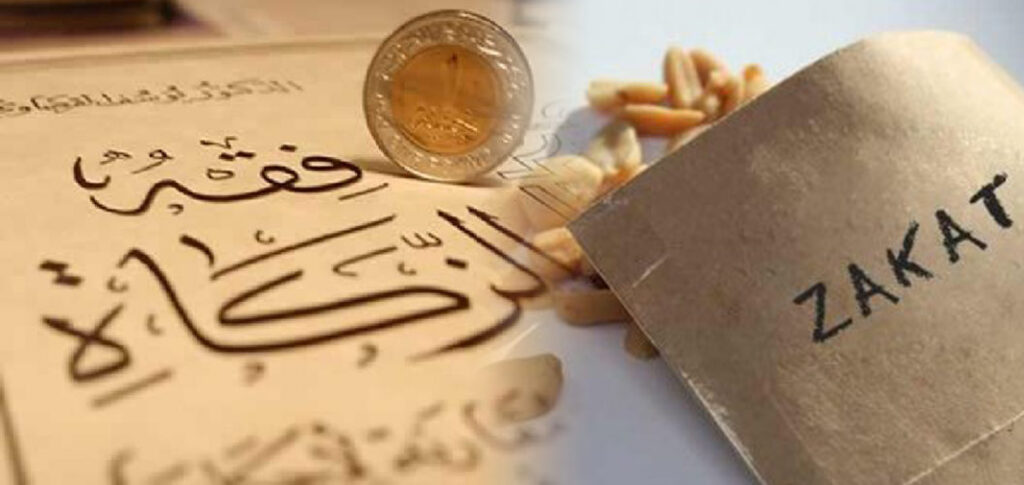
Zakat (زكاة), often translated as “purification” or “growth,” is the third pillar of Islam. It is a mandatory act of worship that purifies wealth, encourages social justice, and strengthens community bonds. Eligible Muslims are required to give 2.5% of their surplus wealth to specific categories of recipients as outlined in the Quran and Hadith.
Zakat is mentioned 32 times in the Quran alongside Salah (prayer), highlighting its importance: “And establish prayer and give Zakat, and whatever good you put forward for yourselves—you will find it with Allah” (Quran 2:110). Unlike a tax, Zakat is a spiritual obligation aimed at purifying wealth from greed and hoarding while promoting economic circulation and supporting those in need.
This guide explains Zakat in detail, including its meaning, calculation, rules, recipients, differences from Sadaqah, historical context, benefits, and applications in modern times. It draws on authentic Quranic verses, Sahih Hadith, classical Fiqh schools (Hanafi, Shafi‘i, Maliki, Hanbali), and contemporary research. Topics such as Zakat on gold, exemptions, and practical calculators are also included, making it a comprehensive resource for anyone seeking to understand and fulfill this essential act of worship.
With global Muslim wealth estimated at $3 trillion, fully observed Zakat has the potential to significantly reduce poverty worldwide. This guide aims to provide clear, practical information to help Muslims fulfill their obligation with confidence and understanding.
What is Zakat? Definition, Meaning, and Importance
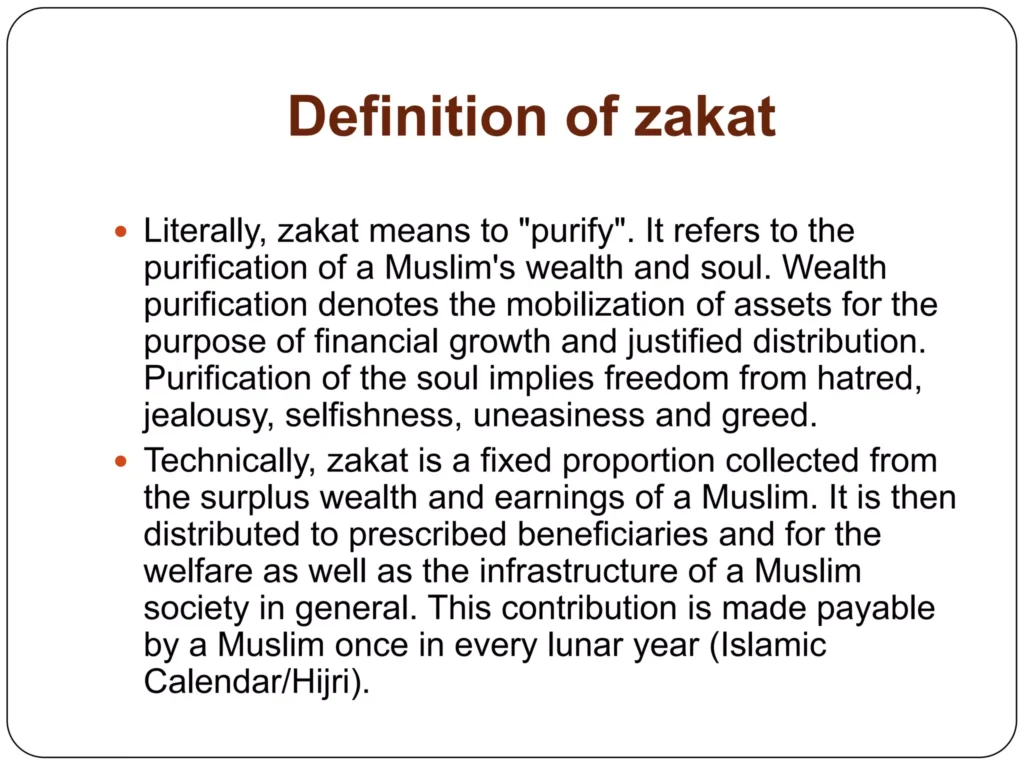
Zakat, derived from the Arabic root”ز-كا-ة” (“z-k-w”) meaning “purification,” “growth,” and “blessing,” is the obligatory charity that Muslims pay annually on their surplus wealth. It is one of the Five Pillars of Islam, alongside Shahadah (faith declaration), Salah (prayer), Sawm (fasting), and Hajj (pilgrimage). Zakat is not voluntary but a religious duty (Fard) for those meeting the Nisab threshold, calculated at 2.5% (1/40th) of eligible assets held for a lunar year (Hawlan).
Meaning: Zakat literally means “to purify” (Quran 9:103: “Take from their wealth a charity by which you purify them”). It cleanses wealth from greed, hoarding, and ill-gotten gains, while fostering growth in spiritual and communal terms. The Prophet (PBUH) said: “Allah has made Zakat obligatory to purify your remaining property” (Ibn Majah).
Importance: Zakat bridges economic gaps, alleviates poverty, and promotes social equity. It is mentioned 82 times in the Quran, often paired with Salah (e.g., Quran 2:43). Economically, it circulates wealth (Quran 59:7: “So that it does not circulate among the rich”). Spiritually, it detaches from materialism and builds Taqwa. Zakat’s global potential is $550–1,100 billion annually (World Bank), capable of eradicating poverty if optimized.
Historical Origins of Zakat in Islam
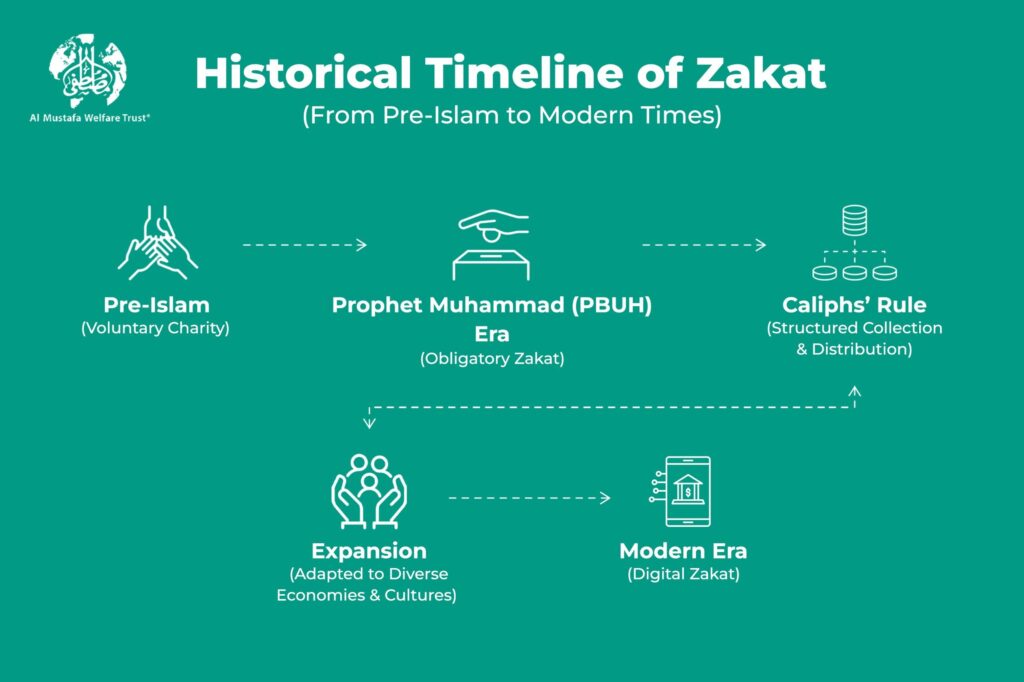
Zakat’s roots trace to pre-Islamic Arabia, where it meant “purification,” but Islam formalized it. Revealed in Madinah (2 AH/623 CE), Zakat became obligatory after Hijrah (Quran 9:60). The Prophet (PBUH) implemented it during Ramadan 2 AH, appointing collectors (Amil).
During Abu Bakr’s caliphate (632 CE), Zakat wars (Ridda) were enforced against tribes refusing payment. Umar (RA) expanded administration, establishing Bayt al-Mal. Umayyad and Abbasid eras institutionalized Zakat, with scholars like Abu Yusuf (d. 798 CE) detailing rules in Kitab al-Kharaj.
Ottoman Empire (1299–1922) centralized Zakat, while the colonial eras disrupted it. At present, countries like Saudi Arabia mandate Zakat (2.5% on net worth), while others (e.g., Pakistan) integrate it into taxation.
Timeline of Zakat History
| Era | Key Development | Reference |
|---|---|---|
| Pre-Islam | Voluntary charity in Arabia | Seerah |
| 623 CE | Obligatory in Madinah (Quran 9:60) | Quran |
| 632 CE | Ridda Wars enforce Zakat | Ibn Sa’d |
| 8th Century | Fiqh books detail rules (e.g., al-Muwatta) | Malik ibn Anas |
| 19th-20th Century | Revival in Muslim nations | al-Qaradawi |
| Present Days | Digital Zakat platforms | World Bank |
Types of Zakat in Islam
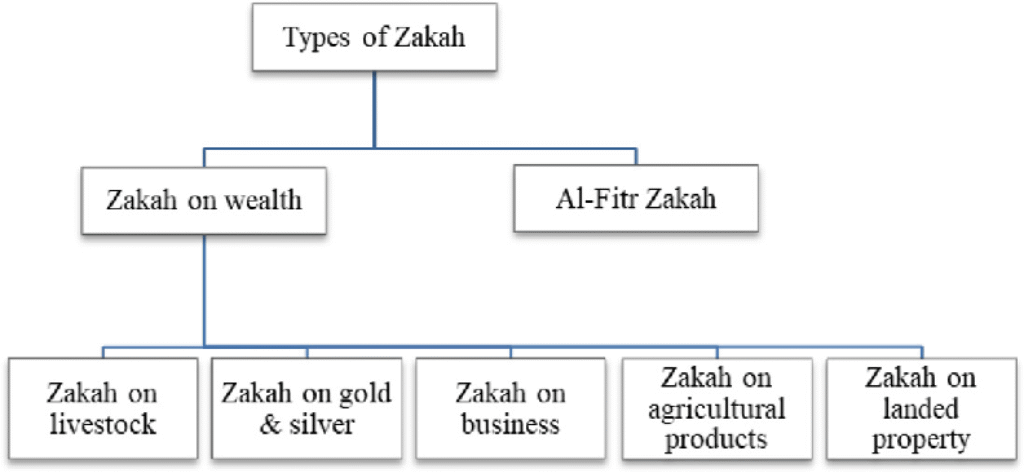
- Zakat al-Mal (Wealth Zakat): On surplus assets (cash, gold, business, agriculture).
- Zakat al-Fitr (Fitrana): Obligatory charity at Ramadan’s end, ~$10/person.
- Zakat on Professions: Modern debate; some include salaries if above Nisab.
- Zakat on Ushr (Agriculture): 5-10% on crops (Quran 6:141).
- Zakat on Rikaz (Buried Treasure): 20% on found treasures.
Table: Types of Zakat
| Type | Description | Rate | When Paid |
|---|---|---|---|
| Zakat al-Mal | Surplus wealth | 2.5% | Annually |
| Zakat al-Fitr | End-Ramadan charity | ~$10/person | Before Eid |
| Ushr | Agricultural produce | 5-10% | Harvest time |
| Rikaz | Found treasures | 20% | Upon discovery |
Who Must Pay Zakat? Eligibility and Nisab Threshold
Eligibility: Sane, adult Muslims (post-puberty) with wealth above Nisab for one lunar year (Hawlan ~354 days). Excludes non-Muslims, children, insane.
Nisab 2025: Equivalent to 87.48g gold (~$7,500) or 612.36g silver (~$500). Use gold for conservative calculation. Assets: Cash, gold, silver, stocks, business inventory, livestock, crops. Exclude home, car, and personal items.
Zakat Calculator (Formula):
- Total Assets = Cash + Gold/Silver Value + Investments + Receivables – Liabilities.
- If > Nisab and held 1 year: Zakat = 2.5% of total.
Example: $10,000 savings > Nisab = $250 Zakat.
How to Calculate Zakat: Step-by-Step Guide
Step 1: Determine Hawlan’s anniversary.
Step 2: List assets (cash, gold [22k/24k value], silver, stocks at market value, business net worth, agricultural produce).
Step 3: Subtract debts/liabilities.
Step 4: If above Nisab, multiply by 0.025.
Zakat on Gold: 2.5% of weight in grams x current price (if >87.48g).
Zakat on Silver: Similar (if >612.36g).
Zakat on Cash: 2.5% of savings above Nisab.
Zakat on Business: Net assets (inventory – liabilities) x 2.5%.
Zakat on Agriculture: 5% (irrigated), 10% (rainfed).
Zakat on Livestock: Specific thresholds (e.g., 30 cows = 1 calf).
2025 Nisab Update: Gold $86/g, Nisab ~$7,500; Silver $0.82/g, Nisab ~$500 (use local rates).
Online Tools: Haqq Finder Zakat Calculator (free, 2025 updated).
Zakat on Different Assets: Gold, Silver, Cash, Business, Agriculture, and More
- Gold/Silver: 2.5% on value if above Nisab (Quran 9:34 warns against hoarding).
- Cash/Savings: 2.5% on bank balances, cash.
- Investments/Stocks: 2.5% on market value (long-term) or profits (short-term).
- Business/Trade: 2.5% on net assets (inventory, receivables – payables).
- Agriculture: Ushr (10% rainfed, 5% irrigated, Quran 6:141).
- Livestock: E.g., 5 camels = 1 sheep (detailed in Fiqh books).
- Cryptocurrency: Treated as currency; 2.5% if held as investment (al-Qaradawi fatwa).
- Real Estate: Rental income Zakat-eligible; personal home exempt.
- Debts/Loans: Receivables included if recoverable.
Table: Zakat Rates by Asset
| Asset | Nisab | Rate | Notes |
|---|---|---|---|
| Gold | 87.48g | 2.5% | Value-based |
| Silver | 612.36g | 2.5% | Often lower Nisab |
| Cash | Equivalent to silver Nisab | 2.5% | Annual surplus |
| Crops | Harvest value | 5-10% | Ushr |
| Livestock | Varies (e.g., 30 cows) | Specific animals | Per type |
Exemptions and Who is Excused from Zakat
- Non-Muslims, children, insane.
- Debtors below Nisab after debts.
- Elderly/chronically ill unable to earn: Receive Zakat instead.
- Women on jewelry for personal use (Hanafi view; debated).
- Assets below Nisab or held <1 year.
Fiqh Differences: Shafi’i includes jewelry; Hanafi exempts personal use.
Recipients of Zakat: The 8 Categories Explained
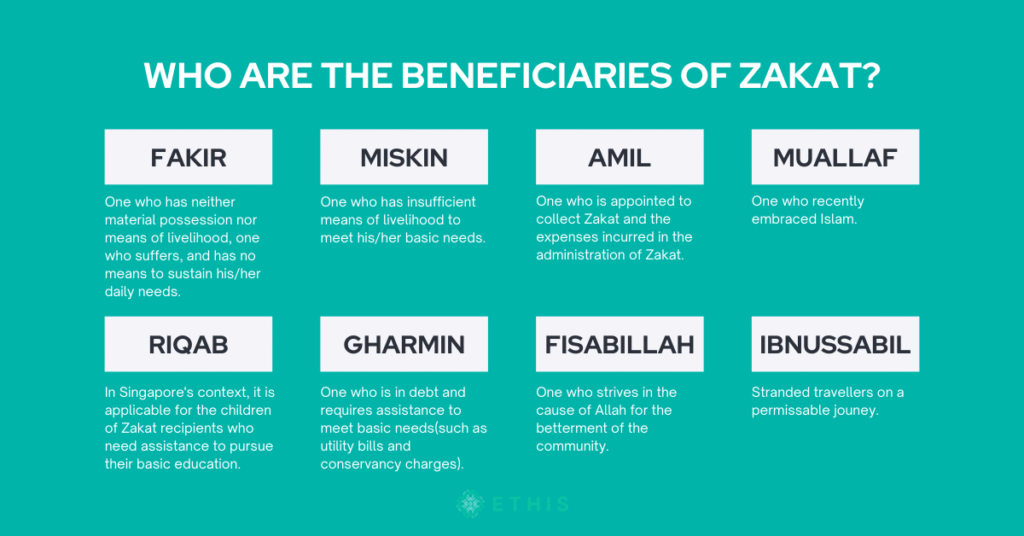
Quran 9:60 specifies 8 categories (Asnaf):
- Fuqara (Poor): Below basic needs.
- Masakin (Needy): Extreme poverty.
- Amilin (Collectors): Zakat administrators.
- Mu’allafah Qulubuhum (Hearts to Reconcile): New Muslims, allies.
- Riqab (Slaves): Freeing captives (modern: trafficking victims).
- Gharimun (Debtors): Overburdened by debt.
- Fi Sabilillah (In Allah’s Cause): Jihad, education, da’wah.
- Ibn as-Sabil (Travelers): Stranded wayfarers.
Priority: Local poor, then global (al-Qaradawi).
Zakat vs Sadaqah vs Zakat al-Fitr: Key Differences
- Zakat: Obligatory 2.5% annual of wealth.
- Sadaqah: Voluntary, any amount/time (Quran 2:280).
- Zakat al-Fitr: End-of-Ramadan charity (~$10/person) for purification.
Table: Differences
| Aspect | Zakat | Sadaqah | Zakat al-Fitr |
|---|---|---|---|
| Obligation | Mandatory | Voluntary | Mandatory |
| Amount | 2.5% | Any | ~$10/person |
| Timing | Annual | Anytime | End-Ramadan |
| Purpose | Purify wealth | General charity | Purify fast |
Rules and Etiquette of Paying Zakat
- Niyyah (Intention): Must be for Allah.
- Timing: After Hawlan; Ramadan preferred for rewards.
- Payment: Direct or via trusted organizations (e.g., Islamic Relief).
- Etiquette: Give secretly to avoid riya (showing off, Quran 2:271).
- No Zakat to family dependents or the rich.
- Debts: Deduct before calculation.
When and How Often to Pay Zakat
Annually after Hawlan. Pay anytime, but Ramadan maximizes rewards (Hadith: “Charity in Ramadan multiplied 70 times” – Tirmidhi). Track with apps like Zakatify.
Spiritual Benefits of Zakat
- Purifies the soul from greed (Quran 9:103).
- Increases blessings (Hadith: “Charity does not decrease wealth” – Muslim).
- Builds Taqwa and empathy.
- Forgiveness of sins (Hadith in Tirmidhi).
Al-Ghazali: Zakat detaches from Dunya.
Social and Economic Benefits: Poverty Alleviation and Community Building
- Reduces inequality (Quran 59:7).
- Economic circulation: World Bank 2025 estimates Zakat could lift 100M from poverty.
- Community support: Builds welfare systems.
- Global impact: In 2025, Zakat funds aid in Gaza, Yemen (Islamic Relief reports $500M+ annually).
Health and Psychological Benefits of Zakat
Giving activates the brain’s reward centers (Harvard 2024 study). Reduces stress, increases happiness (NIH). In today’s world, Zakat was linked to mental health via “giver’s high” (Psychology Today).
Zakat in Different Islamic Schools of Thought
- Hanafi: Exempts personal jewelry; Zakat on business profits.
- Maliki: Zakat on all jewelry above Nisab.
- Shafi’i/Hanbali: Similar to Maliki; includes receivables.
Consensus on 2.5% rate.
Zakat in Global Contexts: Cultural and Regional Variations
- Saudi Arabia: Mandatory, collected by the state.
- Pakistan: Deducted from banks.
- Indonesia: Community-based.
- UK/USA: Voluntary via charities; apps for calculation.
Modern Trends: Blockchain Zakat for transparency.
Modern Challenges
- Crypto Zakat: 2.5% on holdings (fatwas by al-Azhar).
- Inflation Adjustment: Use gold Nisab.
- Climate Crises: Zakat for disaster relief (e.g., Pakistan floods 2025).
- Digital Tools: Zakat apps with AI calculators.
Common Misconceptions About Zakat
- Only Cash: Includes all assets.
- Voluntary: Obligatory for the eligible.
- Poor Only: 8 categories.
- Women Exempt: No, if above Nisab.
- Ineffective: Properly managed, it alleviates poverty (World Bank).
How to Prepare and Pay Zakat: Practical Tips for Beginners
- Track Hawlan.
- Inventory assets annually.
- Use calculators.
- Pay via charities for distribution.
- Make Niyyah.
Zakat and Technology: Apps, Calculators, and Online Platforms
- Zakatify: AI-based.
- Islamic Relief Calculator
- Blockchain: Transparent tracking.
Hadith and Quranic Verses on Zakat
Quran: “Take from their wealth a charity to purify them” (9:103).
Hadith: “Zakat is a bridge of Islam” (Tirmidhi). “Charity extinguishes sins like water extinguishes fire” (Tirmidhi).
Over 82 verses, 30 Hadith.
Scholarly Perspectives on Zakat
- Al-Ghazali: Spiritual purification.
- Ibn Taymiyyah: Economic justice.
- Al-Qaradawi: Modern assets (crypto).
- Zakat for SDGs (UNDP).
Scientific Research on Zakat’s Impact
World Bank 2025: Zakat could generate $1T annually, ending poverty. Psychological studies (APA): Giving reduces stress.
Timeline of Zakat in Islamic History
| Year | Event |
|---|---|
| Pre-Islam | Voluntary charity. |
| 623 CE | Obligatory (Quran 9:60). |
| 632 CE | Ridda Wars enforce. |
| 8th Century | Fiqh codification. |
| In this era | Digital Zakat platforms. |
Frequently Asked Questions (FAQs) on Zakat
1. What is Zakat?
Zakat (زكاة) is a mandatory act of worship in Islam that purifies wealth, supports the needy, and strengthens social justice. It is typically 2.5% of a Muslim’s surplus wealth. It is sometimes translated as “purification” or “growth.”
2. What is the meaning of Zakat?
Zakat literally means “to purify” or “to increase.” It purifies the giver’s wealth and soul and contributes to the welfare of society.
3. What is the difference between Zakat and Sadaqah?
Zakat is obligatory, fixed in amount, and given to specific categories of recipients. Sadaqah is a voluntary charity given freely, without a fixed amount or restriction on recipients.
4. Who is eligible for Zakat?
Eligible Muslims are those whose wealth exceeds the nisab (minimum threshold) and has been held for one lunar year.
5. Who is not eligible for Zakat?
Those whose wealth is below the nisab or has not been held for a full lunar year, and non-Muslims (in classical Islamic rulings), are not eligible to pay Zakat.
6. Who can receive Zakat?
Recipients are specified in the Quran: the poor, the needy, Zakat collectors, those whose hearts are to be reconciled, freeing captives, those in debt, in Allah’s cause, and travelers in need.
7. Can Zakat be given to non-Muslims?
Classical rulings typically restrict Zakat to Muslims. Some scholars allow certain categories, like helping non-Muslims in dire need, but voluntary charity (Sadaqah) is recommended for non-Muslims.
8. Can Zakat be given to family members?
Zakat can be given to needy relatives, except those whom one is already obligated to support financially, like parents, children, or spouses.
9. Can Zakat be given to Masjid or mosque construction?
Direct payment to a mosque or for general construction is not valid Zakat unless it directly benefits the eligible categories, such as helping the poor using the mosque’s resources.
10. Can Zakat be used for education?
Yes, if it directly benefits eligible recipients, such as funding education for the poor or needy students.
11. Can Zakat be given to parents or siblings?
Zakat cannot be given to parents or children, as one is already obliged to support them. It can be given to siblings if they are financially needy and not under your obligatory support.
12. What are the rules of Zakat?
- Wealth must exceed the nisab.
- It must be held for one lunar year.
- Only eligible wealth is zakatable (cash, gold, silver, business inventory, agricultural produce, etc.).
- It should be given to eligible recipients.
13. What are the types of Zakat?
- Zakat on wealth (Zakat al-Mal): cash, savings, gold, silver, stocks.
- Zakat on agricultural produce: crops, fruits.
- Zakat on business inventory.
- Zakat al-Fitr: a small charity at the end of Ramadan for each family member.
14. When did Zakat become obligatory?
Zakat became obligatory during the second year after Hijrah (622 CE) when Islamic society began formalizing its social welfare system.
15. Where did Zakat originate?
Zakat was established in Arabia during the time of Prophet Muhammad (PBUH), following Quranic commandments and the practice of previous prophets.
16. How to calculate Zakat in Islam?
- Determine all zakatable wealth (cash, gold, silver, business inventory).
- Deduct liabilities.
- If the remaining wealth exceeds nisab, pay 2.5%.
- Use online or manual Zakat calculators for accuracy.
17. How to do Zakat al-Fitr?
Zakat al-Fitr is a fixed amount given before Eid prayers, usually in the form of staple food or its monetary equivalent.
18. Does Zakat have to be paid all at once?
It is recommended to pay Zakat as a lump sum, but it can be paid in installments as long as it reaches the recipients promptly.
19. Does Zakat only go to Muslims?
Classically, yes. Non-Muslims should receive voluntary charity (Sadaqah) instead.
20. Does Zakat have to be money?
No, Zakat can be in cash, gold, silver, crops, livestock, and other assets that are zakatable.
21. Does Zakat include property, land, or stocks?
Zakat is due on productive assets like business inventory, cash, gold, silver, and in some schools on land or stocks if they generate income. Personal property, like houses, is generally exempt.
22. Does Zakat mean purification?
Yes, it purifies wealth from greed and helps spiritual growth.
23. Does Zakat increase wealth?
Spiritually, yes. Practically, Zakat circulation benefits the community and can create economic growth.
24. Should Zakat be paid in Ramadan?
No, Zakat can be paid any time after it becomes due. However, paying in Ramadan is recommended for an extra reward.
25. Should Zakat be given locally or anonymously?
Giving locally ensures support reaches those in need, and anonymity is encouraged to maintain the dignity of recipients.
26. How much Zakat is due on gold, silver, or other assets?
- Gold and silver: 2.5% of the total if above nisab.
- Cash, business assets: 2.5% of net wealth.
- Agricultural produce: 5–10% depending on irrigation method.
27. How does Zakat help eradicate poverty?
Zakat redistributes wealth, supports the poor, funds social welfare, and reduces economic inequality.
28. Is Zakat mandatory?
Yes, it is one of the five pillars of Islam.
29. Is Zakat a tax?
Zakat is a religious obligation, not a government tax, though some Muslim-majority countries may institutionalize it.
30. Can Zakat be applied to modern assets like 401(k) or investments?
Yes, modern scholars advise calculating Zakat on liquid or productive assets, including stocks, retirement accounts, and business investments, following zakatable rules.
31. How often should Zakat be paid?
Once a lunar year has passed on eligible wealth, Zakat should be paid annually.
32. Can diamonds or other valuables have Zakat?
Yes, if they are held as investment or trade items and exceed nisab, they are zakatable.
33. Who can manage or receive Zakat funds?
Qualified Zakat collectors, charitable organizations following Shariah guidelines, or directly giving to eligible recipients.
Conclusion
Zakat is Islam’s transformative pillar, purifying wealth and society. From origins to today’s applications, it fosters equity and spirituality. Fulfill Zakat for blessings.
References
- Quran (Sahih International).
- Sahih al-Bukhari.
- Sahih Muslim.
- Sunan al-Tirmidhi.
- Sunan Ibn Majah.
- Kitab al-Kharaj by Abu Yusuf.
- Ihya Ulum al-Din by al-Ghazali.
- Fatawa Ibn Taymiyyah.
- Islamic Economics by al-Qaradawi.
- World Bank Zakat Report (2025).
- Pew Research on Muslim Wealth (2025).