

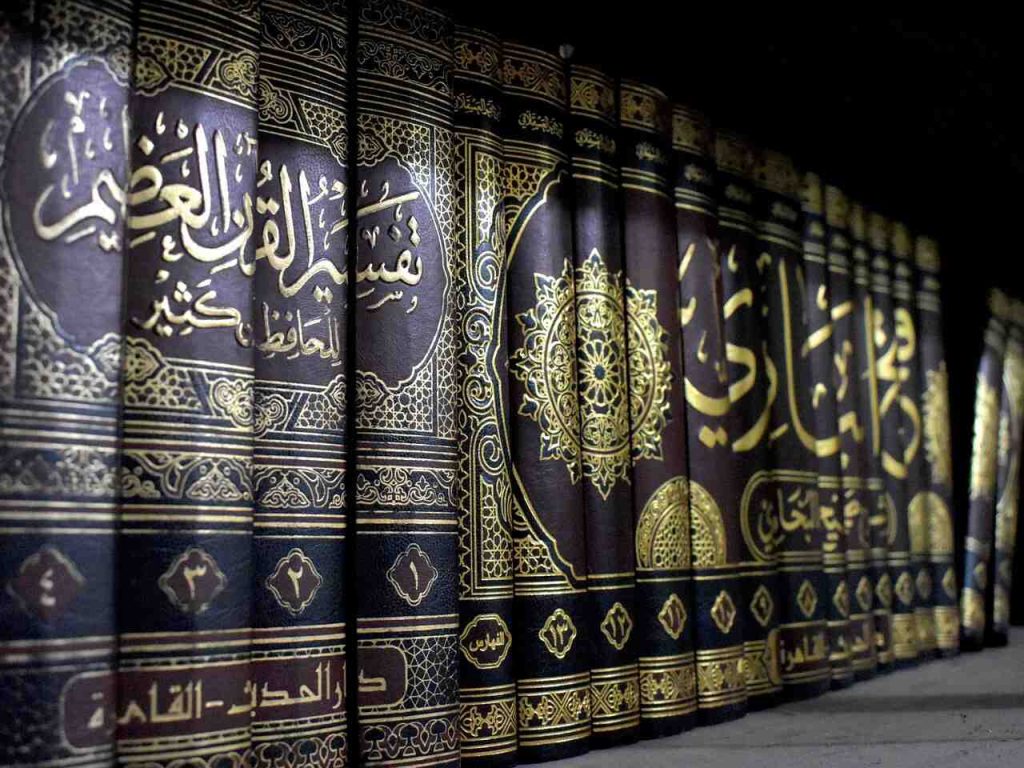
In an era of rapid social change and digital misinformation, the Sunnah of Prophet Muhammad ﷺ stands as the ultimate anchor for the Muslim Ummah. While the Holy Qur’an provides the divine blueprints for faith, the Sunnah serves as the living, breathing application of those commands. It is not merely a historical record; it is a timeless manual that bridges the gap between 7th-century Arabia and the complexities of 21st-century life.
However, the modern seeker of knowledge often faces a barrage of questions: How can we be sure of the authenticity of Hadith centuries later? How does the Sunnah address contemporary scientific and social challenges? Is it possible to follow the Qur’an while rejecting the Prophetic legacy?
In this comprehensive guide, we delve into the significance of the Sunnah, exploring the rigorous “Science of Hadith” that ensured its preservation and refuting the misconceptions that seek to undermine its authority. From the meticulous efforts of the Sahabah to the modern digital archives of the Prophetic tradition, discover why the Sunnah remains the most documented and scientifically preserved legacy in human history.
What is Sunnah? A Clear Definition

Etymology of Sunnah
To fully grasp “what is Sunnah in Islam,” we must begin with its linguistic roots and evolving definitions. The Arabic word “Sunnah” (سنة) stems from the triliteral root s-n-n (س ن ن), which conveys ideas of shaping, fashioning, or following a consistent path.
In classical Arabic lexicons like Lisan al-Arab by Ibn Manzur (d. 1311 CE), Sunnah is described as “a way, course, rule, manner of conduct, or the like,” often implying a habitual or normative practice that becomes a precedent.
In pre-Islamic Arabia, Sunnah referred to tribal customs and ancestral precedents, whether positive or negative. For example, it denoted the “sunnat al-awwalin” – the ways of the ancients – as mentioned in the Qur’an: “But if they turn away, then say, ‘I have warned you of a thunderbolt like the thunderbolt [that struck] ‘Ad and Thamud‘” (Qur’an 41:13), alluding to destructive patterns of past nations. This neutral connotation shifted with the advent of Islam, where Sunnah became synonymous with exemplary conduct sanctioned by divine approval.
Post-revelation, the Sunnah specifically denotes the Prophet Muhammad’s ﷺ comprehensive lifestyle as a model for believers. As defined by scholars like Imam al-Shafi’i in ar-Risala (The Epistle on Legal Theory), Sunnah is “the wisdom (hikmah) mentioned alongside the Book in the Qur’an,” referencing verses like: “He it is Who has sent among the unlettered ones a Messenger from among themselves, reciting to them His verses, purifying them, and teaching them the Book and the wisdom” (Qur’an 62:2). Here, “hikmah” is interpreted as the Sunnah, providing practical wisdom to complement the Qur’an’s theoretical guidance.
Contemporary definitions vary slightly by context. In fiqh (Islamic jurisprudence), Sunnah is the second primary source after the Qur’an, encompassing:
- Qawli (Verbal): The Prophet’s sayings, e.g., “Actions are judged by intentions” (Sahih al-Bukhari 1, Sahih Muslim 1907).
- Fi’li (Actions): His deeds, such as performing Wudu (ablution) in a specific manner.
- Taqrir (Approvals): Silent or explicit endorsements of companions’ actions, like approving Bilal’s (RA) call to prayer.
Hadith scholars expand it to include the Prophet’s biography, physical attributes, and pre-prophetic life. Britannica describes it as “the body of traditional social and legal custom and practice,” highlighting its normative role in Sharia.
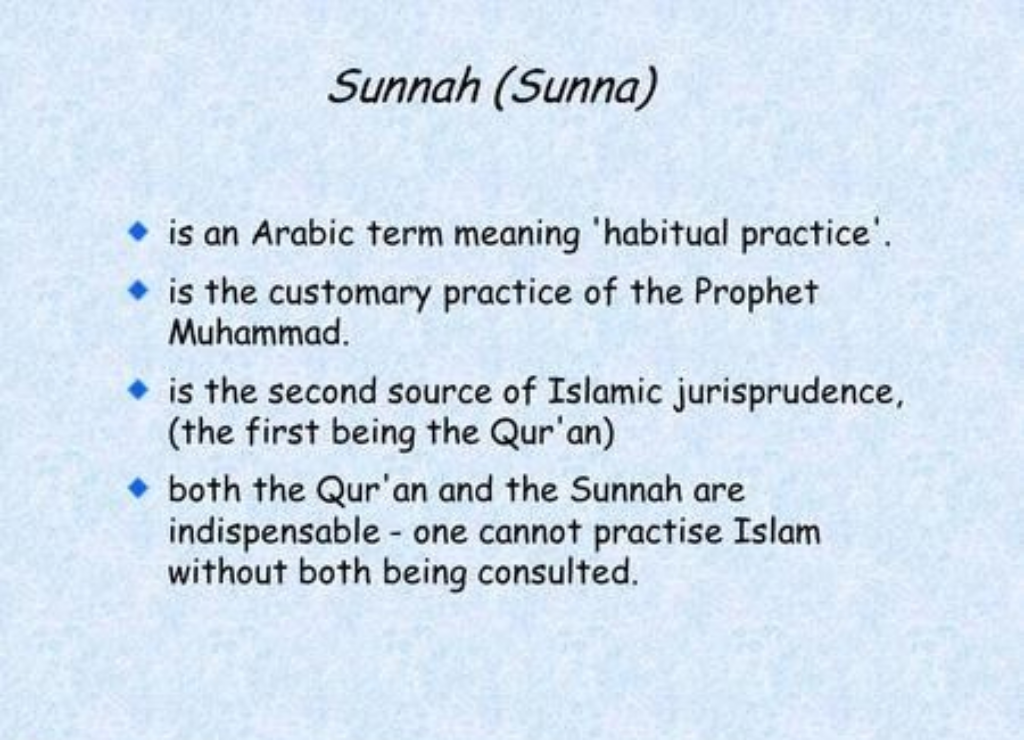
So, in general, the Sunnah refers to the words, actions, tacit approvals, and personal habits of Prophet Muhammad ﷺ, providing Muslims with a complete model of how to live by the Qur’an. It serves as the second foundational source of Islamic law and guidance, after the Book of Allah.
Distinctions are crucial: Sunnah is not synonymous with “Sunni” (Ahl as-Sunnah wal-Jama’ah), though the latter derives from adhering to the Prophet’s Sunnah. In Shia tradition, it includes the practices of the Ahl al-Bayt (the Prophet’s family). Quranists, however, may minimize it, viewing the Qur’an as self-sufficient, a view critiqued by mainstream scholars for ignoring verses like Qur’an 4:80: “Whoever obeys the Messenger has obeyed Allah.“
In essence, the Sunnah transforms theoretical faith into lived reality, bridging the divine and human. As Jonathan Brown notes in Hadith: Muhammad’s Legacy in the Medieval and Modern World, “The Sunnah is the lens through which Muslims see the Qur’an” (p. 15). This depth surpasses brief definitions in sources like Iqra Network’s blog, offering a multifaceted understanding for seekers of “Sunnah definition in Islam.”
Definition by experts
Hadiths—the authenticated narrations of the Prophet’s life—are the primary means of preserving and understanding the Sunnah. As scholar Jonathan A.C. Brown explains:
“Hadith reports describe the Prophet’s sayings, deeds, and physical attributes, offering Muslims a detailed guide to emulate his exemplary life.”
(Hadith: Muhammad’s Legacy)
The Qur’an itself commands believers:
“Say: If you love Allah, then follow me, and Allah will love you and forgive your sins. Allah is All-Forgiving, All-Merciful.”
— Qur’an 3:31
More than just a set of religious rituals, the Sunnah represents a holistic model—one that addresses worship, ethics, family life, governance, and spiritual development.
🔍 See: Jonathan A.C. Brown, “Hadith: Muhammad’s Legacy” (Oxford, 2009), p. 3
Historical Development of the Sunnah Concept

The evolution of Sunnah from a pre-Islamic tribal norm to a cornerstone of Islamic theology is a fascinating journey spanning centuries. In the Jahiliyyah (pre-Islamic era), Sunnah signified ancestral customs, often oral traditions that governed tribal life, as documented in early Arabic poetry and histories like al-Tabari’s Tarikh al-Rusul wal-Muluk. These precedents were not always virtuous; the Qur’an critiques them as “sunnat al-awwalin” – destructive patterns leading to divine punishment (Qur’an 8:38).
With the Prophet’s ﷺ mission in 610 CE, Sunnah began its transformation. During his lifetime (570-632 CE), it was lived rather than codified – companions like Abu Bakr and Umar (RA) emulated his conduct directly. The Qur’an reinforced this: “Obey Allah and obey the Messenger” (Qur’an 4:59), establishing obedience to the Prophet as integral to faith. Post-Hijrah (622 CE), in Medina, the Sunnah shaped the first Islamic community, from the Constitution of Medina to daily practices.
After the Prophet’s death, the Rashidun Caliphs (632-661 CE) preserved the Sunnah through practice and memory. Abu Bakr (RA) compiled the Qur’an to prevent loss, while Umar (RA) emphasized communal consensus (ijma) as part of Sunnah, stating on his deathbed: “Hold fast to the Book of Allah… and the Sunnah of His Prophet” (though his instructions prioritized groups like Muhajirun).
Early divergences emerged: In Iraq, rationalist schools (ahl ar-ra’y) adapted Sunnah flexibly, while Medinan scholars (ahl al-hadith) stuck to local traditions.
The Umayyad era (661-750 CE) saw political misuse, with fabricated Hadith supporting rulers, prompting caution from scholars like Imam Malik (d. 795 CE), who prioritized Medinan practice in his Muwatta. The Abbasid period (750-1258 CE) marked systematization. Imam al-Shafi’i (767-820 CE) revolutionized the concept in ar-Risala, arguing Sunnah equals Hadith from the Prophet alone, not companions or local customs, elevating it to a Qur’anic parallel: “The Sunnah rules over the Qur’an, but the Qur’an does not rule over the Sunnah” (ar-Risala, p. 76). This shifted from “living Sunnah” (community practice) to textual authority.
Hadith compilation peaked in the 9th century with the Six Books (Kutub as-Sittah): Sahih al-Bukhari (d. 870 CE) and Sahih Muslim (d. 875 CE) set rigorous standards, collecting thousands from hundreds of thousands of narrations. Al-Bukhari traveled 16 years, memorizing 600,000 Hadith but authenticating only 7,275. This era developed ‘Ilm al-Hadith, with isnad (chain of transmission) scrutiny.
Medieval developments included sectarian refinements: Sunnis standardized via madhhabs (Hanafi, Maliki, Shafi’i, Hanbali), Shias via their Imams’ narrations in al-Kafi (al-Kulayni, d. 941 CE). Sufis emphasized inner Sunnah (spiritual states), as al-Ghazali (d. 1111 CE) in Ihya’ Ulum ad-Din urged imitating the Prophet’s character.
The Ottoman era (1299-1922 CE) integrated Sunnah into state law, while colonial encounters (18th-20th centuries) sparked revivalism. Muhammad ibn Abd al-Wahhab (d. 1792 CE) called for pure Sunnah against bid’ah (innovations). Modernists like Muhammad Abduh (d. 1905 CE) reinterpreted Sunnah for contemporary needs, while Salafis like Muhammad Nasiruddin al-Albani (d. 1999 CE) focused on Hadith re-authentication.
Today, digital tools preserve Sunnah via databases like Sunnah.com, but challenges like misinformation persist. As Wikipedia notes, the concept evolved from broad precedents to Prophet-centric Hadith, ensuring its resilience.
Timeline of Key Milestones:
- 570-632 CE: Prophet’s life – Sunnah in action.
- 632-661 CE: Rashidun – Oral transmission.
- 795 CE: Muwatta’ by Malik – First major compilation.
- 820 CE: ar-Risala by Shafi’i – Theoretical foundation.
- 870-875 CE: Sahih al-Bukhari and Muslim – Pinnacle of authentication.
- 19th-20th CE: Revivalist movements – Modern applications.
This historical depth, absent in shorter articles like Britannica’s, reveals Sunnah as a dynamic, adaptive force.
The Science of Hadith: How the Sunnah Was Preserved

The reliability of the Sunnah hinges on a rigorous system of preservation that is unparalleled in human history. This process evolved from oral memorization to the sophisticated “Science of Men” (Ilm ar-Rijal), ensuring the Prophetic legacy remained intact.
1. Primary Sources of the Sunnah
The Sunnah is derived from two foundational pillars:
- The Qur’an: The primary source that implicitly mandates following the Prophet ﷺ. As Allah states: “So take what the Messenger assigns to you, and deny yourselves that which he withholds from you” (Qur’an 59:7).
- Hadith Literature: The documented narrations of the Prophet’s ﷺ speech, actions, and silent approvals, authenticated via a verifiable chain of transmission.
2. Early Efforts: From Memory to Manuscript
Preservation began with the Sahabah (Companions), who practiced and memorized the Sunnah with religious devotion.
- The Role of Abu Hurayrah (RA): He narrated over 5,000 Hadith, explaining his dedication: “I devoted myself to the Prophet while others were busy with trade” (Sahih al-Bukhari 118).
- The Evolution of Writing: Initially, the Prophet ﷺ cautioned against writing Hadith to prevent confusion with the Qur’anic text (Sahih Muslim 3004). However, once the Qur’an was well-established, writing was encouraged and became a vital tool for the Tabi’un (the followers).
3. Systematic Compilation and Authentication
Under the Umayyad Caliph ‘Umar ibn ‘Abd al-Aziz (d. 720 CE), the first official, systematic collection of Hadith was ordered to combat forgeries. This birthed ʿUlūm al-Ḥadīth (Hadith Sciences), which analyzes two core components:
- Sanad (Isnad): The chain of narrators. Each person’s integrity (Adalah) and memory (Dabt) were scrutinized.
- Matn: The actual text or content.
Classification of Hadith:
- Sahih (Authentic): A sound chain with no flaws in text or transmission.
- Hasan (Good): A slightly weaker chain that is still reliable for legal rulings.
- Da’if (Weak): Contains a flaw in the chain or a narrator’s memory.
- Mawdu’ (Fabricated): Invented narrations, immediately rejected.
4. The Major Collections (Kutub as-Sittah)
The preservation effort culminated in the “Six Books,” which remain the gold standard for Muslims today:
- Sahih al-Bukhari & Sahih Muslim: The most authentic, organized by legal and theological topics.
- The Sunan (Abu Dawud, at-Tirmidhi, an-Nasa’i, Ibn Majah): Focused primarily on legal rulings (Fiqh).
- Musnad Ahmad: A massive collection organized by the original companion who narrated the Hadith.
5. Global Transmission and Modern Defense
The collection of Hadith involved riḥlah (epic journeys). Scholars like Imam al-Bukhari traveled across Egypt, Syria, and Iraq to verify single narrations. This rigorous methodology surpasses modern empirical sciences in its verification of historical chains.
In the modern era, the Sunnah faces “Orientalist skepticism” (e.g., Joseph Schacht). However, modern researchers like Harald Motzki have used isnad-cum-matn analysis to scientifically prove that these narrations date back accurately to the 1st century AH, refuting theories of late-stage fabrication.
Types of Sunnah
Sunnah is classified by form and obligation level, providing nuanced guidance.
By Form (Aqsām as-Sunnah):
- Sunnah Qawliyyah (Verbal Sunnah): Sayings, e.g., “The best of you are those who are best to their wives” (Sunan at-Tirmidhi 1162, Sahih).
- Sunnah Fi’liyyah (Actional Sunnah): Deeds, like praying two Rak’ah before Fajr.
- Sunnah Taqririyyah (Approbatory Sunnah): Approvals, e.g., not objecting to companions’ variations in recitation.
By Obligation:
- Sunnah Mu’akkadah (Emphasized): Regularly practiced, e.g., Witr prayer.
- Sunnah Ghayr Mu’akkadah (Non-Emphasized): Optional, e.g., four Rak’ah before ‘Asr.
- Mandub/Mustahabb (Recommended): General encouraged acts.
In fiqh, Sunnah denotes non-obligatory acts in worship, contrasting with fard. As Areeb Academy explains, this classification aids practical adherence.
The Significance: Why Is the Sunnah Essential in Islam?
The Sunnah is indispensable for several reasons:
- It explains Qur’anic injunctions (e.g., prayer, zakat, fasting)
- It offers moral and ethical standards
- It sets the practical framework of Islamic law
- It defines the Prophetic mission of character building:
“I was sent to perfect noble character.” — al-Adab al-Mufrad, vol. 1, p. 104
Moreover, Allah commands:
“Say (O Prophet): If you truly love Allah, then follow me. Allah will love you and forgive your sins.”
— Qur’an, Āl ʿImrān: 3:31
A Divine Guide for Humanity
The Qur’an and Sunnah are the sole authoritative sources for understanding divine guidance, providing clarity on matters beyond human reason, such as the afterlife and divine attributes. The Prophet (peace be upon him) was divinely protected from error in conveying revelation, ensuring the reliability of his teachings. As Allah states:
“Indeed, in the Messenger of Allah, you have an excellent example for anyone whose hope is in Allah and the Last Day” (Qur’an 33:21).
Through the Prophet’s words, Muslims received the Qur’an, and through his actions, they learned its practical application, from prayer to personal hygiene.
Ethical Framework for Life
The Sunnah is not limited to rituals—it provides a complete ethical blueprint for both individual behavior and societal order. The Prophet ﷺ stated:
“I was sent to perfect noble character.”
— al-Adab al-Mufrad
From self-discipline and family values to environmental responsibility and social justice, scholars have extracted timeless principles from the Prophet’s life. Even non-Muslim thinkers have admired these teachings as solutions to modern problems—including poverty, injustice, moral decay, and ecological crises.
Sunnah vs. Hadith: Clarifying the Distinction
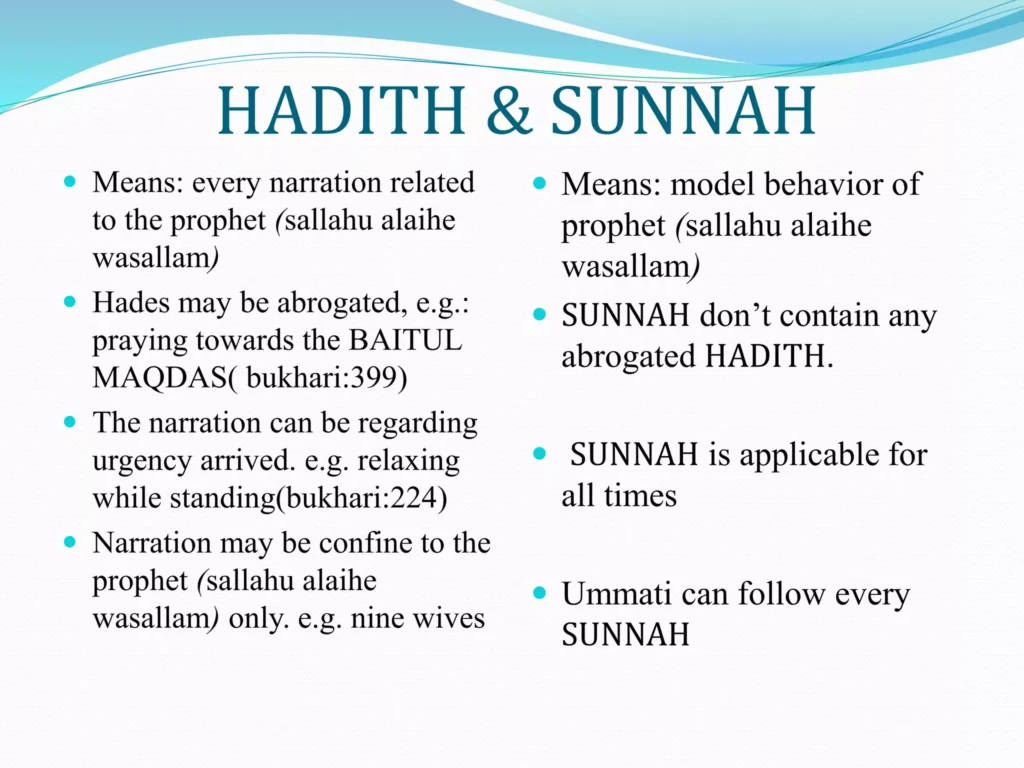
While the terms “Sunnah” and “Hadith” are often used interchangeably in everyday discourse, classical Islamic scholarship recognizes important nuances between them, which are particularly relevant when addressing modern critiques of authenticity and reliability.
Practical Implications: This distinction protects the integrity of the Sunnah in modern debates. For instance, critics may point to isolated weak narrations to question Prophetic guidance, but traditional scholarship filters these out, ensuring the Sunnah remains robust and defensible. The Sunnah is primarily preserved through mass-transmitted practices (mutawatir) and authentic reports, making it as reliable as the Qur’an in its core elements.
Core Definitions: Hadith refers to the narrated reports—words, actions, approvals, or descriptions—attributed to the Prophet Muhammad ﷺ, transmitted through chains of narrators (isnad). Sunnah, on the other hand, denotes the Prophet’s ﷺ established way, path, and exemplary practice (his normative model for Muslims to follow). In essence, Hadith are the textual transmissions (the “vessel”), while Sunnah is the authoritative content and living tradition derived from them.
Not All Hadith Constitute Sunnah: Scholars classify Hadith such as sahih (authentic), hasan (good), da’if (weak), or mawdu’ (fabricated) based on rigorous scrutiny of chains and content. Only authentic (sahih or hasan) Hadith reliably establish the Sunnah as a binding or recommended guidance. Weak or fabricated Hadith do not form part of the authoritative Sunnah, though some weak ones may be cautiously referenced for encouragement in virtues (fada’il al-a’mal) if they align with established principles and are not severely deficient.
Sunnah in Different Islamic Sects
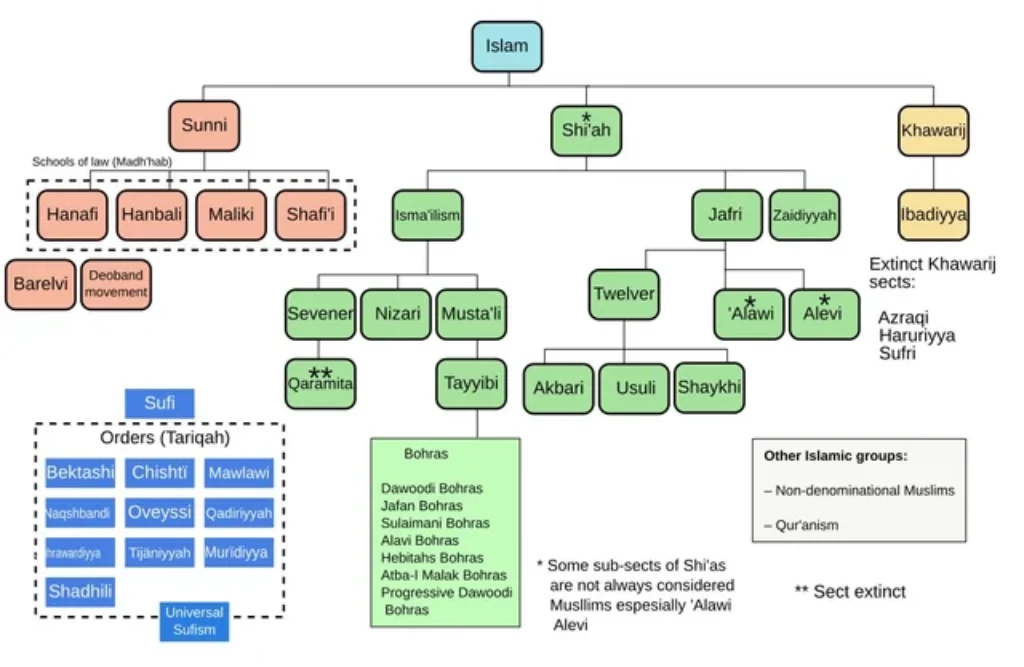
The understanding and sources of the Sunnah vary across Islamic sects and movements, reflecting differences in transmission, authority, and emphasis while sharing a common reverence for the Prophet’s ﷺ exemplary path.
- Sunnis (Ahl al-Sunnah wa al-Jama’ah): The vast majority of Muslims rely on the Kutub al-Sittah (the Six Authentic Books): Sahih al-Bukhari, Sahih Muslim, Sunan Abi Dawud, Jami’ al-Tirmidhi, Sunan al-Nasa’i, and Sunan Ibn Majah. These collections, compiled in the 9th century CE, embody the Sunnah through authenticated reports from the Companions, forming the basis of law, ethics, and practice alongside the Qur’an.
- Shias (Twelver/Imami): Emphasis is placed on the Ahl al-Bayt (the Prophet’s ﷺ household, including Ali, Fatima, Hasan, Husayn, and the subsequent Imams) as infallible transmitters. The primary sources are the Kutub al-Arba’ah (Four Books): Al-Kafi, Man La Yahduruhu al-Faqih, Tahdhib al-Ahkam, and Al-Istibsar. These prioritize narrations from the Imams, viewing them as the authoritative interpreters and preservers of the Prophet’s ﷺ Sunnah.
- Ibadis: This distinct branch, predominant in Oman, relies on the Tartib al-Musnad (a 12th-century rearrangement of earlier collections like Jami’ Sahih by al-Rabi’ ibn Habib), containing about 1,005 hadiths, many with short chains tracing back to early figures like Jabir ibn Zayd. Ibadis accept many Sunni hadiths but prioritize their own musnad-style compilation, with less central emphasis on hadith studies compared to jurisprudence.
- Sufis (Tasawwuf): Sufism, often integrated within Sunni or Shia frameworks, emphasizes the inner, spiritual dimensions of the Sunnah—such as purification of the heart (tazkiyah), love for the Prophet ﷺ, and ethical excellence (ihsan). While drawing from standard hadith collections, Sufis highlight transmission of esoteric knowledge through spiritual chains (silsilah) of masters, viewing the Prophet’s ﷺ inner state and noble character as the deepest expression of Sunnah.
- Quranists: This minority approach rejects Hadith collections entirely, arguing that the Qur’an is complete and sufficient, with no need for external narrations. They view “Sunnah” as limited to Qur’anic principles or mass-transmitted practices directly observable in the Prophet’s ﷺ era, dismissing most traditional Sunnah as unreliable later inventions.
Sunnah and Revelation: Beyond Rational Boundaries

Unlike empirical knowledge, the Qur’an and Sunnah provide certain, divine knowledge. They cover aspects beyond human reason, such as metaphysical truths, unseen realities, and divine wisdom. Ibn Khaldūn warns against judging revelation solely through intellect:
“Using human reason to judge revelation is like weighing mountains with a jeweler’s scale.”
— Muqaddimah, vol. 3, p. 38
Modern Challenges and the Global Relevance of the Sunnah
While the preservation of the Sunnah is historically robust, the modern era has introduced unique intellectual and philosophical challenges. Understanding and navigating these is essential for any student of knowledge, researcher, or thoughtful Muslim seeking to reconcile authentic tradition with contemporary thought.
1. Navigating the Rise of “Quran-Only” Movements (Hadith Rejectionism)
In recent decades, some groups have advocated for the total rejection of Hadith literature, claiming the Qur’an alone is sufficient for all aspects of life. However, from both theological and practical perspectives, this “Quranist” approach faces insurmountable hurdles:
- The Problem of Detail: The Qur’an commands Muslims to “Establish Prayer” (Aqimus-Salah), but the number of units (Rak’ahs), specific postures, and timings are only detailed in the Sunnah.
- Divine Mandate for Clarification: Allah states, “And We revealed to you the message that you may make clear to the people what was sent down to them” (16:44). Without the Sunnah, this promised clarification of the revelation would be absent.
- Historical Discontinuity: Rejecting the Sunnah implies that the Ummah practiced Islam incorrectly for 1,400 years, contradicting the divine promise of preservation in Qur’an 15:9.
2. Defending Against Orientalist Critiques
In the 19th and 20th centuries, Western scholars such as Ignaz Goldziher and Joseph Schacht argued that most Hadiths were “back-projected” fabrications from the 2nd and 3rd centuries AH to support emerging legal schools. Modern scholarship, however, has significantly undermined these skeptical claims:
- Early Manuscripts: Muslim scholars like M.M. Azami highlighted the existence of early written collections—such as the Sahifah of Hammam ibn Munabbih (d. 101 AH)—predating the major 9th-century compilations by centuries.
- Advanced Academic Methods: Even Western researchers like Harald Motzki, through isnad-cum-matn analysis (a rigorous statistical examination of chains and texts), have demonstrated that many Hadiths can be traced with high historical certainty to the Companions in the 1st century AH, moving scholarship closer to the traditional Islamic position.
3. The Sunnah in the Age of Science and Rationalism
A frequent modern challenge is the perceived conflict between certain Hadith narrations and contemporary scientific understanding.
- Contextual Understanding (Fiqh al-Hadith): Classical and contemporary scholarship emphasizes distinguishing the Prophet’s ﷺ legislative role from his personal worldly opinions—such as in the well-known date palm pollination incident—resolving many apparent contradictions through proper linguistic and situational context.
- The Limits of Empiricism: The Sunnah provides essential guidance on the Ghaib (Unseen), metaphysical realities beyond the scope of the scientific method, offering a comprehensive framework for spiritual and moral well-being that empirical science cannot address.
4. A Living Blueprint for 21st-Century Challenges: Practical and Global Relevance
Far from being a mere historical artifact, the Sunnah serves as a timeless manual addressing contemporary global crises:
- Environmental Ethics: Prophetic teachings on water conservation, animal welfare, and the encouragement of planting trees lay a profound spiritual foundation for modern environmental stewardship.
- Social Justice and Human Dignity: The Farewell Sermon (Khutbatul Wada) powerfully proclaimed racial equality and universal human rights centuries before modern international declarations.
- Mental Health and Resilience: The Sunnah’s emphasis on sabr (patience), shukr (gratitude), and dhikr (mindful remembrance of Allah) aligns closely with contemporary psychological research on emotional intelligence, stress reduction, and long-term well-being.
In an era of rapid change, the Sunnah remains not only defensible but indispensable—offering intellectual rigor, spiritual depth, and practical solutions that resonate across cultures and continents.
Canonical Hadith Collections
Among the earliest and most authentic hadith collections are:
| Compiler | Work | Death Year (AH/CE) |
|---|---|---|
| Mālik ibn Anas | Muwaṭṭāʾ | 179 AH / 795 CE |
| Aḥmad ibn Ḥanbal | Musnad | 241 AH / 855 CE |
| al-Bukhārī | Ṣaḥīḥ al-Bukhārī | 256 AH / 870 CE |
| Muslim ibn al-Ḥajjāj | Ṣaḥīḥ Muslim | 261 AH / 875 CE |
| Abū Dāwūd, al-Tirmidhī, al-Nasā’ī, Ibn Mājah | Sunan collections | 273–303 AH |
These collections vary by method:
- Ṣaḥīḥ works: thematically arranged and strictly authenticated
- Musnads: arranged by a companion narrator
Modern works on Manāhij al-Muḥaddithīn study these methodologies in-depth.
The Role of Hadith in Sīrah and Islamic Law
Sirah: Documenting the Prophet’s Life
The Sīrah (biography of the Prophet Muhammad ﷺ) relies heavily on Hadith literature to reconstruct the details of his life. While the Qur’an offers broad references, it is the Hadiths that provide intimate insights into the Prophet’s daily life, battles, diplomacy, character, and interactions with companions. Early historians like Ibn Isḥāq and Ibn Hishām compiled sīrah using both authentic and less strict narrations, as their goal was to narrate events, not establish legal rulings. Thus, historical Hadiths in sīrah are evaluated more leniently compared to legal Hadiths.
Legal and Ethical Guidance
In Islamic jurisprudence (fiqh), Hadith plays a central role. Along with the Qur’an, it forms the primary source of Shariah law, especially in matters where the Qur’an is silent or general. The Sunan collections (Abu Dawood, Tirmidhi, an-Nasa’i, Ibn Majah) organize Hadiths by legal categories—such as prayer, marriage, commerce, and criminal law. Unlike sīrah, strict authentication is crucial here. Scholars apply rigorous methods to classify Hadiths as ṣaḥīḥ (sound), ḥasan (good), or ḍaʿīf (weak), and use only reliable narrations for legal rulings.
Western Criticism and Revision
❌ Orientalist Skepticism
- Ignaz Goldziher and Joseph Schacht claimed that hadiths were later inventions.
- Accused early scholars like al-Zuhrī of fabricating reports.
✅ Western Re-evaluation
- Scholars like Harald Motzki used the isnād-cum-matn method to prove the early existence and reliability of hadiths.
- Their findings highlight the academic depth of Muslim hadith methodology.
See: Jonathan A.C. Brown, Hadith: Muhammad’s Legacy, p. 197
Hadith Studies in Islamic Education
In traditional madrasahs, students begin with content-focused works (without sanad), especially:
- Al-Arbaʿīn al-Nawawiyyah – 40 Hadiths essential to Islamic ethics and law
- Riyāḍ al-Ṣāliḥīn – Hadiths on virtues and spirituality
Each hadith in these texts is a foundational principle of the religion.
Timeless Guidance: The Modern Relevance of the Sunnah
The Sunnah of Prophet Muhammad ﷺ is not confined to 7th-century Arabia. Its teachings continue to offer comprehensive solutions to some of the most pressing challenges in today’s world—social injustice, environmental degradation, moral decline, and failed leadership.
1. Social Justice and Economic Ethics
The Prophet ﷺ emphasized compassion for the poor, fair treatment of workers, and prohibition of exploitation:
“Pay the laborer his wages before his sweat dries.”
(Sunan Ibn Mājah)
These principles directly address today’s global crises of income inequality, worker abuse, and unjust systems.
2. Environmental Ethics
The Sunnah promotes conservation, tree planting, and animal welfare:
“If a Muslim plants a tree or sows a field and a human, bird, or animal eats from it, it is a charity for him.”
(Sahih al-Bukhari)
This aligns with modern sustainability goals and climate responsibility.
3. Ethical Leadership and Accountability
The Prophet ﷺ modeled transparent, just, and humble leadership, rejecting nepotism and corruption. He said:
“Each of you is a shepherd, and each of you is responsible for his flock.”
(Sahih al-Bukhari & Muslim)
This hadith provides a foundation for ethical governance and public service accountability.
4. Reviving the Sunnah in Contemporary Life
To counter modernist, secular, and rationalist critiques, reviving Hadith education is essential. Short, powerful collections like Imam al-Nawawī’s Arbaʿīn serve as gateways for learners of all backgrounds. These forty hadiths capture the essence of Islamic values, from sincerity and humility to social responsibility.
“I was sent only to perfect noble character.”
(al-Adab al-Mufrad)
Conclusion: The Sunnah as a Living Legacy
The Sunnah of Prophet Muhammad ﷺ is not merely a historical tradition—it is a living, breathing guide for Muslims navigating the complexities of modern life. From environmental care and ethical leadership to spiritual refinement and social justice, the Sunnah offers timeless solutions grounded in divine wisdom.
Reviving the Prophetic Way
Despite rising intellectual skepticism and misinterpretations, the rigorous methodology of Hadith preservation remains unmatched in religious scholarship. Studying foundational collections like Ṣaḥīḥ al-Bukhārī, Ṣaḥīḥ Muslim, and al-Nawawī’s Arbaʿīn empowers believers to reconnect with authentic guidance.
To truly revive the Sunnah, we must move beyond admiration and into action—studying, implementing, and sharing its teachings in our homes, communities, and institutions.
“Whoever revives my Sunnah has loved me, and whoever loves me will be with me in Paradise.” > — Sunan al-Tirmidhī
An Invitation to Knowledge
Let this be an invitation to Muslims and researchers alike to explore, appreciate, and implement the Prophetic tradition in all walks of life.
“Say: If you love Allah, follow me; Allah will love you and forgive your sins…” (Qur’an 3:31)
May Allah ﷻ guide us to live by the Sunnah, defend it with knowledge, and pass it on with sincerity. Āmīn.
Endnotes
- Mālik ibn Anas, Muwaṭṭāʾ, vol. 2, p. 899.
- Muslim ibn Ḥajjāj, Ṣaḥīḥ Muslim, vol. 1, p. 512.
- Jonathan A.C. Brown, Hadith: Muhammad’s Legacy in the Medieval and Modern World, p. 3.
- Al-Qur’an, Āl ʿImrān: 3:31-32.
- Muḥammad ibn Ismāʿīl al-Bukhārī, al-Adab al-Mufrad, vol. 1, p. 104.
- Ibn Khaldūn, The Muqaddimah, trans. Franz Rosenthal, vol. 3, p. 38.
- Muḥammad ibn Ismāʿīl al-Bukhārī, Ṣaḥīḥ al-Bukhārī, vol. 1, p. 39.
- Shawqī Abū Khalīl, Aṭlas al-Ḥadīth al-Nabawī.
- Yāsir al-Shimālī, al-Wāḍiḥ fī Manāhij al-Muḥaddithīn.
- Jonathan A.C. Brown, Hadith: Muhammad’s Legacy, p. 197.
- Abū Zakariyyah al-Nawawī, Al-Arbaʿūn al-Nawawiyyah, p. 46.