

In the name of Allah, the Most Gracious, the Most Merciful. Peace and blessings be upon our beloved Prophet Muhammad (ﷺ), his noble family, companions, and all who follow his guidance until the Day of Judgment.
If you seek truth, inner peace, and a meaningful purpose in life, Islam offers a timeless answer. Islam is not merely a religion; it is a complete deen—a holistic way of life revealed by Allah (God) to guide humanity toward justice, peace, and spiritual balance. The word Islam means “submission” to the will of the One True God, through which the heart finds harmony and the world finds order.
With over 2.1 billion followers in 2025 (Pew Research, 2023 projections), Islam is the world’s second-largest faith, growing rapidly due to its clarity, compassion, and wisdom. This guide invites you to explore Islam as a mercy from Allah, drawing from the Quran, the Sunnah (teachings of the Prophet ﷺ), and authentic scholarly sources. Whether you’re a curious seeker, a new Muslim, or someone deepening their faith, this article explores Islam’s beliefs, practices, history, contributions, and relevance in today’s world.
May Allah open every sincere heart to the truth, as He says: “Invite to the way of your Lord with wisdom and good instruction” (Surah An-Nahl, 16:125).
The Meaning and Divine Origins of Islam
Islam, derived from the Arabic root s-l-m, encapsulates a profound concept shaping the lives of over 2.1 billion Muslims worldwide. The term Islam reflects both spiritual submission and the pursuit of peace, offering a holistic framework for living in harmony with Allah’s will.
Linguistic Roots of Islam
The word Islam originates from the Arabic trilateral root sīn-lām-mīm (س-ل-م), which conveys:
- Aslama (أسلم): To submit or surrender.
- Salām (سلام): Peace or safety.
- Silm (سلم): Peace or reconciliation.
Thus, Islam linguistically means “submission to the will of Allah,” inherently linked to achieving inner tranquility and societal harmony. The Quran reinforces this in Surah Al-Baqarah (2:208): “O you who have believed, enter into silm completely and do not follow the footsteps of Satan.”
Theological Significance: Submission and Peace
At its core, Islam is the act of submitting entirely to Allah, the One True God in Islamic monotheism (tawhid). This submission involves:
- Faith (Iman): Belief in Allah, His angels, books, prophets (e.g., Muhammad, Jesus, Moses, peace be upon them), the Day of Judgment, and divine decree (qadar).
- Worship (Ibadah): Acts of devotion like prayer, fasting, charity (zakat), and pilgrimage (Hajj), performed to please Allah.
- Surrender of the Self: Aligning personal desires with divine guidance as revealed in the Quran and exemplified by the Prophet Muhammad (ﷺ).
The Quran describes Islam as humanity’s natural disposition (fitrah): “So direct your face toward the religion, inclining to truth. [Adhere to] the fitrah of Allah upon which He has created [all] people” (Surah Ar-Rum, 30:30). This suggests Islam is the universal path to fulfilling humanity’s purpose.
The Revelation and Prophethood
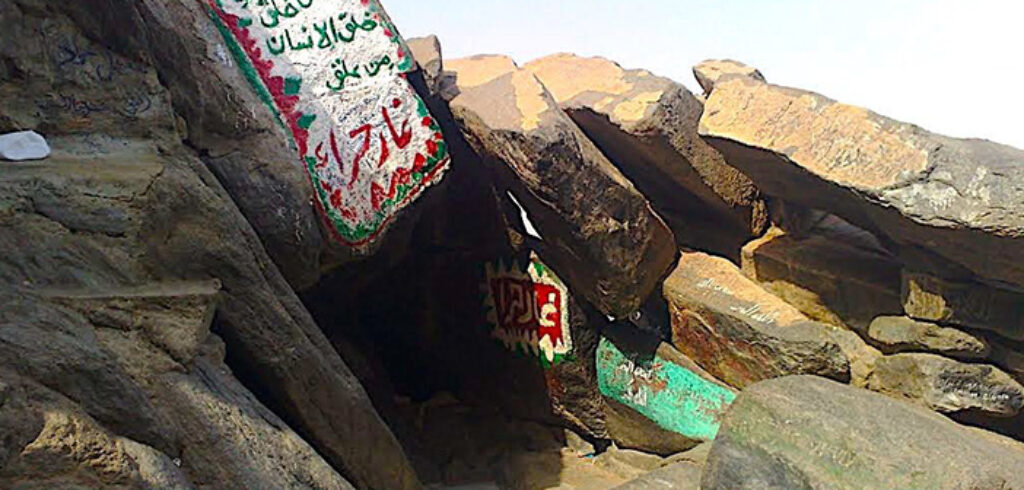
In 610 CE, in the Cave of Hira near Mecca, Allah revealed the first verses of the Quran to Muhammad (ﷺ) via Angel Jibril: “Read in the name of your Lord who created” (Surah Al-Alaq, 96:1).
Over 23 years, the Quran—Allah’s unchanged word—was completed, guiding humanity. Muhammad (ﷺ), an unlettered orphan known as Al-Amin (the trustworthy), faced persecution but established the ummah (community) in Medina after the Hijrah in 622 CE.
The Prophet (ﷺ) said: “I have been sent to perfect good character” (Muwatta Malik). From Arabia, Islam spread with mercy and justice; its message of tawhid resonates globally, addressing spiritual voids in a materialistic world.
Core Beliefs: The Six Pillars of Faith (Iman)
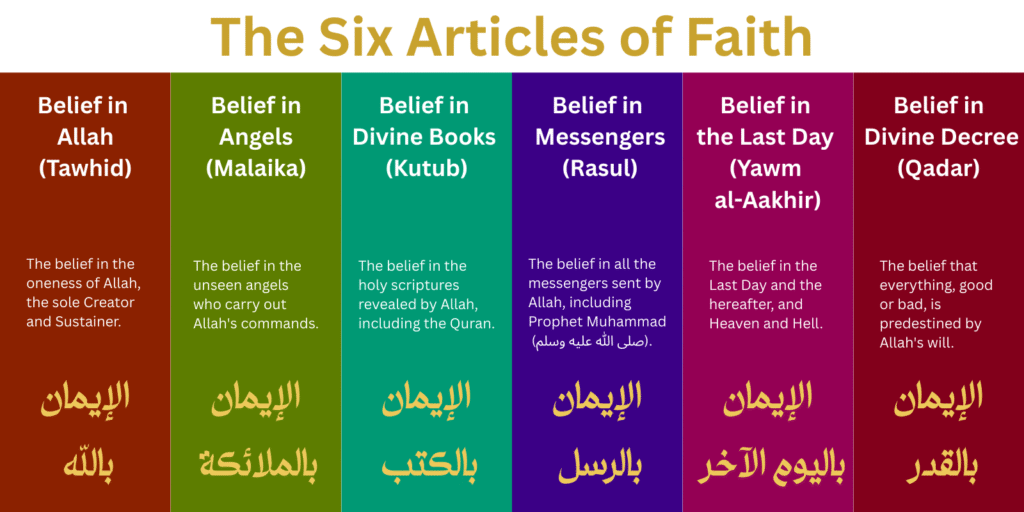
Faith in Islam rests on six articles, as taught by the Prophet (ﷺ): “Faith is to believe in Allah, His angels, His books, His messengers, the Last Day, and divine decree—the good and the bad” (Sahih Muslim). These are:
| Pillar | Description | Quranic Reference |
|---|---|---|
| Allah (Tawhid) | One God, Creator of all, without partners. | “Say: He is Allah, the One” (Surah Al-Ikhlas, 112:1). |
| Angels | Pure beings like Jibril (revelation) and Mikail (sustenance). | “Whoever is an enemy to Jibril—it is he who brought down [the Quran]” (Surah Al-Baqarah, 2:97). |
| Holy Books | Allah’s wisdom in all events encourages effort and trust. | “We sent down the Book to you for the truth” (Surah Al-Ma’idah, 5:48). |
| Prophets | From Adam to Muhammad (ﷺ), all calling to tawhid. Jesus (Isa) is a prophet, not divine. | “We make no distinction between any of His messengers” (Surah Al-Baqarah, 2:285). |
| Day of Judgment | Accountability for deeds; Paradise or Hell. | “Whoever does an atom’s weight of good will see it” (Surah Az-Zalzalah, 99:7). |
| Allah’s wisdom in all events encourages effort and trust. | Allah’s wisdom in all events; encourages effort and trust. | “No calamity befalls except by Allah’s permission” (Surah At-Taghabun, 64:11). |
These beliefs foster a balanced life, reminding Muslims to worship Allah alone.
The Five Pillars of Islam: Acts of Worship
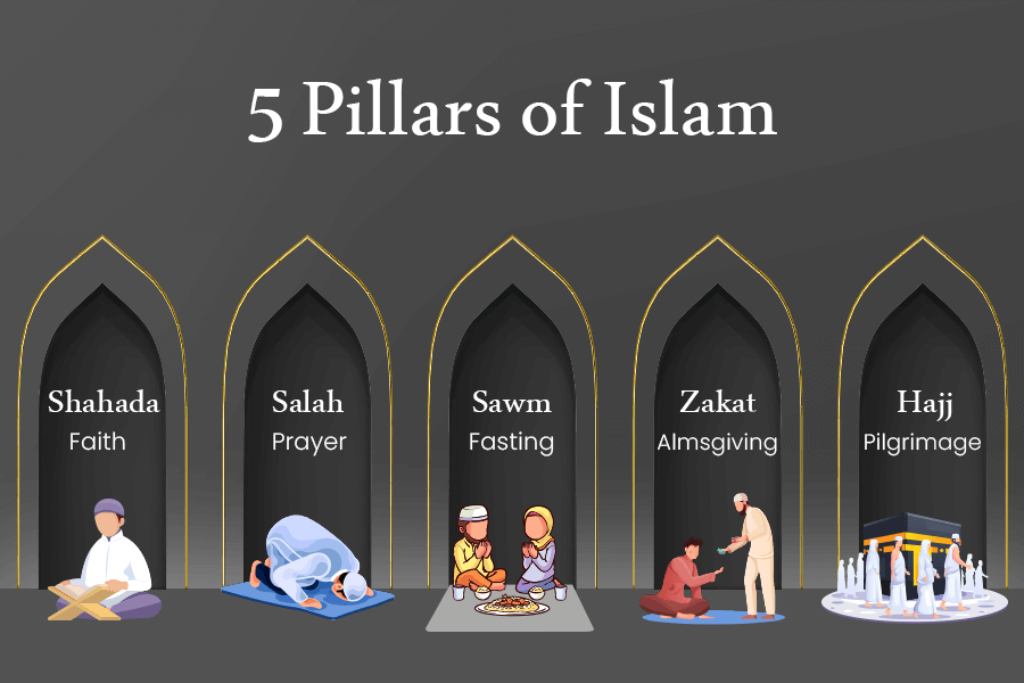
The Prophet (ﷺ) said: “Islam is built on five pillars” (Sahih Bukhari). These obligatory acts draw Muslims closer to Allah:
| Pillar | Description | Spiritual Benefit | Reference |
|---|---|---|---|
| Shahada | Declaring: “There is no god but Allah, Muhammad is His messenger.” | Renews faith daily. | Hadith: Sahih Muslim. |
| Salah | Five daily prayers: Fajr, Dhuhr, Asr, Maghrib, Isha. | Direct connection to Allah; “Prayer prohibits immorality” (Quran, 29:45). | Surah An-Nisa, 4:103. |
| Zakat | 2.5% of wealth to the needy annually. | Cleanses greed, builds community. | Surah At-Tawbah, 9:60. |
| Sawm | Fasting in Ramadan from dawn to dusk. | Teaches empathy; “Fasting is a shield” (Sahih Bukhari). | Surah Al-Baqarah, 2:183. |
| Hajj | Pilgrimage to Mecca if able. | Erases sins, unites Muslims. | Surah Al-Hajj, 22:27. |
These pillars structure a Muslim’s spiritual and social life, fostering peace and purpose.
Moral and Ethical Conduct in Islam
Islam emphasizes virtues like compassion, justice, honesty, and humility. The Prophet (ﷺ) said: “The best among you are those best in character” (Sahih Bukhari).
Examples include:
- Compassion: “The merciful are shown mercy by the Most Merciful” (Sunan Tirmidhi).
- Justice: “Stand firmly for justice, even if it be against yourselves” (Surah An-Nisa, 4:135).
- Honesty: The Prophet (ﷺ) was called Al-Amin for his trustworthiness.
- Humility: “No one who has an atom’s weight of arrogance in his heart will enter Paradise” (Sahih Muslim).
These principles guide Muslims in personal and societal interactions.
Peaceful Coexistence and Interfaith Relations
Islam promotes peaceful coexistence: “There is no compulsion in religion” (Surah Al-Baqarah, 2:256). Muslims are encouraged to respect other faiths, as the Quran honors prophets like Moses and Jesus (peace be upon them).
The Prophet (ﷺ) said: “The Muslim is the one from whose tongue and hand the people are safe” (Sahih Bukhari). Historical examples, like the Constitution of Medina (622 CE), show Muslims living harmoniously with Jews and Christians.
Daily Life as a Muslim: Guidance from Allah
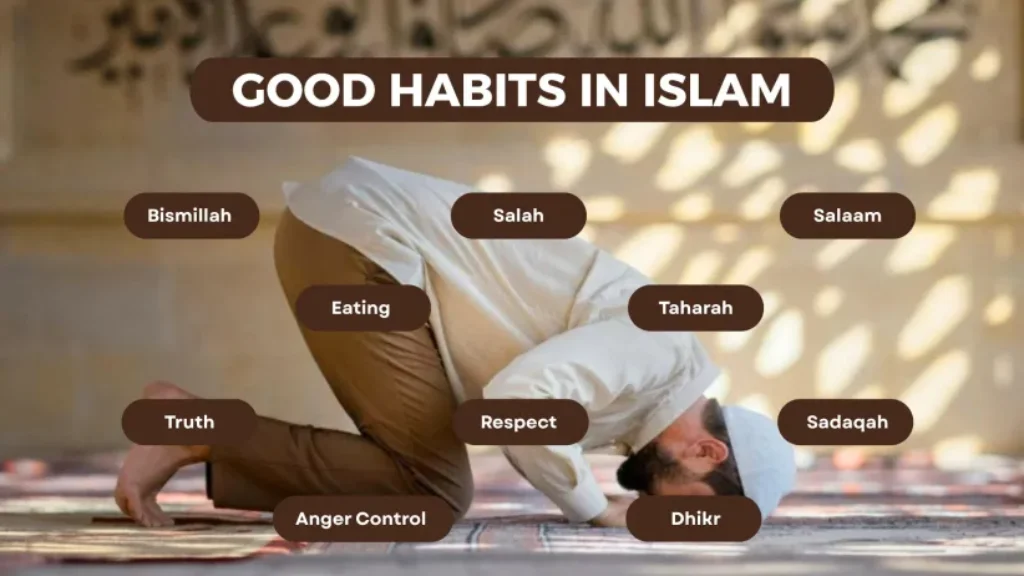
Islam guides every aspect of life:
- Halal Food: Ensures purity; “Eat of what is lawful and good” (Quran, 2:168).
- Modesty: Dress and behavior reflect dignity; “Tell the believing women to lower their gaze” (Quran, 24:31).
- Family: “The best among you are those best to their families” (Tirmidhi).
- Charity: Beyond zakat, voluntary charity (sadaqah) brings blessings.
In today’s world, Muslims use apps like Muslim Pro for prayer times and Quran study, blending faith with technology. Festivals like Eid al-Fitr and Eid al-Adha strengthen community bonds.
Historical Journey of Islam: From Mecca to the Modern World
Islam starts from Adam (pbuh) and the mission is completed by Prophet Muhammad (pbuh). In the time of Prophet Muhammad (Pbuh), Islam’s spread was miraculous:
- 610-632 CE: Revelation to Muhammad (ﷺ); Hijrah to Medina (622 CE); establishment of the ummah.
- 632-661 CE: Rightly Guided Caliphs (Abu Bakr, Umar, Uthman, Ali) expanded Islam to Persia and Byzantium.
- Golden Age (8th-13th centuries): Scholars like Ibn Sina (medicine), Al-Khwarizmi (algebra), and Al-Ghazali (theology) advanced knowledge.
- Empires: Ottoman, Mughal, and Safavid empires showcased Islamic art, architecture, and justice.
- 2025: With 2.1 billion Muslims (Pew, 2023), Islam thrives in diverse regions, from Indonesia to Europe.
Islam’s Contributions to Civilization
Islam fostered advancements that shaped the world:
- Science: Al-Khwarizmi’s algebra and Ibn al-Haytham’s optics laid the foundations for modern science.
- Medicine: Ibn Sina’s Canon of Medicine was a standard text in Europe for centuries.
- Architecture: The Great Mosque of Cordoba and the Taj Mahal reflect Islamic aesthetics.
- Education: The House of Wisdom in Baghdad preserved Greek, Persian, and Indian knowledge.
These contributions highlight Islam’s emphasis on knowledge: “Seeking knowledge is obligatory on every Muslim” (Ibn Majah).
Branches of Islam: Unity in Diversity
Islam’s main branches share core beliefs but differ in historical interpretations:
- Sunni (85-90%): Follow the Sunnah and community consensus (ijma).
- Shia (10-15%): Emphasize the leadership of Ali (RA) and his descendants; subgroups include Twelvers and Ismailis.
- Sufism: Focuses on spiritual closeness to Allah through practices like dhikr (remembrance).
The Quran urges unity: “Hold firmly to the rope of Allah all together” (Surah Aal-E-Imran, 3:103).
Addressing Common Misconceptions About Islam
- Violence: Islam means peace; jihad is primarily an inner struggle or just defense. “Whoever kills a soul… it is as if he killed all mankind” (Quran, 5:32).
- Women’s Rights: Islam granted women inheritance and education rights in the 7th century. Aisha (RA) was a leading scholar. Modern Muslim women like Malala Yousafzai excel globally.
- Science: The Quran encourages exploration: “Do they not look at the camels, how they are created?” (Quran, 88:17). Verses align with discoveries like embryology (Quran, 23:12-14).
- Sharia: A framework for ethical living, not oppression. It prioritizes justice and mercy.
- Terrorism: Condemned; “Do not transgress limits” (Quran, 2:190).
Learn from authentic sources like Quran.com or Sunnah.com.
Islam in Modern Times: Addressing Modern Challenges
Islam offers solutions to contemporary issues:
- Climate Change: The Quran emphasizes stewardship (khilafah): “Do not cause corruption on the earth” (Quran, 7:56). Muslim initiatives like EcoMasjid promote sustainability.
- Mental Health: Salah and dhikr reduce stress; “In the remembrance of Allah do hearts find rest” (Quran, 13:28).
- Social Justice: Zakat and charity address inequality; Muslim NGOs like Islamic Relief aid millions.
Testimonials: Islam’s Impact on Lives
- Aisha, USA (2025): “Converting to Islam gave me purpose. Salah centers my day, and the Quran answers my questions about life.”
- Ahmed, Indonesia: “Islam’s emphasis on community helped me rebuild after the 2024 floods. Zakat supported my family.”
These stories show Islam’s transformative power.
Frequently Asked Questions (FAQs)
What is the purpose of life in Islam?
To worship Allah and live righteously, earning Paradise: “I have not created jinn and mankind except to worship Me” (Quran, 51:56).
How can I become a Muslim?
Recite the Shahada sincerely: “There is no god but Allah, Muhammad is His messenger.” Contact a mosque for guidance—Allah welcomes all.
Does Islam respect other religions?
Yes: “There is no compulsion in religion” (Quran, 2:256). Prophets like Moses and Jesus are honored.
Is Islam compatible with science?
Absolutely; the Quran aligns with discoveries like embryology (Quran, 23:12-14).
What about women’s rights?
Islam empowers women; Aisha (RA) was a scholar. Muslim women lead in fields like science and politics.
What is Sharia?
A framework for ethical living, prioritizing justice and mercy, not punishment.
Conclusion: A Universal Call to Peace
The meaning of Islam—submission to Allah leading to peace—offers a holistic approach to life. Through faith, worship, and ethical living, Islam fosters personal tranquility and communal harmony, fulfilling humanity’s purpose of connecting with the Creator. As the Quran says: “Indeed, the religion in the sight of Allah is Islam” (Surah Aal-E-Imran, 3:19).
We invite you to explore Islam further. Visit a mosque, read the Quran, or contact us at haqqfinder.com for free resources. Share your thoughts—what aspect of Islam inspires you?
References and Further Reading
- Quran translations (e.g., Sahih International, Quran.com).
- Sahih Bukhari, Sahih Muslim (Sunnah.com).
- Pew Research Center (2023). “Religion Projections to 2050.”
- Esposito, J. L. (2011). What Everyone Needs to Know About Islam.
- Al-Ghazali, M. (2000). The Incoherence of the Philosophers.
- Ibn Majah, Sunan Tirmidhi, Muwatta Malik.