


Musʿab ibn ʿUmair (Arabic: مصعب بن عمير), also known as Musʿab al-Khayr (“the Good”), was one of the most noble companions of the Prophet Muhammad (peace be upon him) and among the earliest to accept Islam. His life tells a story of remarkable transformation—from the comfort and luxury of Mecca to the hardship of faith, sacrifice, and martyrdom.
As the first ambassador of Islam in Medina, Musʿab played a pivotal role in preparing the ground for the Prophet’s migration (Hijrah) and in spreading the message of Islam among the Ansar. His courage and dedication ultimately led him to the battlefield of Uhud, where he gave his life for the cause of Allah.
This biography explores his early life, conversion to Islam, mission in Medina, character, and martyrdom, drawing on authentic sources such as Sahih al-Bukhari, Sunan al-Tirmidhi, Ibn Saʿd’s Al-Tabaqat al-Kubra, and Ibn Hisham’s Al-Sirah al-Nabawiyyah. It seeks to present not only the events of his life but also the lessons of faith, humility, and steadfastness that continue to inspire Muslims today.
Early Life and Background: Mecca’s Pampered Youth
Mus’ab ibn Umair was born into the Banu Abd al-Dar branch of the Quraysh tribe in Mecca, approximately between 594 and 598 CE [1]. His full lineage is Mus’ab ibn Umair ibn Hashim ibn Abd Manaf ibn Abd al-Dar ibn Qusay al-Qurashi, connecting him to the noble Quraysh, the custodians of the Kaaba in pre-Islamic Arabia [2]. His father, Umair ibn Hashim, and mother, Khunas (or Khannas) bint Malik, were among Mecca’s wealthiest elites [3].
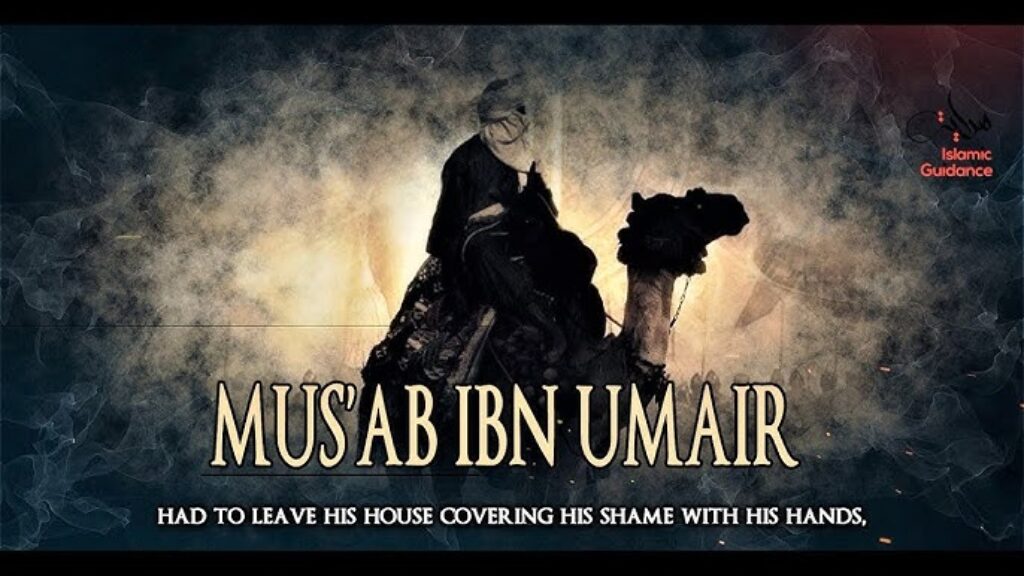
As the only child of his mother (with two half-brothers from his father’s side, Mansur ibn Umair and Abu Yazid ibn Umair, who later embraced Islam), Mus’ab Ibn Umayr inherited a substantial portion of his father’s fortune upon his early death, reportedly amounting to nearly half of Mecca’s wealth [4, 5].
Raised in opulence, Mus’ab Ibn Umayr was celebrated as the “flower of the Quraysh” for his extraordinary handsomeness, charisma, and intellect [6]. He donned the finest silk garments, custom-tailored attire, and Hadrami shoes imported from Yemen, a luxury reserved for the affluent [7]. His use of expensive perfumes was so distinctive that their scent lingered in Mecca’s streets, setting fashion trends among the youth [8].
As a child, he wore gold ornaments, and his mother, who never remarried, devoted her life to his upbringing, showering him with unmatched care [9]. Despite his young age, Mus’ab Ibn Umayr was permitted to attend Quraysh elders’ councils, a rare privilege reflecting his eloquence and social standing [1]. Historical accounts describe him as courteous, articulate, and admired by both peers and elders, making him a central figure in Meccan society [10]. Yet, beneath this glamorous exterior, Mus’ab’s soul yearned for deeper meaning, a quest that would lead him to Islam.
Conversion to Islam: A Transformative Encounter
In 614 CE, during the Prophet Muhammad’s (peace be upon him) secret preaching phase at Dar al-Arqam, the house of Al-Arqam ibn Abi al-Arqam, serving as an early Islamic learning center, Mus’ab’s curiosity drew him to investigate the new faith [1]. Despite his life of luxury, he was intrigued by the Prophet’s message of monotheism and the Hereafter.
Sneaking into Dar al-Arqam at night to avoid detection, he heard the Quran recited and the Prophet’s teachings, which profoundly moved him [2]. At approximately 16-20 years old, Mus’ab Ibn Umayr embraced Islam, becoming one of the Sabiqun al-Awwalun (the foremost converts) alongside figures like Ali ibn Abi Talib and Abu Bakr [3]. The Prophet welcomed him warmly, recognizing his potential as a future leader [11].
Fearing his mother Khunas’s fierce opposition, a staunch defender of Quraysh polytheism, Mus’ab Ibn Umayr kept his conversion secret [4]. However, Uthman ibn Talha, a non-Muslim at the time, observed him praying in the Islamic manner and informed Khunas, leading to a confrontation [5].
Mus’ab Ibn Umayr boldly declared his faith, reciting Quranic verses to his mother, who was momentarily moved but refused to accept his choice [12]. His unwavering commitment marked the beginning of his trials, as his family sought to deter him from Islam through persuasion and force [13].
Persecution and Imprisonment: Unyielding Faith
Khunas, wielding significant influence in Mecca, reacted with fury, imprisoning Mus’ab Ibn Umair in their home and chaining him to force recantation [1]. Historical accounts detail severe measures, including beatings and deprivation of food, yet Mus’ab remained resolute, refusing to renounce Islam [14]. His mother, torn between love and anger, disinherited him, stripping away his wealth and comforts [2].
This marked a dramatic shift from luxury to hardship, as noted by companion Sa’d ibn Abi Waqqas: “I saw Mus’ab when he was affluent, but after embracing Islam, his skin deteriorated from hardship” [15]. Mus’ab’s trials exemplify the Quranic principle of testing believers: “Do people think they will be left alone after saying ‘We believe’ without being tested?” (Quran 29:2) [16].
Despite confinement, Mus’ab’s faith grew stronger. He reportedly recited the Quran to his mother during imprisonment, softening her resolve momentarily, though she persisted in opposition [17]. His steadfastness under such pressure underscores his conviction, as later praised by the Prophet: “Mus’ab was brought up in luxury, yet left it all for Allah” [3].
First Migration to Abyssinia: Seeking Sanctuary

As persecution of Muslims intensified in Mecca, the Prophet advised a group to seek refuge in Abyssinia (modern-day Ethiopia) under the Christian king Negus (Ashama ibn Abjar), known for his justice [1].
In 615 CE, Mus’ab Ibn Umayr seized an opportunity when his guard was distracted, escaped confinement, and joined the first Hijrah to Abyssinia [2]. This migration, involving companions like Ja’far ibn Abi Talib, offered Mus’ab safety and a chance to learn from Ja’far’s eloquent defense of Islam before Negus [18]. His time in Abyssinia strengthened his skills in da’wah (Islamic outreach), preparing him for future roles [19].
Mus’ab Ibn Umair returned to Mecca around 616 CE upon hearing false rumors that the Quraysh had softened toward Muslims [3]. Finding the persecution unchanged, his mother attempted to re-imprison him, but Mus’ab, now emboldened, stood firm, even threatening self-defense if coerced [4]. His mother relented, unable to break his resolve, marking a turning point in their relationship [20].
Return to Mecca and Hardships: From Riches to Rags
Upon returning to Mecca, Mus’ab Ibn Umayr faced poverty and social ostracism. Once adorned in fine silks, he wore patched leather clothes, a stark contrast noted by companions [1]. The Prophet, seeing him in this state, wept and said, “I have not seen a more handsome individual than Mus’ab, nor one who was brought up afforded by comforts and luxuries” [2]. Sa’d ibn Abi Waqqas observed, “His skin would come off like a snake’s from hardship” [15].
This transformation reflected Mus’ab’s choice to prioritize faith over worldly wealth, aligning with the Quranic verse: “Indeed, Allah has purchased from the believers their lives and their properties [in exchange] for that they will have Paradise” (Quran 9:111) [16].
Mus’ab’s sacrifices were profound. He lost his social status, wealth, and family support, yet his demeanor remained calm and resolute. The Prophet’s emotional response highlights Mus’ab’s significance among the Sahaba, as noted in Al-Tabaqat al-Kubra: “He left all for the love of Allah and His Messenger” [3].
Appointment as the First Ambassador of Islam to Medina

In 621 CE, following the First Pledge of Aqabah, where 12 men from Yathrib (later Medina) pledged allegiance to the Prophet, Mus’ab Ibn Umair was appointed as the first ambassador (safeer) of Islam to teach the Quran and spread the faith in Medina [1].
The Prophet chose him for his noble character, eloquence, and intellect, as well as his proven resilience under persecution [4]. Accompanied by As’ad ibn Zurarah of the Khazraj tribe, Mus’ab Ibn Umayr resided in his home and earned the title “al-Muqri” (the Reciter/Teacher) for his mastery in teaching the Quran [2].
Mus’ab’s mission was to educate new converts, unite the rival Aws and Khazraj tribes, and prepare Medina for the Prophet’s Hijrah. His approach combined patience, wisdom, and Quranic recitation, making him an ideal ambassador [19].
Within a year, he expanded the Muslim community from 12 to over 75, a testament to his diplomatic prowess [5]. He also established the first Jumu’ah (Friday) prayer in Medina, a significant milestone in Islamic communal worship [17].
Key Conversions in Medina: Uniting Aws and Khazraj
Mus’ab’s diplomatic efforts led to the conversion of key tribal leaders, transforming Medina into a Muslim stronghold. A pivotal moment occurred with Usayd ibn Hudayr, a leader of the Aws tribe, who approached Mus’ab Ibn Umair and As’ad with a spear, intent on expelling them for “misguiding” his people [1].
Mus’ab calmly invited him to listen, reciting verses from the Quran (likely Surah Al-Baqarah or Al-Fath) [2]. Moved by the words, Usayd converted, declaring, “What beautiful words! How does one join this religion?” After performing ritual ablution and testifying to Allah’s oneness, he returned to his tribe, paving the way for further conversions [3].
This incident led to Sa’d ibn Mu’adh, another Aws leader and As’ad’s cousin, visiting Mus’ab Ibn Umayr. Initially angry, Sa’d was similarly swayed by Mus’ab’s recitation and calm demeanor, converting and declaring to his Banu Ashhal clan: “None of you may speak to me until you embrace Islam” [4]. By day’s end, the entire clan converted, a monumental achievement [17].
Mus’ab Ibn Umair also converted Sa’d ibn Ubadah of the Khazraj, uniting the tribes through the Quranic message of brotherhood: “The believers are but brothers” (Quran 49:10) [16]. His ability to resolve tribal rivalries laid the foundation for Medina’s unity, as detailed in Ibn Hisham’s Seerah [19].
The Pledges of Aqabah: Foundation for the Hijrah
In 622 CE, Mus’ab Ibn Umayr returned to Mecca with 75 Medinans (including two women) for the Second Pledge of Aqabah, a clandestine meeting near Mina where they pledged to protect the Prophet at all costs [1]. Mus’ab’s detailed reports on Medina’s growing Muslim community convinced the Prophet of the city’s readiness for the Hijrah [2].
This pledge, conducted under moonlight to avoid Quraysh detection, marked a turning point, transitioning Islam from a persecuted movement to an established community [19]. Mus’ab’s role as the liaison between Mecca and Medina earned him the title “bridge between the Muhajirun and Ansar” in scholarly works [17].
Hijrah to Medina: Building the Muslim Community
Mus’ab Ibn Umair migrated to Medina in 622 CE (his second Hijrah), joining the Muhajirun from Mecca [1]. He participated in constructing Masjid an-Nabawi, the Prophet’s Mosque, and fostering brotherhood between the Muhajirun (Meccan emigrants) and Ansar (Medinan supporters) [2].
His continued teaching of the Quran to new converts strengthened Medina’s educational foundation, as noted in Al-Tabaqat al-Kubra: “Mus’ab sowed the seeds of knowledge in Medina” [3]. His presence during this formative period solidified the community’s spiritual and social cohesion [19].
Participation in Battles: Badr and Uhud
Battle of Badr: Standing Firm

In 624 CE, Mus’ab Ibn Umayr fought in the Battle of Badr, a pivotal victory for the Muslims against a Quraysh force of 1,000, led by figures like Amr ibn Hisham (Abu Jahl) [1]. The Muslims, numbering around 313 with only 70 camels and two horses, relied on faith and strategy [2].
While specific actions by Mus’ab are not detailed, his participation alongside Ali, Hamza, and others underscored his commitment [3]. The Prophet later testified that Badr’s participants were “martyrs in Allah’s sight,” a praise encompassing Mus’ab [4].
Battle of Uhud: Heroic Martyrdom
In 625 CE, Mus’ab Ibn Umair was entrusted with carrying the Muslim standard in the Battle of Uhud [1]. When some archers abandoned their posts, believing victory was secured, the Quraysh, led by Khalid ibn al-Walid, launched a counterattack targeting the Prophet [2].
Mus’ab, resembling the Prophet in stature and appearance, raised the standard and shouted “Allahu Akbar!” to divert the enemy’s attention [3].
Ibn Qami’ah, a Quraysh warrior, severed Mus’ab’s right hand; he switched the flag to his left, reciting Quran 3:144: “Muhammad is but a messenger; messengers have passed before him” [4]. When his left hand was severed, he clutched the standard with his arms, refusing to let it fall, until he was fatally wounded [5].
Sixty-five Muslims, including Mus’ab Ibn Umayr, were martyred [17]. His sacrifice protected the Prophet, ensuring the Muslim community’s survival.
Martyrdom and Burial at Uhud: A Humble Farewell
After Uhud, the Prophet stood by Mus’ab’s body, weeping and reciting Quran 33:23: “Among the believers are men true to their covenant with Allah” [1]. With only a single Namira (sheet) for a shroud, Mus’ab’s body could not be fully covered; when his head was covered, his feet were exposed, and vice versa [2].
The Prophet instructed, “Cover his head and place Idhkhir grass over his feet,” honoring his sacrifice [3]. Mus’ab Ibn Umayr was buried beside Hamza ibn Abdul Muttalib, the Prophet’s uncle, cementing their shared legacy as early ambassadors (Ja’far to Abyssinia, Mus’ab to Medina) [4].
Hamnah bint Jahsh, Mus’ab’s wife, learned of her brother Abdullah and uncle Hamza’s martyrdoms, responding with “Inna lillahi wa inna ilayhi raji’un” (To Allah we belong, and to Him we return), seeking forgiveness for them [5].
Upon hearing of Mus’ab’s death, she cried out in grief, prompting the Prophet to remark, “A husband holds a special status in the eyes of his wife” [17]. This narration, recorded in Sunan Ibn Majah (Hadith 1590), underscores the emotional weight of his loss [18].
Family and Personal Life: Bonds Amid Sacrifice
Mus’ab Ibn Umair married Hamnah bint Jahsh, sister of Zainab bint Jahsh (a wife of the Prophet), and they had a daughter named Zainab, through whom his lineage continued [1]. His half-brothers, Mansur (martyred at Yarmouk) and Abu Yazid (converted later), also embraced Islam, though Mus’ab’s immediate family life was marked by his mother’s opposition [2].
Despite Khunas’s attempts to deter him, she eventually ceased confrontation, unable to break his faith [3]. The Prophet’s prayer for Mus’ab’s orphaned children, “O Allah, be their Guardian and Protector,” highlights his concern for their welfare [4].
Hamnah’s grief at Uhud, as detailed in Al-Sirah al-Nabawiyyah, reflects the deep marital bond, with the Prophet acknowledging its uniqueness [19]. Mus’ab’s family dynamics illustrate the personal costs of his devotion, as he balanced faith with familial ties.
Character and Virtues: The Good (al-Khayr)

Mus’ab Ibn Umayr was renowned for his eloquence, calm demeanor, and diplomatic skill, earning titles like “al-Muqri” (the Reciter/Teacher) in Medina and “Mus’ab al-Khayr” (the Good) for his piety [1]. His intelligence shone in Quraysh councils, and his patience was evident in enduring persecution [2].
His courage in battles and diplomacy in Medina showcased a multifaceted character [3]. Companions like Aamir ibn Rabi’ah praised his manners: “I have never seen someone as well-mannered as Mus’ab, nor one who avoided disputes” [4].
His virtues included sincerity, humility, and reliance on Allah, as seen in his transformation from luxury to poverty [17]. Ibn Sa’d notes, “Mus’ab’s heart was free of pride despite his wealth” [3]. His impact—converting Medina’s leaders and uniting tribes—earned him the prophetic praise: “Mus’ab planted the seed and trusted Allah for rain” [19].
Hadith Narrations Involving Mus’ab ibn Umair
The following authentic Hadith highlights Mus’ab’s significance:
- Martyrdom and Shroud: Khabbab ibn al-Aratt narrated, “We migrated with the Messenger of Allah seeking Allah’s pleasure… Mus’ab was martyred on the day of Uhud, and did not leave anything except a Namira. If we covered his head, his feet were uncovered… The Prophet said, ‘Cover his head and put Idhkhir over his feet’” (Sahih al-Bukhari, Kitab al-Jana’iz, Hadith 1376) [1].
- Special Status: Ali ibn Abi Talib reported, “The Prophet said, ‘Every prophet has seven noble companions… I have been granted fourteen,’” naming Mus’ab among them alongside Abu Bakr, Umar, and others (Sunan al-Tirmidhi, Abwab Manaqib, Hadith 3785) [2].
- Wife’s Grief: The Prophet said of Hamnah’s reaction to Mus’ab’s martyrdom, “A husband holds a special status in the eyes of his wife” (Sunan Ibn Majah, Kitab al-Jana’iz, Hadith 1590) [3].
- Sacrifice and Remembrance: Abdurrahman ibn Awf wept, saying, “Mus’ab was better than me, yet had only a sheet for a shroud… I fear our rewards have been given in this world” [4].
These narrations emphasize Mus’ab’s sacrifice, status, and the emotional impact of his martyrdom, reinforcing his eternal reward.
Scholarly Perspectives: Historical and Modern Insights
Historical scholars provide rich insights into Mus’ab’s life:
- Ibn Sa’d (Al-Tabaqat al-Kubra): Details his lineage, wealth, conversion, and ambassadorial role, noting his transformation as a model of sacrifice [1].
- Ibn Hisham (Al-Sirah al-Nabawiyyah): Highlights his diplomacy in Medina and heroism at Uhud, calling him “the bridge between Mecca and Medina” [2].
- Ibn al-Athir (Usd al-Ghabah): Praises his eloquence and role in uniting tribes, emphasizing his title “al-Muqri” [3].
- Al-Bayhaqi States, “What man could meet Allah with Medina in his scale?” reflecting Mus’ab’s monumental contribution [4].
Modern scholars view Mus’ab Ibn Umayr as a youth role model, countering materialism with his rejection of luxury [5]. The Supreme Seerah series describes his conversion as a “silent revolution,” inspiring those chasing worldly fame [6].
Shia sources, like Al-A’lam by Zarkuli, emphasize his zeal as a “passionate defender,” though Sunni sources focus more on diplomacy [7]. These perspectives collectively affirm Mus’ab’s multifaceted legacy.
Legacy: The Bridge Between Mecca and Medina
Mus’ab’s legacy is profound: he bridged the Muhajirun of Mecca and the Ansar of Medina, enabling the Hijrah and Islam’s establishment [1]. His role in converting Medina’s leaders and uniting tribes laid the foundation for the Muslim Ummah [2].
His martyrdom at Uhud, protecting the Prophet, cemented his status as a symbol of sacrifice [3]. Modern works, like the 2025 children’s book The Life of Hadrat Musʿab ibn Umair, illustrate his story with vivid imagery for young readers, ensuring accessibility [8]. Scholarly lectures, such as Yaqeen’s “The Man Who Gave It All,” highlight his relevance in combating materialism [5].
Mus’ab’s absence of recorded Hadith narrations from himself reflects his humility; he left no personal sayings, only actions [4]. His daughter Zainab carried his lineage, and his story continues to inspire, as seen in educational resources like Small Steps to Allah [9]. His burial beside Hamza links their legacies as ambassadors who sacrificed all [10].
Lessons from Mus’ab ibn Umayr’s Life
Mus’ab’s life offers timeless lessons, grounded in the Quran and Hadith:
- Sacrifice for Faith: He abandoned wealth for Islam, embodying Quran 9:111 [1].
- Courage and Resilience: Endured imprisonment and poverty without wavering [2].
- Diplomacy and Leadership: United tribes through patience and Quranic recitation [3].
- Trust in Allah: Relied on divine support, as in Quran 29:2 [4].
- Youth Potential: Chosen as an ambassador in his teens, showing young people’s impact [5].
- Humility: Never boasted despite pre-Islamic fame [6].
- Da’wah Excellence: Converted through character and the Quran, a model for outreach [7].
- Martyrdom’s Honor: His death reflects Quran 33:23 [8].
- Family Duty: Honored his mother despite opposition [9].
- Eternal Perspective: Choose hereafter over worldly gains [10].
These lessons resonate with modern audiences, encouraging purpose-driven lives over materialism.
Timeline of Mus’ab ibn Umair’s Life
| Year (CE) | Event | Details |
|---|---|---|
| 594-598 | Born in Mecca | The affluent Quraysh family inherited vast wealth. |
| 614 | Converts to Islam | At Dar al-Arqam, join Sabiqun al-Awwalun. |
| 615 | Imprisoned; escapes to Abyssinia | First Hijrah to escape persecution. |
| ~616 | Returns to Mecca | Faces disinheritance, poverty. |
| 621 | Ambassador to Medina | At Dar al-Arqam, joins Sabiqun al-Awwalun. |
| 622 | Second Pledge of Aqabah; Hijrah | Teaches Quran, converts leaders, and establishes Jumu’ah. |
| 624 | Battle of Badr | Fights with Muslims against Quraysh. |
| 625 | Battle of Uhud; martyrdom | Holds standard, protects Prophet, buried beside Hamza. |
Frequently Asked Questions (FAQs)
Who was Mus’ab ibn Umair?
A prominent Sahabi, early convert, first ambassador of Islam, and martyr at Uhud [1].
What was Mus’ab ibn Umayr’s role in Medina?
He taught the Quran, converted tribal leaders, united Aws and Khazraj, and prepared for the Hijrah [2].
How did Mus’ab ibn Umair die?
Martyred at Uhud in 625 CE, holding the Muslim standard to protect the Prophet [3].
What lessons can we learn from Mus’ab ibn Umair?
Sacrifice, resilience, diplomacy, trust in Allah, and youth potential [4].
Who was Mus’ab ibn Umair’s wife?
Hamnah bint Jahsh; they had a daughter, Zainab [5].
Why is Mus’ab called the first ambassador of Islam?
Appointed by the Prophet to spread Islam in Medina, laying the groundwork for the Hijrah [1].
What Hadith mentions Mus’ab ibn Umair?
Examples include his shroud narration (Bukhari 1376) and special status (Tirmidhi 3785) [2, 3].
How does Mus’ab ibn Umair inspire today?
His rejection of luxury for faith counters modern materialism, inspiring purposeful living [5].
Conclusion
Mus’ab ibn Umair’s transformation from Mecca’s wealthiest youth to a martyr at Uhud exemplifies unparalleled devotion to Islam. His role as the first ambassador bridged Mecca and Medina, enabling the Hijrah and the Ummah’s foundation. His sacrifices, praised in Hadith and Seerah, inspire across centuries, reminding us that true wealth lies in faith. For further study, consult the referenced Hadith and Seerah texts. Share your thoughts—what aspect of Mus’ab’s life resonates with you?
References
- Ibn Sa’d, Al-Tabaqat al-Kubra, Vol. 3, pp. 85-87, Dar-ul-Kutub al-Ilmiyyah, Beirut, 1990.
- Ibn Hisham, Al-Sirah al-Nabawiyyah, pp. 294-396, Dar Ibn Hazm, Beirut, 2009.
- Ibn al-Athir, Usd al-Ghabah fi Ma’rifat al-Sahabah, Vol. 5, pp. 175-177, Dar-ul-Kutub al-Ilmiyyah, Beirut, 2003.
- Al-Bayhaqi, cited in Yaqeen Institute, “Musab Ibn Umair (ra): The Man Who Gave It All,” https://yaqeeninstitute.org/omar-suleiman/musab-ibn-umair-ra-the-man-who-gave-it-all-the-firsts.
- Yaqeen Institute, “Musab Ibn Umair (ra): The Man Who Gave It All,” https://yaqeeninstitute.org/omar-suleiman/musab-ibn-umair-ra-the-man-who-gave-it-all-the-firsts.
- Supreme Seerah, “From Luxury to Legacy: The Life of Mus’ab Ibn Umair,” https://supremeseerah.com/2025/07/18/from-luxury-to-legacy/.
- Zarkuli, Al-A’lam, Vol. 7, p. 248, cited in Al-islam.org, https://al-islam.org/exemplary-youths-during-early-days-islam-muhammad-ali-chenarani/musab-ibn-umayr-passionate-defender.
- The Life of Hadrat Musʿab ibn Umair, Amazon, https://www.amazon.com/Islamic-Childrens-Illustrations-Pictures-Muslim/dp/B0CF4J6VMV.
- Small Steps to Allah, “The Great Companions – Mus’ab Ibn Umayr R.A,” https://smallstepstoallah.com/the-great-companions-musab-ibn-umayr-r-a/.
- WithProphet.com, “Musab ibn Umair, the first ambassador,” https://www.withprophet.com/en/musab-ibn-umair-the-first-ambassador-of-islam-in-12-bh.
- Sahih al-Bukhari, Kitab al-Jana’iz, Hadith 1376.
- Sunan al-Tirmidhi, Abwab Manaqib, Hadith 3785.
- Sunan Ibn Majah, Kitab al-Jana’iz, Hadith 1590.
- Al-Isabah fi Tamyiz al-Sahabah, Vol. 3, p. 401, Dar-ul-Kutub al-Ilmiyyah, Beirut.
- Siyar as-Sahaba, Vol. 2, pp. 270-275, Darul Isha’at, Karachi, 2004.
- The Holy Quran, Surah Al-Baqarah (2:155), Surah Al-Ankabut (29:2), Surah Al-Ahzab (33:23), Surah At-Tawbah (9:111), Surah Al-Fath (49:10).
- Al-Sirat al-Nabawiyyah li Ibn Ishaq, p. 230, Dar-ul-Kutub al-Ilmiyyah, Beirut, 2004.
- Hilyat al-Awliya’, Vol. 1, p. 106, cited in Al-islam.org.
- Amtā‘ al-Asmā‘, p. 35, cited in Al-islam.org.
- Nahāyat al-Arb, p. 232, cited in Al-islam.org.