

Shah Abdul Aziz Muhaddith Dehlvi (November 11, 1746 –June 5, 1824) was a monumental Sunni scholar, Sufi saint, and Islamic reformer in the Indian subcontinent. As the eldest son of Shah Waliullah Dehlawi, he inherited a profound intellectual and spiritual legacy, advancing Islamic scholarship during a time of Mughal decline and the rise of British colonialism.
Renowned for his Tafsir-i-Azizi, Tohfa Ithna Ashariyya, and the groundbreaking Dar ul Harb fatwa, Shah Abdul Aziz Dehlvi shaped Islamic revivalism and inspired anti-colonial resistance. His leadership at Madrasah Rahimiyya and progressive rulings on issues like abortion and birth control cemented his status as a mujaddid (reviver). This comprehensive biography explores his life, scholarly contributions, socio-political impact, and enduring legacy in South Asian Islamic history.
Early Life and Education
Shah Abdul Aziz Dehlvi was born on 25 Ramadan 1159 AH (11 October 1746) in Delhi, during the reign of Mughal Emperor Muhammad Shah. Claiming Arab descent through Caliph Umar, his family had resided in India for 15 generations, holding prominent military and scholarly roles. His grandfather, Shah Abd-al-Rahim, was a noted theologian and mystic, and his father, Shah Waliullah Dehlawi, was a towering Islamic reformer whose works, like Hujjatullah al-Baligha, reshaped South Asian scholarship.
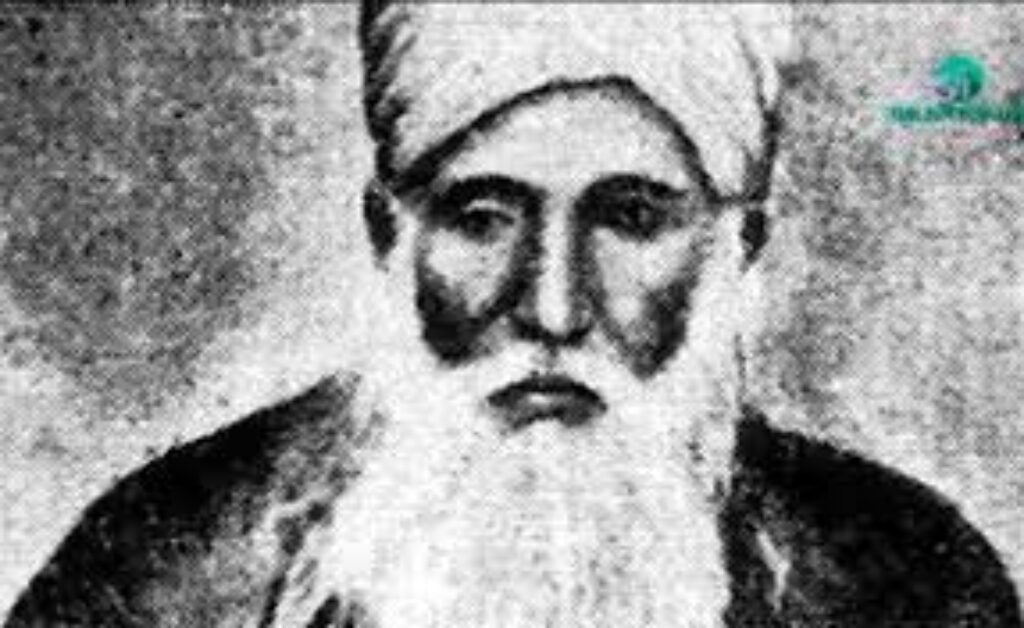
Raised in Delhi’s vibrant intellectual milieu, Maulana Shah Abdul Aziz Muhaddis Dehlvi was educated by his father and eminent scholars Khwaja Amin and Aseq Folti. By age 17, he mastered Qur’an, Hadith, Tafsir (Quranic exegesis), Fiqh (jurisprudence), logic, philosophy, and Tasawwuf (Sufism).
Despite health challenges, he displayed remarkable diligence. After Shah Waliullah died in 1762, Shah Abdul Aziz, at just 16, assumed leadership of Madrasah Rahimiyya, his father’s institution, transforming it into a leading center of Islamic learning. His lectures drew scholars from across India, establishing him as a prodigious muhaddith (Hadith scholar) and mujtahid (independent jurist).
Scholarly Contributions
Tafsir and Hadith
Hazrat Shah Abdul Aziz Dehlvi was a distinguished mufassir and muhaddith. His Tafsir-i-Azizi, a Persian Quranic commentary, provided profound insights tailored to Indian Muslims navigating colonial rule. He continued his father’s exegesis, covering Surah Al-Maida to Al-Hujurat’s 13th verse.
His Urdu Quran translation, completed 50 years after Shah Waliullah’s Persian version, made the Qur’an accessible to a broader audience as Urdu replaced Persian in India. His BustaanU-l-Muhadditheen systematized Hadith scholarship, emphasizing rigorous methodology adaptable to local contexts. His Sahih Bukhari lectures at Madrasah Rahimiyya attracted leading scholars, reinforcing his authority in Hadith studies.
Fiqh and Fatwa Literature
As a Hanafi jurist of the Maturidi creed, Shah Abdul Aziz Dehlvi’s Fatawa Aziziyya addressed a wide range of religious and socio-political issues, blending tradition with innovation. His progressive rulings permitted abortion before four months for reasons such as poverty, travel, or excessive children, citing examples from Caliphs Umar and Ali. He also endorsed birth control methods, including azl (coitus interruptus) and medicinal interventions, a forward-thinking stance for the 18th century.
Shah Abdul Aziz’s fatwa against Shia scholar Tafazzul Husain Khan, labeling him an apostate, sparked theological debates, reflecting his commitment to Sunni orthodoxy. These rulings showcased his ability to interpret the Quran and Sunnah independently, avoiding blind adherence to later jurists and addressing contemporary challenges faced by Indian Muslims.
Shah Abdul Aziz’s Books and Other Works
Shah Abdul Aziz Dehlawi (1746–1824), a prolific Sunni scholar, authored over 50 works in Arabic, Persian, and Urdu, including Azīz al-Iqtibās (on virtuous deeds), spanning Qur’anic exegesis, Hadith, fiqh, polemics, and Sufi thought. His Malfuzat-e Shah Abdul Aziz compiled his sayings, offering insights into his theological and spiritual views.
His writings on Qur’anic exegesis, Hadith, and polemics cemented his role as a mujaddid (reviver) of Islam in the Indian subcontinent. His works responded to the intellectual, sectarian, and colonial challenges of his age and played a key role in the Islamic revival in South Asia.
Note: The number of his works is variably given—from “over 50” to as many as 200 in some sources—but many are minor treatises or lost. The list below comprises those most reliably documented in manuscripts, catalogs, and modern editions.
📚 Verified Major Works of Shah Abdul Aziz Dehlawi
| Title | Language(s) | Approx. Date / Place | Description / Notes |
|---|---|---|---|
| Tafsir Fatḥ al-ʿAzīz (Tafsir-i-Azizi) | Persian | mid-19th century editions (posthumous) | 19th-century compilations |
| Fatawa-ye ʿAzīzī (Fatawa Aziz) | Arabic / Persian / Urdu | 19th century compilations | A multi-volume collection of his legal opinions (fatwas) on diverse theological, social, and political issues. |
| Tohfa Ithna Ashariyya (Gift to the Twelvers) | Persian (later translated) | written 1789; published later | A well-known Sunni polemic against Twelver Shia theology, under the pen name Ḥāfiẓ Ghulām Ḥalīm. |
| Sirr al-Shahādatayn | Persian / Urdu | published posthumously (e.g. Delhi, 1892) | A treatise on the martyrdom of Imams Hasan and Husayn, recognizing commemoration while denouncing innovations. |
| Bustan al-Muhaddithin (Bostān-ul-Muhadditheen) | Persian / Urdu | published posthumously (e.g., Delhi, 1892) | 19th-century editions |
| ʿAzīz al-Iqtebās fī Faẓāʾil al-Akhyār | Persian | 19th-century compilations | 19th-century editions |
| Malfūẓāt-e Shah ʿAbd-al-ʿAzīz | Persian / Urdu | compiled posthumously | A collection of his discourses, letters, and sayings, giving insight into his theology, spiritual views, and responses to his era. (Found in e-book collections) |
| Fazā’il-e-Sahāba o Ahl al-Bayt | Urdu (later editions) | 19th-century editions | 20th-century editions |
| Risāla-e-Asrār | Urdu / Persian | 1895 (posthumous) | A treatise on spiritual “secrets” (asrār), aligning certain Sufi practices with orthodox Islam. (Listed in e-book catalog) |
| Tarjuma Tafseer Fatḥ ul-ʿAzīz (Sipara Tabārak al-Lazhī) | Urdu | later translation editions | An Urdu rendering of portions of his Persian Tafsir, notably Tabārak al-Ladhī. |
| Tazkira-e-Azīzīyah | Urdu | 1934 edition | A biographical work (tazkira) of scholars/saints, including his reflections and those of his circle. |
| Hadiya-e-Isna Ashariyya | Urdu / Persian | later editions | His most famous Qur’anic commentary continues his father’s exegesis from Surah al-Mā’idah onward. |
Tohfa Ithna Ashariyya and Views on Shia
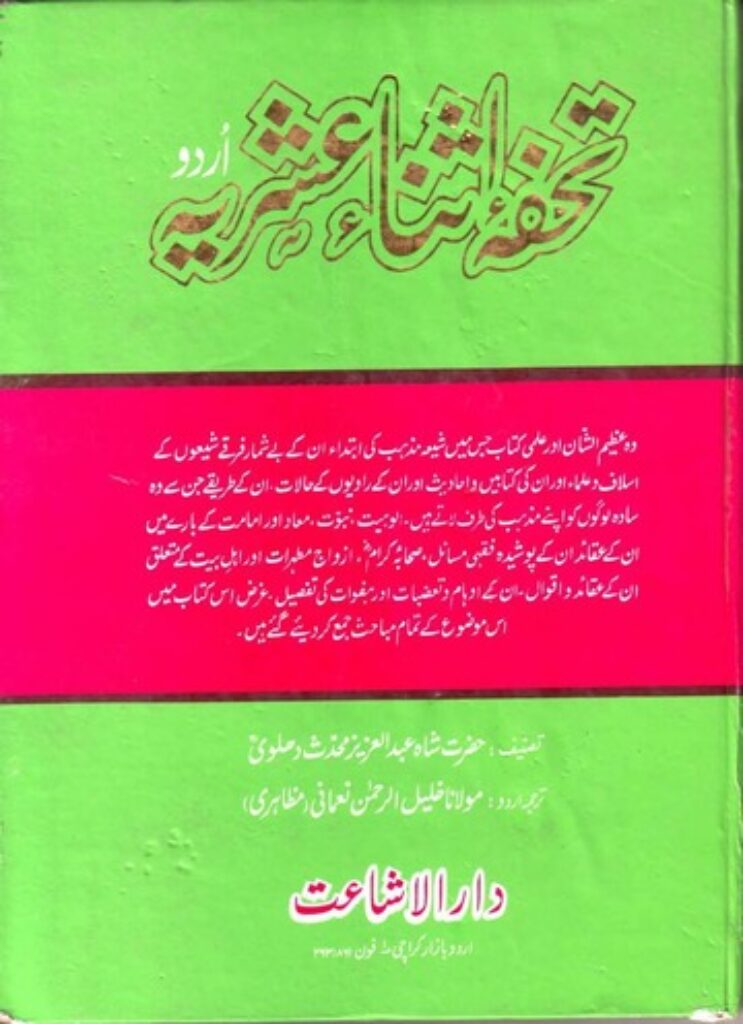
Published in 1789 under the pen name Hafiz Ghulam Haleem, Tohfa Ithna Ashariyya (Gift to the Twelvers) is Shah Abdul Aziz Dehlawi’s landmark Sunni critique of Shia theology. Written in Persian and supported by Sunni patrons, it systematically addressed doctrinal and ritual differences between Sunnis and Twelvers.
While firmly opposing Shia views on Imamate and certain mourning practices, Shah Abdul Aziz refrained from declaring Shias non-Muslims. Instead, he advised social caution—avoiding intermarriage and consumption of their slaughtered meat—while maintaining respectful dialogue. The work provoked major Shia rebuttals, including Abqāt al-Anwār by Mir Hamid Husain al-Musavi.
Contrary to popular confusion, Sirr al-Shahadatayn (on the martyrdom of Imams Hasan and Husain) was authored by his father, Shah Waliullah Dehlawi. Yet Shah Abdul Aziz continued his father’s balanced reverence for the Prophet’s family: he encouraged remembrance of Karbala within Islamic limits and criticized Taziya rituals as un-Islamic innovations. His approach reflected Naqshbandi restraint and Sunni orthodoxy grounded in love for Ahl al-Bayt.
Shah Abdul Aziz’s Fatwa on Dar al-Harb
One of his most influential legal pronouncements was the Fatwa on Dar al-Harb, declaring British-ruled India an “Abode of War” amid Mughal collapse. This ruling legitimized resistance against colonial rule and inspired later jihad movements led by Sayyid Ahmad Barelvi and Shah Ismail Shaheed. It also permitted strategic alliances—even with non-Muslim powers—to expel British dominance.
Yet Shah Abdul Aziz remained pragmatic, allowing Muslims to learn English and serve in civil posts under necessity, provided they avoided sinful acts. This equilibrium between resistance and adaptation shaped Muslim political thought for decades, influencing the 1857 uprising and later independence movements.
Views on Hindus
Shah Abdul Aziz viewed Hindus through a theological lens of comparative monotheism, considering them analogous to ahl-e kitab (People of the Book). He acknowledged traces of divine revelation in Hindu scriptures and paralleled avatars with prophetic signs, while condemning idolatry as a deviation from Tawheed. His nuanced view reflected the pluralistic realities of India, promoting intellectual engagement rather than hostility.
Social and Political Context
Decline of Mughal Authority
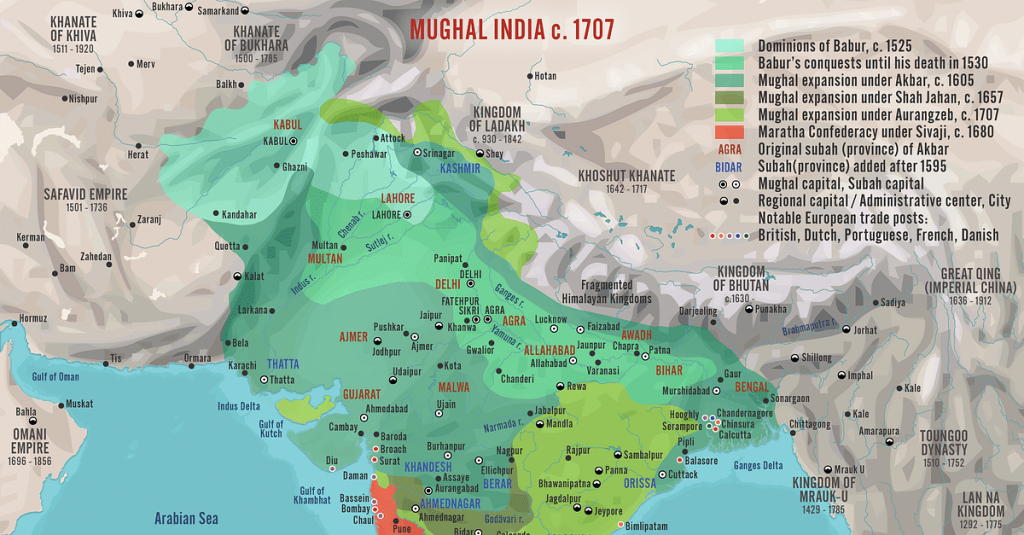
By the late 18th century, the Mughal Empire was in terminal decline, with Marathas, Sikhs, and the British East India Company vying for power. Shah Abdul Aziz provided intellectual and spiritual leadership to a fragmented Muslim community. His letters to his uncle, Shah Ahl-Allah, expressed dismay at Sikh and Maratha atrocities, praying for divine retribution against their oppression of Muslims and even shepherds.
Relations with the British and Local Powers
While avoiding direct political involvement, his Dar ul Harb fatwa and teachings at Madrasah Rahimiyya galvanized resistance, influencing revolutionaries like Sayyid Ahmad Barelvi, who launched jihad against Sikh rule in Northwest India, and Shah Ismail Shaheed, author of Ujala-ye Nafe’a.
The Mughal emperor Shah Alam II held Shah Abdul Aziz in high regard, granting him three villages in Muzaffar Nagar as jagirs for his family’s upkeep. His balanced approach—opposing British rule while advocating English education and civilian employment—distinguished him from rigid traditionalists, offering practical solutions for Muslims under colonial dominance.
Legacy and Influence

Shah Abdul Aziz Dehlawi passed away on 7 Shawwal 1239 AH (5 June 1824 CE) in Delhi during the reign of Mughal Emperor Akbar Shah II. He was buried at the Mehdiyan Cemetery, near the present Mawlana Azad Medical College in Delhi. His legacy continues to illuminate Islamic scholarship and reform across South Asia.
Shah Waliullah’s Heir: Continuation of Shah Waliullah’s Mission
As the eldest son and foremost successor of Shah Waliullah Dehlawi, Shah Abdul Aziz advanced his father’s intellectual and spiritual mission. This included:
- Reinforcing the primacy and reviving the authentic understanding of the Qur’an and Sunnah.
- purifying Naqshbandi Sufism and Sufi practices to eliminate innovation (bid’ah) and syncretic deviations.
- Promoting Islamic unity (Tawheed) as the core of Islamic revival and resisting sectarian fragmentation.
Influence on Islamic Movements
The ideological inspiration stemming from Shah Abdul Aziz’s works was pivotal in shaping subsequent Islamic movements in South Asia:
- Jihad Movements: Sayyid Ahmad Barelvi and Shah Ismail Shaheed adopted his concept of Dar al-Harb in their campaigns.
- Deobandi Movement: Later Islamic educational reform movements, especially the Deobandi school, drew from his scholarship and teachings.
- Political Awakening: His emphasis on political consciousness laid the groundwork for the 19th-century Islamic reform and resistance against colonial rule and future Islamic political activism in India.
Educational Legacy
Shah Abdul Aziz transformed the Madrasah Rahimiyyah, founded by his father, into the leading center of higher Islamic learning in India. This madrasa played a critical role in preserving Islamic learning during the colonial period and influencing institutions that emerged in later years.
From its graduates emerged major scholars and reformers who carried forward the Hadith-centered educational tradition, giving rise to virtually all Indian and Pakistani schools of Hadith study today.
Modern Relevance of His Literary Works:
As of today, Shah Abdul Aziz’s works—such as Tafsir-i-Azizi, Fatawa Aziziyyah, and Tohfa Ithna Ashariyya—continue to be taught in South Asian madrasahs and universities. His writings influence ongoing debates in Islamic jurisprudence and ethics, including topics like bioethics, abortion, and family planning, highlighting his continuing relevance to modern Islamic thought.
Family Legacy:
His daughter, Amtul Aziz, and grandson, Shah Muhammad Ishaq Dehlawi, continued the family’s scholarly heritage. Shah Muhammad Ishaq later became a prominent hadith scholar and taught at Madrasah Rahimiyyah, ensuring that the intellectual chain of Shah Waliullah’s family remained unbroken.
Timeline of Key Events
| Year | Event | Significance |
|---|---|---|
| 1746 | Born in Delhi (25 Ramadan 1159 AH) | Son of Shah Waliullah, of Arab descent through Caliph ʿUmar ibn al-Khattab (RA) |
| 1762 | Led Madrasah Rahimiyyah | Became head of India’s premier Islamic seminary at age 16 |
| 1789 | Published Tohfa Ithna Ashariyya | Sparked major Sunni–Shia theological debates |
| 1822 | Hosted Muharram gatherings | Balanced reverence for Ahl al-Bayt with reformist critique of ritual innovations |
| 1824 | Died in Delhi (7 Shawwal 1239 AH) | Buried at Mehdiyan Cemetery, leaving a profound reformist legacy |
Shah Abdul Aziz’s life stands as a bridge between Mughal-era scholarship and colonial-era reform, shaping the course of South Asian Islam’s intellectual, spiritual, and political evolution.
Conclusion: A Legacy of Revival and Resistance
Shah Abdul Aziz Dehlawi remains a defining figure in the history of Islamic revivalism in the Indian subcontinent. His intellectual brilliance, combined with a profound sense of duty to uplift the Muslim community spiritually and politically, distinguished him as more than just a scholar—he was a mujaddid (reviver) for his era.
While he did not personally lead armies or engage in militant revolts, his pen and teachings sowed the seeds for a century of Islamic activism in India. His ideological heirs, like Sayyid Ahmad Barelvi, transformed his thoughts into organized jihad movements. Later reformers across the spectrum of Islamic schools in India revered his contributions to Hadith studies, Tafsir, jurisprudence, and political thought.
In a time of despair and fragmentation, Shah Abdul Aziz provided clarity, vision, and hope for a unified, authentic Islamic identity amidst the storm of colonial encroachment. His works continue to be studied and referenced by scholars, historians, and Islamic thinkers in South Asia and beyond.
As a beacon of scholarship and resistance, Shah Abdul Aziz Dehlawi remains immortal in the annals of Islamic history.
Frequently Asked Questions
Who was Shah Abdul Aziz Muhaddith Dehlvi?
Shah Abdul Aziz Dehlvi (1746–1824) was a Sunni scholar, muhaddith, and Naqshbandi Sufi, son of Shah Waliullah. He led Madrasah Rahimiyya and authored Tafsir-i-Azizi and Tohfa Ithna Ashariyya.
What is Tohfa Ithna Ashariyya by Shah Abdul Aziz?
Tohfa Ithna Ashariyya (1789), published as Hafiz Ghulam Haleem, is a Sunni critique of Shia theology, sparking debates with responses like Abqaat-ul Anwar by Mir Hamid Husain Musavi.
What was Shah Abdul Aziz’s fatwa on Dar ul Harb?
He declared British-ruled India Dar ul Harb, legitimizing jihad and non-Muslim alliances (e.g., Marathas), influencing the 1857 Rebellion and Sayyid Ahmad Barelvi’s campaigns.
What books did Shah Abdul Aziz write?
Key works include Tafsir-i-Azizi (Quranic exegesis), Tohfa Ithna Ashariyya (anti-Shia polemic), Fatawa Aziziyya (legal rulings), Bustān al-Muhadditheen (Hadith), and Azīz al-Eqtebās (virtuous deeds).
How was Shah Abdul Aziz connected to Shah Waliullah?
As Shah Waliullah’s eldest son, he led Madrasah Rahimiyya and continued his father’s reformist mission, advancing Hadith and Quranic studies while reforming Sufism.
What were Shah Abdul Aziz’s views on Shia and Muharram?
He criticized Shia practices in Tohfa as Hindu-like but supported Muharram gatherings for Imams Hasan and Husain (Sirr al-Shahadatayn), opposing Taziya arts as bid‘ah.
What was Shah Abdul Aziz’s role in Sufism?
A Naqshbandi Sufi, he reformed practices to align with Sunnah, emphasizing Tawheed and spiritual purity, continuing his father’s legacy.
How did Shah Abdul Aziz view Hindus?
He saw Hindus as ahl-e ketāb (People of the Book), comparing avatars to Islamic prophetic signs (e.g., Moses’ staff), but criticized deviations like idol worship.
When and where did Shah Abdul Aziz die?
He died on 5 June 1824 (7 Shawwal 1239 AH) in Delhi and was buried at Mehdiyan cemetery near Mawlana Azad Medical College.
Did Shah Abdul Aziz support British collaboration?
While declaring Dar ul Harb, he permitted Muslims to learn English and take civilian jobs under the British for practical benefits, balancing resistance with adaptation.
What was Shah Abdul Aziz’s stance on abortion and birth control?
He allowed abortion before four months for reasons like poverty or travel and endorsed birth control (azl, medicines), citing Prophetic examples, showing progressive thought.
How did Shah Abdul Aziz influence later Islamic movements?
His scholarship inspired the Deobandi movement and jihad campaigns by Sayyid Ahmad Barelvi and Shah Ismail Shaheed, author of Ujala-ye Nafe’a, with Madrasah Rahimiyya shaping Indian Hadith schools.\
References:
- Tafsir-i-Azizi by Shah Abdul Aziz
- Tohfa Ithna Ashariyya by Shah Abdul Aziz
- Islamic Revival in British India by Barbara Metcalf
- Saviours of Islamic Spirit by Abul Hasan Ali Nadwi
- “History of the Freedom Movement in India” by K.K. Datta
- Encyclopædia Iranica, “Abd-Al-Aziz Mohaddet Dehlavi” by Azduddin Khan
- Interpretations of Jihad in South Asia by Tariq Rahman
- “The Indian Musalmans” by W.W. Hunter
- “Jihad Movement in India” by M. Abdul Jabbar Beg