


Kohl, surma, and kajal have been used for centuries across Muslim communities and other cultures. In Islamic tradition, particular attention is given to ithmid (الإثمد), a type of mineral-based kohl mentioned in Hadith narrations concerning the use of eye cosmetics.
However, not every product sold as kohl, surma, kajal or Sunnah ithmid is necessarily the same. Their ingredients, mineral composition, manufacturing processes and safety standards can vary significantly. Some traditional eye cosmetics have also been found to contain lead and other potentially harmful substances.
Therefore, before using kohl or ithmid, Muslims should consider more than its colour, price, traditional reputation or religious marketing. They should examine its ingredients, source, purity, safety testing, packaging and suitability for use around the eyes.
This guide explains what to check before buying or applying kohl and ithmid, how to identify warning signs, and how to approach traditional Islamic practices responsibly without overlooking modern eye-safety concerns.
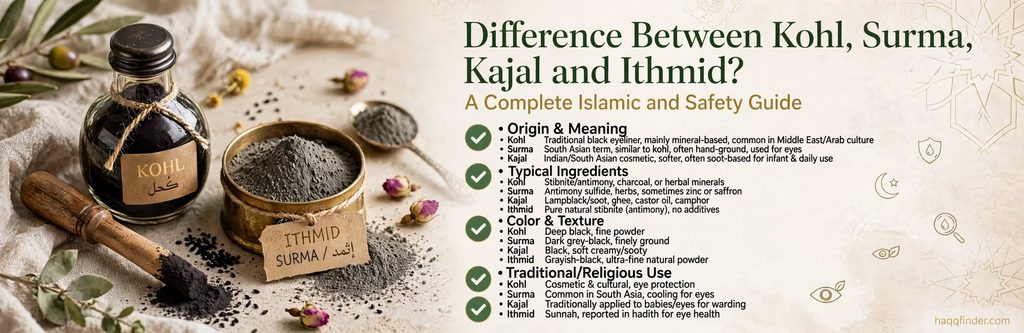
1. Understand the Differences Between Kohl, Surma, Kajal and Ithmid
Before purchasing a product, understand what its name actually means.
The terms kohl, surma and kajal are often used interchangeably in everyday conversation. However, they do not necessarily refer to the same substance.
- Kohl: A broad term for cosmetic preparations applied around the eyes. Depending on the region and product, it may refer to mineral powders, traditional mixtures or modern eyeliners.
- Surma: A commonly used South Asian term for traditional eye cosmetics, often sold in powder or stick form.
- Kajal: A term used for different types of traditional and modern eye cosmetics. Its ingredients vary between manufacturers.
- Ithmid: A particular mineral traditionally associated with kohl and mentioned in Islamic Hadith literature.
Ithmid is especially relevant to Muslims because narrations from Ibn Abbas (رضي الله عنهما) mention it as one of the preferred types of kohl.
However, a product labelled “Ithmid”, “Sunnah Kohl” or “Prophetic Kohl” is not automatically verified as genuine Ithmid. A seller’s description is not scientific proof of a product’s mineral identity, purity or safety.
What to check:
- Does the manufacturer identify the actual ingredients?
- Does it specify whether the product contains mineral-based ithmid or a different cosmetic formulation?
- Is the mineral source explained?
- Is there reliable documentation supporting the product’s composition?
- Is the product simply using the word “ithmid” as a marketing term?
Do not assume that every black or dark-grey traditional powder is ithmid.
📖 Read More: The Complete Guide to Kohl In Islam: Sunnah, Benefits, Rulings & Modern Concerns
2. Check the Complete Ingredient List
One of the first things to examine is the product’s ingredient declaration.
A trustworthy manufacturer should provide clear information about what the product contains. Avoid relying exclusively on phrases such as “100% natural”, “chemical-free”, “herbal”, “organic” or “traditional”.
These expressions do not tell you the exact composition of a cosmetic.
Depending on the formulation, kohl products may contain mineral substances, pigments, binders, oils, preservatives, or other cosmetic ingredients.
Some traditional eye cosmetics have been found to contain lead compounds, including lead sulfide. Other potentially concerning substances and contaminants may also be present.
The US Food and Drug Administration (FDA) specifically warns consumers that traditional products sold as kohl, kajal, surma, and similar names may contain high levels of lead.
What should appear on the label?
Before buying, look for:
- A complete ingredient list.
- The manufacturer’s name and contact information.
- Product identification and intended cosmetic use.
- Batch or lot number.
- Manufacturing and expiry information, where applicable.
- Usage and storage instructions.
- Relevant safety and testing information.
If the seller cannot identify the ingredients or refuses to provide basic product information, consider that a warning sign.
Important: A product with no visible ingredient list is not necessarily pure. It may simply be inadequately labelled.
3. Check for Lead Contamination
Lead contamination is one of the most serious safety concerns associated with traditional kohl, surma and kajal.
Some traditional eye cosmetics contain substantial concentrations of lead. The FDA reports that lead, often in the form of lead sulfide, can account for more than half the weight of certain kohl products.
Lead exposure can harm the nervous system, kidneys, and other organs. Children are particularly vulnerable because their developing nervous systems are more sensitive to its effects.
The concern is not limited to products that look old-fashioned or homemade. A product can be attractively packaged, marketed as natural, and sold as a traditional Islamic cosmetic while still containing harmful contaminants.
What should you check?
Before using a mineral-based kohl product, look for reliable laboratory testing that specifically addresses lead contamination.
A useful report should:
- Identify the product or batch tested.
- Identify the laboratory that performed the analysis.
- State the test method.
- Report the measured lead concentration.
- Provide the relevant units, such as parts per million (ppm) or mg/kg.
- Show the applicable safety limit or regulatory standard used for interpretation.
- Be traceable to the actual product being purchased.
A generic certificate saying “heavy-metal tested” is less useful if it does not identify the product, batch, test method and actual results.
Can you identify lead by appearance?
No.
Colour, texture, smell, price and packaging cannot reliably establish whether a kohl product contains lead.
A black powder is not necessarily contaminated, and a smooth, attractive product is not necessarily safe.
Do not rely on visual inspection or informal home experiments to establish that a mineral cosmetic is lead-free.
My recommendation: If a manufacturer cannot provide credible evidence of lead testing for its product, do not assume it is safe for use around the eyes.
4. Check for Other Heavy Metals and Harmful Contaminants
Lead is not the only substance that deserves attention.
Depending on the raw materials and manufacturing process, mineral-based cosmetics may contain other heavy metals or impurities.
When evaluating a laboratory report, look for testing relevant to:
- Lead (Pb).
- Arsenic (As).
- Mercury (Hg).
- Cadmium (Cd).
- Other relevant contaminants identified through the product’s composition and manufacturing process.
For a mineral product identified as ithmid, antimony is also relevant to its mineral composition. The objective is not simply to demand that every product contain zero antimony, but to establish what substance is present, its chemical form, concentration, and suitability for the intended cosmetic use.
A reliable laboratory should use appropriate analytical methods and interpret the findings against applicable cosmetic safety requirements.
What makes a laboratory report more credible?
Prefer reports from an independent laboratory with appropriate competence and accreditation, such as ISO/IEC 17025 accreditation for the relevant testing.
Check whether:
- The report identifies the tested product.
- The batch number matches the product you intend to purchase.
- The analytical method is identified.
- The results are quantitative rather than marked “Pass”.
- The laboratory can be contacted, or the report independently verified.
A report for a different product, a different batch, or an unidentified raw material does not automatically prove that the finished product is safe.
5. Verify Whether the Product Is Actually Ithmid
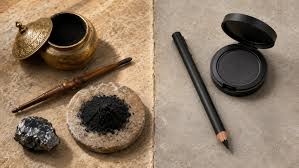
For Muslims interested in following the traditional practice associated with ithmid, product identity matters.
Sunan Abi Dawud 3878 and Sunan an-Nasa’i 5113 contain narrations from Ibn Abbas (رضي الله عنهما) mentioning ithmid and its reported benefits relating to eyesight and eyelash growth.
However, these narrations do not authenticate every modern commercial product carrying the name.
A seller might describe a product as:
- Authentic Egyptian ithmid.
- Natural Arabian ithmid.
- Original Sunnah surma.
- Pure mineral kohl.
- Traditional Prophetic eyeliner.
These descriptions should not be accepted as proof without supporting information.
Questions to ask the manufacturer
- What is the actual mineral or ingredient used?
- Where does the raw material originate?
- Is the material independently identified or analysed?
- Is the finished product tested for relevant contaminants?
- Can the manufacturer provide a batch-specific laboratory report?
- Does the product contain additional pigments, binders or other ingredients?
If a seller claims that a product is genuine ithmid, ask for evidence supporting the mineral identity rather than relying solely on traditional branding.
Remember: Authenticity and safety are two different questions. Establishing that a mineral is ithmid does not, by itself, establish that a finished cosmetic is free from harmful contaminants.
6. Check Whether the Product Is Specifically Intended for Eye Use
Not every black cosmetic powder is suitable for the eyes.
A product may be marketed as a natural mineral powder, herbal preparation or traditional cosmetic without having been manufactured or tested for application around the eyes.
Before using it, check whether the manufacturer explicitly identifies it as an eye cosmetic and provides suitable directions for use.
Avoid applying:
- Industrial mineral powders.
- Unlabelled mineral mixtures.
- Products intended for skin or hair rather than the eye area.
- Homemade mixtures with unknown ingredients.
- Products whose instructions are missing or unclear.
- Cosmetics with pigments that are not approved for the intended eye-area use in the relevant market.
What about modern eyeliner labelled “Kohl”?
Some modern eyeliners use the word “kohl” to describe their colour or cosmetic style. This does not necessarily mean they contain traditional mineral kohl or ithmid.
Read the ingredient list rather than judging the product by its name.
Regulatory requirements also differ between countries. For example, the FDA does not approve traditional kohl as a cosmetic colour additive for use in the United States. Its regulatory position should not be confused with a universal Islamic ruling or with the cosmetic regulations of every other country.
7. Look for Evidence of Microbiological Safety
Mineral purity is important, but it is not the only safety consideration.
Eye cosmetics can become contaminated with bacteria or fungi during manufacturing, storage or use. Contaminated products can cause eye irritation and infection.
This is particularly relevant for cosmetics applied close to the eyelid margins or eyes.
What should you check?
- Is the product manufactured under appropriate hygiene and quality-control conditions?
- Is the packaging clean and properly sealed?
- Is the applicator protected from contamination?
- Is there information about product stability and storage?
- Does the manufacturer provide appropriate microbiological quality information?
Loose powder is not automatically sterile, and a dry appearance does not establish microbiological safety.
A clean-looking product may still be contaminated.
For products intended for use around the eyes, appropriate manufacturing controls and relevant microbiological testing are important considerations.
8. Examine the Packaging and Applicator
Packaging affects how easily a cosmetic can become contaminated.
Before buying, inspect the container and applicator.
Check the following:
Sealed packaging: The product should arrive with intact packaging. Avoid containers that appear opened, tampered with, or previously used.
Clean applicator: The applicator should be protected from dust, dirt, and repeated contact with contaminated surfaces.
Suitable container: The design should allow the product to be used without repeatedly introducing dirty fingers or objects.
Clear instructions: The manufacturer should explain how to use, store and clean the product or applicator, where applicable.
No visible contamination: Reject products with unusual foreign particles, visible mould, damaged containers or evidence of moisture entering a powder product.
Do not share kohl sticks, applicators or containers with other people, even family members. Sharing can transfer microorganisms.
📖 Read More: The Benefits of Kohl in Islam: A Comprehensive Guide
9. Check the Manufacturing and Expiry Information
A product’s manufacturing date, batch number and shelf-life information help consumers trace its quality.
Before using a product, check:
- Manufacturing date.
- Expiry date, where provided.
- Batch or lot number.
- Manufacturer or responsible business.
- Storage instructions.
- Any period-after-opening instructions.
Do not use a product if its expiry date has passed or its packaging has deteriorated.
If the manufacturer provides no expiry or storage guidance, ask for clarification before purchasing.
Also, do not assume that mineral powders last forever. Their original ingredients may be mineral-based, but the finished product can contain other ingredients and become contaminated through handling.
10. Check the Manufacturer’s Reputation and Transparency
A trustworthy seller should be willing to answer reasonable questions about product composition and safety.
Before buying, investigate the manufacturer rather than relying exclusively on online reviews or social media promotions.
What to investigate
Company identity: Does the business provide a verifiable name, address or contact information?
Product information: Does it explain what the product contains and how it is manufactured?
Testing evidence: Does it provide relevant laboratory reports rather than vague statements?
Traceability: Can the seller identify the batch or lot number?
Customer support: Can you contact the manufacturer if you experience a problem?
Marketing claims: Does it avoid unsupported medical promises?
Be particularly cautious of claims such as:
- “100% lead-free” without laboratory evidence.
- “Guaranteed to improve eyesight.”
- “Clinically proven to grow eyelashes” without relevant clinical evidence.
- “Completely safe for newborn babies.”
- “No side effects because it is natural.”
- “FDA approved ithmid” without verifiable regulatory documentation.
A product’s popularity, customer rating, or religious branding cannot replace independent safety evidence.
11. Check Whether It Is Halal and Suitable for Muslim Use
For Muslim consumers, product permissibility is another important consideration.
A kohl product should be evaluated according to its actual ingredients and intended use, rather than its marketing description.
Consider these points
Ingredient permissibility: Check whether the formulation contains ingredients derived from prohibited or otherwise impermissible sources according to the Islamic guidance you follow.
Purity: Investigate whether the product contains contaminants or impurities that raise religious or health concerns.
Harm: A product should not be used in a way that creates avoidable harm.
Honest representation: Do not assume that a product is Sunnah-approved simply because a seller uses Islamic language or imagery.
Does a Halal certificate prove that kohl is safe?
No.
Halal certification and cosmetic safety testing address different questions.
A halal certificate may provide information about the permissibility of ingredients and manufacturing processes within the scope of that certification. It does not necessarily establish that the product is free from lead, microbiological contamination or other eye-safety risks.
Similarly, a laboratory report showing low levels of certain contaminants does not, by itself, establish that every ingredient meets Islamic requirements.
For responsible purchasing, both religious considerations and product safety should be examined separately.
12. Consider Your Own Eye Health Before Application
Even a properly manufactured cosmetic may not be suitable for every individual.
Before using kohl or ithmid, consider your current eye condition and any history of sensitivity.
Avoid applying eye cosmetics if you currently have:
- An eye infection.
- Redness or inflammation around the eyes.
- Unexplained eye pain.
- Irritated or damaged eyelid skin.
- An active allergic reaction.
- Recent eye surgery, unless your eye-care professional has confirmed that cosmetic use is appropriate.
People with recurring eye irritation, dry-eye problems or other eye conditions should seek advice from an eye-care professional before introducing a new eye cosmetic.
What if the product irritates?
Stop using it immediately.
Do not continue applying the product in the hope that your eyes will become accustomed to it.
If symptoms persist, worsen or include pain, significant redness, discharge, light sensitivity or vision changes, seek prompt medical assessment.
Do not use kohl as a substitute for prescribed eye medication or treatment.
13. Follow Safe Application and Hygiene Practices
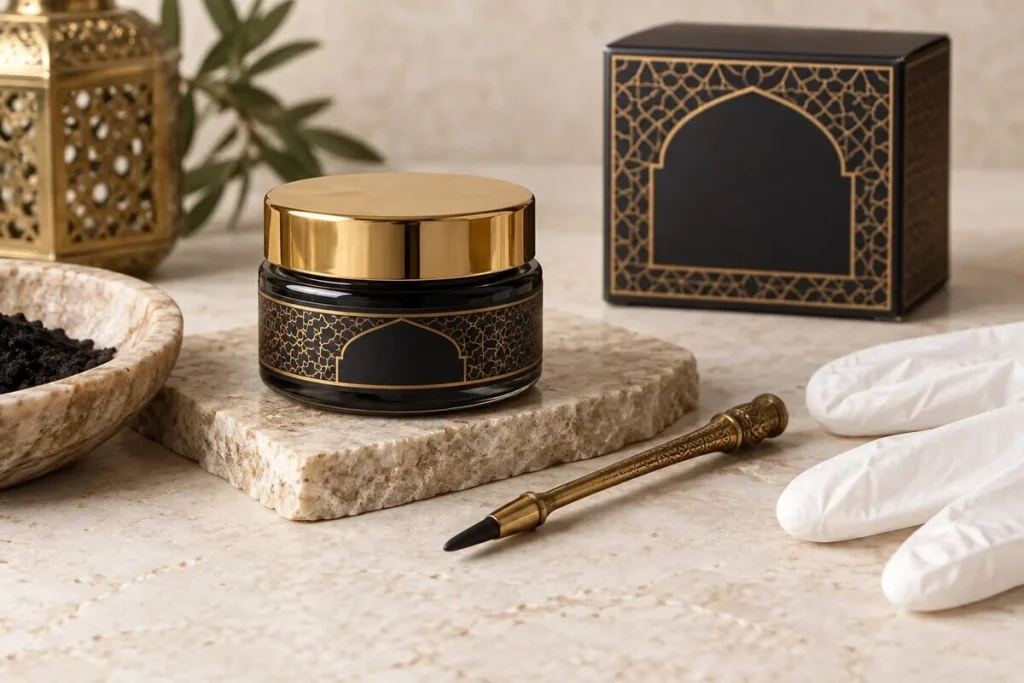
Once a product has passed your initial checks, safe handling remains important.
The following precautions can reduce avoidable risks:
- Wash your hands before handling the product.
- Use a clean, dedicated applicator.
- Never share the product or applicator.
- Keep the container closed when not in use.
- Avoid touching the applicator to dirty surfaces.
- Do not apply cosmetics while travelling in a moving vehicle.
- Stop using the product if irritation occurs.
- Discard cosmetics that may have become contaminated during an eye infection.
The American Academy of Ophthalmology recommends keeping eye makeup outside the lash line rather than applying it along the inner eyelid margin. This helps reduce the risk of irritating the eye and interfering with the oil glands along the eyelid.
Traditional methods of applying kohl should not automatically be interpreted as modern medical instructions. If a particular application method creates irritation or discomfort, do not continue simply because it is traditional.
14. Should You Use Kohl on Babies and Children?
Extra caution is necessary when it comes to infants and children.
Traditional practices in some communities involve applying surma or kohl to newborns and young children. However, this practice can expose children to harmful substances, particularly when the product contains lead.
The CDC published a report in 2024 documenting lead poisoning in a mother and four children associated with the use of traditional surma.
Lead exposure can seriously affect children’s development and health.
Therefore:
- Do not apply unverified kohl or surma to newborns.
- Do not use traditional mineral powders on children’s eyes without reliable evidence of safety and suitability.
- Keep kohl containers and loose powders away from children.
- Never allow children to play with eye cosmetics.
- Seek medical advice if a child has been exposed to a product suspected of containing lead.
A traditional custom should not be treated as proof of safety for infants.
15. What If You Have Already Used Traditional Kohl?
If you have already used a traditional kohl or surma product, do not panic. However, take the possibility of exposure seriously, particularly if the ingredients are unknown.
Consider the following steps:
Stop using an unverified product: If you cannot establish its composition or safety, discontinue use.
Keep the packaging: Preserve the container, ingredient list, batch number and any available laboratory documents.
Assess the exposure: Consider how long you have used it, how frequently it was applied and whether children or pregnant or breastfeeding family members may also have been exposed.
Seek medical advice: If the product may contain lead, discuss the exposure with a healthcare professional. Blood lead testing may be appropriate, especially for children and pregnant or breastfeeding individuals.
Do not wait for symptoms: Lead exposure may not produce obvious immediate symptoms. A person can be exposed without noticing an immediate reaction.
If you experience eye pain, significant irritation, redness or vision changes, seek appropriate eye care rather than attempting to treat the problem with another cosmetic.
16. A Practical Checklist Before Buying or Using Kohl and Ithmid
Use this checklist to review a product before purchasing or applying it.
Product identity and ingredients
- The product has a clearly identified formulation.
- The ingredient list is available.
- The manufacturer explains whether it contains traditional Ithmid or another cosmetic formulation.
- Its intended use around the eyes is clearly stated.
- There are no unexplained or undisclosed ingredients.
Purity and laboratory testing
- The manufacturer provides relevant heavy-metal testing.
- Lead levels are reported quantitatively.
- Other relevant contaminants are assessed.
- The report identifies the actual product or batch.
- The testing laboratory is independently verifiable.
- Any safety claims are supported by appropriate evidence.
Manufacturing and packaging
- The manufacturer is identifiable and contactable.
- The packaging is intact and properly sealed.
- The applicator is clean and protected.
- The batch number is available.
- Manufacturing, expiry and storage information are provided.
- The product has no visible signs of contamination or deterioration.
Islamic considerations
- The ingredients have been checked for permissibility.
- Claims of authentic ithmid are supported rather than assumed.
- The product is not marketed with unsupported religious or medical promises.
- Its use does not knowingly create avoidable harm.
Personal safety
- I do not currently have an eye infection or irritation.
- I have considered any existing eye condition.
- I have a clean, personal applicator.
- I will not share the product.
- I know when to stop using it and seek medical advice.
If important safety information is missing, the safest decision is not to use the product until its suitability can be established.
Frequently Asked Questions
1. Is all-natural ithmid safe for the eyes?
No. Natural origin does not guarantee purity or safety. A mineral product may contain harmful contaminants, including lead. Its identity, composition, and laboratory testing should be examined before use.
2. How can I identify genuine ithmid kohl?
You cannot reliably identify genuine ithmid through colour, smell, texture or appearance alone. Ask the manufacturer for information about the mineral source and independent evidence of the product’s composition.
3. Is lead-free kohl safe to use?
A credible test showing low or non-detectable lead is important, but it does not establish complete safety. Other contaminants, microbiological quality, formulation, intended use, and personal sensitivity also matter.
4. Does a halal certificate guarantee that kohl is safe?
No. Halal certification and cosmetic safety testing are different assessments. A product may meet the requirements of a particular halal certification while still requiring separate testing for heavy metals and microbiological contamination.
5. Does authentic ithmid always contain antimony?
Ithmid is traditionally associated with antimony-containing mineral material. However, the exact composition and chemical form of a particular commercial product must be established through appropriate analysis rather than assumed from its name.
6. Can I use kohl if the seller says it is 100% natural?
A seller’s claim is not sufficient evidence. Ask for the ingredient declaration, product information and relevant independent safety testing. Natural products can also contain harmful substances.
7. Can I use kohl every day?
Daily use should not be assumed safe merely because a product is traditional. Suitability depends on its formulation, purity, application method, hygiene and your individual eye health. Follow the manufacturer’s safe-use instructions and seek professional advice if you have an eye condition.
8. Is homemade surma safer than commercial kohl?
Not necessarily. Homemade products may have unknown mineral sources, uncontrolled ingredients and no reliable laboratory testing. Homemade preparation does not automatically eliminate lead or contamination risks.
9. Can I use traditional kohl on newborn babies?
It is best to avoid applying unverified traditional kohl or surma to newborns and children. Some products contain lead, which can cause serious harm to developing children.
10. What should I do if I discover that my kohl contains lead?
Stop using it and keep the packaging and product details. If you or a family member has used it, consult a healthcare professional about whether blood lead testing is appropriate. This is especially important for children and pregnant or breastfeeding individuals.
11. Can a laboratory report guarantee that a kohl product is completely safe?
No laboratory report can establish absolute safety in every circumstance. A credible report can provide important evidence about the substances tested in a particular sample or batch. It does not necessarily assess every possible contaminant, every manufacturing condition or every individual’s sensitivity.
Conclusion: Make an Informed Choice Before Using Kohl or Ithmid
Kohl and ithmid have an important place in Islamic tradition, but responsible use requires careful attention to product identity, ingredients and safety.
A product labelled natural, authentic, handmade or Sunnah-inspired should never be accepted as safe without appropriate evidence. Check the ingredients, investigate the manufacturer, examine laboratory reports, look for possible heavy-metal contamination and make sure the product is intended for use around the eyes.
Muslims interested in following the traditional practice of ithmid should also distinguish the mineral mentioned in Hadith literature from modern commercial products sold under its name.
Most importantly, religious interest and cosmetic preferences should not lead anyone to overlook avoidable health risks. Protecting one’s health is an important consideration when choosing and using any cosmetic.
The responsible approach is to respect the Sunnah, verify the product and avoid harm.
Allah knows best.
References and Further Reading
- Sunan Abi Dawud 3878 – Narration from Ibn Abbas (رضي الله عنهما) concerning ithmid. Read the Hadith.
- Sunan an-Nasa’i 5113 – Narration concerning ithmid and its reported benefits. Read the Hadith.
- U.S. Food and Drug Administration (FDA) – Kohl, Kajal, Al-Kahal, Surma, Tiro, Tozali, or Kwalli: By Any Name, Beware of Lead Poisoning. Read the FDA guidance.
- U.S. Food and Drug Administration (FDA) – Eye Cosmetic Safety. Read the safety guidance.
- U.S. Food and Drug Administration (FDA) – Lead in Cosmetics. Read the FDA information.
- Centers for Disease Control and Prevention (CDC), 2024 – Lead Poisoning in a Mother and Her Four Children Using a Traditional Eye Cosmetic — New York City, 2012–2023. Read the report.
- American Academy of Ophthalmology (AAO) – How to Use Cosmetics Safely Around Your Eyes. Read the guidance.
Editorial note: This article provides general educational information. It does not certify any particular kohl or ithmid product as authentic, halal, or medically safe. Product safety depends on its actual composition, testing, manufacturing quality, and intended use. Consult a qualified Islamic scholar for individual religious questions and an eye-care professional for medical concerns.