Mastodon
haqqfinder

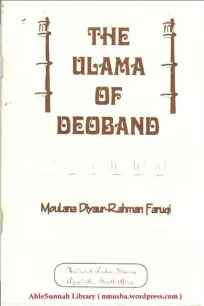
The Ulama of Deoband: The Majestic Past

Translator: Maulana Muhammad Kadwa
Format: 71 pages, Third Edition
Language: English
Published Date: August 2006
User's Rating:
Not rated yet
|
Editor's Rating:
3.7

Summary and Key Themes

The ‘Ulamā of Deoband: Their Majestic Past develops a historical and devotional narrative around the scholars associated with Darul Uloom Deoband and the wider tradition from which the seminary emerged. Based on a lecture delivered in 1983, the book seeks not only to recount historical events but also to inspire Muslim readers, particularly younger generations, through the achievements and sacrifices attributed to earlier scholars.

1. Shah Waliullah and the Intellectual Background

The book reaches back to Shah Waliullah and other influential Muslim scholars to establish the intellectual and religious background of the Deobandi tradition. It presents their scholarship and reform efforts as part of a longer history of Muslim religious renewal in the Indian subcontinent.

This broad historical framing helps readers understand why Deobandi accounts frequently connect nineteenth-century scholars to earlier traditions of Islamic learning. However, intellectual influence and direct institutional continuity are different historical claims and should be examined separately.

2. British Colonial Rule and Muslim Resistance

One of the book's most prominent themes is resistance to British colonial authority. Its contents include discussions of Tipu Sultan, Sayyid Ahmad Shahid, the Battle of Balakot, the struggle associated with the 1857 uprising, and the imprisonment and execution of Muslim figures who opposed colonial rule.

The book places religious scholars within a wider narrative of resistance and national history. This is an important perspective for studying how some Muslim communities remember the colonial period, although the specific roles of individuals and organizations require comparison with contemporary records and independent historical research.

3. The Establishment of Darul Uloom Deoband

The establishment of Darul Uloom Deoband receives particular attention as a turning point in the institutional history of traditional Islamic education. The seminary is portrayed as a center for preserving religious knowledge and training scholars during a period of major political and social change.

The narrative emphasizes the educational and religious legacy of the institution and the later reach of its scholarly network. Readers interested in its historical development should also consult academic studies that examine its curriculum, institutional organization, and changing relationship with colonial society.

4. The Major Scholars of the Deobandi Tradition

The book discusses a broad range of scholars and religious figures, including Haji Imdadullah Muhajir Makki, Maulana Qasim Nanotwi, Maulana Rashid Ahmad Gangohi, Shaikhul Hind Mahmud Hasan, Maulana Ashraf Ali Thanwi, Maulana Husain Ahmad Madani, and Allama Anwar Shah Kashmiri.

It also refers to wider intellectual and political figures such as Shah Waliullah, Shibli Nomani, Abul Kalam Azad, and Muhammad Ali Jauhar. This range gives the book a broader frame than a simple institutional history, although the figures mentioned do not all occupy the same position within the Deobandi tradition.

5. Scholarship, Spirituality, and Religious Character

The narrative presents the scholars as models of religious commitment, learning, courage, and personal sacrifice. Their contributions to jurisprudence, Hadith, Qur'anic interpretation, spiritual instruction, and religious education are central to the book's account of their legacy.

This combination of intellectual biography and devotional admiration makes the book particularly relevant to readers seeking inspiration from religious scholars. At the same time, devotional assessments of piety and spiritual rank should be distinguished from claims that can be independently established through historical evidence.

6. Political Leadership and the Formation of Pakistan

The book also addresses the formation of Pakistan and differences among Muslim leaders concerning the political future of the subcontinent. Its contents include a discussion of the objectives behind Pakistan's formation and the roles of particular scholars.

This material is important because Deobandi scholars did not all adopt one political position. Their views on nationalism, composite Indian identity, Muslim political representation, and partition varied. A careful reading should therefore distinguish the positions of individual scholars rather than treating the tradition as politically uniform.

7. History as a Source of Inspiration

The work repeatedly presents historical memory as a means of encouraging future generations. Its purpose is not simply to preserve information about earlier scholars but to inspire renewed religious commitment and a sense of responsibility among contemporary readers.

This motivational purpose helps explain the book's celebratory tone. It is valuable evidence of how a community transmits its collective memory, but it also means that the narrative should be read with awareness of its persuasive and devotional objectives.


Pros
  • Broad coverage of influential scholars: Introduces readers to numerous figures associated with Islamic scholarship, religious reform, and political activity in the subcontinent.
  • Connects scholarship with colonial history: Examines religious institutions and scholars in relation to British rule and resistance movements.
  • Useful for understanding Deobandi self-representation: Shows how an appreciative account of the tradition connects religious authority, education, and historical memory.
  • Accessible and concise: Its lecture-based origins and relatively short length make it approachable for general readers and students.
  • Highlights educational institutions: Explains the importance attached to Darul Uloom Deoband and the wider network of institutions influenced by its tradition.
  • Includes religious and political dimensions: Goes beyond biographies of scholars to discuss resistance, imprisonment, political leadership, and the formation of Pakistan.
  • Preserves a community’s historical perspective: The text is useful as a primary source for studying how sympathetic Deobandi writers remember and interpret their predecessors.
  • Encourages further research: Its references to numerous scholars and events provide a starting point for investigating biographies, institutional histories, and colonial-era documents.
Cons
  • Strongly celebratory approach: The book presents Deobandi scholars in highly admiring terms and is not designed as a detached assessment of their achievements or controversies.
  • Limited academic apparatus: The accessible edition does not provide the extensive footnotes, source discussion, and bibliography expected in a modern scholarly monograph.
  • Historical inaccuracies require checking: Some statements in the text appear inaccurate or chronologically confused. For example, its account of the English arrival in India confuses Vasco da Gama, a Portuguese navigator who reached India in 1498, with the English East India Company’s establishment in 1600. Such errors make independent verification essential.
  • Compressed historical chronology: The book moves across centuries and several political movements in a short space, limiting the context it can provide for complex events.
  • Risk of presenting a diverse tradition as uniform: The scholars discussed held differing political positions and sometimes disagreed over the appropriate response to colonial rule and the future of India.
  • Political interpretation needs comparison: Its treatment of resistance, nationalism, and Pakistan reflects a particular perspective. Readers should compare its account with independent research and other contemporary viewpoints.
  • Religious praise is not equivalent to historical proof: Descriptions of spiritual rank, doctrinal superiority, or the moral standing of individuals express the author’s commitments and should be assessed accordingly.
  • Limited scope for opposing perspectives: The narrative does not aim to systematically examine criticisms of Deoband or the interpretations of scholars from other Muslim traditions.

Critical Reception and Scholarly Context

Publication History and Purpose

The available edition records show that the English translation was published in 1999, with further editions in 2004 and 2006. The publisher’s forewords and preface describe the work as a means of preserving the legacy of Deobandi scholars and inspiring younger Muslims. These statements establish the book’s intended purpose, but they are endorsements from within its own scholarly community rather than independent critical reviews.

Primary text: The English edition, including its forewords, preface, and contents.

Comparison with Academic Scholarship

Barbara D. Metcalf’s Islamic Revival in British India: Deoband, 1860–1900 is an important companion work. Published by Princeton University Press, it examines the formation and development of the Deobandi scholarly tradition under British colonial rule, focusing on religious scholars’ responses to changing political and social conditions.

Unlike a commemorative account, Metcalf’s study situates the movement within a sustained historical analysis. Reading both works together allows readers to compare the community’s own interpretation of its heritage with an academic account of its institutional and intellectual development.

Academic reference: Barbara D. Metcalf, Islamic Revival in British India: Deoband, 1860–1900.

Resistance, Nationalism, and Political Differences

The book places considerable emphasis on the participation of Muslim scholars in anti-colonial resistance and the political history of the subcontinent. This is an important subject, but the wider historical record includes differing strategies and political positions among Muslim scholars. For example, scholars associated with Deoband did not all take the same position on the Pakistan movement or the relationship between religious identity and Indian nationalism.

Consequently, the book is best used as one account of how Deobandi resistance and political participation have been remembered, rather than as the sole authority on the movement’s role in India’s history.

Historical Accuracy and Source Verification

The text contains at least one clear chronological problem in its account of the arrival of the English in India. It associates the East India Company’s arrival with Vasco da Gama and gives 1601 as the date. Vasco da Gama was Portuguese and reached the Indian coast in 1498; the English East India Company was chartered in 1600. This is a substantive error, not merely a difference in interpretation.

Such problems do not make the entire publication useless, but they reinforce the need to verify names, dates, quotations, and claims about political events against independent sources before reproducing them in research or educational content.

Independent Critical Reception

The sources consulted establish the publication history and provide access to the text, but they do not establish a substantial body of independent formal reviews of this specific book. It would therefore be misleading to claim a scholarly consensus for or against its overall quality. The editorial evaluation here is based on the text’s stated purpose, its structure and themes, the historical claims that can be checked, and comparison with established academic scholarship.

Editorial Rating

Evaluation Criteria Weight Score Assessment
Content Quality & Depth 20% 3.80/5 Covers numerous scholars and major historical themes, but compresses complex events and offers limited source documentation.
Writing Style & Clarity 15% 3.50/5 Its lecture-based format is accessible, although rhetorical and devotional language sometimes takes priority over analytical precision.
Relevance & Target Audience Fit 15% 4.50/5 Highly relevant to readers interested in Deobandi scholarship, Muslim religious institutions, and colonial-era history.
Originality & Creativity 15% 3.50/5 Offers a distinctive tradition-centered narrative, but its historical interpretations are not developed as a systematic academic argument.
Cultural & Ethical Sensitivity 10% 2.80/5 Preserves an important community perspective but gives limited space to competing interpretations and differences within the wider Muslim community.
Practical Value & Applicability 10% 3.60/5 Useful for introductory reading and identifying subjects for further research, but individual claims require corroboration.
Presentation & Design 10% 3.50/5 The short, organized format is serviceable; the accessible edition does not provide the critical apparatus of a scholarly reference work.
Value for Price 5% 4.50/5 The concise text may offer good value for readers seeking an introduction, although current retail pricing has not been verified.
Weighted Overall Score 100% 3.70/5 A useful tradition-centered introduction, best read alongside independently researched history.

Our editorial ratings are based on HaqqFinder’s established evaluation criteria and weighted scoring system. For details, see our Rating & Evaluation Methodology.

Overall Verdict:

The ‘Ulamā of Deoband: Their Majestic Past offers a concise and strongly appreciative account of the Deobandi scholarly tradition. By connecting religious learning, personal sacrifice, colonial resistance, and political history, it seeks to preserve the memory of influential Muslim scholars and inspire future generations.

Its main strength is its value as a tradition-centered source. Readers can learn which scholars and historical events the author considers especially significant, how the book understands the legacy of Darul Uloom Deoband, and how religious scholarship is connected to a broader narrative of Muslim history.

Its limitations are equally important. The book is not a comprehensive academic history, provides limited critical documentation, and contains at least one identifiable chronological error. Its celebratory interpretation of Deobandi scholars should therefore be supplemented with independent historical research, particularly when discussing colonial resistance, political movements, and the formation of Pakistan.

Final verdict: A useful introductory and devotional account of the Deobandi scholarly legacy, particularly for readers interested in traditional Islamic education and Muslim resistance to colonial rule. For academic research or publication-quality historical writing, it should be read alongside independently researched scholarship and its factual claims carefully verified.

Citation:

Fārūqī, Diyāur-Rahmān. The ‘Ulamā of Deoband: Their Majestic Past. English translation by Maulana Muhammad Kadwa, Publication Department, Madrasah Arabia Islamia. Compiled by Maulana Imdādullāh Bhāgalpūrī, with assistance acknowledged in the preface. Azaadville, South Africa, and Karachi, Pakistan: Madrasah Arabia Islamia and Zam Zam Publishers, 3rd ed., August 2006. Publication No. A 131.

🛒 WHERE TO BUY

*When you purchase through this link, HaqqFinder may earn a small commission at no extra cost to you. Learn more

Share On:
Facebook
X
LinkedIn
Pinterest
Reddit
WhatsApp
Tumblr
Telegram
Threads

Ratings & Reviews

0
0 out of 5 stars (based on 0 reviews)
Excellent
Very good
Average
Poor
Terrible

There are no reviews yet. Be the first one to write one.

Where We Reference This Book
Explore HaqqFinder articles that cite, discuss, or mention this publication.
Related Recommendations:

Login

Fill out the form below, and we will be in touch shortly.
🛒 WHERE TO GET