Mastodon
haqqfinder

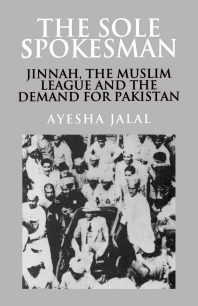
The Sole Spokesman: Jinnah, the Muslim League and the Demand for Pakistan

Author: Ayesha Jalal
Format: 336 pages
Language: English
Published Date: May 27, 1994
ISBN: 978-0521458504
User's Rating:
Not rated yet
|
Editor's Rating:
4.32

Summary and Key Themes

Jinnah’s Political Strategy and the Pakistan Demand

The book’s central theme is the relationship between Jinnah’s demand for Pakistan and his broader objective of securing political power for the Muslim League. Jalal argues that the demand cannot be interpreted adequately without considering the constitutional negotiations in which it operated. In her account, Pakistan was not merely a territorial objective; it was also a means of pressing for a political arrangement in which Muslim interests could not be overridden by a centralized all-India government.

This interpretation complicates the familiar narrative that Jinnah pursued partition from the outset as the only acceptable outcome. Jalal instead emphasizes the distinction between demanding Pakistan and negotiating over the actual constitutional structure of the subcontinent. Her argument should not be reduced to the claim that Jinnah never wanted Pakistan. Rather, she questions whether the final territorial outcome fully reflected his earlier political calculations.

Muslim Political Representation

Jalal places the Muslim League’s claim to represent Indian Muslims at the heart of the story. Jinnah’s strategy depended on establishing the League as the principal political representative of Muslims across British India, including those living in provinces where Muslims were a minority.

This created a fundamental political problem. Muslim-majority provinces possessed their own political interests and influential regional leaders, while Muslims in minority provinces faced different concerns about representation and constitutional safeguards. A single political demand therefore had to accommodate communities whose regional circumstances and political priorities were not identical.

The book’s analysis of representation is particularly valuable because it demonstrates that religious identity did not automatically produce political unity. The League had to build its authority through elections, negotiations, and competition with provincial political forces.

Provincial Politics and the Limits of Central Leadership

The political landscape of British India was not controlled exclusively by Congress and the Muslim League. Provincial parties, regional elites, and local political alliances also influenced the negotiations. Jalal examines the difficulties Jinnah faced in extending the League’s authority across Muslim-majority provinces.

The 1937 provincial elections were an important setback for the League in several key areas. The results exposed the gap between Jinnah’s ambition to establish the League as the authoritative voice of Indian Muslims and the realities of provincial politics. The subsequent growth of the Pakistan demand must therefore be understood in the context of the League’s efforts to strengthen its position.

The Cabinet Mission Plan and Constitutional Negotiations

The Cabinet Mission Plan of 1946 is central to Jalal’s interpretation. It proposed a framework intended to preserve a form of Indian union while accommodating provincial autonomy and grouping. Its acceptance, rejection, and subsequent breakdown reveal the difficulties of reconciling the Congress’s vision of an effective central government with the League’s demand for constitutional safeguards and political parity.

Jalal uses these negotiations to question the idea that partition was the only conceivable result of the Pakistan movement. The breakdown of the proposed settlement highlights the role of political mistrust, incompatible constitutional objectives, and strategic calculations by the major parties.

British Policy and the Transfer of Power

The British government was not simply a neutral referee between Congress and the League. Its policies, constitutional proposals, and decisions about the timing and structure of the transfer of power shaped the choices available to Indian political leaders.

Jalal’s focus on negotiations helps readers understand how British withdrawal, the competing ambitions of Indian political organizations, and the difficulty of constructing a workable constitutional settlement interacted. The result was not produced by a single decision-maker acting alone but by a process involving multiple actors with conflicting objectives.

Partition as a Contingent Historical Outcome

One of the book’s most significant themes is the distinction between a political demand and the eventual outcome of a political struggle. The establishment of Pakistan in 1947 does not, by itself, prove that every earlier demand for Pakistan had always referred to precisely the same territorial and constitutional arrangement.

Jalal’s argument encourages readers to examine changing strategies and missed opportunities. It also challenges national histories that present Partition as inevitable from the beginning. However, the contingency of the outcome does not mean that the Pakistan movement, Muslim political identity, or the demand for a separate state lacked genuine support. These issues require careful historical assessment rather than a simple either-or conclusion.

Further reading: Cambridge University Press, “Jinnah between the wars”, and the publisher’s paperback-edition preface.

Critical Analysis

A Major Contribution to Partition Historiography

The chief strength of The Sole Spokesman is its refusal to accept a simple, predetermined explanation of Partition. Instead of treating the creation of Pakistan as the inevitable culmination of a single political movement, Jalal investigates the negotiations and competing constitutional visions that shaped the outcome.

This approach makes the book valuable for readers who want to understand the political process behind the division of British India. It shifts attention from retrospective national narratives to the uncertainties that political leaders confronted before 1947.

The Strength of the Bargaining-Strategy Thesis

Jalal’s interpretation of the Pakistan demand as a bargaining strategy is intellectually stimulating because it distinguishes political rhetoric from negotiating objectives. It encourages readers to ask what Jinnah sought from Congress, what kind of central government he considered acceptable, and why the League’s negotiating position changed over time.

The thesis is most persuasive when read as an explanation of the strategic uses of the Pakistan demand, rather than as definitive proof that Jinnah’s commitment to a separate state was insincere. Political strategies can change, and leaders can pursue immediate bargaining goals while also advancing objectives that become more concrete as circumstances evolve.

Attention to Constitutional Detail

The book demonstrates why constitutional proposals matter to the history of Partition. Questions about the distribution of power, provincial autonomy, representation, and the authority of the central government were not technical details detached from political reality. They were at the heart of the disagreement.

Readers who are unfamiliar with the constitutional politics of late colonial India may find some of these discussions demanding. Nevertheless, the detail helps explain why negotiations failed despite repeated attempts to reach an agreement.

The Limits of a Leadership-Centred Narrative

The book’s emphasis on high politics is also a limitation. Its principal focus is on Jinnah, the Muslim League, Congress, and British decision-makers. The experiences of ordinary people, local activists, women, refugees, and communities directly affected by communal violence receive less attention than the elite negotiations leading up to Partition.

This emphasis is understandable given the book’s central research question, but it means the book should not be treated as a comprehensive social history of Partition. Readers seeking to understand mass migration, local violence, lived experience, and the long-term consequences for affected families will need complementary studies.

Does the Bargaining Thesis Explain Everything?

Jalal’s argument is a powerful interpretive framework, but it should not be used as a universal explanation for every aspect of the Pakistan movement. The motives of Muslim League leaders, provincial political groups, and ordinary supporters were not necessarily identical. A strategy devised by Jinnah at the negotiating table does not automatically explain the full range of popular motivations behind support for Pakistan.

Likewise, the argument that partition was not inevitable does not establish that a united constitutional settlement would necessarily have succeeded. Any alternative arrangement would have faced substantial problems of trust, power-sharing, implementation, and political legitimacy.

Historical Interpretation and Political Sensitivity

The book challenges narratives that are deeply embedded in Indian and Pakistani national histories. That makes it important, but also controversial. Readers should distinguish between Jalal’s documented account of negotiations and the broader conclusions she draws from them.

A careful reading neither accepts the thesis uncritically nor dismisses it because it differs from a preferred national narrative. The most productive approach is to consider Jalal’s evidence alongside other scholarship on the Pakistan movement, Muslim political thought, provincial politics, and the human consequences of Partition.

Overall Assessment

The Sole Spokesman is strongest as a study of political strategy and constitutional negotiation. It provides a compelling challenge to teleological histories of Partition and offers a framework for reassessing Jinnah’s role. Its elite-centred focus and the continuing debate over the interpretation of the Pakistan demand mean that it is best read alongside other historical perspectives.


Pros
  • Revisionist historical perspective: Challenges simplistic explanations of the Pakistan movement and the inevitability of Partition.
  • Detailed political analysis: Examines Jinnah’s strategy, the Muslim League’s changing position, and negotiations with Congress and British authorities.
  • Strong constitutional focus: Explains why questions of representation, provincial autonomy, and central power were central to the conflict.
  • Nuanced treatment of political leadership: Encourages readers to distinguish between public demands, negotiating tactics, and long-term political objectives.
  • Important historiographical contribution: Offers a framework that has helped shape scholarly debate about Partition.
  • Useful for comparative study: Provides a foundation for evaluating competing Indian, Pakistani, and scholarly interpretations of 1947.
Cons
  • Limited attention to ordinary people: Focuses more on political elites and negotiations than on the lived experiences of refugees and communities affected by Partition.
  • Demanding constitutional discussions: Readers without background knowledge of late colonial Indian politics may find the negotiations and institutional proposals difficult to follow.
  • Potential for overgeneralization: The central bargaining-strategy thesis can be misapplied if readers assume that Jinnah’s calculations explain every supporter’s motives.
  • Interpretation remains contested: The book’s revisionist argument should be considered alongside other historical scholarship rather than treated as the final word on Partition.
  • Limited coverage of the human aftermath: Those primarily interested in mass violence, migration, trauma, and social reconstruction will need additional books.
  • Historical distance: Published in 1985, the book predates several decades of subsequent scholarship and should be read in conversation with newer research.

Critical Reception

Influence on Partition Historiography

Since its publication in 1985, The Sole Spokesman has become an important work in debates about the origins of Pakistan and the political decisions that led to Partition. Cambridge University Press notes in Jalal’s paperback-edition preface that the book challenged established interpretations and subsequently became influential in scholarly and intellectual discussions of South Asian history.

The book’s central intervention was to question the assumption that the demand for Pakistan necessarily meant that the territorial division of India was always Jinnah’s sole or predetermined objective. By emphasizing constitutional negotiations and the possibility of alternative arrangements, Jalal helped open a wider debate about the relationship between the Pakistan demand and the eventual outcome of 1947.

Contemporary Scholarly Reviews

The book received formal reviews in established academic journals. Khalid Bin Sayeed reviewed it in The Journal of Asian Studies, volume 46, issue 3, in 1987, pages 683–685. Saleem Qureshi also reviewed the book in Pacific Affairs, volume 60, issue 2, in 1987, pages 354–355. These records establish that the book received attention in academic discussions of South Asian politics and history; the bibliographic records alone should not be taken as proof that either reviewer endorsed every part of Jalal’s thesis.

Continuing Debate

Jalal’s interpretation remains part of a broader historiographical debate over Jinnah’s objectives, Muslim political identity, the Two-Nation Theory, and the failure of constitutional negotiations. Later scholarship continues to examine the extent to which Partition resulted from strategic choices, ideological commitments, political mistrust, and the actions of multiple parties.

A 2019 discussion of Partition historiography in South Asia: Journal of South Asian Studies identifies Jalal’s intervention as a significant challenge to earlier interpretations that treated Jinnah’s role in the Pakistan movement in more straightforward terms. More recent scholarship also continues to revisit the competing interpretations of Jinnah and Partition.

How Readers Should Interpret Its Reputation

The book’s significance lies less in establishing an uncontested verdict than in reshaping the questions historians ask. Its arguments are influential, but the precise relationship between Jinnah’s bargaining strategy, his commitment to Pakistan, popular Muslim political aspirations, and the eventual partition remains a subject for critical evaluation.

Sources: Cambridge University Press, paperback-edition preface; Khalid Bin Sayeed’s review record in The Journal of Asian Studies; Saleem Qureshi’s review record in Pacific Affairs; and “Spaces before Partition: An Introduction”.

Who Should Read This Book?

  • Students of South Asian history: Especially those studying the Pakistan movement, the end of British rule, and the political origins of Partition.
  • Political science and international relations students: Readers interested in bargaining, political representation, federalism, constitutional design, and negotiations between competing political groups.
  • Researchers of Muhammad Ali Jinnah: Those seeking a detailed interpretation of Jinnah’s political strategy and his relationship with the Muslim League.
  • Readers interested in India and Pakistan: Anyone who wants to understand the historical debates underlying the creation of the two states.
  • Historiography enthusiasts: Readers interested in how historians challenge established narratives and interpret the same political events differently.
  • Advanced general readers: Those comfortable with detailed historical arguments and willing to compare different interpretations of a politically sensitive subject.

Who May Want a Different Starting Point?

Readers looking for a narrative centred on Partition’s human suffering, refugee experiences, communal violence, or family histories may prefer to begin with a social history or oral-history collection. This book is primarily concerned with political leadership and constitutional negotiations, so it works best as part of a broader reading programme on 1947.

HaqqFinder Editorial Rating

Overall Editorial Rating: 4.32/5

The Sole Spokesman earns a strong rating for its historical depth, original interpretation, and lasting importance to the study of Partition. Its principal limitations are its concentration on political elites, demanding constitutional analysis, and the need to evaluate its central thesis alongside other scholarship.

Evaluation Criteria Weight Score Assessment
Content Quality & Depth 20% 4.50/5 Detailed examination of political strategy and constitutional negotiations.
Writing Style & Clarity 15% 4.20/5 Scholarly and analytical, though some discussions require prior historical knowledge.
Relevance & Target Audience Fit 15% 4.50/5 Highly relevant to students and researchers of South Asian history.
Originality & Creativity 15% 4.60/5 Offers a distinctive reinterpretation of Jinnah’s political strategy and the Pakistan demand.
Cultural & Ethical Sensitivity 10% 4.00/5 Engages a sensitive historical subject analytically, though its elite-centred approach limits attention to ordinary people’s experiences.
Practical Value & Applicability 10% 4.20/5 Provides a useful framework for historical research and political analysis.
Presentation & Design 10% 4.00/5 Academic presentation suited to serious historical study.
Value for Price 5% 4.00/5 Offers substantial scholarly value, although affordability depends on the edition and format.

Rating Calculation

Weighted score = (4.50 × 0.20) + (4.20 × 0.15) + (4.50 × 0.15) + (4.60 × 0.15) + (4.00 × 0.10) + (4.20 × 0.10) + (4.00 × 0.10) + (4.00 × 0.05) = 4.315/5, rounded to 4.32/5.

Final Rating: 4.32/5 — Highly Recommended for Students of South Asian History

Our editorial ratings are based on HaqqFinder’s established evaluation criteria and weighted scoring system. For details, see our Rating & Evaluation Methodology.

Overall Verdict:

The Sole Spokesman: Jinnah, the Muslim League and the Demand for Pakistan is a major contribution to the study of the political origins of Partition. Ayesha Jalal challenges straightforward accounts of Pakistan’s creation by examining Jinnah’s negotiating strategy, the Muslim League’s struggle for representative authority, and the constitutional disagreements that ultimately undermined the possibility of an agreed settlement.

The book’s greatest achievement is its demonstration that the demand for Pakistan must be understood within the wider political negotiations of late colonial India. It encourages readers to question whether the outcome of 1947 was inevitable and to examine how competing ideas of representation, provincial autonomy, and central power shaped the final settlement.

Nevertheless, the book should not be treated as a complete account of every motivation behind the Pakistan movement or of the human tragedy of Partition. Its emphasis on elite politics leaves important questions about popular aspirations, provincial experiences, mass violence, and displacement for other historians to explore. Its central thesis is influential but remains open to debate.

For readers seeking a serious, analytical account of Jinnah’s political strategy and the constitutional negotiations leading to Partition, this book is highly recommended. It is particularly valuable when read alongside scholarship that explores Muslim political thought, provincial movements, popular mobilization, and the experiences of people affected by the division of British India.

HaqqFinder Verdict: A historically significant and intellectually challenging study that deserves a place on the reading list of anyone seeking to understand the political complexities behind the creation of Pakistan in 1947.

Citation: Jalal, Ayesha. The Sole Spokesman: Jinnah, the Muslim League and the Demand for Pakistan. Cambridge: Cambridge University Press, 1985.

Publisher: Cambridge University Press

Publication year: 1985

Subject: South Asian history, the Pakistan movement, Muhammad Ali Jinnah, constitutional negotiations, and the Partition of British India.

🛒 WHERE TO BUY

*When you purchase through this link, HaqqFinder may earn a small commission at no extra cost to you. Learn more

Share On:
Facebook
X
LinkedIn
Pinterest
Reddit
WhatsApp
Tumblr
Telegram
Threads

Ratings & Reviews

0
0 out of 5 stars (based on 0 reviews)
Excellent
Very good
Average
Poor
Terrible

There are no reviews yet. Be the first one to write one.

Where We Reference This Book
Explore HaqqFinder articles that cite, discuss, or mention this publication.
Related Recommendations:

Login

Fill out the form below, and we will be in touch shortly.