Book Summary
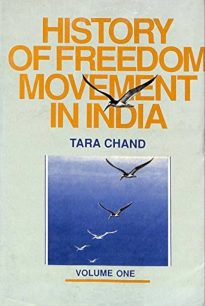
History of the Freedom Movement in India, Volume I by Tara Chand is a historical study of the political, social, cultural, and economic conditions that shaped India during the eighteenth century and the early phase of British expansion. First published in 1961 by the Publications Division of India's Ministry of Information and Broadcasting, the book forms the opening volume of a broader history of the Indian struggle against British rule.
Unlike a conventional account of the nationalist movement centred on organizations, demonstrations, and prominent freedom fighters, Volume I examines the historical circumstances that preceded the organized independence struggle. It explores the weakening of Mughal authority, the emergence of regional powers, political rivalries among Indian states, and the growing military and commercial influence of European trading companies, particularly the British East India Company.
Chand places these political developments within a wider account of Indian society and economic life. The book considers agriculture, land revenue, trade, manufacturing, administration, and the conditions of cultivators and artisans. It examines how the Company's commercial interests increasingly became connected with territorial control and how changing systems of revenue collection and governance affected existing institutions.
An important concern of the volume is explaining why Indian political powers were unable to prevent the expansion of British authority. Chand considers the fragmentation of political power, conflicts among regional rulers, military and administrative challenges, and the changing international balance between European powers and Indian states. His approach treats colonial conquest as a historical process shaped by several interacting conditions rather than as the consequence of one battle or one ruler's failure.
The book also reflects an early post-independence effort to construct a broad historical account of the origins of India's freedom movement. Its scope extends beyond the activities of later nationalist leaders to examine the social and political background against which British rule became established.
Volume I is therefore best understood as a study of the historical foundations of colonial domination, rather than a complete account of the organized independence movement. Readers looking for the later nationalist campaigns, the Indian National Congress, Gandhi, or the events of 1942 and 1947 will need the subsequent volumes or other works.
Bibliographic references: Google Books — History of Freedom Movement in India, Volume I; Open Library — 1961 edition.
Summary and Key Themes
1. Eighteenth-Century India and the Changing Political Order
The volume begins from the premise that British supremacy cannot be understood without examining the political order that preceded it. The eighteenth century witnessed the weakening of central Mughal authority and the growing influence of regional states and political powers.
These changes did not mean that India suddenly became politically or culturally disorganized. Regional powers continued to maintain administrations, collect revenue, wage wars, and sustain commercial and cultural networks. The central historical question is how the changing relationships among these powers created opportunities that the East India Company could exploit.
2. Mughal Decline and Regional Powers
The weakening of the Mughal Empire altered the distribution of political authority across the subcontinent. Maratha powers, the Sikhs, regional rulers in Bengal and Awadh, and other political formations pursued their own interests in an increasingly competitive environment.
Chand examines the resulting political landscape as part of the background to British expansion. Rivalries among regional powers could undermine collective resistance, but they should not be treated as proof that all Indian states lacked administrative capacity or political legitimacy. The relationship between regional autonomy, warfare, and colonial expansion requires attention to differences between regions and periods.
3. The East India Company: From Commerce to Territorial Power
The East India Company began as a commercial enterprise, but its military and political role expanded substantially during the eighteenth century. Its involvement in local disputes, alliances with Indian political actors, military campaigns, and acquisition of revenue rights gradually transformed it into a territorial power.
The Company's rise illustrates the connection between commercial ambition and political authority. Control over territory and revenue could finance military operations, strengthen administrative institutions, and give the Company advantages over competitors. Its development was therefore not simply a story of European trade; it was also a transformation in the organization of power.
4. The Battle of Plassey and British Expansion in Bengal
The events surrounding the Battle of Plassey in 1757 were an important turning point in the Company's rise in Bengal. The outcome involved political alliances, divisions within the ruling establishment, and Company intervention, rather than military superiority alone.
The subsequent expansion of Company authority and acquisition of revenue rights in Bengal strengthened its financial and political position. Bengal became central to the development of British power in India, demonstrating how control over a wealthy region could support further military and territorial expansion.
5. Political Rivalries and the Failure of Resistance
A major question underlying the volume is why Indian political powers failed to prevent the consolidation of British rule. Chand's analysis draws attention to the absence of a unified political response, rivalries among rulers, changing alliances, and the Company's ability to take advantage of divisions.
This theme is important, but it should not be reduced to the idea that India lost its independence merely because its people lacked unity. The outcomes of colonial conquest were also influenced by the Company's financial resources, military organization, diplomatic practices, institutional development, and the wider international context. Resistance occurred in different forms and places, even when it did not produce a lasting subcontinental coalition.
6. Agriculture, Land Revenue, and Rural Society
Chand places economic life alongside political developments. Agriculture and land revenue were central to the operation of many Indian states, and control over the collection of revenue became an important source of power for the Company.
Changing systems of assessment, collection, and administration affected cultivators, landlords, intermediaries, and local institutions in different ways. Examining these arrangements helps explain how colonial rule extended beyond military occupation to reshape the relationship between the state and rural society.
However, the effects of colonial revenue systems varied considerably across regions. Readers should avoid assuming that every locality experienced identical changes or that precolonial agrarian arrangements were uniform or free from exploitation.
7. Trade, Manufacturing, and Economic Change
The book considers commerce and manufacturing as part of the transformation of Indian society. Indian producers and merchants were connected to extensive regional and international trading networks before the establishment of British political supremacy.
The growing power of the Company changed the environment in which trade and production operated. Commercial monopolies, revenue demands, political intervention, and shifting relationships with European markets affected economic institutions and interests. These developments provide context for later debates about colonial extraction and the transformation of India's economy.
The precise extent and regional distribution of economic decline require careful historical investigation. The existence of colonial exploitation does not remove the need to examine evidence about particular industries, periods, and communities.
8. Administration, Law, and the Transformation of Authority
The consolidation of British rule involved more than conquest. Administrative structures, revenue collection, legal institutions, and systems of political supervision helped turn military victories into a durable form of government.
Studying these changes reveals how a trading company developed governing powers and how colonial administration increasingly influenced economic and social relationships. It also raises questions about continuity: some institutions were transformed, others adapted, and still others were incorporated into new systems of authority.
9. The Historical Foundations of the Freedom Movement
Volume I provides background for understanding the later freedom movement by tracing the establishment of colonial power and the conditions that shaped subsequent opposition. It helps readers distinguish the early history of British conquest from the emergence of modern organized nationalism in the nineteenth and twentieth centuries.
The volume's contribution is therefore foundational. It supplies historical context for the later development of political consciousness and resistance, rather than attempting to cover the entire independence struggle within a single book.
Further reading: Google Books' description and searchable text identify the work's emphasis on eighteenth-century social, political, cultural, and economic conditions. For the volume's intended historical scope, see also Tara Chand's letter to Jawaharlal Nehru dated 1 August 1960, which describes the first volume as covering the eighteenth century and the first half of the nineteenth century.
Critical Analysis
A Broad Foundation for Understanding Colonial Rule
One of the volume's principal strengths is its broad historical scope. Rather than treating British conquest as an isolated military episode, Chand situates it within changes in political authority, regional competition, commerce, agriculture, and administration.
This approach helps readers understand why colonial expansion required both coercive power and the ability to exploit existing political and economic structures. The book is particularly useful for connecting the establishment of British supremacy with the conditions that preceded the modern nationalist movement.
Political Fragmentation Without Oversimplification
Chand's attention to political divisions provides an important explanation for the Company's success. Alliances with local elites, rivalries among rulers, and conflicts over succession or territory could weaken resistance to an expanding external power.
Nevertheless, political fragmentation should not become a universal explanation for colonial conquest. Indian states sometimes cooperated, negotiated, or resisted effectively, while the Company itself faced setbacks and depended on Indian soldiers, financiers, merchants, administrators, and political partners. A balanced interpretation must recognize both local agency and the structural advantages that the Company gradually acquired.
Economic History as an Explanation of Power
The book's attention to revenue, agriculture, trade, and manufacturing strengthens its account of colonial expansion. Territorial control could generate financial resources, while revenue systems could support armies and administration. These connections are essential for understanding how the Company sustained its growth.
The economic framework also encourages readers to look beyond political personalities. However, broad claims about economic decline or colonial exploitation should be assessed alongside more recent economic history, including regional studies and research on production, taxation, trade, and living standards.
The Perspective of an Early Post-Independence Historian
First published in 1961, the volume belongs to an important period of post-independence historical writing. The effort to explain how colonial rule developed formed part of the wider project of interpreting India's transition from colonial subordination to independence.
This context gives the work historical significance in its own right. It also means that its interpretive framework should be considered in relation to the scholarship and historiographical debates of its time. A reader should not assume that a government-published history is necessarily neutral, nor that its institutional origins automatically invalidate its conclusions.
The Meaning of “Freedom Movement” in Volume I
The title can create an expectation that the volume focuses on organized nationalist campaigns. In practice, Volume I primarily establishes the historical background to colonial rule and the conditions preceding the later freedom struggle.
This is an important distinction for prospective readers. The volume is most useful to those who want to understand how British power developed; it is less suited to readers seeking a direct account of the Indian National Congress, Gandhian mass movements, revolutionary organizations, or the final transfer of power in 1947.
Historical Coverage and the Need for Multiple Perspectives
A general synthesis necessarily selects certain events, institutions, and explanations. Although Chand examines several dimensions of Indian society, readers may wish to supplement the volume with more specialized studies of regional resistance, peasant movements, tribal communities, caste relations, gender, and the experiences of particular social groups.
Similarly, accounts of the eighteenth century can differ in their interpretations of Mughal political change, regional state formation, and the economic consequences of Company rule. Comparing Chand with later scholarship helps readers identify where interpretations have developed and where historical debates remain unsettled.
Overall Critical Assessment
History of the Freedom Movement in India, Volume I is a useful historical synthesis that connects political change with economic and social conditions. Its greatest value lies in explaining the background to British expansion and establishing the context for the later freedom struggle.
Its limitations are those of a broad mid-twentieth-century historical synthesis: some interpretations benefit from reassessment through more recent regional, social, and economic research, and the volume does not cover the organized independence movement in full. It remains valuable as a foundation, particularly when read critically and alongside newer scholarship.