Book Summary
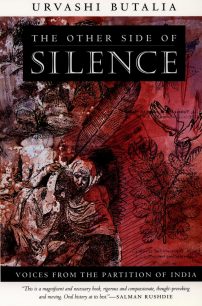
The Other Side of Silence: Voices from the Partition of India by Urvashi Butalia is an influential work of oral history that examines the human consequences of the 1947 Partition of British India. Rather than concentrating primarily on political leaders, diplomatic negotiations, or the drawing of national borders, Butalia explores how Partition transformed ordinary lives, divided families, displaced communities, and left psychological wounds that often remained unspoken for decades.
Drawing on interviews conducted over approximately a decade, personal testimonies, diaries, letters, memoirs, official documents, and her own family history, Butalia reconstructs experiences that conventional historical narratives frequently overlooked. Her subjects include women, children, lower-caste communities, survivors of violence, and people whose lives crossed the newly established border between India and Pakistan.
The book investigates the relationship between communal violence, gender, caste, religious identity, family honour, and collective memory. It explores how women experienced abduction, sexual violence, forced separation, and decisions made by families and communities in the name of honour. It also examines children who were separated from relatives, individuals who concealed painful experiences, and families whose relationships were permanently altered by Partition.
One of the book’s central concerns is silence itself. Butalia asks why survivors sometimes avoided discussing their experiences, why families suppressed particular memories, and how public narratives of national independence could obscure the suffering that accompanied it. Her investigation demonstrates that silence does not necessarily mean an absence of memory; it may instead reflect trauma, shame, fear, social pressure, or the difficulty of expressing experiences that challenge accepted accounts of the past.
Butalia also reflects on her own Partition-affected family history, connecting personal memory with wider historical questions. This approach blurs the conventional boundary between researcher and subject, showing how historical inquiry can be shaped by the investigator’s relationship to the events being studied.
First published in India in 1998, the book became a significant contribution to Partition studies, feminist historiography, and oral history. Its lasting importance lies in demonstrating that the history of Partition cannot be understood through political decisions and casualty estimates alone. It must also account for individual testimony, social hierarchies, family relationships, and the memories that official histories have often left at the margins.
Publisher reference: Duke University Press — The Other Side of Silence.
Summary and Key Themes
1. Partition Beyond Political History
Conventional accounts of Partition often emphasize the political conflict between the Indian National Congress, the Muslim League, and the British government. Butalia shifts the focus to the people who experienced the consequences of those decisions. Her work examines the loss of homes, the separation of families, the destruction of familiar social worlds, and the struggle to rebuild lives in unfamiliar places.
This change of perspective is not simply a matter of adding emotional detail to an established historical narrative. It changes the questions that history asks. Instead of examining only how new states were created, Butalia investigates what those new borders meant to people whose identities, relationships, and livelihoods had developed across the regions being divided.
2. Oral History and the Recovery of Marginalized Voices
Oral testimony is the book’s principal method. Through conversations with survivors and their families, Butalia recovers experiences that may never have entered official records or may have been deliberately concealed. The stories reveal the limits of archives that privilege government documents, political correspondence, and the perspectives of powerful institutions.
Oral history also allows individuals to describe the meanings they attach to past events. Two people who experienced the same historical upheaval may remember it differently, emphasize different losses, or interpret the actions of relatives and neighbours in contrasting ways. Such differences are not necessarily defects in the historical record; they are part of the evidence about how memory works.
3. Gendered Violence and Women's Experiences
One of the book’s most important contributions is its examination of the violence experienced by women during Partition. Abduction, rape, forced separation, and coercion were not merely individual tragedies; they were connected to ideas about religious community, family honour, masculinity, and national identity.
Women could become symbols of community honour, with their bodies treated as territory to be defended, recovered, or avenged. The social consequences of sexual violence could persist long after immediate physical danger had passed. Butalia explores the ways family and community decisions could further restrict the agency of women who had already suffered violence.
The book is particularly significant because it does not assume that all women experienced Partition in the same way. Their circumstances differed according to religion, caste, class, location, family relationships, and the decisions they were permitted or compelled to make.
4. Family Honour, Abduction, and Recovery
The language of honour is central to Butalia’s examination of Partition. In some cases, women who were abducted or remained with people from another religious community became subjects of competing claims by families, communities, and states. Official efforts to recover abducted women could treat them as members of a community to be returned rather than as individuals whose wishes and circumstances required careful consideration.
These accounts expose a difficult contradiction: actions described as protection or rescue could also restrict personal autonomy. The book encourages readers to question whose understanding of honour prevailed and whether a woman’s own preferences were respected in decisions concerning her future.
5. Children, Separation, and Disrupted Childhoods
Children experienced Partition through separation from parents, sudden displacement, loss of familiar surroundings, and the breakdown of family networks. Some were too young to understand the political circumstances that transformed their lives. Others carried memories that remained difficult to communicate even as adults.
By attending to childhood experiences, Butalia reveals how the consequences of Partition extended beyond the immediate period of violence. The event could shape family identity, relationships, and personal memory for decades.
6. Caste and the Margins of Historical Memory
Butalia's attention to caste challenges the idea that Partition can be explained entirely through Hindu-Muslim relations. Social status influenced people's vulnerability, access to resources, ability to relocate, and position within the stories later told about the upheaval.
Marginalized communities were not simply passive victims outside the main historical narrative. Their experiences reveal how communal identity intersected with pre-existing inequalities. Including these perspectives makes the history more complex and helps prevent the experiences of socially privileged groups from standing in for the whole population.
7. Silence, Trauma, and Collective Memory
The title captures the book’s central concern: why do people remain silent about experiences that have shaped their lives? Survivors may avoid speaking because memories are painful, because they fear stigma or judgment, or because their experiences conflict with the stories their families and societies prefer to tell.
Silence can also be socially produced. Families may suppress stories to protect reputations, preserve relationships, or allow younger generations to live without confronting painful histories. Public narratives of independence and national achievement can similarly make it difficult to acknowledge violence committed within one's own community.
Butalia does not suggest that a single act of remembering can resolve every wound. Rather, she demonstrates the historical importance of listening to accounts that have remained private and recognizing that memory is shaped by both personal experience and social conditions.
8. The Researcher's Family History
Butalia incorporates her own family's experience into her investigation, acknowledging that Partition is not merely an abstract historical subject. Personal connections can provide access to memories and questions that a more detached inquiry might overlook.
This approach also creates methodological challenges. A researcher must consider how personal involvement influences the selection of testimony, the interpretation of events, and the presentation of conflicting memories. Butalia’s willingness to reflect on her own position makes the research process part of the book’s broader inquiry into how history is remembered and narrated.
9. Memory Across Borders
Partition created international borders, but family histories, emotional attachments, and memories did not necessarily end at those boundaries. People who migrated to India or Pakistan often continued to remember places, relationships, and communities they had left behind.
These memories complicate national narratives that present the two countries as entirely separate historical worlds. Butalia shows how the aftermath of Partition continued through family stories, absences, inherited memories, and the difficulty of reconciling personal loss with official accounts of national beginnings.
Further reading: Duke University Press's book description and contents outline the work's focus on bloodshed, facts, women, honour, children, marginalized communities, and memory.
Critical Analysis
Reframing the History of Partition
The book’s most important achievement is its transformation of the scale at which Partition is understood. Political histories are essential for explaining how the division occurred, but they cannot fully describe what it meant to live through it. Butalia makes the individual experience central to historical interpretation without losing sight of the wider social and political conditions.
This approach reveals that the history of Partition consists of more than one narrative. National independence, migration, communal violence, family survival, and the loss of home can coexist within the same historical moment while producing very different memories. The result is a more human and less triumphalist understanding of 1947.
Oral Testimony as Historical Evidence
Butalia demonstrates the value of oral history in recovering experiences that conventional archives may overlook. Personal testimonies can reveal the emotional and social consequences of events that official records describe only in administrative or statistical terms.
However, oral testimony requires critical interpretation. Memory can change over time, details may be incomplete, and recollections may be influenced by later events, family narratives, or the circumstances of an interview. The fact that a story is deeply moving does not automatically establish every detail as independently verified.
The strongest approach is therefore to recognize testimony as evidence of both remembered experience and the ways people construct meaning from the past. Butalia's combination of interviews with documentary materials strengthens the historical inquiry, while the reader should remain attentive to the distinction between personal recollection and independently corroborated fact.
Gender as a Historical Framework
The book's feminist perspective is a major strength. It demonstrates that gender was not a secondary issue during Partition but an important part of how violence, displacement, and community identity operated. Women’s experiences expose the limitations of historical narratives that treat communities as unified political actors without examining inequalities within them.
By investigating honour, abduction, and recovery, Butalia also questions the assumption that a family or state necessarily acts in the best interests of the women it claims to protect. This makes the book relevant beyond Partition studies, particularly to scholarship on gender, nationalism, and bodily autonomy.
Beyond a Simple Hindu-Muslim Binary
Communal identity was central to the violence surrounding Partition, but Butalia's attention to caste, gender, age, and family circumstances demonstrates why a two-community framework is insufficient. People occupied different positions within their own communities, and those differences shaped their experiences.
This does not diminish the importance of religiously organized violence. Instead, it provides a more precise account of how religious identity interacted with social hierarchy, gender expectations, and local circumstances. The book is strongest when it reveals these overlapping forces rather than treating any one of them as a complete explanation.
The Ethics of Telling Painful Stories
Collecting testimony about sexual violence, family separation, and trauma creates ethical responsibilities. Researchers must consider consent, privacy, the possibility of retraumatization, and the risk of turning suffering into a dramatic narrative for readers.
Butalia's reflective approach draws attention to the responsibilities involved in listening to survivors and representing their experiences. The book also raises a broader question: when does telling a story help challenge historical silence, and when might public retelling expose a person or family to further harm?
These questions do not invalidate oral history. They demonstrate why sensitive testimony should be presented with care and why the person telling a story should not disappear behind the researcher's interpretation.
Limitations of Scope and Representation
No collection of interviews can represent every community, region, or experience of Partition. Butalia's work broadens the historical record, but it cannot function as a complete account of the event's enormous geographic and demographic diversity.
Readers seeking a systematic regional comparison, a detailed account of state policy, or a comprehensive chronology of political negotiations will need additional sources. Likewise, the book’s focus on marginalized voices should not lead readers to assume that every community or social group is represented equally.
Does Personal Narrative Weaken Historical Objectivity?
Butalia's inclusion of her own family history may be seen as a departure from conventional academic detachment. Yet personal involvement does not automatically make historical research less rigorous. Acknowledging one's position can make the assumptions and emotional stakes of research more visible.
The relevant question is not whether the researcher has a personal connection to the subject, but whether claims are presented transparently and interpreted critically. The book's reflective method is valuable precisely because it makes the relationship between personal memory and historical inquiry part of the discussion.
Overall Critical Assessment
The Other Side of Silence is most persuasive as a humane, reflective study of memory, violence, and the lives obscured by official history. It does not replace political histories of Partition; it exposes what those histories may leave out. Its limits arise largely from the challenges inherent in oral history and the impossibility of representing an event of such scale through any single work.
For readers willing to engage with complex testimony and unresolved historical questions, the book offers a powerful reminder that historical understanding depends not only on reconstructing what happened but also on listening carefully to those who lived through it.