Discover the brutal history of British colonial atrocities against Indian Muslims, from the 1857 rebellion to the Mopla uprising and beyond.
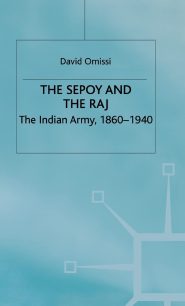
David Omissi’s The Sepoy and the Raj: The Indian Army, 1860–1940 examines the Indian Army as both a military institution and an instrument of British colonial rule. Rather than focusing exclusively on commanders, campaigns, and military strategy, Omissi directs attention toward the Indian soldiers whose service helped sustain the Raj for eight decades.
Drawing on archival research, the book investigates why Indian men enlisted, how military authorities recruited and managed them, what motivated their service, and how soldiers responded to the demands and contradictions of serving a colonial power. It explores the relationship between military organization and the social backgrounds of the men who filled the ranks.
The study is organized around several major subjects: recruiting strategy, enlistment, fighting spirit, dissent, Indian officers and Indianization, and the role of military power in maintaining colonial rule. Together, these themes connect the everyday experiences of soldiers with the larger political and administrative structures of British India.
Omissi examines the policies and assumptions that shaped recruitment into the Indian Army. Recruitment was not simply a matter of finding willing soldiers: it reflected colonial administrative priorities, ideas about suitable military communities, and the practical interests of the army. The distinction between official recruiting strategies and individual enlistment decisions helps illuminate how imperial institutions depended on Indian participation.
The book considers the reasons Indian soldiers served the British state and the factors that influenced military performance. It encourages readers to look beyond simplistic explanations of loyalty or obedience and to consider the interaction of personal circumstances, military culture, social relationships, and institutional incentives.
Service in a colonial army did not mean that soldiers invariably accepted its authority without question. By examining dissent, Omissi explores the tensions that could emerge between military discipline and the interests or expectations of Indian servicemen. This theme is important for understanding colonial rule as a system that relied on Indian soldiers while also having to manage their grievances and resistance.
The discussion of Indian officers and Indianization addresses questions of advancement, authority, and the limits imposed on Indian participation in military leadership. These issues reveal the unequal structure of the colonial army and the difficulties involved in expanding Indian responsibility within an institution historically dominated by British officers.
The book's wider argument concerns the relationship between military organization and imperial power. The Indian Army defended the Raj against external threats and helped preserve British authority within the subcontinent. Omissi's approach makes it possible to examine how that power depended not only on British command but also on the recruitment, labour, and cooperation of Indian soldiers.
Overall, the book offers a social and institutional history of the colonial army. Its main value lies in connecting soldiers' experiences and choices with the broader political structures that shaped military service in British India.
Bibliographic reference: Palgrave Macmillan / Springer edition record and table of contents.
The Sepoy and the Raj received positive attention from historians working in military and imperial history. The publisher’s record reproduces assessments describing the work as original, important, and valuable for understanding how armies operate within wider social and political systems.
Historian Bernard Cohn, writing in the International History Review, praised the book’s originality and its challenge to assumptions about British rule. David French’s assessment in War in History emphasized its importance for military and social history, while T. A. Heathcote’s review in the Journal of Imperial and Commonwealth History highlighted its research, documentation, and usefulness to other scholars. These assessments are reproduced on the publisher’s book page.
Independent, book-specific reviews also appeared in established academic journals. David French reviewed the book in War in History, volume 2, issue 2 (July 1995), pages 241–242. Anthony S. Bennell reviewed it in the Journal of the Royal Asiatic Society, volume 6, issue 1 (April 1996), pages 123–125. Their bibliographic records can be consulted through SAGE Journals and Cambridge University Press.
Critical perspective: The available reception supports the book’s standing as a significant scholarly contribution. However, the reviews cited here do not establish that every argument remains uncontested or that the book incorporates subsequent developments in historical research. Readers should use newer scholarship alongside it when preparing advanced academic work.
The following rating evaluates the book’s scholarly contribution, accessibility, usefulness, and presentation as a historical research resource. Scores are editorial assessments, not reader-review averages.
| Evaluation Criteria | Weight | Score | Assessment |
|---|---|---|---|
| Content Quality & Depth | 20% | 4.5/5 | Substantial archival research and a focused examination of military and colonial institutions. |
| Writing Style & Clarity | 15% | 4.2/5 | A structured scholarly study; specialist terminology and historical detail may challenge general readers. |
| Relevance & Target Audience Fit | 15% | 4.5/5 | Highly relevant to colonial Indian history, military history, and imperial studies. |
| Originality & Creativity | 15% | 4.5/5 | A distinctive focus on Indian soldiers’ motivations, experiences, and dissent within the colonial army. |
| Cultural & Ethical Sensitivity | 10% | 4.0/5 | Its attention to Indian servicemen complicates colonial narratives, though readers should consider the limits of any historical framework. |
| Practical Value & Applicability | 10% | 4.2/5 | Useful for coursework, research, and understanding the mechanisms of colonial military power. |
| Presentation & Design | 10% | 4.0/5 | The contents, references, notes, and index support scholarly use; the physical design of individual editions may differ. |
| Value for Price | 5% | 4.0/5 | The research value is strong, but actual value depends on the edition and purchase price. |
| Weighted Overall Score | 100% | 4.30/5 | Very Good — a valuable scholarly study of the Indian Army under colonial rule. |
Rating note: Our editorial ratings are based on HaqqFinder’s established evaluation criteria and weighted scoring system. For details, see our Rating & Evaluation Methodology.
Assessment limitation: The score is provisional because the complete text and a specific physical edition were not independently inspected for this review. The presentation and price-related scores are therefore less certain than the assessment of the book’s documented scope and scholarly reception.
David Omissi’s The Sepoy and the Raj: The Indian Army, 1860–1940 is a valuable work for understanding how the British Indian Army functioned as both a military organization and a pillar of colonial authority. Its attention to recruitment, soldier motivation, dissent, and Indianization makes it more illuminating than a narrative concerned only with campaigns and commanders.
The book’s greatest strength is its focus on the Indian soldiers whose service sustained an imperial system that did not grant them equal authority. By examining their participation and the tensions within military service, Omissi offers a more nuanced picture of colonial power than explanations based solely on British leadership or unquestioning Indian loyalty.
Its specialist focus, historical scope, and publication date are limitations for some readers, rather than reasons to dismiss its contribution. Students, researchers, and serious readers of South Asian military history will benefit most, especially when they compare its findings with newer scholarship.
HaqqFinder verdict: A strong academic resource recommended for readers interested in the Indian Army, British imperialism, and the social history of colonial India.
*When you purchase through this link, HaqqFinder may earn a small commission at no extra cost to you. Learn more
There are no reviews yet. Be the first one to write one.

Discover the brutal history of British colonial atrocities against Indian Muslims, from the 1857 rebellion to the Mopla uprising and beyond.