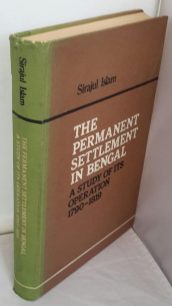
The Permanent Settlement in Bengal: A Study of Its Operation, 1790–1819 examines the practical operation of the land-revenue system introduced by the East India Company in Bengal in 1793. Under this arrangement, the colonial government fixed the land-revenue demand payable by zamindars on a permanent basis. The policy sought to create a more predictable revenue system, but its implementation had significant consequences for landownership, estate management, and agrarian relations.
Sirajul Islam moves beyond the formal objectives of the settlement to investigate how it affected existing landed families and who acquired estates when land was sold to recover unpaid revenue. Using official records and statistical analysis, he reconstructs patterns of dispossession, estate transfers, and the emergence of new landholding interests during the period under study.
The Origins and Operation of the Permanent Settlement
The book places the settlement within the broader transformation of Bengal's revenue administration under the East India Company. The permanent fixing of the government's revenue demand was intended to provide fiscal stability, but the system also imposed strict obligations on zamindars to pay revenue on time.
Understanding the distinction between the government's fixed revenue demand and the income collected by individual landholders is essential to understanding the policy's operation. Zamindars had to meet their obligations even when collection from their estates proved difficult. Failure to pay could result in the sale of an estate under the colonial revenue-sale system.
The Zamindars and Their Financial Difficulties
Islam examines the response of Bengal's established zamindars to the new system, including the difficulties faced by major landed families. The book considers how revenue demands, arrears, estate administration, and the threat of public sale affected their ability to retain inherited property.
The study is particularly useful because it does not assume that the consequences of the settlement were identical for every landholder. By examining individual estates and broader patterns, it investigates which families lost land, which retained or recovered property, and how the balance of landed wealth changed.
Revenue Arrears and Public Auctions
One of the book's central concerns is the sale of estates to recover unpaid government revenue. These sales were a key mechanism through which ownership could change under the settlement. Islam investigates the frequency and operation of public sales and considers why the pattern of estate transfers changed over time.
This analysis helps explain how a policy designed to stabilize government income could also produce substantial changes in the composition of the landed elite. Estate auctions were not merely administrative procedures: they could alter established property relationships and create opportunities for new purchasers.
The Transfer of Land and the Rise of New Owners
The book's statistical analysis examines who lost estates and who acquired them. The available review by historian John R. McLane highlights Islam's estimate that, during the decade following the settlement, land associated with approximately 43 percent of Bengal's land revenue was transferred to new owners, after adjustments for certain fictitious transfers and repurchases.
McLane also notes the book's conclusion that a large share of these transfers involved the twelve major zamindari families identified by Islam. The precise reconstruction of ownership is complicated by transactions made under false names, known as benami purchases, and by private sales that were not fully recorded in Company accounts. Islam explains the uncertainties involved rather than presenting every estimate as exact.
Continuity and Change Among Bengal's Landed Elite
The study explores whether the Permanent Settlement destroyed Bengal's established landed aristocracy or primarily redistributed property among different groups of landholders. This distinction is important: the loss of an estate by one family did not necessarily mean that the land passed to peasants or ceased to be controlled by large proprietors.
By examining the identities and backgrounds of purchasers, Islam considers the extent to which land passed to other landlords, government and zamindari employees, merchants, and emerging landed interests. The book thus presents estate transfers as a process of social and economic restructuring rather than a simple story of the disappearance of an old elite.
Historical Evidence and Quantitative Analysis
A major strength of the book is its effort to measure the consequences of the settlement using historical records. The study draws on revenue administration documents and examines public sales, ownership changes, and the difficulties of identifying purchasers accurately.
These records do not provide a complete account of every transaction. Nevertheless, by explaining the limitations of the evidence and identifying where estimates are uncertain, Islam offers a more systematic basis for assessing the policy's operation than general statements about the decline or survival of the zamindars.
Overall, the book is a focused institutional and agrarian history of colonial Bengal. Its contribution lies in examining how the Permanent Settlement worked in practice and how revenue policy helped reshape landed property and elite power between 1790 and 1819.
Bibliographic reference: Google Books — The Permanent Settlement in Bengal.