Summary & Key Themes
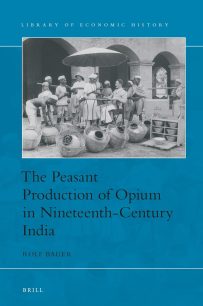
Rolf Bauer’s The Peasant Production of Opium in Nineteenth-Century India examines the lives and economic circumstances of Indian peasants who cultivated opium for the colonial state. Published by Brill in 2019 as part of the Library of Economic History, the book challenges the assumption that participation in a commercial agricultural system necessarily benefited the cultivators who supplied it.
Bauer's central argument is that more than one million peasants produced opium for the colonial state, yet poppy cultivation could leave them facing substantial economic losses. He investigates how the colonial administration's authority interacted with debt and social dependencies within villages, creating conditions that encouraged or compelled peasants to continue producing opium.
Major Themes
1. The Creation of the Colonial Opium System
The book examines how the colonial opium-production system was established and how it became embedded in rural economic life. Rather than treating opium simply as a commodity in international trade, Bauer investigates the institutions and relationships that connected the colonial state to agricultural producers.
2. The Everyday Operation of Opium Production
Bauer moves beyond the broad history of the opium trade to examine the system's practical operation. The organisation of production, the role of state officials and intermediaries, and the conditions under which peasants cultivated poppy are central to understanding how the system functioned at the local level.
3. A Local Study of Saran
A dedicated chapter examines Saran, a district in the opium-producing region of Bihar. This local-level approach helps connect the larger colonial system to the economic and social relationships that shaped agricultural decisions in particular communities.
4. The Costs and Benefits of Poppy Cultivation
One of the book's most important contributions is its examination of cultivation costs and returns. Bauer argues that peasants could produce poppy at a substantial loss. This raises a fundamental historical question: why would cultivators continue growing a crop when its financial returns were unfavourable?
5. Incentives, Coercion, and Dependence
Bauer addresses this question through a framework connecting three forces: indebtedness, the coercive power of the colonial state, and social dependencies within village society. His analysis suggests that agricultural choices cannot be understood solely as voluntary market decisions when the people making them operate under unequal economic and political conditions.
6. Colonial Power and Peasant Economies
By centring the cultivators rather than focusing exclusively on government revenue or international commerce, the book contributes to the social and economic history of colonial India. It invites readers to consider who benefited from a profitable colonial commodity system and who carried its production costs.
Based on empirical research and a detailed examination of local power relations, the book offers a focused study of how colonial institutions shaped rural livelihoods. Its principal subject is not the entire history of opium or the later opium trade with China, but the production system and the peasants who sustained it.
Critical Analysis
The strongest feature of The Peasant Production of Opium in Nineteenth-Century India is its decision to examine colonial economic power from the perspective of agricultural producers. The history of opium is often associated with imperial trade, government revenue, and international conflict. Bauer redirects attention to the people who cultivated the crop and asks whether the economic arrangements governing production served their interests.
Moving Beyond the Profits of Colonial Trade
A commodity can generate considerable revenue for a state or commercial network without making its producers prosperous. Bauer's analysis of cultivation costs and benefits is important because it separates the economic value of opium to the colonial system from its value to individual peasant households.
This distinction helps readers understand why the existence of an export-oriented agricultural industry should not automatically be interpreted as evidence of rural economic improvement. To assess the consequences of commercial agriculture, historians must consider production costs, payment arrangements, access to alternative crops, and the distribution of gains across the economic chain.
Explaining Coercion Through Everyday Relationships
Bauer's emphasis on debt, colonial authority, and village-level dependencies is a particularly valuable part of his argument. Coercion does not always operate through a single, visible act of physical force. Unequal credit arrangements, dependence on influential local actors, and the power of state institutions can restrict the practical choices available to cultivators.
This framework offers a more nuanced account than one that treats peasants either as entirely free market participants or as people whose behaviour was determined exclusively by direct state commands. It draws attention to the interaction between formal colonial power and local social relationships.
The Value of Local-Level Research
The chapter devoted to Saran provides a regional lens through which to investigate the larger production system. Local analysis is valuable because colonial institutions did not operate in a social vacuum: landholding arrangements, labour, caste and status relationships, credit, and agricultural conditions could influence how policies worked in practice.
A district-level study cannot represent every opium-producing region of India in exactly the same way. Nevertheless, close examination of a particular area can reveal mechanisms that broad accounts of imperial trade or government policy might overlook.
Empirical Evidence and Historical Interpretation
The book's empirical approach is central to its value. Its investigation of production costs, peasant circumstances, and the functioning of the colonial system provides a basis for assessing the relationship between policy and rural economic outcomes. Readers should, however, distinguish the evidence presented for particular locations and periods from conclusions that might apply to all cultivators throughout nineteenth-century India.
Historical records also require careful interpretation. Government statistics and administrative documents can illuminate production and revenue, but they may not fully capture household hardship, informal relationships, or the choices available to cultivators. The strength of a study lies partly in how effectively it interprets such evidence and acknowledges the limits of what can be established.
What the Book Does Not Establish on Its Own
The book's findings should not be expanded into the claim that every Indian peasant experienced the same conditions, that every form of opium cultivation was equally unprofitable, or that the entire history of British colonial rule can be explained through this one industry. Its focus is more specific: the economic and social mechanisms that sustained peasant opium production under colonial rule.
Similarly, the book offers important evidence for understanding colonial extraction, but evaluating the full economic impact of British rule requires additional research into taxation, land revenue, other cash crops, trade, industrial development, famine, and regional differences.
Overall Assessment
Bauer's study is a valuable contribution because it connects colonial economic structures to the material conditions of rural producers. Its combination of local investigation, economic analysis, and attention to coercive relationships makes it especially useful for readers interested in how unequal systems function in practice. It is a specialised scholarly monograph rather than a general introduction to the entire history of British India, and it is best read with that scope in mind.