Summary & Key Themes
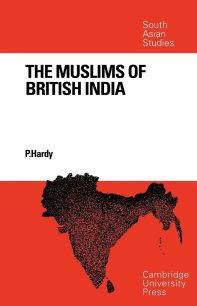
Peter Hardy's The Muslims of British India examines the transformation of Muslim society and political thought under British rule, from the decline of earlier Muslim political authority to the creation of Pakistan in 1947. Rather than treating Indian Muslims as a unified political community throughout history, Hardy explores how religious ideas, social conditions, colonial policies, and political developments contributed to the gradual formation of modern Muslim political identity.
The book is organised chronologically, beginning with the medieval legacy and the effects of British rule before 1857. It then follows Muslim responses to colonial government, the development of political organisations, the increasing importance of religion in politics, and the eventual division of British India and the Muslim community.
Major Themes
1. The Medieval Legacy and Muslim Identity
Hardy challenges the assumption that Muslims across the Indian subcontinent had always understood themselves as one unified political nation. Muslim communities differed in language, region, social position, and religious outlook. The memory of earlier Muslim rule became increasingly significant in later political thinking, but it should not be confused with an established, uniform national identity in the precolonial period.
2. The Effects of British Rule Before 1857
The book examines how the expansion of British power affected Muslim elites and communities. Hardy pays particular attention to the social and economic changes in the regions that later formed the United Provinces of British India. He questions the assumption that British rule had immediately and uniformly devastated the economic position of all Muslims, arguing that the historical circumstances were more complex.
3. The Revolt of 1857 and Its Aftermath
The rebellion of 1857 and the transfer of power from the East India Company to the British Crown form a major turning point in the book. Hardy investigates how the rebellion affected Muslim political standing, British perceptions of Muslims, and the ways Muslim intellectuals and leaders subsequently approached colonial rule.
4. Muslim Responses to Colonial Modernity
Hardy explores how Muslims attempted to adapt to the institutions and intellectual conditions of British India. Educational reform, engagement with Western knowledge, religious scholarship, and changing relationships with the colonial state contributed to different visions of Muslim social and political advancement.
5. The Growth of Muslim Political Community, 1871–1901
The book examines the emergence of a more organised sense of Muslim political interests during the late nineteenth century. Political representation, educational initiatives, elite leadership, and concerns about the position of Muslims within a changing constitutional order helped shape new forms of collective political identification.
6. Constitutional Politics and All-India Representation
Hardy traces the development of Muslim participation in constitutional politics, including debates over representation and political safeguards. These developments reveal that Muslim political identity was not formed through religious sentiment alone; it was also shaped by institutions, electoral arrangements, and negotiations over power within British India.
7. Religion Enters Politics, 1910–1924
The period surrounding the Khilafat movement and the Non-Cooperation movement receives particular attention. Hardy examines how religious concerns became increasingly connected to political mobilisation and how Muslim modernists and traditional religious scholars contributed to debates about the community's future.
8. Political Frustration, 1924–1935
The book considers the tensions and disappointments that followed earlier political mobilisations. Disagreements over constitutional reform, representation, leadership, and the future structure of India complicated efforts to establish a common Muslim political programme.
9. Partition and the Limits of Muslim Unity
Hardy's final chapters examine the political developments leading to the Partition of British India in 1947. He argues that the emergence of Pakistan should not be interpreted as proof that all Muslims had always shared one political outlook. The division of the subcontinent also exposed disagreements over the meaning, geographical boundaries, and political future of Muslim nationhood.
Overall, the book offers a historical explanation of how Muslim political identity developed under colonial conditions. Its principal contribution is to connect religious thought and collective memory with changing social circumstances and the practical demands of modern politics.
Critical Analysis
The Muslims of British India is important because it examines Muslim political identity as a historical process rather than an unchanging inheritance. Hardy explores the interactions between religious traditions, colonial power, social and economic change, and constitutional politics. This approach helps explain why Muslim political mobilisation took different forms at different moments in British Indian history.
Questioning the Idea of an Unchanging Muslim Nation
One of Hardy's most significant arguments is that the existence of Muslim communities across the subcontinent did not automatically produce a single, unified political nation. Muslims lived in different regional, linguistic, and social environments and did not necessarily share the same political priorities.
Hardy argues that a stronger sense of collective political identity emerged through particular historical developments, including colonial rule, modern education, religious mobilisation, and debates over political representation. This interpretation helps distinguish religious belonging from the modern political idea of nationhood.
However, the absence of a single, uniform political identity does not mean that earlier Muslims lacked wider religious connections, shared intellectual traditions, or ideas of community. Religious solidarity and political nationhood are related but distinct phenomena. A balanced reading should avoid replacing one oversimplification with another.
Colonial Rule and Muslim Social Change
Hardy's treatment of the period before 1857 challenges sweeping narratives that portray British expansion as producing the same immediate economic consequences for every Muslim community. His emphasis on regional circumstances, especially in the area that later became Uttar Pradesh, encourages readers to investigate social position, occupation, landholding, and access to political institutions rather than assuming a uniform experience.
This is a useful corrective to broad generalisations. Yet findings about one region or particular social groups cannot automatically be applied to Muslims across Bengal, Punjab, Sindh, the Deccan, or other parts of the subcontinent. Muslim experiences under colonial rule varied considerably according to locality, class, occupation, and political circumstances.
Religion as a Political Force
The book's discussion of religious scholarship and political mobilisation is another major strength. Hardy argues that the development of Muslim political identity cannot be explained solely through Western education or the activities of modernist elites. Traditional religious scholars and Islamic ideas also helped shape the political imagination of Muslim communities.
This interpretation challenges explanations that present religious politics as merely a reaction to modernisation or as a tool manipulated exclusively by political leaders. Religion could supply ethical arguments, collective symbols, networks of communication, and understandings of political obligation.
At the same time, religious scholars did not constitute a single political bloc. Their positions differed on cooperation with the British, relations with other communities, constitutional participation, and the appropriate future of India. The same religious tradition could inform different political strategies.
Constitutional Politics and Separate Representation
Hardy's account of Muslim political development highlights the importance of constitutional arrangements and political representation. Questions about elected institutions, safeguards for minorities, and the distribution of political power influenced the strategies of Muslim leaders and organisations.
This dimension is essential for understanding the development of separate Muslim political representation. It demonstrates that the history cannot be reduced to religious identity alone: political institutions and perceptions of future majority-minority relations also mattered.
Nevertheless, constitutional politics involved competing interests. Elite leaders, provincial politicians, religious scholars, landholders, urban professionals, and ordinary voters did not always agree. Any comprehensive interpretation of Muslim politics must consider these internal divisions alongside relations between Muslims and other political communities.
The Khilafat Movement and Political Mobilisation
Hardy's treatment of the period from 1910 to 1924 explores the growing relationship between religious concerns and political action. The Khilafat movement is especially important because it connected the fate of the Ottoman Caliphate with Indian Muslim anxieties and broader anti-colonial mobilisation.
This history reveals the capacity of religious symbols to mobilise people across different social settings. It also demonstrates the difficulties of sustaining political coalitions whose participants may agree on immediate objectives while holding different long-term visions.
The movement should not be interpreted as representing every Indian Muslim equally. Its appeal, organisational strength, and political implications varied across regions and social groups. Regional histories and studies of grassroots participation can help clarify these differences.
Partition and the Limits of Political Unity
The final chapters are particularly valuable for readers interested in the origins of Pakistan. Hardy's emphasis on the limitations of Muslim political unity challenges retrospective narratives that portray Partition as the inevitable result of a continuous, unified national movement.
Muslim political identity developed through competing ideas about representation, religion, territoriality, constitutional safeguards, and statehood. The political outcome of 1947 was shaped by changing circumstances and strategic decisions, not simply by a single, uninterrupted historical trajectory.
However, the claim that Muslim unity was limited should not obscure the genuine support that the Pakistan movement acquired among many Muslims. The extent and character of that support varied by region and social context, and its meaning remains an important subject of historical debate.
Limitations and Historiographical Context
First published in 1972, the book predates several decades of subsequent scholarship on Muslim political thought, provincial politics, popular mobilisation, gender, and the social history of Partition. Its arguments remain historically significant, but readers should compare them with newer studies that draw on additional archival material and explore a wider range of social experiences.
Its broad chronological scope also creates limitations. The book offers a connected narrative from the medieval legacy to 1947, but it cannot give equal depth to every region, movement, or social group. Its treatment of Muslim political development is especially useful as an interpretive framework, rather than a complete account of every Muslim community in British India.
Overall Assessment
Hardy's work remains valuable for understanding how Muslim political identity developed through the interaction of religion, colonial rule, social change, and constitutional politics. Its most enduring contribution is the rejection of simplistic explanations that treat Muslim nationhood as either timeless or exclusively the product of political manipulation. Readers should engage critically with its regional emphasis and supplement it with later scholarship, but it remains a strong foundation for studying Muslims in British India.