Summary and Key Themes
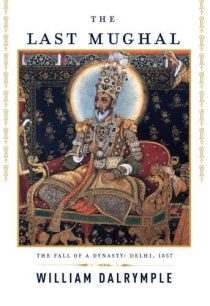
In The Last Mughal: The Fall of a Dynasty: Delhi, 1857, William Dalrymple reconstructs the final years of Mughal rule through the life of Bahadur Shah Zafar II, the poet-emperor who became the symbolic leader of the uprising against the British East India Company in 1857. The book follows the political tensions that preceded the revolt, the arrival of rebel soldiers in Delhi, the collapse of authority within the city, the British siege and recapture, and the devastating aftermath for Delhi’s population and cultural life.
Rather than presenting 1857 only as a military rebellion, Dalrymple explores the destruction of a society and the end of a political world. His research draws on Persian and Urdu sources, including eyewitness testimony and records connected to the Mughal court and Delhi's administration. These sources help recover experiences that are less visible in many conventional British accounts.
Bahadur Shah Zafar: Emperor without effective power
Bahadur Shah Zafar presided over a court whose cultural prestige survived even as its political authority diminished. By 1857, the Mughal emperor had little practical power over the expanding British-controlled territories. When rebel soldiers reached Delhi and declared him their leader, he became the symbolic centre of a revolt that he could neither fully control nor easily refuse.
Dalrymple presents Zafar as a complex figure: a poet and patron of culture caught in a political catastrophe. His story illustrates the distance between the prestige of the Mughal institution and the emperor’s limited ability to direct events.
Delhi as a centre of Indo-Persian culture
The book reconstructs Delhi as a major centre of poetry, scholarship, religious life, courtly etiquette, and artistic exchange. Its account of the city emphasizes the interdependence of political authority and cultural patronage, showing that the fall of the dynasty was also a severe rupture in the lives of poets, scholars, artisans, officials, and ordinary residents.
Through literary and documentary sources, Dalrymple brings the late Mughal world into focus beyond its familiar monuments and dynastic chronology.
The causes and character of the uprising
The uprising began with mutinies among Company soldiers and developed into a wider challenge to British authority. Dalrymple examines the political, religious, military, and social pressures that contributed to the crisis. He does not reduce the revolt to the controversy over rifle cartridges, nor does he treat the participants as a single, unified political movement.
Delhi became a gathering point for soldiers and other opponents of Company rule, but the rebels differed in their objectives, resources, and expectations. Zafar's symbolic position could not eliminate these internal divisions or solve the practical problems of governing a city at war.
The siege and recapture of Delhi
After months of fighting, British forces recaptured Delhi in September 1857. Dalrymple describes the military struggle alongside the breakdown of urban life, the violence committed during the conflict, and the severe reprisals that followed the British victory.
The recapture was not simply the restoration of administrative control. It brought mass displacement, executions, dispossession, and the destruction of communities. The experiences of Delhi’s inhabitants are central to the book’s account of what the defeat of the uprising meant in human terms.
British reprisals and the destruction of a city
Dalrymple gives particular attention to the violence and punitive measures inflicted on Delhi after its recapture. The persecution of suspected rebels, the expulsion of residents, and the loss of homes and livelihoods transformed the city. The scale and character of this destruction challenge narratives that focus overwhelmingly on violence against British civilians while marginalizing the consequences of British retaliation.
This emphasis does not require denying atrocities committed by rebels. Rather, the book invites readers to examine the violence of both sides while also considering the unequal power that allowed the victorious colonial state to reshape the city and determine the official interpretation of events.
The exile and death of the last Mughal
Following the British victory, Zafar was captured, tried, and exiled to Rangoon, where he died in 1862. His fate symbolized the end of Mughal sovereignty. The dynasty’s demise also reflected a wider transfer of power: after the rebellion, the British Crown assumed direct rule in India, replacing the East India Company’s government.
Key themes at a glance
- The decline of Mughal political power before 1857.
- The role of Bahadur Shah Zafar as a symbolic rather than commanding leader.
- The literary and cultural richness of late Mughal Delhi.
- The varied motives and limitations of the uprising’s participants.
- The siege, recapture, and punitive destruction of Delhi.
- The use of Urdu and Persian sources to recover Indian perspectives.
- The relationship between colonial violence, historical memory, and the transformation of British rule.
Source: William Dalrymple’s official book page and the book’s bibliographic record and description.
Critical Analysis
Original research and Indian documentary voices
One of the book’s most important achievements is its use of Urdu and Persian materials to reconstruct the uprising from perspectives that received less attention in older British narratives. Court records, eyewitness accounts, and documents associated with Delhi’s administration allow Dalrymple to move beyond a story told principally through military dispatches and colonial officials.
This source base is especially valuable because the people affected by the uprising were not merely spectators to a contest between armies. They were poets, merchants, religious figures, soldiers, artisans, servants, officials, and families whose lives depended on a city suddenly transformed by war. Their experiences help explain why the fall of Delhi represented a cultural and social catastrophe as well as a political defeat.
A nuanced portrait of Bahadur Shah Zafar
Dalrymple’s treatment of Zafar is a major strength. The emperor is neither portrayed as a powerful military strategist nor dismissed as an irrelevant figurehead. Instead, the book explores the contradictions of a ruler whose symbolic authority exceeded his practical control.
His poetry and cultural patronage illuminate a world that cannot be understood through dynastic politics alone. His reluctant and precarious position during the revolt also complicates simple portrayals of him as either the architect of rebellion or a passive victim without agency.
Reconsidering the history of 1857
The book challenges the restrictive label of “mutiny” when it is used to imply that the crisis was merely a military disturbance. The uprising included mutinous soldiers, but its spread and political significance cannot be explained by military grievances alone. Dalrymple situates Delhi within a wider crisis of Company rule and shows how the revolt acquired broader anti-colonial meaning.
Nevertheless, the uprising was not a modern nationalist movement with a single programme shared by every participant. Different groups pursued different goals, and their alliances were often fragile. Reading the book alongside wider histories of 1857 helps prevent the opposite oversimplification: treating the entire rebellion as one coherent national struggle.
Colonial violence and the unequal aftermath
The account of Delhi’s recapture is among the book’s most powerful elements. By examining reprisals, executions, expulsions, and the devastation of urban life, Dalrymple exposes the human consequences of British victory. His treatment broadens the historical record beyond the suffering of British residents and the military narrative of the siege.
Historical balance does not mean assigning identical responsibility to all parties. The rebellion included serious violence against civilians, while British forces exercised the power of a victorious colonial military and state. The book encourages readers to examine each episode in its specific context rather than treating one side’s violence as self-evident proof of barbarity and the other’s as automatically legitimate punishment.
Culture, religion, and coexistence
Dalrymple is particularly effective at showing how late Mughal Delhi connected literary culture, court patronage, religious communities, and urban society. The city’s cultural world cannot be reduced to a simple division between Hindu and Muslim populations or between Indians and Europeans.
At the same time, descriptions of cultural coexistence should not be mistaken for proof that late Mughal society was free of hierarchy, conflict, or religious tension. The city contained unequal social relationships and competing interests. Its cultural achievements and internal contradictions must be understood together.
Limitations and questions for further study
The book’s close focus on Delhi gives it unusual depth, but it also narrows the geographical scope. The uprising unfolded across many regions, and experiences outside the capital differed considerably. Readers seeking a comprehensive history of the rebellion should supplement Dalrymple with works examining other centres, rural resistance, regional politics, and the experiences of groups less visible in the Delhi narrative.
Dalrymple’s vivid narrative style also means that readers should distinguish documentary evidence from the author’s reconstruction of atmosphere, motivation, and personality. His use of historical sources is a major strength, but not every interpretation carries the same degree of certainty. Specific claims should be assessed in light of the underlying evidence and other scholarship.
Overall assessment
The Last Mughal combines archival research, cultural history, biography, and military narrative to produce a compelling account of a decisive turning point in South Asian history. Its greatest contribution is to show that 1857 was not only the defeat of an uprising but also the destruction of a political and cultural world. Its Delhi-centred perspective is a deliberate strength and a limitation: it delivers exceptional depth in one place while leaving room for broader regional histories to complete the picture.