Mastodon
haqqfinder

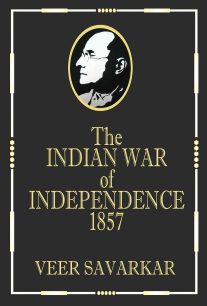
The Indian War of Independence of 1857

Format: 528 pages, Golden Collectors Edition
Language: English
Published Date: January 1, 2020 (First Published On 1 Jan. 1947)
ISBN: 978-8182478350
User's Rating:
Not rated yet
|
Editor's Rating:
3.9

The Indian War of Independence, 1857 by Vinayak Damodar Savarkar, widely known as Veer Savarkar, is a nationalist interpretation of the Indian Rebellion of 1857. Written in the early twentieth century and first published in 1909, the book challenged the colonial description of the uprising as merely a sepoy mutiny. Savarkar instead presented it as a coordinated struggle against British rule, emphasizing the political significance of the rebellion and its potential to inspire a wider movement for independence.

The book traces the causes and development of the uprising, discussing military grievances, British policies, political developments, and the activities of prominent figures such as Nana Sahib, Rani Lakshmibai, Bahadur Shah Zafar, and Mangal Pandey. Its narrative follows the outbreak of rebellion at Meerut and the subsequent events in Delhi, Cawnpore, Jhansi, Lucknow, and other centres. Savarkar also emphasizes the participation of Hindus and Muslims, presenting their resistance as part of a broader struggle against foreign rule.

The work emerged during the growth of Indian anticolonial nationalism. Its historical interpretation was intended not simply to recount past events but also to cultivate national consciousness and inspire resistance to British rule. Its publication history reflects this political significance: the original work was published abroad in 1909 after difficulties publishing it in India, and British authorities sought to suppress its circulation.

Although influential in nationalist interpretations of 1857, the book should not be treated as a definitive or neutral account. Savarkar's emphasis on coordinated national resistance has been questioned by later historians who examine the uprising's regional diversity, different local motivations, and the limitations of interpreting the rebellion as a unified national movement. Readers can gain more from the work by comparing its arguments with modern scholarship and other contemporary accounts.

Key Themes

1. The Rebellion as a War of Independence

Savarkar's central argument is that the events of 1857 should be understood as a war against British domination rather than reduced to a military mutiny. This reinterpretation challenged colonial historical narratives and helped establish the rebellion as an important symbol in Indian nationalist thought.

2. British Policies and the Causes of Resistance

The book examines political, military, and administrative developments that contributed to the uprising. Savarkar connects grievances against British rule with the actions of Indian soldiers, rulers, and other participants, although his explanations should be evaluated against evidence and alternative interpretations.

3. Hindu-Muslim Cooperation

Savarkar highlights instances of cooperation between Hindu and Muslim participants in the rebellion, presenting their shared opposition to British power as a source of collective strength. This theme is important to the book's interpretation of 1857, but readers should distinguish its nationalist framing from the varied religious, political, and regional interests represented in the historical record.

4. Leadership and Resistance

Figures including Rani Lakshmibai, Nana Sahib, Bahadur Shah Zafar, and Mangal Pandey feature in the narrative as participants in the struggle against British authority. Savarkar's treatment of these figures contributes to the book's commemorative and inspirational character, while also inviting scrutiny of how individual actions and motivations are interpreted.

5. National Consciousness and Political Mobilization

The book treats history as a resource for building national consciousness. By presenting the uprising as a precedent for independence, Savarkar sought to connect the experiences of 1857 with the political aspirations of Indians living under British rule in the early twentieth century.

6. Colonial Historiography and Historical Memory

The work challenges the language and assumptions of British accounts of the rebellion. Its significance therefore extends beyond the events it describes: it also illustrates how historical writing can become a site of conflict over national identity, political legitimacy, and the memory of colonial rule.

7. The Limits of a Unified National Narrative

While the book emphasizes collective resistance, the uprising involved different regions, communities, leaders, and objectives. Later scholarship highlights these variations and cautions against assuming that all participants shared a single national programme. Comparing these perspectives helps readers distinguish Savarkar's influential interpretation from the wider complexity of the historical events.


Pros

1. An Influential Challenge to Colonial Interpretation

The book directly challenges the view that the uprising was merely a military mutiny. Its interpretation helped establish 1857 as a major reference point in Indian nationalist historical writing and remains important for understanding how the rebellion acquired its political symbolism.

2. Broad Coverage of Major Events and Leaders

Savarkar discusses multiple centres of rebellion and prominent participants, offering readers a connected narrative of events across different parts of northern and central India. This makes the book useful for exploring how nationalist writers linked local episodes into a larger historical account.

3. Emphasis on Shared Resistance

The work draws attention to cooperation between Hindu and Muslim participants in opposition to British rule. This theme provides an important starting point for investigating alliances, political loyalties, and the different forms of solidarity that emerged during the uprising.

4. Significant for the History of Indian Nationalism

The book is an important primary source for studying anticolonial political thought in the early twentieth century. It demonstrates how interpretations of the past could be used to challenge imperial narratives and encourage political mobilization.

5. Useful for Historiographical Comparison

Reading Savarkar alongside British colonial accounts, other Indian interpretations, and modern academic research allows readers to compare competing explanations of the rebellion. The differences between these accounts are valuable for students of history and historical methodology.

6. Accessible Narrative Structure

The book’s chronological organization and attention to major events and personalities can make it engaging for readers interested in political and military history, particularly those seeking to understand the nationalist interpretation of 1857.

Cons

1. Strong Nationalist Framing

Savarkar wrote with an explicit political purpose: to reinterpret the rebellion as a war of independence and strengthen national consciousness. This purpose gives the book its historical importance, but it can also encourage a unified narrative that places less emphasis on conflicting motives and regional differences.

2. The Extent of Coordination Is Debatable

The book emphasizes planning and collective purpose across the uprising. However, the degree to which the different centres of rebellion were coordinated, and whether participants shared a common national objective, remain questions that require comparison with historical evidence and later scholarship.

3. Selective Emphasis on Leaders and Events

The narrative gives considerable attention to prominent figures and dramatic episodes. Readers seeking a fuller social history should supplement it with research on peasants, local communities, women beyond celebrated leaders, and other groups whose experiences may not receive equal attention in a nationalist narrative.

4. Historical Claims Require Independent Verification

Some interpretations of motives, organization, and the scale of cooperation should be checked against primary sources and modern historical research. The book’s rhetorical force should not substitute for source criticism or be taken as proof that every episode formed part of one coordinated plan.

5. The Book Reflects Its Political and Intellectual Context

Written during the early twentieth-century nationalist movement, the work reflects the concerns of its time. It is therefore essential to distinguish Savarkar’s political objectives and later influence from the question of how accurately each historical claim represents the events of 1857.

6. Not a Standalone Modern History of 1857

The book remains important for understanding nationalist historiography, but readers seeking a balanced contemporary account should consult modern research that addresses regional diversity, civilian participation, social tensions, and competing interpretations of the rebellion.

7. Edition Differences Matter

Modern editions vary in publisher, pagination, introductory material, and presentation. Readers should check the particular edition being purchased rather than assuming that every reprint reproduces the original text and supplementary material in the same form.

Critical Reception

The Indian War of Independence, 1857 has attracted scholarly attention primarily because of its role in reshaping nationalist interpretations of the uprising. Published in 1909, the book challenged British accounts that characterized the events chiefly as a sepoy mutiny and instead presented them as a coordinated struggle for national independence. Its interpretation became influential in the history of Indian anticolonial thought and contributed to the continuing debate over the meaning of 1857.

Modern scholarship recognizes the book’s historical and political significance while also examining the relationship between Savarkar’s nationalist objectives and his approach to historical evidence. In her chapter A Nationalist Historian: Savarkar and the Past, historian Janaki Bakhle examines Savarkar’s historical writing in the context of his political thought and argues that his use of history was closely connected to nationalist mobilization. This provides a scholarly framework for understanding the book not only as a narrative of 1857 but also as an intervention in the politics of historical memory.

Kim A. Wagner’s article, The Marginal Mutiny: The New Historiography of the Indian Uprising of 1857, surveys later developments in scholarship on the uprising. Gautam Chakravarty’s research, discussed in The 1857 Indian Uprising and the British Empire, also helps contextualize the competing British and Indian interpretations that shaped the historiography of the rebellion.

Critical Perspective

The book’s enduring importance lies in its challenge to colonial interpretations and its influence on nationalist historical memory. At the same time, Savarkar’s presentation of the rebellion as a coordinated national struggle should be examined alongside research that emphasizes regional variation, local political interests, and the differing aims of soldiers, rulers, and civilian participants. Its central interpretation is historically consequential, but it is not the only framework through which the rebellion can be understood.

Assessment of Available Reception

Substantive scholarly discussion of Savarkar’s historical writing and the wider historiography of 1857 is available. However, the sources consulted do not establish a comprehensive consensus among critics on every aspect of this particular book. The assessment above therefore distinguishes the book’s documented historical influence from scholarly debates about its interpretation and method.

HaqqFinder Editorial Rating

3.9/5
HaqqFinder Editorial Rating
An influential nationalist interpretation of 1857 that benefits from comparison with modern scholarship.

Rating Breakdown

Evaluation Criteria Weight Score Assessment
Content Quality & Depth 20% 4.2/5 Broad narrative of the uprising, though some claims require comparison with other sources.
Writing Style & Clarity 15% 3.6/5 Engaging historical narrative, with rhetorical passages shaped by its nationalist purpose.
Relevance & Target Audience Fit 15% 4.5/5 Highly relevant to Indian nationalism, colonial history, and historiography.
Originality & Creativity 15% 4.4/5 A consequential reinterpretation of the uprising as a struggle for independence.
Cultural & Ethical Sensitivity 10% 3.2/5 Highlights shared resistance but requires critical examination of its broad national narrative.
Practical Value & Applicability 10% 3.8/5 Useful for studying nationalist thought and comparing interpretations of 1857.
Presentation & Design 10% 3.4/5 Provisional; the exact edition’s layout, typesetting, and supplementary material have not been inspected.
Value for Price 5% 3.8/5 Provisional; the current price and exact edition have not been verified.
Weighted Overall Score 3.945/5 — Rounded: 3.9/5

Our editorial ratings are based on HaqqFinder’s established evaluation criteria and weighted scoring system. For details, see our Rating & Evaluation Methodology.

Note: This rating is provisional because the complete text and the specific edition’s presentation and price have not been independently verified.

Overall Verdict:

The Indian War of Independence, 1857 by V. D. Savarkar is an influential work of Indian nationalist historiography. By challenging the colonial description of the uprising as merely a mutiny, Savarkar presented the events of 1857 as a struggle against British rule and helped shape the rebellion’s place in nationalist historical memory.

The book’s greatest value lies in its historical interpretation, political context, and influence on later discussions of the rebellion. Its emphasis on collective resistance and the participation of Hindu and Muslim figures offers important themes for historical investigation. Nevertheless, its account should be approached critically, especially where it presents the uprising as a coordinated national movement or interprets the motives of different participants.

Who should read this book? It is particularly relevant to students of Indian history, researchers of anticolonial nationalism, readers interested in Savarkar’s historical thought, and those comparing colonial and nationalist accounts of 1857. Readers seeking a comprehensive modern history should pair it with contemporary scholarship and other primary sources.

Final verdict: An influential and historically significant nationalist interpretation of the Indian Rebellion of 1857. Its contribution to historical memory is substantial, but its claims should be evaluated alongside other evidence and interpretations. HaqqFinder’s provisional editorial rating is 3.9/5.

🛒 WHERE TO BUY

*When you purchase through this link, HaqqFinder may earn a small commission at no extra cost to you. Learn more

Share On:
Facebook
X
LinkedIn
Pinterest
Reddit
WhatsApp
Tumblr
Telegram
Threads

Ratings & Reviews

0
0 out of 5 stars (based on 0 reviews)
Excellent
Very good
Average
Poor
Terrible

There are no reviews yet. Be the first one to write one.

Where We Reference This Book
Explore HaqqFinder articles that cite, discuss, or mention this publication.
Related Recommendations:

Login

Fill out the form below, and we will be in touch shortly.