Mastodon
haqqfinder

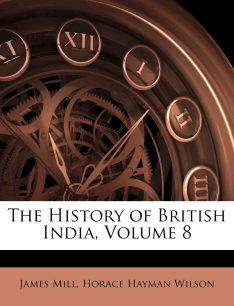
The History of British India, Vol 8

Publisher: Nabu Press
Format: 0 pages, Edition Name
Language: English
Published Date: April 8, 2010
ISBN: 978-1148638720
User's Rating:
Not rated yet
|
Editor's Rating:
3.90

Summary & Key Themes

The History of British India, Volume 8 belongs to the expanded edition of James Mill's historical series, with the continuation written by Horace Hayman Wilson. The 1848 edition covers the period from 1813 to 1823, a decisive decade in the consolidation of British power across the Indian subcontinent.

The narrative examines the renewal of the East India Company's Charter in 1813, the Company's changing commercial and political position, conflicts along the Himalayan frontier, the Pindari campaigns, and the Third Anglo-Maratha War. These events illustrate how the Company combined military intervention, diplomatic pressure, territorial expansion, and administrative control to strengthen its authority.

The volume also explores the political relationships between the Company and Indian rulers, the conduct of British officials, and the financial and administrative consequences of warfare. The narrative presents the period largely through the perspectives of colonial officials and the political institutions that shaped British policy.

Key Themes

  • Renewal of the Company's Charter: The 1813 Charter Act and its implications for the Company's commercial privileges, governance, and relationship with Britain.
  • The Gorkha War: Conflict between the Company and the Kingdom of Nepal, reflecting competition over frontier territories and regional influence.
  • The Pindari campaigns: British military operations against groups described in contemporary accounts as Pindaris, and the political circumstances surrounding these campaigns.
  • The Third Anglo-Maratha War: The conflict that weakened the Maratha confederacy and substantially expanded British dominance in India.
  • Lord Hastings's administration: The policies, military decisions, and diplomatic strategies associated with the governor-generalship of Francis Rawdon-Hastings.
  • Imperial expansion and sovereignty: The relationship between treaties, military coercion, alliances, and the erosion of the independence of Indian states.
  • Colonial administration: The financial, political, and institutional challenges involved in governing an expanding empire.

The volume is useful for understanding the mechanisms of British expansion during the early nineteenth century. However, its explanations should be read critically: the language and priorities of colonial-era history can give greater prominence to British strategic concerns than to the experiences and political objectives of Indian communities and rulers.

Edition reference: The History of British India, Volume 8 (1848), Google Books.

Critical Analysis

Historical Scope and Importance

Volume 8 covers a consequential period in the transformation of the East India Company from a commercial corporation with territorial possessions into the dominant political power across much of India. The conflicts and administrative developments described in the book help explain how British influence grew through a combination of warfare, treaties, financial pressure, and intervention in the affairs of Indian states.

The renewal of the Company's Charter in 1813 is particularly important because it reveals the changing relationship between the Company, the British state, and commercial interests. The Gorkha War and the campaigns against the Pindaris and Marathas illustrate different dimensions of the expansion of Company power, from frontier conflict to the restructuring of political authority within the subcontinent.

Military Expansion and Indian Sovereignty

The volume's treatment of military and diplomatic affairs provides material for examining how British authority expanded. The Third Anglo-Maratha War was a turning point in the decline of the Maratha confederacy as a major counterweight to the Company. Its outcome strengthened British political supremacy, although regional resistance and the complexities of Indian politics cannot be reduced to a simple narrative of inevitable British victory.

The narrative is especially valuable when read alongside modern historical scholarship that investigates the interests of Indian rulers, the internal divisions within political confederacies, and the consequences of colonial expansion. Readers should distinguish the author's explanations of British policy from the broader historical evidence concerning why conflicts occurred and how different parties experienced their outcomes.

The Colonial Viewpoint

As a nineteenth-century British historical account, the volume often gives priority to the concerns of governors-general, military commanders, treaties, and administrative institutions. Indian rulers and political groups can consequently appear primarily in relation to British strategic objectives rather than as actors with their own complex interests and interpretations.

Terminology such as “pacification,” “order,” or “security,” when used in colonial accounts, deserves careful scrutiny. Such descriptions may reflect the government's justification for military intervention rather than a neutral assessment of the conflict or its effects on local populations. The same caution applies to depictions of the Pindaris, whose varied activities and relationships with regional power structures require more contextual analysis than colonial labels alone can provide.

Wilson's Continuation of Mill

Although the series is commonly associated with James Mill, Volume 8 is part of Horace Hayman Wilson's continuation covering 1805–1835. Wilson's narrative should therefore not automatically be treated as Mill's own writing. The distinction matters when assessing the arguments, evidence, and historical judgments presented in this volume.

James Mill's original history is widely discussed in scholarship on utilitarianism, Orientalism, and imperial knowledge. Javed Majeed's Ungoverned Imaginings: James Mill's The History of British India and Orientalism offers useful context for understanding Mill's historical project. It is a study of Mill's work, however, not a direct evaluation of Wilson's Volume 8.

Writing Style and Accessibility

The volume's detailed chronology and discussion of military and administrative affairs make it useful for readers conducting historical research. Its attention to treaties, campaigns, and political decisions provides leads for investigating how colonial policy was formulated and implemented.

Its limitations include dense nineteenth-century prose, extensive discussions of officials and military operations, and a narrative framework that may be unfamiliar to general readers. Those looking for a concise introduction to British India may find a modern historical overview more accessible before turning to this primary-era account.

Overall Assessment

Volume 8 is a valuable source for studying British imperial expansion between 1813 and 1823. Its detailed account of the Charter renewal, Gorkha War, Pindari campaigns, and Maratha conflict gives it considerable research value. Yet its colonial perspective and emphasis on official political history mean it should be read alongside modern scholarship and sources that give greater attention to Indian experiences and perspectives.


Pros
  • Historically significant period: Covers a decade of major political and military change in British India.
  • Detailed account of expansion: Examines the Gorkha War, Pindari campaigns, and Third Anglo-Maratha War.
  • Institutional and political context: Explores the relationship between the East India Company, the British government, and Indian states.
  • Useful for research: Provides a nineteenth-century account that can be compared with modern scholarship and other historical sources.
  • Chronological detail: Helps readers trace the sequence of campaigns, treaties, and administrative decisions.
  • Insight into imperial thinking: Shows how British historical writing represented expansion, political authority, and colonial governance.
  • Accessible digitized edition: The 1848 volume is available through Google Books.
Cons
  • Colonial bias: The narrative reflects the assumptions and priorities of nineteenth-century British imperial historiography.
  • Limited popular perspectives: The experiences of ordinary Indians and the social consequences of warfare receive less attention than official and military affairs.
  • British-centred narrative: Indian rulers and political groups are often discussed in relation to Company policy.
  • Dense prose: Its lengthy political and military discussions may challenge readers unfamiliar with the period.
  • Requires historical corroboration: Official explanations and judgments should be compared with modern research and other primary sources.
  • Authorship can be misleading: Although published within Mill’s series, the continuation was written by Horace Hayman Wilson.
  • Not a modern social history: Readers seeking detailed accounts of everyday life, gender, labour, and local society will need additional works.

Critical Reception

Reliable, volume-specific modern reviews of the 1848 edition are not readily identifiable in the sources consulted for this review. Its historical importance is better assessed through bibliographic records and scholarship on the wider series than through an unsupported claim about a general critical consensus.

Publication and Bibliographic Context

The Google Books record identifies the work as The History of British India, Volume 8, published by J. Madden in 1848. The National Library of Ireland catalogue describes the expanded series as James Mill’s history with notes and continuation by Horace Hayman Wilson. It identifies volumes 7–9 as Wilson’s continuation, covering the period from 1805 to 1835.

These records establish the edition’s bibliographic place in the series, but they are not critical reviews of Volume 8.

Modern Scholarly Context

Javed Majeed’s Ungoverned Imaginings examines the relationship between Mill’s historical writing, Orientalism, and British imperial thought. It provides a useful framework for considering the intellectual tradition associated with the series, although it focuses on Mill’s work rather than serving as a direct review of Wilson’s continuation.

For modern readers, the volume’s account of the Company’s wars and political expansion is best assessed in conjunction with contemporary scholarship on the Maratha states, Nepal, colonial military power, and the changing structure of British rule. Such comparisons help distinguish the information preserved in the historical narrative from the author’s interpretation of events.

Reception Assessment

The volume’s continuing value lies chiefly in its usefulness as a historical source and as evidence of nineteenth-century British interpretations of Indian history. Its official and colonial perspective limits its use as a standalone account, but careful comparison with modern scholarship can make it valuable for researchers and advanced readers.

No numerical critical-reception score is assigned because the sources consulted do not establish a sufficiently reliable set of reviews specific to this volume.

Who Should Read This Book?

  • Students of British Indian history: Particularly those studying the period between 1813 and 1823.
  • Researchers of colonial expansion: Readers examining the Gorkha War, Pindari campaigns, and Third Anglo-Maratha War.
  • Students of political and military history: Those interested in treaties, warfare, diplomacy, and the expansion of Company authority.
  • Historiography researchers: Readers investigating how nineteenth-century British writers interpreted Indian political history.
  • Advanced history enthusiasts: Readers comfortable with detailed historical narratives and older prose.

Who May Find It Less Suitable?

Readers seeking an accessible introduction, a people-centred social history, or a balanced contemporary overview of the period may prefer to begin with a modern historical study. This volume is most rewarding when read critically alongside scholarship that incorporates Indian perspectives.

HaqqFinder Editorial Rating

Evaluation Criteria Weight Score Assessment
Content Quality & Depth 20% 4.4/5 Detailed coverage of major political, military, and administrative developments.
Writing Style & Clarity 15% 3.4/5 Structured and informative, but dense by contemporary standards.
Relevance & Target Audience Fit 15% 4.5/5 Highly relevant to researchers studying colonial expansion and early nineteenth-century India.
Originality & Creativity 15% 4.0/5 Valuable as a period interpretation, though shaped by established imperial historical conventions.
Cultural & Ethical Sensitivity 10% 2.7/5 Requires critical reading of its colonial assumptions and the perspectives it underrepresents.
Practical Value & Applicability 10% 4.0/5 Useful for historical research, comparison, and understanding colonial institutions.
Presentation & Design 10% 3.3/5 Conventional nineteenth-century presentation, less accessible than modern editions.
Value for Price 5% 4.5/5 Strong research value, especially when consulted through a free digitized edition.
Overall Weighted Score 100% 3.90/5 A valuable historical source that benefits from critical comparison.

Rating interpretation: 3.90/5 — Good, especially for specialist historical research, though its colonial perspective and older prose require careful reading.

Our editorial ratings are based on HaqqFinder’s established evaluation criteria and weighted scoring system. For details, see our Rating & Evaluation Methodology.

Overall Verdict:

The History of British India, Volume 8 is a useful historical work for understanding the expansion of East India Company power during the years 1813–1823. Its discussion of the Charter renewal, Gorkha War, Pindari campaigns, and Third Anglo-Maratha War provides substantial material for examining the political and military processes through which British dominance grew.

The book’s main limitation is its colonial historical perspective. Its emphasis on officials, campaigns, and imperial strategy can leave Indian experiences and political objectives underrepresented. Readers should therefore treat its explanations as interpretations shaped by the period in which it was written, rather than as a complete or neutral account of events.

The distinction between James Mill and Horace Hayman Wilson is also essential: Volume 8 belongs to Wilson’s continuation of the series. Correctly identifying the author helps readers assess its arguments within the proper intellectual and publication context.

HaqqFinder’s verdict: Recommended for students, researchers, and serious readers interested in British Indian political and military history. It is best used alongside modern scholarship and sources that provide fuller accounts of Indian perspectives.

Editorial Rating: 3.90/5

Citation: Wilson, Horace Hayman. The History of British India from 1805 to 1835. Volume 2 (Volume 8 of the expanded History of British India). London: J. Madden, 1846.

Read the digitized Volume 2 of Wilson's continuation on Google Books.

🛒 WHERE TO BUY

*When you purchase through this link, HaqqFinder may earn a small commission at no extra cost to you. Learn more

Share On:
Facebook
X
LinkedIn
Pinterest
Reddit
WhatsApp
Tumblr
Telegram
Threads

Ratings & Reviews

0
0 out of 5 stars (based on 0 reviews)
Excellent
Very good
Average
Poor
Terrible

There are no reviews yet. Be the first one to write one.

Where We Reference This Book
Explore HaqqFinder articles that cite, discuss, or mention this publication.
Related Recommendations:

Login

Fill out the form below, and we will be in touch shortly.