Summary & Key Themes
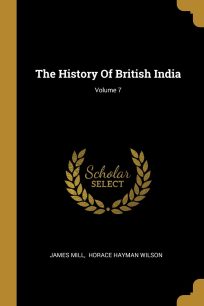
The History of British India, Volume 7 continues the historical narrative associated with James Mill's influential work, but the edition reviewed here requires an important distinction: this volume belongs to the continuation written by Horace Hayman Wilson, rather than being a volume newly authored by Mill. Published in 1845 as the first volume of Wilson's three-volume continuation, The History of British India from 1805 to 1835, it examines the development of East India Company rule after the period covered by Mill's original narrative.
The volume follows the Company's political and administrative affairs during the governorship of Sir George Barlow and the administration of Lord Minto. Its subjects include relations with Indian rulers, military and diplomatic decisions, the management of Company territories, public finance, revenue collection, judicial administration, and the competing interests of British officials and Indian political authorities.
The book is particularly valuable for readers interested in how a commercial corporation developed into a territorial power. Rather than treating colonial expansion simply as a sequence of battles, it records the institutional arrangements, negotiations, regulations, and financial considerations through which the Company maintained and extended its authority.
Key Themes
- Company government after 1805: The administrative and political challenges facing British rule following the major conflicts of the late eighteenth and early nineteenth centuries.
- Governor-Generalship and political authority: The decisions and policies associated with Sir George Barlow and Lord Minto.
- Military power and diplomacy: The relationship between armed force, alliances, treaties, and the Company's influence over Indian states.
- Revenue and administration: The importance of taxation, public expenditure, landholding, and bureaucratic regulation to colonial government.
- Resistance and political conflict: Disputes involving Company officials, military personnel, local authorities, and communities affected by colonial policies.
- Colonial knowledge and interpretation: The way nineteenth-century British historians organized evidence and interpreted Indian institutions through contemporary political assumptions.
The volume should be read as a historical account produced within the intellectual and political world of nineteenth-century British imperialism, not as a neutral or comprehensive representation of Indian society. Its documentary and administrative detail is useful, but its explanations need to be compared with modern scholarship and Indian perspectives.
Edition reference: Google Books: The History of British India, Volume 7 (1845); IGNCA Central Library catalogue record.
Critical Analysis
Historical and Documentary Value
One of the volume's principal strengths is its attention to the machinery of government. The account of British India after 1805 helps readers understand how political authority was exercised through administrative departments, revenue arrangements, military establishments, treaties, and negotiations with Indian rulers. These subjects are essential for explaining colonial power beyond the battlefield.
Its treatment of successive administrations also offers a useful perspective on the continuity and change of Company policy. Individual governors could pursue different approaches, but they operated within an expanding imperial structure shaped by financial constraints, military priorities, institutional rivalries, and the interests of the East India Company.
Nevertheless, the book's documentary detail should not be confused with completeness. Official correspondence and administrative records tend to preserve the concerns of governments and political elites more clearly than the experiences of ordinary cultivators, workers, women, and other groups who had less access to written bureaucratic records.
Wilson's Role and the Problem of Attribution
A major consideration is authorship. Although this book is frequently catalogued as The History of British India, Volume 7 under James Mill's name, the continuation covering 1805–1835 was written by Horace Hayman Wilson. The Indira Gandhi National Centre for the Arts catalogue identifies volumes 7–9 with Wilson's continuation, while the Google Books record lists the 1845 work as Volume 1 of Wilson's history from 1805 to 1835.
This distinction matters when evaluating the volume's arguments and historical method. Mill's original work was shaped by utilitarian philosophy and a strong tendency to judge Indian institutions against his own ideas of social and political improvement. Wilson's continuation belongs to the same broad imperial historiographical tradition, but it should not automatically be treated as Mill's own writing or assumed to reproduce every aspect of Mill's method.
Colonial Perspective and Historical Limitations
The account is written from within the institutional world of British India. Its attention naturally gravitates toward governors, officials, military commanders, treaties, and government policy. Indian rulers and communities often appear in relation to Company objectives, which can leave their independent political calculations, social priorities, and interpretations of events less fully developed.
This limitation is important when examining colonial claims about order, reform, stability, or administrative efficiency. A policy described in official terms as necessary or beneficial may have had different consequences for local populations. Readers should therefore distinguish between the government's stated intentions, the author's interpretation, and the outcomes that can be established through other evidence.
Modern scholarship on Mill's broader historical project highlights the relationship between utilitarian thought, imperial knowledge, and representations of India. Javed Majeed's Ungoverned Imaginings: James Mill's The History of British India and Orientalism is useful for understanding that intellectual context, although it is a study of Mill's work rather than a review of this specific volume.
Style and Accessibility
The book is structured around political and administrative developments, making it useful for readers who prefer detailed institutional history. Its chronological narrative and discussion of official decisions can help researchers trace the evolution of Company government.
However, the prose and presentation reflect nineteenth-century historical writing. The long discussions of officials, administrative arrangements, and political disputes can feel dense to modern readers. The volume is best approached as a research resource or a work of historical interpretation rather than as a fast-paced introduction to the period.
Overall Assessment
Volume 7 is most valuable as a source for examining how British rule was narrated and justified during the nineteenth century. It provides a substantial account of the Company's political and administrative concerns, but its colonial viewpoint and official emphasis limit its usefulness as a standalone account of Indian experiences. A careful reading alongside Indian records and modern historical research can make it considerably more informative.