Summary & Key Themes
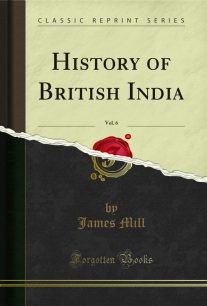
The History of British India, Volume 6 by James Mill completes the six-volume third edition of his influential history of British India, published in 1826. It continues Book VI, covering the period from the establishment of the new constitutional arrangements for governing India in 1784 to the conclusion of the war with the Marathas in 1805.
This final volume focuses particularly on the expansion of British power under Lord Wellesley, the political and military campaigns led by British commanders, the subsidiary alliance system, and the conflicts that reshaped relations between the East India Company and major Indian states. It also considers the conduct of British officials, the costs of imperial expansion, and the institutions through which the Company governed its territories.
1. Lord Wellesley and the Expansion of British Power
The volume examines the increasingly assertive policies associated with Governor-General Richard Wellesley, who sought to strengthen the Company's strategic position and limit the influence of rival European powers. Mill describes how diplomacy, military force, and political pressure worked together to expand British influence across the subcontinent.
Wellesley's policies represented a significant development in the Company's transformation from a trading organization into a territorial power. They also intensified the relationship between imperial ambitions and the financial and military resources required to sustain them.
2. The Subsidiary Alliance System
A central theme is the use of subsidiary alliances to extend British influence over Indian rulers. Under these arrangements, rulers generally accepted British troops and political constraints in exchange for protection, while the Company gained strategic advantages and greater influence over regional affairs.
Mill's account helps readers understand the diplomatic and administrative mechanisms behind this expansion. However, such agreements should not be treated simply as voluntary partnerships without examining the unequal power relationships, strategic pressures, and constraints that shaped them.
3. Mysore, Hyderabad, and the Changing Balance of Power
The volume discusses the Company's relations with Mysore, Hyderabad, and other Indian powers. The defeat of Tipu Sultan in 1799 and the subsequent reorganization of political authority in Mysore marked a major turning point in southern Indian politics. The Company also strengthened its relationship with the Nizam of Hyderabad, increasing its influence over regional security and diplomacy.
Mill provides a British-centered account of these developments. Readers should supplement his narrative with modern scholarship on Mysore, Tipu Sultan, and the political objectives of Indian states to gain a fuller understanding of the period.
4. The Second Anglo-Maratha War
The conflict with the Maratha powers forms a major part of the volume's later narrative. Mill describes the political circumstances surrounding the Treaty of Bassein, the Company's relationship with the Peshwa, and the campaigns against major Maratha leaders, including Daulat Rao Scindia and the Bhonsle ruler of Nagpur.
The war significantly altered the balance of power in India. British victories expanded the Company's territorial and diplomatic reach, while the peace settlements of 1805 helped bring the period's major military campaigns to a close. Nevertheless, the Maratha political world was complex, and British accounts must be read alongside scholarship that considers the interests and strategies of the Maratha states themselves.
5. Military Command, Diplomacy, and Imperial Strategy
The volume examines the roles of British commanders and political officials, including Lord Lake and Arthur Wellesley, in campaigns across northern and central India. Military operations were closely connected with negotiations, alliances, territorial settlements, and attempts to reshape regional political relationships.
This combination of military and diplomatic history makes the volume useful for understanding how the Company consolidated power. It also raises questions about the relationship between the language of protection and the practical extension of colonial authority.
6. The Costs and Consequences of Imperial Expansion
Mill's broader approach encourages readers to consider the administrative and financial consequences of British expansion. Military campaigns required substantial resources, while new alliances and territorial responsibilities increased the Company's obligations. The volume illustrates the growing complexity of governing an expanding empire, even as it gives comparatively limited attention to the everyday experiences of populations affected by warfare and political reorganization.
Key Takeaway
Volume 6 completes Mill's account by examining the consolidation of British power from the late eighteenth century through 1805. Its discussions of Wellesley's policies, subsidiary alliances, the defeat of Mysore, and the Second Anglo-Maratha War are valuable for studying imperial strategy and colonial historiography. However, its British-centered perspective and colonial-era assumptions require careful critical reading.
Edition note: This review concerns Volume 6 of the six-volume third edition published in 1826. The original 1817 edition used a different physical volume arrangement, so volume numbers and chapter divisions may not match across editions.
Sources: Online Library of Liberty, Volume 6; Google Books, Volume 6; Cambridge University Press, Book VI: 1784–1805.
Critical Analysis
A Valuable Account of Imperial Expansion
Volume 6 is important for its detailed account of the political and military processes through which the East India Company strengthened its position in India. Mill connects diplomatic negotiations, subsidiary alliances, military campaigns, and territorial settlements, showing how imperial expansion depended on more than battlefield victories alone.
The discussion of Wellesley's administration is particularly useful for understanding the transition toward a more assertive form of British imperial policy. The Company increasingly sought to influence the decisions of Indian rulers, restrict the room available to rival European powers, and establish a strategic position that could be defended through military and diplomatic arrangements.
The Subsidiary Alliance System and Unequal Power
The subsidiary alliance system illustrates the relationship between diplomatic agreements and imperial expansion. Although alliances could be presented as arrangements for mutual security, they could also limit the independence of Indian rulers, increase their dependence on British military support, and give the Company greater influence over regional affairs.
Mill's account helps explain the institutional and strategic logic of these arrangements. A modern assessment, however, should also examine the asymmetry of power between the parties and the consequences for the rulers and populations involved.
Military History and Indian Political Agency
The campaigns against Mysore and the Maratha powers provide substantial detail about British military strategy and the political settlements that followed. The defeat of Tipu Sultan in 1799 and the conflicts of 1803–1805 were crucial to the expansion of Company authority.
Nevertheless, the narrative is primarily organized around British officials, commanders, and strategic objectives. Indian rulers appear frequently, but their political aims and interpretations are not always explored with equal depth. Readers interested in the Maratha confederacy, Mysore, or Hyderabad should compare Mill with modern regional histories and scholarship based on a wider range of sources.
James Mill's Philosophical Framework
Mill's history is an example of Benthamite philosophical history. He sought to draw broader lessons about government, institutions, reason, and the consequences of commercial monopolies. This approach gives the work an analytical structure and encourages readers to consider the principles behind political decisions rather than merely memorizing events.
However, Mill wrote without having visited India or learned its languages. His interpretations of Indian civilization were shaped by colonial-era assumptions and British intellectual debates. The Library of Congress record identifies both his historical influence and this important limitation.
Consequently, Mill's account should be distinguished from a neutral reconstruction of Indian history. His criticisms of Company policy can be insightful, but they do not remove the cultural biases that influence his descriptions and evaluations of Indian institutions.
The Limits of the Narrative
Although Volume 6 provides extensive detail about rulers, treaties, military campaigns, and administration, it gives less sustained attention to the everyday experiences of soldiers, cultivators, merchants, and other communities affected by imperial warfare and political change. Its emphasis on elite politics makes it more useful for studying imperial decision-making than for understanding the full social history of the period.
The volume is also demanding for modern readers. Its lengthy discussions of diplomatic exchanges and military movements require concentration and some familiarity with eighteenth-century Indian politics. A modern overview can help readers navigate the narrative before engaging with the original text.
Overall Assessment
The History of British India, Volume 6 is a valuable historical source for examining the consolidation of Company power through alliances, warfare, and political intervention. It is particularly useful for understanding British imperial strategy at the turn of the nineteenth century. Its limitations lie in its colonial perspective, its emphasis on elite political history, and its dated prose. It is best read alongside modern scholarship rather than accepted as a definitive account of Indian history.
Further reading: Online Library of Liberty, Volume 6; Library of Congress, The History of British India; Javed Majeed, Ungoverned Imaginings; Jane Rendall, “Scottish Orientalism: From Robertson to James Mill”.