Summary & Key Themes
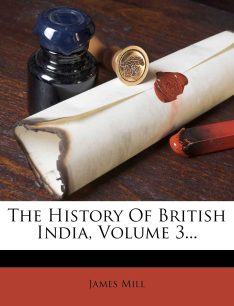
The History of British India, Volume 3 by James Mill continues his ambitious account of the East India Company’s transformation from a commercial enterprise into a territorial and political power. First published in 1817, this volume covers the period from the establishment of the new system of Indian government under Pitt’s India Act of 1784 to the conclusion of the Second Anglo-Maratha War and the peace with Maharaja Yashwantrao Holkar in 1805.
Organized as Book VI of Mill’s larger history, the volume examines the relationship between the Company’s government in India and the political authorities in Britain. It discusses the Board of Control, the authority of the Company’s directors, the administration of successive governors-general, parliamentary scrutiny, military campaigns, diplomacy with Indian states, and the growing reach of British power.
1. Parliamentary Oversight and Colonial Government
Mill considers the institutional arrangements created to supervise the East India Company after Pitt’s India Act. He explores the tensions between the Company’s directors, the Board of Control, Parliament, and officials serving in India. These discussions illuminate the British state’s evolving mechanisms for managing an expanding empire and attempting to regulate the conduct of colonial administrators.
2. Warren Hastings and the Problem of Accountability
The trial of Warren Hastings receives substantial attention. Mill examines the political and parliamentary proceedings surrounding the charges against the former governor-general. The episode raises enduring questions about corruption, the accountability of imperial officials, the limits of parliamentary oversight, and whether the institutions governing distant colonies could effectively restrain abuses of power.
3. Lord Cornwallis and Administrative Reform
The volume discusses Lord Cornwallis’s administration, including financial and judicial reforms and efforts to reorganize colonial governance. These measures are presented within Mill’s broader concern with institutional design and administrative efficiency. Modern readers should nevertheless distinguish the reforming language of colonial officials from the actual experiences and interests of the Indian populations affected by their policies.
4. Wars, Alliances, and Territorial Expansion
Military conflict and diplomacy form a major part of the narrative. Mill examines the Company’s conflicts involving Mysore under Tipu Sultan, its relations with the Nizam and other Indian rulers, and the shifting alliances that shaped British expansion. The later chapters follow the political and military developments that culminated in the Second Anglo-Maratha War and the settlement with Holkar in 1805.
5. The Growth of British Imperial Power
Across these subjects, the volume traces how the Company consolidated authority through legislation, revenue arrangements, diplomacy, military force, and intervention in regional politics. It offers a detailed account of the machinery of imperial government, although its emphasis on British institutions and political calculations leaves many Indian perspectives less fully represented.
Key Takeaway
Volume Three is most valuable as a major early nineteenth-century interpretation of the consolidation of British power in India. It supplies extensive detail about imperial institutions, political disputes, and military campaigns, but it should be read critically: Mill’s narrative is not a neutral account, and his judgments about Indian societies reflect the assumptions of his own intellectual and political context.
Edition note: This review follows the original 1817 volume, whose stated chronological scope is 1784–1805. Volume numbering and pagination may differ in later editions.
Sources: Google Books, 1817 edition; Cambridge University Press, book description and contents.
Critical Analysis
Historical Value and Documentary Detail
One of the volume’s principal strengths is its extensive treatment of the institutions and political decisions behind British expansion. Rather than presenting empire only as a sequence of battles, Mill devotes considerable attention to parliamentary debates, administrative arrangements, diplomatic negotiations, and disputes over the conduct of officials. This makes the book useful for studying how early nineteenth-century British writers understood the development and management of colonial government.
Its account of the Hastings impeachment and the changes associated with Pitt’s India Act is especially relevant to readers interested in the relationship between commercial power and state supervision. The volume also documents the calculations and alliances that shaped the Company’s conflicts with Indian powers.
A Strong but Uneven Analytical Framework
Mill was influenced by utilitarian political thought and sought to assess institutions according to principles of government, reform, and administrative effectiveness. Cambridge University Press describes his approach as emphasizing historical processes and institutions over human-interest narrative. This lends the work a sustained analytical structure, but it can also reduce complex political and social realities to judgments about administrative systems.
His emphasis on British decision-making is particularly important to recognize. Indian rulers and political communities often appear through the lens of their relationship to Company interests. Their own strategic priorities, political traditions, and understandings of sovereignty are not always explored with the same depth as British deliberations.
Colonial Assumptions and Cultural Bias
Mill wrote without having visited India or learned its languages. The Library of Congress notes that his history made severe judgments about Indian civilization and became a standard reference work for much of the nineteenth century despite its limitations. This context matters because Mill’s descriptions of Indian institutions and societies are shaped by the intellectual categories and prejudices of his time.
Readers should therefore distinguish between the historical events documented in the volume and Mill’s interpretations of those events. His evaluations of Indian rulers, customs, and political systems should not be accepted as impartial conclusions. They are themselves evidence of how colonial-era British intellectuals justified, criticized, or explained imperial rule.
Whose History Is Being Told?
The book provides substantial insight into the British state and East India Company, but its focus creates gaps. Indian soldiers, peasants, local administrators, merchants, and other communities affected by warfare, revenue demands, and political reorganization receive less sustained attention than imperial officials and elite political actors.
Modern readers will benefit from comparing Mill with scholarship that examines Indian archives, regional political histories, and the social consequences of colonial expansion. Such comparison can reveal both the value of Mill’s detailed narrative and the limitations imposed by its perspective.
Overall Assessment
The History of British India, Volume 3 is an important historical source and an influential example of colonial-era historical writing. It is strongest when used to investigate the institutions, controversies, and imperial assumptions of British rule. It is less reliable as a standalone, balanced account of Indian society and politics. Its best use is critical and comparative rather than unqualified acceptance.
Further reading: Library of Congress digitized volume; Javed Majeed, Ungoverned Imaginings (Oxford University Press); Jane Rendall, “Scottish Orientalism: From Robertson to James Mill”.