Summary and Key Themes
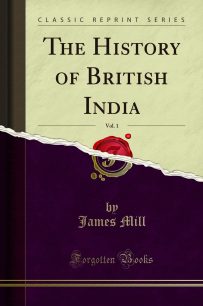
The History of British India, Volume One is the opening volume of James Mill’s influential multivolume history, first published in 1817. It combines an account of early British commercial contact with India and the formation of the English East India Company with broad discussions of Hindu and Muslim society, religion, government, law, taxation, and customs.
Mill approaches Indian history through the intellectual framework of the Scottish Enlightenment and utilitarian philosophy associated with Jeremy Bentham. Rather than concentrating primarily on individual rulers or dramatic events, he attempts to classify societies, compare institutions, and judge forms of government according to his ideas about civilization, rationality, and social progress.
The result is an influential but deeply problematic work: it offers a substantial record of early nineteenth-century British thinking about India, while frequently presenting Indian institutions and traditions through an external and highly judgmental framework.
Early British contact and the East India Company
The opening historical section traces the development of English commercial activity in India and the institutional evolution of the East India Company. It describes the establishment and consolidation of trading interests, the competition between commercial ventures, and the arrangements that culminated in the union of rival companies in 1708.
This section is useful for understanding how a trading organization developed its commercial position before the later expansion of British territorial power. It also illustrates the importance of charters, corporate privileges, trade, and political connections in the early history of British involvement in India.
Hindu society and civilization
Mill devotes substantial attention to Hindu society, discussing social organization, government, law, taxation, religion, and customs. He attempts to construct a general picture of Hindu civilization by organizing information drawn from earlier European scholarship, translated texts, and published accounts.
His treatment is not a neutral description. Mill judges Indian institutions against his own assumptions about progress and rational government, often interpreting unfamiliar social and religious practices as evidence of intellectual or institutional inferiority. These judgments are central to understanding the book's historical influence, but they should not be accepted as reliable conclusions about Hindu society as a whole.
Muslim rule and the history of conquest
The volume also examines Muslim rulers and the historical development of Muslim political power in India. Mill attempts to compare the institutions and social practices of Muslim rulers with those he attributes to Hindu society.
His approach tends to organize complex and varied histories into broad civilizational categories. Such classifications can obscure regional differences, changes across centuries, and the diversity of political and religious life. Modern readers should therefore distinguish Mill's interpretive framework from the historical events and sources he discusses.
Government, law, and taxation
Mill's interest in institutions is one of the defining features of the work. He examines how governments operate, how laws are formulated and applied, how revenue is collected, and how social authority is maintained.
These discussions reveal his utilitarian priorities. He evaluates institutions in relation to administrative efficiency, rational organization, and the welfare of society as he understands it. Although this perspective can make the book useful for studying nineteenth-century political thought, its assumptions also influence the conclusions he reaches about India.
Religion, manners, and social customs
The volume considers religious traditions and everyday customs as evidence in Mill's larger assessment of Indian civilization. His discussion reflects the categories and prejudices common in some European writing of his period, including a tendency to judge unfamiliar religious practices through an assumed hierarchy of civilizations.
For contemporary readers, these chapters are best approached as historical documents about the production of colonial knowledge. They demonstrate how descriptions of religion, law, and social life could be turned into broad claims about a population's fitness for self-government.
History as a justification for reform and rule
Mill presents his work as a critical inquiry intended to improve understanding of historical processes and institutions. He also criticizes aspects of British involvement in India. His position, however, does not amount to a rejection of imperial rule. Instead, his criticism is tied to the belief that better knowledge and rational administrative reform could improve British governance.
This tension is important: a writer can criticize the conduct of colonial administrators while still accepting the premise that Britain has the authority to judge and reorganize Indian society. Mill's work is therefore useful for examining how criticism and reform could coexist with imperial assumptions.
Key themes at a glance
- The rise of English commercial activity and the East India Company.
- Hindu and Muslim institutions as interpreted by an early nineteenth-century British philosopher.
- Government, law, taxation, religion, and social customs.
- Utilitarianism and the measurement of social progress.
- The role of historical writing in shaping colonial policy.
- The tension between criticism of British administration and acceptance of imperial authority.
- The distinction between historical evidence and the ideological framework used to interpret it.
Sources: Cambridge University Press edition and description; Google Books record for Volume One.
Critical Analysis
A landmark in colonial historiography
Mill's book became influential because it offered a systematic interpretation of India at a time when British institutions were expanding their political and administrative power. Rather than treating Indian history as a succession of dynasties and battles alone, he attempted to explain social and political institutions through a broad theory of historical development.
This approach helped establish a framework through which British readers could interpret Indian society. Its importance lies not only in the information it collected but also in the categories and judgments it made available to policymakers and educated readers. The book therefore deserves study as part of the intellectual history of British imperialism.
The problem of writing about a country never visited
A major limitation is that Mill never travelled to India and did not know Indian languages. He relied on published accounts, translations, and other writers' descriptions to develop his conclusions. The Library of Congress explicitly notes these limitations in its biographical summary of Mill.
Working through secondary and translated sources is not inherently invalid. The difficulty arises when an author uses such materials to make confident generalizations about an enormous and internally diverse society without sufficient firsthand knowledge or engagement with its languages and intellectual traditions.
Mill's distance from India becomes especially consequential where he interprets religion, custom, and social organization through assumptions that he treats as universal standards of progress.
Utilitarianism and the hierarchy of civilizations
Mill's intellectual commitment to utilitarian reform shapes his treatment of Indian institutions. He evaluates social arrangements according to his views about reason, utility, law, and political improvement. This can produce useful questions about governance, but it also encourages him to place societies on a single scale of development.
Such a framework risks reducing complex institutions to evidence for or against a predetermined judgment. Religious traditions, legal systems, and customs become objects to be ranked rather than historical formations to be understood in their own contexts.
For this reason, the book should not be treated as an objective measure of Indian civilization. Its assessments tell us at least as much about early nineteenth-century British political philosophy as they do about the societies Mill describes.
Generalizations about Hindu and Muslim societies
Mill's categories of “Hindus” and “Mahomedans” flatten differences in region, language, class, political organization, religious practice, and historical period. The societies he discusses were not uniform cultural blocs, and their institutions changed considerably over time.
His comparisons can also reproduce stereotypes by presenting broad populations as possessing fixed characteristics. Modern historical scholarship generally requires closer attention to specific places, periods, texts, institutions, and the people who participated in them.
Readers should therefore separate verifiable historical information from Mill's sweeping characterizations. His descriptions can reveal how British intellectuals constructed knowledge about India, but his conclusions about the inherent qualities of Indian communities require substantial skepticism.
Criticism of British rule without rejection of empire
One of the book's most revealing tensions is that Mill criticizes British conduct and administration while still approaching India from the perspective of a British reformer. His preferred remedy is largely improved governance informed by rational principles, rather than recognition that Indians should determine their own political future.
This distinction matters when assessing colonial writing. Criticism of corruption, administrative failure, or inefficient policy does not necessarily challenge the underlying distribution of power. Mill's work illustrates how a critique of imperial administration could support the ambition to govern India more systematically.
What remains historically valuable?
The book remains valuable in several ways. It documents the intellectual assumptions through which a prominent British thinker interpreted India; it records early nineteenth-century arguments about the Company and colonial administration; and it offers a case study in how historical writing can influence political judgment.
Its descriptions of institutions and historical events may also be useful as leads for further research, provided they are checked against primary sources and modern scholarship. The work should not be used as a stand-alone authority for the history of Hinduism, Islam in India, Indian law, or the character of Indian society.
Overall assessment
The History of British India, Volume One is an important but ideologically compromised work. Its systematic approach and historical influence make it essential for understanding colonial knowledge production, while its reliance on mediated sources and sweeping civilizational judgments limit its reliability as a history of India itself.
The most productive way to read Mill is critically: identify the sources he uses, examine how he interprets them, and compare his conclusions with Indian-authored texts and modern historical research. That method preserves the book's value without reproducing its prejudices.