
Overview
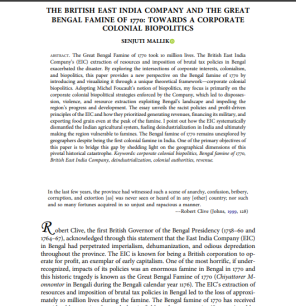
- Title: The British East India Company and the Great Bengal Famine of 1770: Towards a Corporate Colonial Biopolitics
- Author: Senjuti Mallik
- Publication Type: Peer-reviewed academic journal article
- Journal: Geographical Review
- Publication Details: Volume 114, Issue 4, 2024, pp. 464–488
- First Published Online: March 14, 2024
- DOI: 10.1080/00167428.2024.2325977
- HaqqFinder Provisional Rating: 4.32/5
What Is the Article About?
In The British East India Company and the Great Bengal Famine of 1770: Towards a Corporate Colonial Biopolitics, Senjuti Mallik examines the relationship between the British East India Company’s colonial authority, commercial interests, revenue policies, and the devastating famine that affected Bengal in 1770. Rather than treating the catastrophe solely as the consequence of environmental hardship, the article explores how political and economic structures may have intensified vulnerability and suffering.
Mallik develops the concept of corporate colonial biopolitics, drawing on Michel Foucault’s idea of biopolitics to investigate how corporate power and colonial governance shaped the conditions in which people lived, worked, produced food, and experienced deprivation. The article places particular emphasis on resource extraction, land revenue, food-grain exports, agricultural disruption, and the Company’s priorities during a period of severe scarcity.
The study also brings a geographical perspective to the famine by considering how colonial power operated through the landscape and its resources. It connects the management of territory and agricultural production with the wider political economy of Company rule.
Its central argument is that the famine cannot be understood adequately through environmental explanations alone. The institutional decisions, economic incentives, and colonial relationships surrounding the crisis also deserve scrutiny. Readers should distinguish the author’s interpretation from a claim that any single policy or institution explains every aspect of the disaster.
Key Themes Explored in the Article
1. The Great Bengal Famine of 1770
The article examines one of the major demographic catastrophes in eighteenth-century South Asian history. It considers the famine in the context of environmental hardship and the political and economic conditions under which people faced food scarcity. Estimates of deaths from this famine vary, so any numerical claim should be understood in light of the historical evidence and its limitations.
2. The East India Company as a Corporate Ruling Power
The East India Company was not simply a trading enterprise. Its growing territorial authority enabled it to influence revenue collection, administration, and economic life. Mallik’s analysis highlights the importance of examining the Company as both a commercial organization and a colonial governing power.
3. Corporate Colonial Biopolitics
The article’s central theoretical contribution is its use of corporate colonial biopolitics. Drawing on Michel Foucault, Mallik considers how a corporate colonial regime organized resources, territory, and populations in ways that affected human survival. The framework invites readers to examine how institutional priorities can determine whose needs receive attention during a crisis.
4. Revenue Extraction and Taxation
The article explores how the Company’s fiscal priorities and revenue practices interacted with the famine. In an agrarian society experiencing severe scarcity, revenue demands could place additional pressure on cultivators and rural communities. Assessing the scale and effects of those pressures requires attention to historical records, regional differences, and the timing of particular policies.
5. Food-Grain Trade and Colonial Economic Priorities
Mallik draws attention to the relationship between commercial activity, food-grain exports, and the Company’s pursuit of revenue and other institutional objectives. This theme raises an important historical question: how did the priorities of a powerful trading corporation interact with the needs of a population facing widespread hunger?
6. Agricultural Disruption and Deindustrialization
The article links colonial resource extraction and economic restructuring with the vulnerability of Bengal’s agricultural and productive systems. This broader argument connects the immediate experience of famine with longer-term changes in the regional economy. Readers should evaluate the evidence for these connections rather than assume that every long-term economic outcome can be attributed to a single event.
7. Colonial Power, Landscape, and Geography
The geographical approach emphasizes that colonial power operated through land, resources, agricultural systems, and patterns of economic activity. This perspective adds a spatial dimension to famine history, helping readers consider why different communities and regions may have experienced scarcity and colonial intervention differently.
8. Corporate Responsibility and Human Welfare
The article raises broader questions about institutional responsibility when commercial interests and human welfare come into conflict. Its historical case study is relevant to discussions of corporate power, public accountability, and the consequences of governing systems that prioritize revenue and strategic objectives over the needs of vulnerable populations.
About the Author
Senjuti Mallik is a researcher whose published work examines colonialism, biopolitics, and the history and geography of famine in Bengal. Her research includes the article Colonial Biopolitics and the Great Bengal Famine of 1943, published in GeoJournal, as well as the 2024 study reviewed here.
Across these publications, Mallik uses a theoretical approach to investigate how colonial governance, political priorities, and economic structures shaped experiences of famine. The two articles provide a basis for understanding her scholarly interest in the relationship between colonial power and food crises.
Detailed Critical Review
A Distinctive Framework for Understanding Famine
One of the article’s principal strengths is its attempt to move beyond a narrowly environmental account of famine. Drought and harvest failure are important to understanding food crises, but they do not by themselves explain how food is distributed, how purchasing power changes, how revenue demands affect rural households, or how authorities respond to scarcity. By focusing on corporate and colonial structures, Mallik encourages readers to investigate the political economy surrounding the disaster.
Connecting Corporate Interests and Colonial Governance
The East India Company’s combination of commercial objectives and governing authority makes it an important case for studying institutional responsibility. Mallik’s framework brings these roles together and asks how revenue collection, resource extraction, and administrative priorities shaped the conditions in which famine unfolded. This is a useful perspective for readers interested in the relationship between private economic power and public authority.
Contribution to the Geography of Famine
The article also contributes a geographical perspective to the study of the 1770 famine. Land, agricultural production, resources, and territorial administration were not simply background conditions; they were part of the setting in which colonial power operated. This approach can complement economic and political histories by drawing attention to the spatial organization of power and vulnerability.
The Value of the Biopolitical Approach
The use of biopolitics gives the article a conceptual focus. It asks readers to consider how institutions manage populations and resources, and how governing priorities affect the protection—or neglect—of human life. This framework can be illuminating, especially for readers familiar with critical geography, colonial studies, and political theory. However, readers unfamiliar with Foucault may need additional background to follow the theoretical argument comfortably.
Questions About Causation and Evidence
A major issue for readers to consider is how the article establishes the relationship between colonial policies and the severity of the famine. Historical famine is rarely explained by a single factor. Environmental conditions, crop yields, market access, food prices, local institutions, purchasing power, and policy decisions can interact in complex ways. The strength of the argument depends on how convincingly the evidence supports the links between these factors.
Because this review is based on the publisher’s abstract and available bibliographic information rather than a verified reading of the complete article, it does not independently confirm every causal claim, archival interpretation, or quantitative estimate. Readers conducting advanced research should consult the article’s full text and references and compare its conclusions with other scholarship on the famine.
Overall Assessment
The article offers a focused and theoretically ambitious interpretation of the Great Bengal Famine of 1770. Its emphasis on corporate colonial power, revenue extraction, and the geographical dimensions of famine makes it relevant to historians, geographers, and readers studying the economic and institutional history of colonial Bengal. Its specialized framework and interpretive emphasis mean that it is best read alongside broader historical studies rather than as a complete account of every cause and consequence of the famine.
Key Strengths of the Article
1. An Original Conceptual Approach
The concept of corporate colonial biopolitics provides a distinctive way to examine the relationship between a commercial corporation, colonial governance, and human vulnerability. It encourages readers to connect economic incentives with the practical consequences of institutional decisions.
2. A Focus on Structural Causes and Vulnerability
Rather than concentrating only on weather and harvest failure, the article draws attention to revenue policies, resource extraction, trade, and the political economy of food scarcity. This wider lens can help readers understand why environmental shocks may become more devastating under particular institutional conditions.
3. Interdisciplinary Perspective
The study connects historical geography, colonial history, political economy, and social theory. This interdisciplinary approach can help readers understand a complex event from more than one analytical perspective.
4. Examination of Corporate Power
The East India Company provides a significant historical example of a commercial organization exercising territorial and administrative authority. The article makes this combination of roles central to its analysis, offering material for discussions of corporate accountability and colonial governance.
5. Attention to Revenue and Resource Extraction
The article highlights the relevance of fiscal demands and the use of regional resources during a period of severe hardship. This focus helps direct attention to the economic pressures experienced by agrarian communities and to the priorities of the governing institution.
6. A Geographical Contribution to Famine Studies
By emphasizing landscape, territory, agricultural systems, and resource management, the article offers a perspective that can complement conventional political or economic narratives of the famine.
7. Relevance Beyond Eighteenth-Century Bengal
Although its subject is historical, the article raises questions that remain relevant to the study of crises: how institutions allocate resources, whose welfare receives priority, and how concentrated economic power affects vulnerable populations.
8. A Useful Starting Point for Further Research
The article can help students and researchers identify themes for deeper investigation, including colonial taxation, food-grain trade, famine causation, corporate governance, and the use of biopolitical theory in historical geography.
Limitations and Critical Considerations
1. A Specialized Academic Framework
The concept of corporate colonial biopolitics draws on theoretical literature that may be unfamiliar to general readers. Readers without a background in critical geography or political theory may need to consult introductory material before fully appreciating the argument.
2. A Narrow Historical Focus
The article focuses on one famine and one particular interpretive framework. It is not designed to provide a comprehensive history of Bengal, the entire East India Company, or every famine in South Asia. Readers seeking a broad historical overview will need additional sources.
3. Causation Requires Careful Assessment
The relationship between colonial policy and famine severity is a complex historical question. Environmental shocks, regional markets, household purchasing power, agricultural conditions, and local administration may all matter. Readers should examine how the article weighs these factors and supports its conclusions with evidence.
4. A Strong Interpretive Lens May Not Answer Every Question
Biopolitics can illuminate the relationship between power and the management of human life, but no single theoretical framework can address every economic, demographic, ecological, and social dimension of a famine. Other approaches may provide complementary explanations.
5. Historical Evidence Has Inherent Limitations
Reconstructing an eighteenth-century famine depends on surviving records that may be incomplete, inconsistent, regionally uneven, or shaped by the priorities of those who produced them. Estimates of mortality and the effects of particular policies should therefore be interpreted cautiously.
6. Limited Practical Guidance for Modern Policy
The article is primarily a historical and theoretical study, not a practical manual for famine prevention, emergency food distribution, or contemporary food-security planning. Readers seeking policy recommendations will need to supplement it with modern research.
7. May Need to Be Read Alongside Alternative Interpretations
Readers looking for a balanced understanding of the 1770 famine should compare the article with scholarship that examines environmental conditions, food availability, entitlement and purchasing power, regional variation, and the available evidence about Company policy. Comparing interpretations helps distinguish established evidence from continuing scholarly debate.
8. The Complete Text Is Needed for a Definitive Evaluation
This HaqqFinder assessment is provisional because the full article has not been independently examined for this review. Detailed judgments about its prose, use of archival evidence, citations, visual presentation, and the strength of individual claims should be revisited after a full-text assessment.
Who Should Read This Article?
- Students of colonial Indian history: Readers exploring the East India Company, eighteenth-century Bengal, and the history of colonial administration.
- Historians of famine and food security: Researchers interested in the interaction between environmental shocks, economic structures, and institutional responses.
- Geographers and political geographers: Readers studying the relationship between territory, resource management, colonial power, and social vulnerability.
- Students of postcolonial and critical theory: Readers interested in applying biopolitics to historical and geographical questions.
- Researchers studying corporate power: Readers investigating how commercial priorities interact with public authority and social responsibility.
- Readers of Bengal’s colonial history: Those seeking a focused academic interpretation to complement broader histories of the region.
Less suitable for: Readers seeking a general introductory narrative, a comprehensive textbook on Bengal’s history, or a practical guide to contemporary famine response. The article is a specialized research publication rather than a general-audience book.
HaqqFinder Rating Breakdown
The following scores use HaqqFinder’s weighted eight-criterion framework as an adapted, provisional assessment of this journal article. Scores are based on the publication’s stated subject, abstract, and available bibliographic information. They should not be treated as a verified full-text review.
| Evaluation Criterion | Weight | Provisional Score | Weighted Score |
|---|---|---|---|
| Content Quality & Depth | 20% | 4.6/5 | 0.920 |
| Writing Style & Clarity | 15% | 4.0/5 | 0.600 |
| Relevance & Target Audience Fit | 15% | 4.7/5 | 0.705 |
| Originality & Creativity | 15% | 4.7/5 | 0.705 |
| Cultural & Ethical Sensitivity | 10% | 4.2/5 | 0.420 |
| Practical Value & Applicability | 10% | 3.8/5 | 0.380 |
| Presentation & Design | 10% | 4.0/5 | 0.400 |
| Value for Price | 5% | 3.8/5 | 0.190 |
| Overall Weighted Rating | 4.320/5 | ||
How to Interpret the Rating
Content Quality & Depth — 4.6/5: The stated research question and conceptual approach suggest a substantive contribution to the study of colonial famine. A full-text review is needed to assess the quality and depth of the supporting evidence.
Writing Style & Clarity — 4.0/5: The abstract communicates the central argument, but the accessibility and clarity of the complete article have not been independently assessed.
Relevance & Target Audience Fit — 4.7/5: The article is highly relevant to readers studying colonial Bengal, famine history, political geography, and corporate power, although its specialist scope limits its general readership.
Originality & Creativity — 4.7/5: The corporate colonial biopolitics framework provides a distinctive conceptual lens for the subject.
Cultural & Ethical Sensitivity — 4.2/5: The focus on colonial power and human vulnerability is relevant to ethical historical inquiry. A definitive score requires review of the full text and its treatment of historical actors and affected communities.
Practical Value & Applicability — 3.8/5: The article offers conceptual and research value rather than direct, step-by-step practical guidance.
Presentation & Design — 4.0/5: A provisional placeholder score only. The article’s actual layout, figures, tables, and accessibility should be assessed from the published version.
Value for Price — 3.8/5: A provisional score because access conditions and the reader’s cost have not been confirmed. The publisher’s access page should be checked before making a price or accessibility claim.
Final Verdict
The British East India Company and the Great Bengal Famine of 1770: Towards a Corporate Colonial Biopolitics is a focused academic contribution to the study of colonial Bengal and the history of famine. Senjuti Mallik’s approach encourages readers to examine the relationship between commercial power, colonial administration, revenue extraction, and human vulnerability rather than viewing famine only as an environmental event.
The article’s main value lies in its conceptual framing and its emphasis on the institutional and geographical dimensions of a major historical crisis. Its specialist theoretical approach means that it is best suited to readers with an interest in history, geography, colonial studies, or political economy. For a fuller understanding of the famine, it should be read alongside other historical research and evidence.
HaqqFinder’s provisional assessment: 4.32/5. This score reflects the publication’s apparent research relevance and conceptual contribution based on available information. It should be updated after direct examination of the complete article, its evidence, and its presentation.
Review Transparency
This review is based on the publisher’s article description and abstract, publication details, and available author-publication information. The complete article has not been independently assessed for this review. The rating is therefore provisional, not a claim of a completed full-text evaluation. The review summarizes the article’s stated approach and offers critical questions for readers; it does not independently verify all historical claims or mortality estimates.
Because this is a journal article rather than a standalone book, the presentation and value-for-price scores are especially tentative. HaqqFinder should revise the assessment after checking the full published text and confirming access conditions.
Publication Details and Further Reading
- Publisher’s article page: Taylor & Francis — Geographical Review
- DOI: https://doi.org/10.1080/00167428.2024.2325977
- Author’s other relevant publication: Colonial Biopolitics and the Great Bengal Famine of 1943, published in GeoJournal.