Mastodon
haqqfinder

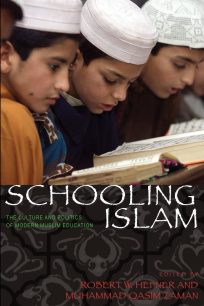
Schooling Islam: The Culture and Politics of Modern Muslim Education

Format: 296 pages
Language: English
Published Date: December 16, 2010
ISBN: 978-1400837458
User's Rating:
Not rated yet
|
Editor's Rating:
4.36

Summary & Key Themes

Schooling Islam: The Culture and Politics of Modern Muslim Education, edited by Robert W. Hefner and Muhammad Qasim Zaman, is a comparative academic collection exploring how Muslim educational institutions respond to modern political, social, and intellectual change. First published by Princeton University Press in 2007, the book brings together eleven scholars to examine Islamic education in a range of national and cultural settings.

The collection challenges the simplistic portrayal of madrasas as uniformly medieval institutions or automatic breeding grounds for extremism. Instead, it presents Muslim education as diverse, historically changing, and closely connected to debates over religious authority, national identity, political power, and the transmission of Islamic knowledge.

Major Themes

1. The Culture, Politics, and Future of Muslim Education

The introductory chapter establishes the book's central concern: Islamic education cannot be understood apart from the societies in which it operates. Schools and seminaries transmit religious knowledge, but they also shape intellectual traditions, social relationships, and debates about the future of Muslim communities.

2. Education and Muslim Identity

The book examines how religious education contributes to competing understandings of Muslim identity. Educational institutions may preserve inherited traditions, respond to national projects, or engage with modern social and political questions. The relationship between education and identity is therefore neither uniform nor politically neutral.

3. Deobandi Madrasas in South Asia

A chapter on Deobandi madrasas investigates tradition and religious authority within an influential South Asian scholarly movement. It helps readers understand how established texts, scholarly lineages, and educational practices contribute to the formation of religious authority in contemporary settings.

4. Madrasas and Religious Minorities in Secular India

The collection considers the position of Muslim educational institutions within India's secular political framework. This topic raises questions about minority identity, religious autonomy, educational policy, and the relationship between Muslim communities and the state.

5. Al-Azhar and the Transformation of Islamic Higher Education

The discussion of al-Azhar in twentieth-century Egypt explores the institutional and intellectual changes affecting one of the best-known centres of Sunni Islamic learning. It provides a historical perspective on the relationship between established religious scholarship and modern state structures.

6. Religious Authority and Institutional Change

Other chapters explore developments in Iran, Turkey, and Indonesia, including the emergence of the Fethullah Gülen movement and the role of Muslim schools in shaping national ideals. These examples illustrate that Islamic education can take different institutional forms and respond to different political circumstances.

7. Islamic Education in Pluralistic Societies

The collection considers how Islamic educational traditions engage with religious diversity, competing conceptions of knowledge, and changing social expectations. Its comparative approach helps readers see that questions about curriculum, authority, and reform are debated within Muslim societies rather than imposed exclusively from outside.

8. Reform, Continuity, and the Future

Across the volume, a recurring theme is the tension between preserving inherited Islamic traditions and adapting educational institutions to changing circumstances. The chapters do not offer a single model of reform; instead, they reveal different approaches shaped by local histories, intellectual traditions, and political contexts.

Overall, Schooling Islam provides a comparative account of the institutions, ideas, and political relationships that shape modern Muslim education. Its value lies in showing the diversity of Islamic educational life rather than reducing it to a single model.

Critical Analysis

The central strength of Schooling Islam is its refusal to treat Muslim education as a single, unchanging institution. Rather than assuming that all madrasas follow the same curriculum, serve the same political purpose, or produce the same social outcomes, the collection compares institutions across different national settings and intellectual traditions.

Challenging Stereotypes About Madrasas

The book responds to public debates that frequently associate Islamic education with extremism or portray religious schools as incompatible with modern society. Its comparative approach challenges these generalisations by examining the actual institutional, intellectual, and social contexts in which Muslim education takes place.

This is an important contribution. A madrasa, a state-regulated Islamic university, a traditional seminary, and a community-based religious school cannot automatically be treated as equivalent. Their curricula, sources of authority, student populations, and relationships with governments may differ considerably.

However, challenging stereotypes does not mean that every Islamic educational institution is beyond criticism. Educational quality, political influence, curriculum, and institutional accountability still require case-specific examination. The book is most useful when its rejection of blanket generalisations is understood as a call for better evidence, not as a reason to avoid critical questions.

Tradition and Modernity Are Not Simple Opposites

A particularly valuable theme is the interaction between inherited religious traditions and modern institutional change. Islamic educational institutions can preserve classical texts and scholarly lineages while adapting to new state policies, public expectations, and social circumstances.

This challenges the assumption that educational reform necessarily means abandoning religious tradition, or that maintaining traditional scholarship necessarily means rejecting all modern developments. The chapters instead reveal a range of responses to changing political and intellectual conditions.

At the same time, the collection's comparative breadth means that it cannot provide a complete account of every debate over Islamic theology, curriculum, or pedagogy. Readers interested in a specific school of thought or institution should supplement it with more specialised research.

Education, Politics, and State Power

The volume shows that Muslim education is shaped partly by the relationship between religious institutions and political authorities. Governments may regulate schools, influence curricula, redefine educational priorities, or seek to incorporate religious institutions into national projects. Religious scholars and educators, meanwhile, may negotiate, resist, or cooperate with state initiatives.

These relationships matter because educational reform is rarely only a technical question about teaching methods. It can also involve disputes over who has the authority to define religious knowledge, who controls institutions, and what kind of Muslim citizen or community education should cultivate.

A Valuable Comparative Perspective

The inclusion of cases from South Asia, the Middle East, North Africa, Turkey, and Southeast Asia is one of the book's greatest strengths. It demonstrates that Muslim educational institutions operate in distinct historical and political environments. The experience of Deobandi madrasas in India, for example, cannot simply be assumed to explain the institutional development of al-Azhar in Egypt or Muslim schooling in Indonesia.

The comparative method also has limitations. The countries and institutions discussed do not constitute a complete survey of the Muslim world, and comparisons across chapters require attention to differences in historical context. The book should therefore be treated as a substantial collection of case studies rather than an exhaustive account of every Muslim educational tradition.

Knowledge, Authority, and Pluralism

The book raises important questions about the transmission of religious knowledge and the authority of teachers, scholars, and institutions. It explores how educational practices shape understandings of legitimate knowledge and how Muslim institutions engage with pluralistic social environments.

These questions are particularly relevant to readers interested in the future of Islamic scholarship. They encourage a distinction between studying how educational institutions operate and making theological judgements about the religious positions they teach. The collection primarily offers a social-scientific and historical analysis; it is not a manual for determining which interpretation of Islam is doctrinally correct.

Limitations and Historical Context

Because the book was first published in 2007, its analysis cannot fully reflect subsequent developments in digital learning, online religious authority, newer educational initiatives, or more recent political changes. Its chapters remain useful for understanding the historical debates and institutions they examine, but contemporary conclusions require additional research.

As an edited collection, the volume also brings together different authors and approaches. This provides intellectual breadth, although readers may find differences in emphasis, methodology, or terminology between chapters. It is best approached as a coordinated set of scholarly investigations rather than a single argument developed uniformly from beginning to end.

Overall Assessment

Schooling Islam is a valuable scholarly contribution to the study of Islamic education because it combines comparative breadth with attention to local context. It challenges reductive assumptions, explores the relationship between religious knowledge and political power, and shows why Muslim educational institutions must be studied in their historical and social settings. Its main limitation is not a lack of relevance, but the need to pair its 2007 case studies with more recent scholarship when addressing present-day educational debates.

Pros
  • Challenges simplistic stereotypes: Rejects the assumption that madrasas are uniform institutions or inherently associated with extremism.
  • International comparative scope: Examines Muslim education across several regions, including South Asia, the Middle East, North Africa, Turkey, and Southeast Asia.
  • Strong academic foundation: Brings together eleven scholars from different disciplinary backgrounds and research traditions.
  • Explores religious authority: Examines how teachers, scholars, institutions, and inherited texts shape the transmission of Islamic knowledge.
  • Connects education with politics: Explains why curricula, educational reforms, and institutional autonomy can become politically significant.
  • Balances continuity and change: Shows how Muslim educational institutions can preserve traditions while responding to modern circumstances.
  • Useful case studies: Chapters on Deobandi madrasas, al-Azhar, secular India, Iran, Turkey, and Indonesia offer different perspectives on Muslim schooling.
  • Research value: Provides a useful foundation for students and researchers in Islamic studies, anthropology, education, and political science.
Cons
  • Published in 2007: It predates many recent developments in online religious education, digital media, and contemporary education policy.
  • Uneven chapter approaches: As an edited volume, it includes different authors and methods rather than one fully unified analytical framework.
  • Not an exhaustive global survey: The selected countries and institutions cannot represent the full diversity of Muslim education worldwide.
  • Academic reading level: The theoretical and social-scientific discussions may be challenging for readers without background knowledge of Islamic studies or education research.
  • Limited practical guidance: It analyses educational institutions and politics more than it offers a step-by-step programme for improving curricula or teaching methods.
  • Requires contemporary supplements: Readers assessing current madrasa reform, educational outcomes, or government policies will need newer studies.
  • Primarily analytical, not theological: It examines Islamic education as a social, political, and intellectual phenomenon rather than providing a definitive Islamic ruling on educational questions.

Critical Reception

Schooling Islam received attention in academic journals covering Islamic studies, anthropology, education, and Middle Eastern studies. The published reviews confirm that the collection became part of scholarly discussion about the relationship between Muslim education, religious authority, and modern politics.

Published Scholarly Reviews

  • Mohammad Talib, Journal of Islamic Studies (2008): Talib reviews the collection in volume 19, issue 3, pages 445–449. The review situates the book within debates about Islamic radicalism and religious education, and describes its comparative, interdisciplinary approach to the culture, practices, and politics of Muslim educational institutions. Read the review record.
  • Lyn Parker, Anthropology & Education Quarterly (2009): Parker published a scholarly review in volume 40, issue 3, pages 326–328. Its publication record confirms the book’s engagement with the anthropology of education. View the review record.
  • Amidu Olalekan Sanni, British Journal of Middle Eastern Studies (2016): Sanni’s review appeared in volume 43, issue 2, pages 250–251. It revisits the collection in the context of debates about Muslim education and the association of madrasas with radicalism. View the review record.

Academic Significance

The editors’ institutional publication page also records favourable assessments from scholars Francis Robinson and Jon W. Anderson. These comments emphasise the collection’s breadth and its challenge to sweeping generalisations about Islamic education. Consult the Princeton University publication page.

Taken together, these sources demonstrate the book’s relevance to scholarly debates. They should not be interpreted as proof that every chapter’s argument has been universally accepted. The strongest reason to read the collection is its comparative approach and its insistence that Muslim educational institutions be understood through careful study of their specific histories, practices, and political contexts.

Editorial note: This section identifies verifiable reviews and institutional assessments. It does not invent reviewer quotations or claim a unanimous scholarly consensus.

Who Should Read This Book?

Schooling Islam is especially useful for readers who want to understand how Islamic educational institutions operate within modern societies and how religious learning intersects with politics, identity, and authority.

  • Students of Islamic studies: For comparative insight into Islamic educational traditions and religious scholarship.
  • Madrasa educators and administrators: For examining how religious institutions negotiate tradition, educational change, and relationships with the state.
  • Researchers in education and anthropology: For studying the social functions of schools, religious learning, and institutional authority.
  • Students of South Asian history: For the discussion of Deobandi madrasas and Muslim education in secular India.
  • Researchers of Muslim politics: For analysing the relationships between education, national identity, public policy, and religious authority.
  • Journalists and policy researchers: For developing a more nuanced understanding of Muslim education beyond common stereotypes.
  • Readers interested in interfaith and pluralistic societies: For exploring how Islamic educational institutions engage with religious diversity and modern political environments.

Who May Prefer a Different Starting Point?

Readers looking for a practical textbook on Islamic teaching methods, a theological guide to curriculum design, or an up-to-date overview of present-day madrasa policy may need additional resources. This collection is most valuable for understanding the social, historical, and political contexts of Muslim education rather than providing a direct implementation manual.

Editorial Rating

Evaluation Criteria Weight Score Assessment
Content Quality & Depth 20% 4.60/5 Substantial scholarly examination of Islamic education across multiple institutions and countries.
Writing Style & Clarity 15% 4.00/5 Scholarly and generally structured, though some theoretical discussions require background knowledge.
Relevance & Target Audience Fit 15% 4.50/5 Highly relevant to Islamic studies, education, religious authority, and Muslim politics.
Originality & Creativity 15% 4.50/5 Strong comparative approach that challenges reductive assumptions about madrasas.
Cultural & Ethical Sensitivity 10% 4.50/5 Recognises the diversity of Muslim educational traditions and the importance of local context.
Practical Value & Applicability 10% 4.20/5 Useful for research and policy analysis, although it is not a practical teaching manual.
Presentation & Design 10% 4.10/5 Organised into thematic and regional studies with supporting references and an index.
Value for Price 5% 4.20/5 Strong academic reference value, subject to edition, availability, and purchase price.
Weighted Overall Score 100% 4.36/5 An excellent comparative study of modern Muslim education.

Rating interpretation: 4.36/5 — Excellent.

Our editorial ratings are based on HaqqFinder’s established evaluation criteria and weighted scoring system. For details, see our Rating & Evaluation Methodology.

Overall Verdict:

Schooling Islam: The Culture and Politics of Modern Muslim Education, edited by Robert W. Hefner and Muhammad Qasim Zaman, is a valuable scholarly collection for understanding the diversity and changing character of Islamic education in the modern world.

Its greatest achievement is to move beyond blanket assumptions about madrasas and examine the institutions, intellectual traditions, and political circumstances that shape Muslim education. Through case studies from South Asia, the Middle East, North Africa, Turkey, and Southeast Asia, the book demonstrates that questions of religious authority, educational reform, and Muslim identity must be understood in their particular historical contexts.

The collection’s academic orientation and publication date are important considerations. It is not a simple introductory guide, nor can its 2007 case studies fully represent developments in Islamic education since publication. Readers researching current educational policy or contemporary religious movements should supplement it with newer work.

Final recommendation: Highly recommended for students, researchers, educators, and serious readers interested in Islamic scholarship, madrasa education, religious authority, and Muslim political life. It is particularly valuable for those seeking a more nuanced, evidence-based understanding of Islamic education beyond media stereotypes.

HaqqFinder Editorial Rating: 4.36/5

Citation: Hefner, Robert W., and Muhammad Qasim Zaman, eds. Schooling Islam: The Culture and Politics of Modern Muslim Education. Princeton, NJ: Princeton University Press, 2007. Princeton Studies in Muslim Politics. ISBN: 978-0-691-12933-4 (paperback). View publisher information.
🛒 WHERE TO BUY

*When you purchase through this link, HaqqFinder may earn a small commission at no extra cost to you. Learn more

Share On:
Facebook
X
LinkedIn
Pinterest
Reddit
WhatsApp
Tumblr
Telegram
Threads

Ratings & Reviews

0
0 out of 5 stars (based on 0 reviews)
Excellent
Very good
Average
Poor
Terrible

There are no reviews yet. Be the first one to write one.

Where We Reference This Book
Explore HaqqFinder articles that cite, discuss, or mention this publication.
Related Recommendations:

Login

Fill out the form below, and we will be in touch shortly.