Mastodon
haqqfinder

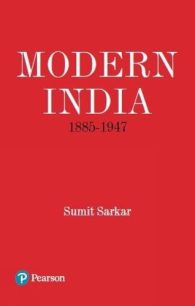
Modern India: 1885–1947

Author: Sumit Sarkar
Format: 424 pages
Language: English
Published Date: January 1, 2014
ISBN: 978-9332535749
User's Rating:
Not rated yet
|
Editor's Rating:
4.20

Summary and Key Themes

Modern India: 1885–1947 examines the political, economic, and social transformations that shaped India between the formation of the Indian National Congress and independence and Partition in 1947. Sarkar organises the narrative chronologically while connecting national political developments with regional movements and changing social conditions.

Colonial Political and Economic Structures, 1885–1905

The opening chapters examine the economic and political foundations of British rule, the emergence of educated Indian political elites, and the early development of organised nationalism. Sarkar considers the moderate phase of Congress politics alongside the structural inequalities and economic grievances that helped shape opposition to colonial rule.

Swadeshi, Boycott, and Political Radicalisation, 1905–1917

The partition of Bengal in 1905 and the Swadeshi movement become central to the discussion of expanding nationalist activity. The book explores boycott campaigns, national education, labour unrest, revolutionary organisations, and changing relations between different political and social groups. It also considers the development of political currents beyond Bengal and the growing tensions within the nationalist movement.

Gandhi and the Rise of Mass Nationalism, 1917–1927

Sarkar examines Gandhi's emergence as a national leader and the transformation of anti-colonial politics through movements such as Non-Cooperation. The discussion includes the Khilafat movement, regional campaigns, peasant and tribal mobilisation, caste movements, and the difficulties of sustaining cooperation among groups with different interests.

Economic Depression and Nationalist Expansion, 1927–1937

The book connects the economic pressures of the interwar years with political developments, including the Civil Disobedience movement, labour activism, peasant struggles, revolutionary politics, and debates over constitutional reform. Sarkar also explores the varied responses of business groups, political organisations, and local communities to colonial policy.

War, Political Conflict, and the End of British Rule, 1937–1945

The establishment of Congress ministries, the outbreak of the Second World War, disagreements over India's participation, the growth of the Muslim League, and the Quit India movement form major parts of this section. Sarkar also addresses wartime economic disruption, the Bengal famine, labour and peasant unrest, and competing political strategies during the final phase of colonial rule.

Independence and Partition, 1945–1947

The concluding chapters examine the negotiations and conflicts that led to the transfer of power. The Indian National Army trials, the Royal Indian Navy revolt, the Cabinet Mission, communal violence, peasant struggles, and the Mountbatten Plan appear within a broader account of the circumstances surrounding independence and Partition.

History from Below

Across these periods, Sarkar repeatedly looks beyond leading politicians and formal institutions. Peasants, workers, tribal communities, lower-caste movements, and regional organisations are treated as participants in history rather than merely as audiences for elite political decisions.

Central argument: India's independence movement developed through the interaction of nationalist leadership, colonial economic and political structures, and diverse forms of popular mobilisation. Its course was neither uniform nor predetermined, and the achievement of independence did not erase the social tensions and competing interests that had shaped the struggle.

Critical Analysis

A Synthesis of Political, Social, and Economic History

One of Sarkar's most important achievements is the way he brings different dimensions of colonial history into a coherent narrative. Political organisations and constitutional developments are discussed alongside economic pressures, class relations, labour activism, caste, and regional movements. This makes the book more analytically useful than a chronology focused mainly on prominent leaders and major political events.

The book was designed to synthesise extensive specialist research while also questioning histories that concentrated too heavily on elite nationalism. Its introduction and bibliography make clear that it is intended as a work of historical interpretation as well as a narrative account.

Mass Nationalism and Popular Agency

Sarkar's treatment of mass nationalism is particularly valuable. Movements such as Non-Cooperation and Civil Disobedience are not presented simply as campaigns launched by Gandhi and the Congress leadership. The author examines how local conditions, economic grievances, social identities, and popular expectations shaped participation and sometimes pushed movements in directions that leaders did not fully control.

This approach also complicates the idea of a unified nationalist movement. Participants could oppose British rule while disagreeing over class interests, caste relations, religious identity, economic policy, and the political future of India.

Economic Structures and Colonial Rule

The book gives economic conditions a meaningful place in the explanation of political change. Commercialisation, industrial development, labour unrest, agricultural pressures, and the Great Depression help explain why nationalist politics evolved differently across regions and social groups.

This approach is useful for readers who want to understand colonialism as more than a political relationship between Britain and Indian leaders. It directs attention to how institutions and economic structures affected everyday life and shaped the possibilities for organised resistance.

Nationalism, Communal Politics, and Partition

Sarkar treats independence and Partition as the outcomes of intersecting political conflicts rather than as a simple final stage in a continuous nationalist success story. His discussion of the Congress, the Muslim League, wartime politics, constitutional negotiations, and communal violence encourages readers to examine the competing aims and changing circumstances that shaped the final years of British rule.

Readers should nevertheless distinguish the book's interpretations from the entire range of scholarship on Partition. The political and social histories of Muslim communities, regional experiences, and the development of competing nationalisms are extensive fields of study. This book provides an important framework, but it cannot replace more specialised work on those subjects.

Strengths of the Historical Method

The book's chronological structure helps readers connect developments across decades. Its further-reading sections and extensive bibliography are valuable for students who want to investigate particular movements, regions, or historiographical debates. The synthesis of political narrative with social and economic analysis remains one of its strongest features.

Limitations and Areas for Critical Reading

The book is a work of its time. Its original publication in 1983 means that later archival discoveries, regional histories, and subsequent debates in gender history, environmental history, and cultural history are not comprehensively incorporated in the original text. The analytical emphasis on class and popular mobilisation is illuminating, but readers may want to supplement it with scholarship that places greater emphasis on gender, religion, political culture, and the diversity of regional experience.

Its wide scope also creates a practical limitation: some topics receive less depth than a dedicated monograph could provide. The chronological narrative necessarily compresses complex developments, and readers may need additional sources to understand individual movements or contested historical episodes in detail.

Overall Assessment

Modern India: 1885–1947 is most effective as a rigorous synthesis and interpretive framework. It challenges leader-centred narratives without dismissing the importance of national political organisations, and it places popular movements within their broader social and economic settings. Its age makes critical supplementation necessary, but does not remove its value as a foundational text for studying late colonial India.


Pros
  • Comprehensive historical coverage: Connects the formation of organised nationalism in 1885 with independence and Partition in 1947.
  • History from below: Gives substantial attention to peasants, workers, tribal communities, and other popular movements.
  • Integrated analysis: Combines political developments with economic structures, class relations, and social change.
  • Nuanced account of nationalism: Shows that nationalist politics contained competing interests, regional variations, and internal disagreements.
  • Strong academic foundation: Offers a substantial synthesis of historical research and a useful bibliography for further study.
  • Useful for students and teachers: Its chronological organisation makes it suitable for advanced study of modern Indian history.
  • Challenges simplistic narratives: Avoids treating independence as the achievement of a few leaders alone or as an inevitable outcome.
Cons
  • Dense academic presentation: The volume of events, organisations, and historical debates may be demanding for beginners.
  • Older historiographical framework: First published in 1983, the original work predates several decades of subsequent scholarship.
  • Uneven depth across subjects: Its broad chronological scope means some regional and social histories receive less attention than they would in specialist studies.
  • Requires supplementary reading: Readers focused on gender, environmental history, religious identity, or particular regional experiences should consult more specialised research.
  • Interpretive perspective: Sarkar’s emphasis on social and economic structures is analytically productive, but readers should compare it with historians using different approaches.
  • Not a complete history of modern India: Its central period begins in 1885 and ends in 1947, so it does not provide a comprehensive account of earlier colonial developments or post-independence India.

Critical Reception

Modern India: 1885–1947 received substantial attention in academic historical scholarship. Its reputation rests on its synthesis of research, its accessible organisation for advanced students, and its emphasis on popular mobilisation alongside elite nationalism.

Contemporary Academic Assessment

Historian D. A. Low’s assessment, reproduced on the publisher’s page for the book, praised its breadth, writing, and incorporation of recent research. Low described it as a work that would become a starting point for people studying modern India. This is a favourable contemporary assessment, rather than evidence of unanimous critical agreement.

Source: Palgrave Macmillan / Springer Nature, Modern India 1885–1947.

Published Scholarly Review

V. G. Kiernan reviewed the book in International Affairs, volume 66, issue 2, in April 1990, pages 435–436. The bibliographic record confirms the review’s publication, although the full text is access-restricted. It would therefore be inappropriate to attribute detailed arguments or a specific verdict to Kiernan without consulting the complete review.

Source: V. G. Kiernan, “Modern India 1885–1947,” International Affairs (1990).

Later Scholarly Perspective

Ramachandra Guha’s discussion of Sarkar’s scholarship identifies Modern India: 1885–1947 as a particularly important account of late colonial rule and mass nationalism. Guha highlights the book’s attempt to move beyond histories centred primarily on the activities and strategies of political leaders.

Source: Ramachandra Guha, discussion of Sumit Sarkar’s historical scholarship.

Reception Assessment

The available evidence supports describing the book as an influential academic synthesis that helped shape the study of modern Indian history. That assessment should not be confused with universal agreement on every interpretation. Historians continue to debate nationalism, class, religion, caste, regional movements, and the causes of Partition, making comparison with later scholarship an important part of reading the book critically.

Who Should Read This Book?

  • University students: Particularly those studying modern Indian history, colonialism, nationalism, or South Asian studies.
  • History teachers and researchers: Readers seeking a broad synthesis of political, social, and economic developments between 1885 and 1947.
  • Students of anti-colonial movements: Those interested in Gandhi, Congress politics, Swadeshi, revolutionary movements, labour activism, and peasant mobilisation.
  • Readers studying economic and social history: Those who want to understand how colonial economic structures and social inequalities influenced political action.
  • Researchers of independence and Partition: Readers exploring the competing political strategies and social conflicts surrounding the end of British rule.
  • Serious general readers: Anyone comfortable with detailed academic history who wants a more complex picture than a leader-centred account of independence.

Less suitable for: Readers looking for a short, introductory narrative or a comprehensive account of India’s entire history. Beginners may find it easier to start with a shorter overview before working through Sarkar’s detailed analysis.

HaqqFinder Editorial Rating

Evaluation Criteria Weight Score Assessment
Content Quality & Depth 20% 4.50/5 Strong synthesis of political, economic, and social history.
Writing Style & Clarity 15% 4.30/5 Well-organised academic prose, although dense in places.
Relevance & Target Audience Fit 15% 4.70/5 Highly relevant to students and researchers of modern South Asian history.
Originality & Creativity 15% 4.40/5 Effectively integrates popular mobilisation with elite political history.
Cultural & Ethical Sensitivity 10% 4.20/5 Recognises diverse social actors and contested political interests; benefits from supplementary perspectives.
Practical Value & Applicability 10% 4.50/5 Useful as a core academic text and a guide to further historical research.
Presentation & Design 10% 4.00/5 Clear chronological structure and useful research apparatus, though the text is demanding.
Value for Price 5% 4.20/5 Strong academic value; actual value depends on the edition, price, and access.
Weighted Overall Score 100% 4.39/5 Highly valuable academic history

Our editorial ratings are based on HaqqFinder’s established evaluation criteria and weighted scoring system. For details, see our Rating & Evaluation Methodology.

Overall Verdict:

Sumit Sarkar’s Modern India: 1885–1947 is a major work for understanding the social, economic, and political forces behind India’s struggle for independence. Its lasting value lies in its insistence that the history of nationalism must include not only prominent leaders and constitutional negotiations but also peasants, workers, tribal communities, and other groups whose participation shaped the movement.

The book is particularly strong in connecting popular mobilisation with colonial economic structures and the changing strategies of nationalist organisations. Its treatment of Swadeshi, Gandhian mass movements, labour and peasant activism, wartime politics, and Partition provides a broad framework for understanding the complexity of the period.

Because the original work appeared in 1983, readers should supplement it with more recent research, particularly when exploring gender, religious identity, regional histories, and newer interpretations of Partition. Nevertheless, its age is not a reason to disregard its contribution. It remains a valuable starting point for serious study of late colonial India.

HaqqFinder Editorial Rating: 4.39/5

Recommendation: Highly recommended for university students, history teachers, researchers, and serious readers seeking an analytical account of India’s transition from colonial rule to independence. It is especially valuable for readers who want to understand nationalism as a complex social process rather than simply a succession of political leaders and events.

Citation: Sarkar, Sumit. Modern India: 1885–1947. London: Macmillan, 1983.

Edition discussed: Sarkar, Sumit. Modern India: 1885–1947. Delhi: Pearson, 2014. ISBN: 9789332535749.

Bibliographic record for the 2014 Pearson edition · Publisher record for the Macmillan edition

🛒 WHERE TO BUY

*When you purchase through this link, HaqqFinder may earn a small commission at no extra cost to you. Learn more

Share On:
Facebook
X
LinkedIn
Pinterest
Reddit
WhatsApp
Tumblr
Telegram
Threads

Ratings & Reviews

0
0 out of 5 stars (based on 0 reviews)
Excellent
Very good
Average
Poor
Terrible

There are no reviews yet. Be the first one to write one.

Where We Reference This Book
Explore HaqqFinder articles that cite, discuss, or mention this publication.
Related Recommendations:

Login

Fill out the form below, and we will be in touch shortly.