Mastodon
haqqfinder

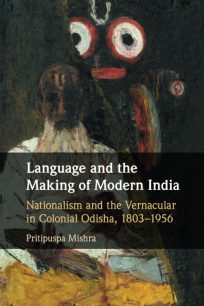
Language and the Making of Modern India: Nationalism and the Vernacular in Colonial Odisha, 1803–1956

Format: 261 pages, Second Edition
Language: English
Published Date: 12 Feb. 2026
ISBN: 978-1108443319
User's Rating:
Not rated yet
|
Editor's Rating:
4.0

Language and the Making of Modern India: Nationalism and the Vernacular in Colonial Odisha, 1803–1956 by Pritipuspa Mishra examines the relationship between language, regional identity, nationalism, and political power in Odisha during the colonial and early postcolonial periods. Published by Cambridge University Press in 2020, the book challenges the assumption that regional language movements were simply expressions of cultural identity or resistance to larger political powers. Instead, it explores how language became an influential tool for defining communities, claiming territory, and shaping modern Indian political life.

The book traces the development of Odia as a regional language and the emergence of a distinct Odia-speaking public through print culture, literature, political debate, and organized activism. It examines the rise of the Odia movement and the campaign to establish Odisha as a province organized around linguistic identity. The study places these developments within the wider history of British colonial rule and the changing relationship between regional nationalism and the idea of an Indian nation.

A central argument is that regional linguistic nationalism did not necessarily conflict with all-India nationalism. Rather, the two could reinforce one another, as regional identity helped shape political participation and claims to recognition within the broader nation. However, Mishra also questions the assumption that linguistic regionalism was inherently inclusive. By examining Adivasi communities and other populations whose languages differed from Odia, the book explores how the creation of a linguistic homeland could marginalize people living within the territory claimed by the movement.

The study therefore presents language not merely as a means of communication or cultural expression, but as a source of institutional and political power. It highlights the tensions between linguistic unity, territorial claims, minority rights, and the governance of a multilingual society. These questions remain relevant to discussions of nationalism, regional autonomy, linguistic justice, and the formation of modern states.

Overall, Language and the Making of Modern India offers a focused scholarly interpretation of Odisha's historical development and its significance for understanding modern India. Its particular strength lies in examining both the political achievements and the exclusionary consequences of linguistic nationalism. Readers interested in colonial South Asian history, nationalism, language politics, and Adivasi studies will find it especially valuable, although its specialized academic approach may be challenging for readers seeking a general introduction to Indian history.


Pros
  • Original historical perspective: Offers a distinctive analysis of how language shaped regional identity, political movements, and modern Indian nationalism.
  • Detailed study of Odisha: Explores the historical development of the Odia language movement and the campaign for a separate linguistic province.
  • Connects regional and national politics: Explains how regional linguistic nationalism could strengthen, rather than simply oppose, broader Indian nationalism.
  • Examines language as political power: Goes beyond literature and communication to investigate how language influences institutions, territorial claims, and political belonging.
  • Addresses Adivasi marginalization: Examines how the construction of an Odia linguistic homeland could exclude or disadvantage communities whose languages differed from Odia.
  • Questions simplistic narratives: Challenges the idea that linguistic movements are always inclusive, powerless, or purely cultural expressions.
  • Strong relevance to wider debates: Contributes to discussions of nationalism, minority rights, linguistic justice, regional autonomy, and multilingual governance.
  • Useful academic structure: Organizes its analysis around language, readership, political identity, territorial belonging, Adivasi communities, and the Indian nation.
  • Valuable for researchers and students: Provides a focused case study for readers studying colonial South Asia, nationalism, language politics, and regional identity.
Cons
  • Specialized academic focus: Concentrates on Odisha and linguistic nationalism rather than offering a comprehensive history of modern India.
  • Requires historical background: Readers unfamiliar with colonial Indian administration, regional politics, and nationalist movements may find some arguments difficult to follow.
  • Potentially demanding prose: Its conceptual approach to nationalism, regional identity, and political power may be challenging for general readers.
  • Limited geographical scope: Although its arguments have wider implications, the main case study is Odisha; comparisons with other linguistic movements may require additional reading.
  • Specialized treatment of Adivasi experiences: Its examination of Adivasi marginalization is important, but readers seeking a comprehensive account of individual Adivasi communities may need more community-specific research.
  • Complex historical interpretation: Its argument about the relationship between regional and national nationalism may need to be considered alongside other scholarly interpretations.
  • Not a general language guide: The book focuses on language as a historical and political force rather than teaching Odia or providing a comprehensive linguistic analysis.
  • Limited practical application: It offers historical and theoretical insights rather than a step-by-step framework for addressing present-day language-policy challenges.

Critical Reception

Language and the Making of Modern India has received attention in academic and independent book reviews. Its central contribution is the examination of linguistic nationalism as a source of both political mobilization and exclusion, particularly in the relationship between Odia regional identity and Adivasi communities.

An independent review published by Outlook India recognizes the book’s contribution to discussions of language, politics, identity, place-making, and marginalization. The reviewer also raises concerns about problems in some footnotes and unnecessary repetition, suggesting that aspects of the book’s presentation could have been improved. These criticisms are worth considering alongside the study’s broader scholarly contribution.

A review in The American Historical Review also examines the book’s argument that linguistic regional movements can themselves exercise power by seeking to incorporate speakers of other languages into their claimed territories. This perspective reinforces the importance of examining regional nationalism critically rather than assuming that language-based movements are automatically inclusive.

Overall, the available critical reception points to a work with a significant and thought-provoking argument, alongside some editorial limitations. Readers should consult the original reviews to assess the full reasoning and context of each evaluation.

Sources for critical reception:

HaqqFinder Editorial Rating

Overall Rating: 4.0/5

Rating status: Provisional editorial assessment. This score reflects the book’s documented scholarly focus and contribution, its intended academic audience, and the limitations identified in available critical commentary. It is not a customer-rating average and should not be interpreted as a complete full-text evaluation.

Evaluation Criterion Score Weight
Content Quality & Depth 4.3/5 20%
Writing Style & Clarity 3.7/5 15%
Relevance & Target Audience Fit 4.5/5 15%
Originality & Creativity 4.5/5 15%
Cultural & Ethical Sensitivity 4.0/5 10%
Practical Value & Applicability 3.5/5 10%
Presentation & Design 3.5/5 10%
Value for Price 3.5/5 5%

Rating Rationale

  • Content Quality & Depth — 4.3/5: Presents a focused historical argument connecting language, regional nationalism, territorial claims, and minority exclusion.
  • Writing Style & Clarity — 3.7/5: The specialized academic framework may be demanding for general readers, and an independent reviewer has raised presentation concerns.
  • Relevance & Target Audience Fit — 4.5/5: Particularly valuable for students and researchers of South Asian history, nationalism, language politics, and Adivasi studies.
  • Originality & Creativity — 4.5/5: Offers a distinctive analysis of how regional linguistic movements can simultaneously support nation-building and reproduce exclusion.
  • Cultural & Ethical Sensitivity — 4.0/5: Directly examines the marginalization of Adivasi communities, although a comprehensive assessment would require closer examination of the full text and relevant community perspectives.
  • Practical Value & Applicability — 3.5/5: Offers valuable conceptual tools for understanding language politics but is not designed as a practical policy manual.
  • Presentation & Design — 3.5/5: A provisional score because the specific print and digital editions have not been independently evaluated in full.
  • Value for Price — 3.5/5: A provisional judgment. The open-access edition improves accessibility, but the value of a purchased edition depends on its price, format, and the reader’s needs.

Calculation: The weighted criteria produce an overall score of approximately 4.04/5, rounded to 4.0/5.

Important rating note: Reader ratings and scholarly reviews inform the assessment but do not directly determine the weighted score. The current score should be revised if a full-text evaluation, reliable reader-feedback sample, or further substantive criticism provides a sound reason to change any criterion.

Overall Verdict:

Language and the Making of Modern India: Nationalism and the Vernacular in Colonial Odisha, 1803–1956 is a valuable scholarly study of the relationship between language, regional nationalism, and political power. Pritipuspa Mishra demonstrates how the development of an Odia linguistic identity contributed to regional political mobilization and the formation of Odisha as a linguistic province, while also drawing attention to the communities that could be marginalized by these projects.

The book’s most significant contribution is its critical examination of linguistic nationalism. Rather than treating a shared language as an automatically inclusive foundation for political unity, Mishra investigates how language can establish boundaries, shape territorial claims, and influence who belongs within a regional community. This perspective makes the book relevant beyond Odisha, particularly for readers interested in minority rights and the politics of national identity.

Although its specialized historical analysis may be demanding for general readers, the book offers substantial value for students, researchers, and readers interested in colonial India, nationalism, language politics, and Adivasi history. It is best approached as a focused academic monograph rather than a general introduction to modern Indian history.

Final verdict: A thoughtful and distinctive study that deepens understanding of linguistic nationalism while highlighting the tensions between regional identity, national unity, and minority inclusion. Recommended for readers seeking a critical, research-oriented perspective on modern Odisha and the making of India.

Citation: Mishra, Pritipuspa. Language and the Making of Modern India: Nationalism and the Vernacular in Colonial Odisha, 1803–1956. Cambridge: Cambridge University Press, 2020. ISBN 978-1-108-42573-5. https://doi.org/10.1017/9781108591263
🛒 WHERE TO BUY

*When you purchase through this link, HaqqFinder may earn a small commission at no extra cost to you. Learn more

Share On:
Facebook
X
LinkedIn
Pinterest
Reddit
WhatsApp
Tumblr
Telegram
Threads

Ratings & Reviews

0
0 out of 5 stars (based on 0 reviews)
Excellent
Very good
Average
Poor
Terrible

There are no reviews yet. Be the first one to write one.

Where We Reference This Book
Explore HaqqFinder articles that cite, discuss, or mention this publication.
Related Recommendations:

Login

Fill out the form below, and we will be in touch shortly.