Mastodon
haqqfinder

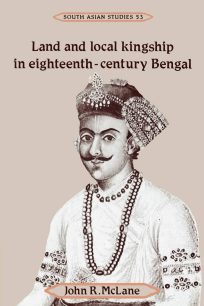
Land and Local Kingship in Eighteenth-Century Bengal

Format: 372 pages, Revised ed.
Language: English
Published Date: July 25, 2002
ISBN: 978-0521051200
User's Rating:
Not rated yet
|
Editor's Rating:
4.35

John R. McLane's Land and Local Kingship in Eighteenth-Century Bengal examines the relationship between landownership, political authority, and rural society during a period of major transformation in eastern India. As Mughal authority weakened, Bengal's regional political order developed its own centers of power. Large zamindars occupied an important position within this system, collecting revenue while exercising substantial influence over the communities and territories under their control.

McLane argues that the zamindars' authority cannot be understood solely through their formal responsibilities as revenue collectors. They also performed functions associated with kingship: dispensing gifts and patronage, maintaining religious and social traditions, enforcing obligations, and mediating between cultivators and the state. Their authority combined economic extraction with political, ritual, and social responsibilities.

The book is divided into two broad parts. The first examines Bengal's wider political and social structures, including revenue collection, coercion, and gift-giving. The second develops these arguments through a detailed history of the Burdwan Raj. This combination allows McLane to connect general patterns of political change with the history of a particular landed dynasty.

Political Change and the Decline of Mughal Authority

The book begins by examining the transformation of Bengal's political order as Mughal authority weakened and regional power became increasingly localized. The growth of large zamindaris was part of this wider process. Landed chiefs acquired influence not merely because they controlled revenue collection, but also because they developed enduring relationships with local gentry, cultivators, and other dependents.

McLane challenges older interpretations that described eighteenth-century India primarily in terms of political chaos, corruption, and administrative decay. He instead examines the commercial, fiscal, and social processes through which new political arrangements emerged. This approach places Bengal's history within broader debates about the continuity between late Mughal society and the subsequent expansion of British power.

Zamindars as Revenue Collectors and Local Rulers

One of the book's central arguments is that Bengal's major zamindars occupied a dual position. To the central government, they were responsible for collecting and transmitting revenue. Within their territories, however, they could function as local rulers who exercised authority over villages, managed relationships with subordinate landholders, and influenced social and religious life.

This distinction helps explain why zamindari power cannot be reduced to a simple landlord-tenant relationship. Large zamindars maintained administrative personnel, enforced obligations, provided patronage, and sometimes acted as intermediaries when local difficulties threatened the payment of revenue.

Revenue Extraction and Coercion

McLane examines how revenue was collected from cultivators through layered systems of intermediaries. Zamindars and their officials had to secure the resources required by the state, but they also depended on the continuing productivity and cooperation of rural society.

The book does not romanticize this relationship. Coercion was part of the system: local authorities could use physical force and administrative pressure to secure payments and enforce obligations. The study therefore explores the tension between the zamindar's role as a provider of protection or patronage and his role as an agent of extraction.

Gifts, Patronage, and the Meaning of Kingship

A particularly distinctive theme is the political and cultural importance of gift-giving. McLane investigates how rulers used gifts, ceremonies, and patronage to establish loyalty, recognize status, and maintain relationships with their dependents.

These practices were not simply expressions of personal generosity. They formed part of a political culture in which authority could be demonstrated through the distribution of resources, the fulfillment of obligations, and the maintenance of ritual and social order. McLane argues that the commercialization of economic life increasingly complicated these relationships, as customary gifts and entitlements could become more transactional and calculated.

The Burdwan Raj: A Case Study in Local Power

The second part of the book examines the Burdwan Raj in detail. McLane uses the history of this major zamindari to investigate how local authority operated during periods of political instability, family disputes, military conflict, and changes in revenue administration.

The Burdwan case illustrates the complex relationship between the landed elite and successive political authorities. The family could exercise considerable influence within its territories while remaining dependent on larger states for the recognition and protection of its position. Internal succession disputes and administrative conflicts also demonstrate that a powerful zamindari was not a unified or unchanging institution.

The Maratha Invasions and Regional Crisis

McLane discusses the Maratha invasions of Bengal between 1742 and 1751 and their effects on western Bengal. The invasions placed pressure on local communities and contributed to economic disruption and the weakening of the Murshidabad regime's legitimacy.

The Burdwan Raj provides an important example of the distinction between damage to a region's population and the long-term survival of a major estate. McLane's account shows why political and economic crises must be examined at multiple levels: a landed dynasty might retain much of its territorial position even while the people living within the affected region endured serious hardship.

British Rule and the Transformation of Zamindari Authority

The expansion of British power changed the conditions under which Bengal's zamindars operated. McLane examines how the East India Company's growing emphasis on monetized revenue, accounting, and predictable fiscal extraction placed pressure on older relationships of local authority.

The Decennial Settlement of 1790 and the Permanent Settlement of 1793 were important turning points. The fixed revenue demand and stricter recovery procedures changed the risks associated with landholding. The sale of estates to recover arrears could weaken established families and encourage investment in revenue-collecting rights rather than other forms of economic enterprise.

Continuity, Change, and the Limits of Colonial Narratives

The book's wider contribution is its insistence that British conquest did not create Bengal's political and economic institutions from nothing. Many structures of revenue collection, landed authority, and local power had deep roots in the preceding period, even as colonial rule altered their operation.

McLane's analysis also complicates the idea that local kingship was simply benevolent. Zamindars could provide patronage and mediate between state and society while simultaneously extracting resources and enforcing unequal obligations. The historical importance of these institutions lies in understanding both sides of that relationship.

Overall, the book offers a detailed account of how landholding, political authority, social obligations, and revenue extraction interacted in eighteenth-century Bengal. Its combination of regional analysis and the Burdwan case study makes it a valuable resource for understanding the transition from Mughal-era political arrangements to British colonial rule.

Publisher's reference: Cambridge University Press — Land and Local Kingship in Eighteenth-Century Bengal.


Pros
  • Challenges simplistic historical narratives: McLane moves beyond accounts that portray eighteenth-century Bengal merely as a period of decline, showing how local institutions and regional power developed during the weakening of Mughal authority.
  • Explains the multiple roles of zamindars: The book connects revenue collection with local governance, patronage, ritual obligations, and coercion, offering a more complete account of landed authority.
  • Combines regional analysis with a detailed case study: The Burdwan Raj provides a concrete example through which readers can examine broader arguments about land, power, family politics, and colonial administration.
  • Strong treatment of political culture: Its analysis of gift-giving and patronage explains how relationships between rulers and dependents were shaped by social expectations as well as economic interests.
  • Connects Mughal and colonial history: The book shows how existing institutions were transformed under British rule instead of assuming that colonial governance began from a historical blank slate.
  • Examines coercion alongside patronage: McLane recognizes that local rulers could provide protection and social benefits while also extracting revenue and enforcing unequal obligations.
  • Substantial research value: The book includes a map, extensive notes, a bibliography spanning pages 323–335, and an index, making it useful for further academic investigation.
  • Longstanding scholarly engagement: Its publication was followed by formal reviews in several academic journals, including the Bulletin of SOAS, the Journal of the Royal Asiatic Society, and the Indian Economic & Social History Review.
Cons
  • Strong emphasis on landed elites: The book focuses on zamindars, political authority, and the Burdwan Raj. Cultivators and other rural groups appear mainly in relation to the systems of extraction and authority affecting them, rather than as the central subjects of a comprehensive social history.
  • Geographical concentration: The detailed case study of Burdwan illuminates wider patterns but cannot represent every region of Bengal or every form of local authority.
  • Complex terminology: Concepts such as zamindari, mansabdari, rent extraction, patronage, and kingship may challenge readers unfamiliar with South Asian administrative and social history.
  • Potentially repetitive argument: One published review in the Agricultural History Review criticized the book for revisiting its central argument about the relationship between colonial rulers and local Hindu notables too frequently.
  • Limited attention to agricultural production: The book’s primary concern is the politics and culture of landholding, not a detailed reconstruction of cropping patterns, agricultural productivity, or the marketing of agricultural surpluses.
  • Interpretive framework invites debate: The emphasis on normative Hindu kingship and gift-based political relationships is illuminating, but readers should also consider how these practices varied among communities and how material interests could conflict with customary ideals.
  • Publication date: First published in 1993, the study should be read alongside later research on Bengal’s agrarian economy, social history, and colonial transition.
  • Not a general introduction: Its detailed historical analysis is best suited to serious readers and researchers rather than those looking for a brief, accessible overview of eighteenth-century Bengal.

Critical Reception

Land and Local Kingship in Eighteenth-Century Bengal received substantial attention in specialist academic journals following its publication in 1993. The surviving bibliographic records identify at least four independent review publications, including reviews in journals specializing in South Asian history, Asian studies, and agricultural history. This provides a stronger documented basis for assessing the book’s academic reception than publisher descriptions or reader comments alone.

1. Radhika Singha — The Indian Economic & Social History Review (1995)

Historian Radhika Singha reviewed the book in The Indian Economic & Social History Review, volume 32, issue 1, March 1995, pages 119–121. Singha was affiliated with the Indian Institute of Advanced Study in Shimla. The journal’s record confirms that this was a formal book review devoted to McLane’s study.

The review’s publication in a specialist journal concerned with economic and social history is significant because the book addresses the relationship between agrarian revenue systems, landed property, political culture, and social hierarchy. However, the accessible bibliographic record does not provide the full text of Singha’s assessment, so specific praise or criticism should not be attributed to her without consulting the complete review.

Review record: Radhika Singha, “Book Reviews: John R. McLane, Land and Local Kingship in Eighteenth-Century Bengal,” The Indian Economic & Social History Review, 32(1), 119–121 (1995).

2. Burton Stein — Bulletin of the School of Oriental and African Studies (1995)

Historian Burton Stein reviewed the book in the Bulletin of the School of Oriental and African Studies, volume 58, issue 1, January 1995, pages 179–180. The review was published online by Cambridge University Press on 5 February 2009.

The publication of this review in a major journal devoted to Asian and African studies places McLane’s work within a wider scholarly discussion of South Asian history. Its bibliographic details are firmly established, although the accessible abstract does not provide enough information to reconstruct Stein’s specific evaluation or identify particular objections.

Review record: Burton Stein, review in the Bulletin of the School of Oriental and African Studies, 58(1), 179–180 (1995).

3. Peter Robb — Journal of the Royal Asiatic Society (1995)

Peter Robb published another formal review in the Journal of the Royal Asiatic Society, volume 5, issue 3, November 1995, pages 432–435. The review is recorded by Cambridge University Press and identifies the book as part of the Cambridge South Asian Studies series.

The four-page review is an additional independent scholarly assessment, particularly relevant to readers interested in the history of South Asia and the interpretation of precolonial and colonial political institutions. As with the other journal records, the accessible abstract does not include a substantive account of Robb’s conclusions, so it would be inappropriate to invent a verdict or imply a particular level of praise.

Review record: Peter Robb, review in the Journal of the Royal Asiatic Society, 5(3), 432–435 (1995).

4. Agricultural History Review — Detailed Analytical Criticism

A review published in the Agricultural History Review provides a more detailed discussion of the book’s strengths and limitations. The available text describes McLane’s two-part structure: the first part examines the wider relationship between landholding, revenue collection, and local kingship, while the second develops the argument through a detailed history of the Burdwan Raj.

The reviewer identifies several important strengths:

  • Detailed explanation of revenue extraction: The book explains how revenue and surplus were collected from Bengal’s cultivators through a hierarchy of zamindars, mansabdars, jotdars, Company officials, and other intermediaries.
  • Attention to political justification: McLane examines how local rulers justified authority through ideas of kingship, patronage, and obligations toward dependents, alongside coercion and revenue extraction.
  • Strong historical research and writing: The review describes the book as well researched and well written, and characterizes its broad arguments as important and persuasive.

The review also identifies a substantive limitation. It argues that the second part, centered on the Burdwan Raj, often reinforces arguments already established in the first part, sometimes repeating the central point about the changing mutual dependence of colonial rulers and local Hindu notables. The reviewer further observes that the book could have devoted more attention to agricultural conditions, including cropping patterns, productivity, and the marketing of agricultural surpluses.

This criticism is particularly useful for prospective readers because it identifies a genuine difference between the book’s subject and a comprehensive agricultural history. McLane’s main objective is to explain the politics and culture of landholding, rather than to reconstruct agricultural production in detail. The reviewer acknowledges this distinction, noting that the criticism partly concerns the kind of book McLane chose not to write.

Review source: Agricultural History Review, book-review section (PDF).

Overall Scholarly Assessment

The available reception evidence points to a well-researched and influential contribution to the history of eighteenth-century Bengal. The book’s value lies in its explanation of the relationship between economic extraction and political culture: zamindars could exercise coercive power while also maintaining patronage networks and rituals that helped legitimize their authority.

The most substantial criticism in the accessible review material concerns the book’s repeated argument and its limited treatment of agricultural production. These are meaningful limitations, but they do not undermine its central purpose as a study of landholding, local kingship, and the transition from Mughal to British rule.

Evidence qualification: Four independent scholarly review records have been identified, but the complete texts of all four reviews were not available for detailed examination. The specific criticism above is attributed only to the accessible Agricultural History Review text. The journal records do not provide numerical ratings, and no scholarly consensus should be inferred merely from the number of reviews.

HaqqFinder Editorial Rating

This assessment evaluates the book’s historical depth, analytical contribution, accessibility, relevance, and usefulness as a research resource. Scores are HaqqFinder’s editorial judgments, not reader-rating averages.

Evaluation Criteria Weight Score Assessment
Content Quality & Depth 20% 4.6/5 Substantial historical analysis of landholding, revenue extraction, local authority, and political culture.
Writing Style & Clarity 15% 4.1/5 Well-structured academic history, though specialized terminology and extensive detail require concentration.
Relevance & Target Audience Fit 15% 4.7/5 Highly relevant to the history of Bengal, zamindari institutions, Mughal-era governance, and colonial transition.
Originality & Creativity 15% 4.5/5 Distinctively connects material extraction with ritual, patronage, and local kingship.
Cultural & Ethical Sensitivity 10% 4.0/5 Examines unequal power and coercion, although its central focus remains landed elites and normative political culture.
Practical Value & Applicability 10% 4.2/5 Useful for historical research and teaching about agrarian institutions and the relationship between state and society.
Presentation & Design 10% 4.2/5 Includes a map, extensive scholarly references, bibliography, and index; edition-specific layout may vary.
Value for Price 5% 4.0/5 Strong potential value for researchers, although current prices and condition vary by edition.
Weighted Overall Score 100% 4.35/5 Very Good — a substantial and influential study of land, political culture, and local authority in Bengal.

Rating note: Our editorial ratings are based on HaqqFinder’s established evaluation criteria and weighted scoring system. For details, see our Rating & Evaluation Methodology.

Assessment limitation: The rating is provisional because the complete text was not independently inspected page by page for this review. The assessment draws on the publisher’s description, available chapter material, bibliographic records, and published scholarly reviews. The presentation and price scores are less certain than the evaluation of the book’s documented scope and scholarly contribution.

Overall Verdict:

John R. McLane’s Land and Local Kingship in Eighteenth-Century Bengal is a substantial study of the institutions that connected land, revenue, and political authority in eighteenth-century Bengal. Its central achievement is to demonstrate that zamindars were not simply landlords or revenue collectors: they also exercised forms of local kingship through patronage, ritual, administration, and coercion.

The detailed history of the Burdwan Raj gives the book a strong empirical foundation, while its broader discussion challenges simplistic accounts of the transition from Mughal rule to British colonialism. Its analysis of gift-giving and patronage is especially valuable for understanding how political authority operated through both material extraction and social obligation.

The book is not without limitations. Its emphasis on landed elites leaves less room for the independent experiences of cultivators, and its treatment of agricultural production is less extensive than that of a dedicated agrarian-economic study. The repeated development of its central argument may also frustrate some readers. Nevertheless, these limitations should be weighed against the book’s clearly defined purpose and its contribution to the historical study of Bengal.

HaqqFinder verdict: Recommended for researchers, university students, and serious readers interested in Bengal’s agrarian history, zamindari institutions, Mughal-era political culture, and the emergence of British colonial rule. It is particularly valuable for readers who want to understand how economic power, social obligations, and local political authority interacted before and during the colonial transition.

Citation: Robb, Peter. (2009). Land and local kingship in eighteenth-century Bengal. By John R. McLane. (Cambridge South Asian Studies, 53.) pp. xxvi, 342, map. Cambridge etc., Cambridge University Press, 1993. £40.00.. Journal of the Royal Asiatic Society. 5. 432-435. 10.1017/S1356186300006842. Available on https://haqqfinder.com/recommendations/land-and-local-kingship-in-eighteenth-century-bengal/
🛒 WHERE TO BUY

*When you purchase through this link, HaqqFinder may earn a small commission at no extra cost to you. Learn more

Share On:
Facebook
X
LinkedIn
Pinterest
Reddit
WhatsApp
Tumblr
Telegram
Threads

Ratings & Reviews

0
0 out of 5 stars (based on 0 reviews)
Excellent
Very good
Average
Poor
Terrible

There are no reviews yet. Be the first one to write one.

Where We Reference This Book
Explore HaqqFinder articles that cite, discuss, or mention this publication.
Related Recommendations:

Login

Fill out the form below, and we will be in touch shortly.