Discover the brutal history of British colonial atrocities against Indian Muslims, from the 1857 rebellion to the Mopla uprising and beyond.
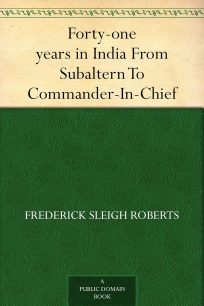
Forty-One Years in India: From Subaltern to Commander-in-Chief is Frederick Sleigh Roberts's account of his long military career in British India. First published in 1897, the memoir combines personal recollections with descriptions of military campaigns, colonial administration, prominent officers, and political developments affecting British interests in South Asia.
Beginning with Roberts's arrival in India as a young officer, the narrative follows his professional development through postings, expeditions, and major military crises. It presents the army from the viewpoint of a participant who rose through its ranks and eventually attained the highest levels of command.
The opening chapters describe Roberts's arrival in Calcutta, his early experiences in military service, and his postings in northern India, including Peshawar. His recollections offer details about the routines, relationships, challenges, and expectations that shaped the life of a British officer in the nineteenth-century Indian Army.
A major portion of the memoir addresses the uprising of 1857 and the British military response. Roberts recounts the spread of rebellion, the difficulties faced by British forces, and the actions of officers and units during the conflict. These passages are historically valuable as a participant's account, but they should be read critically: the narrative reflects a British military perspective and does not substitute for Indian accounts of the uprising, its causes, or its consequences.
Roberts discusses military operations along the north-western frontier and British policy toward Afghanistan. His account explores the relationship between military planning, transport, intelligence, leadership, and political decision-making. These episodes also reveal how strategic anxieties and imperial ambitions shaped British involvement in the region.
The memoir gives considerable attention to the Second Anglo-Afghan War of 1878–1880, including the campaign associated with Roberts's march from Kabul to Kandahar. His narrative provides a senior commander's perspective on the planning and conduct of the campaign, the challenges of operating across difficult terrain, and the relationship between battlefield events and British policy.
Across the narrative, Roberts emphasizes leadership, preparation, discipline, mobility, and the practical demands of commanding troops. His recollections can help readers understand how senior British officers interpreted military success and failure. At the same time, his focus on command decisions means that the perspectives of ordinary Indian soldiers and local populations are not always given equal attention.
The book is more than a record of military operations: it also reveals the assumptions through which a senior British officer understood India and the empire. Its descriptions of Indian people, political resistance, and frontier communities must be situated within the colonial attitudes of its time. The memoir is therefore valuable both for the events it recounts and for what it reveals about the outlook of the imperial establishment.
Overall, Forty-One Years in India is an extensive first-person account of nineteenth-century British military activity in South Asia. It is most useful when read as a historically situated memoir and compared with modern scholarship and sources representing Indian and Afghan perspectives.
Read the public-domain text: Project Gutenberg — Forty-One Years in India.
Forty-One Years in India is primarily important as a historical memoir and a source for studying British military experiences and imperial thinking in nineteenth-century South Asia. Its continued availability in digitized historical collections makes it accessible to researchers and readers interested in the period.
The book’s bibliographic history is well documented. The original editions appeared in the late nineteenth century, and subsequent editions and digitized copies have preserved the text for later readers. Open Library’s edition record and the Project Gutenberg text provide useful access points for identifying and consulting the work.
Limitations of the available reception evidence: The sources consulted for this review do not establish a sufficiently substantial body of modern, independent scholarly book reviews to support a detailed account of its critical reception. Its historical significance as a primary source should therefore be distinguished from a claim that modern historians universally endorse Roberts’s interpretations.
For balanced research, readers should compare Roberts’s recollections with scholarship on the Indian Rebellion of 1857, the British Indian Army, and the Anglo-Afghan conflicts, as well as sources representing Indian and Afghan perspectives. This comparison is especially important where the memoir discusses political resistance, colonial policy, and military conduct.
This assessment evaluates the memoir as a historical resource, taking account of its detail, research usefulness, accessibility, and colonial perspective. The scores are HaqqFinder’s editorial judgments, not a reader-rating average.
| Evaluation Criteria | Weight | Score | Assessment |
|---|---|---|---|
| Content Quality & Depth | 20% | 4.2/5 | Extensive firsthand detail on military campaigns, command, and imperial policy, though the account is selective and personal. |
| Writing Style & Clarity | 15% | 4.0/5 | A generally accessible narrative for readers comfortable with historical prose, military terminology, and lengthy descriptions. |
| Relevance & Target Audience Fit | 15% | 4.5/5 | Highly relevant to readers studying British India, military history, the 1857 uprising, and Anglo-Afghan conflicts. |
| Originality & Creativity | 15% | 4.0/5 | A distinctive career-spanning eyewitness memoir, although its interpretations reflect the author’s institutional position and era. |
| Cultural & Ethical Sensitivity | 10% | 3.0/5 | Important as evidence of imperial attitudes, but its colonial framing requires critical reading and comparison with other perspectives. |
| Practical Value & Applicability | 10% | 4.0/5 | Useful for historical research and teaching when corroborated with independent sources and modern scholarship. |
| Presentation & Design | 10% | 4.0/5 | The original editions include illustrations and reference aids; the reading experience depends on the edition or digital transcription. |
| Value for Price | 5% | 4.5/5 | The public-domain text is freely accessible, although printed editions vary in price, quality, and completeness. |
| Weighted Overall Score | 100% | 4.04/5 | Very Good — a valuable primary source that requires critical historical context. |
Rating note: Our editorial ratings are based on HaqqFinder’s established evaluation criteria and weighted scoring system. For details, see our Rating & Evaluation Methodology.
Assessment limitation: This is a provisional editorial rating based on the bibliographic record and accessible text. The presentation score may vary by edition, and the price score reflects the availability of a free public-domain text rather than the price of a particular printed copy.
Frederick Sleigh Roberts’s Forty-One Years in India: From Subaltern to Commander-in-Chief is a substantial historical memoir that documents a senior British officer’s military career across some of the most consequential episodes of nineteenth-century imperial history in South Asia.
Its strengths lie in the wealth of personal recollection, campaign detail, and insight into the thinking of the British military establishment. It is particularly useful for studying the British response to the 1857 uprising, frontier warfare, the Second Anglo-Afghan War, and the professional culture of imperial command.
Its principal limitation is also central to its value: Roberts writes from within the imperial system he helped maintain. His account provides evidence about how British officers understood events, but it cannot independently establish the experiences or motivations of all the people affected by British rule. Readers should distinguish the author’s observations from his interpretations and corroborate important claims with other sources.
HaqqFinder verdict: Recommended for readers of military and colonial history, particularly students and researchers who want to work with primary sources. It is best read critically and alongside modern historical scholarship rather than as a standalone, comprehensive history of nineteenth-century India.
*When you purchase through this link, HaqqFinder may earn a small commission at no extra cost to you. Learn more
There are no reviews yet. Be the first one to write one.

Discover the brutal history of British colonial atrocities against Indian Muslims, from the 1857 rebellion to the Mopla uprising and beyond.