Mastodon
haqqfinder

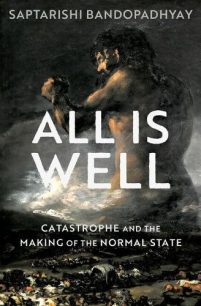
All Is Well: Catastrophe and the Making of the Normal State

Format: 320 pages
Language: English
Published Date: 31 May 2022
ISBN: 978-0197579213
User's Rating:
Not rated yet
|
Editor's Rating:
4.27

All Is Well: Catastrophe and the Making of the Normal State challenges the conventional understanding of disasters as exceptional events that disrupt otherwise stable societies. Saptarishi Bandopadhyay argues that disasters are also shaped by the political, legal, administrative, and intellectual systems through which authorities define danger and organize responses to it.

The book traces the historical development of disaster management and examines how governments and experts have sought to make uncertainty manageable. In doing so, they have helped establish particular ideas about normalcy, public responsibility, state power, and the relationship between human societies and the natural world.

Drawing on legal history, environmental history, political theory, sociology, and critical approaches to international law, Bandopadhyay connects specific catastrophes to broader transformations in state formation. The book's central argument is that disaster management does not merely respond to crises; it can also help reproduce and legitimize the authority of the institutions that claim to manage them.

Disaster and the Making of the Modern State

One of the book's central themes is the relationship between catastrophe and state formation. Governments frequently justify administrative intervention by promising protection against uncertainty and social breakdown. Bandopadhyay examines how these promises contribute to the construction of state authority and shape expectations about what effective governance should look like.

This approach shifts attention from the immediate effects of disasters to the institutions, knowledge systems, and political arrangements that develop around them.

The Marseille Plague of 1720

The outbreak of plague in Marseille provides a historical case study of the relationship between disease, administration, and political authority. The book investigates how authorities respond to epidemic threats and how such responses can reorganize public administration and reinforce particular forms of governance.

Rather than viewing disaster management as a purely technical exercise, this analysis considers how the definition of a crisis and the measures adopted to contain it can influence the relationship between authorities and society.

The Lisbon Earthquake of 1755

The Lisbon earthquake offers another perspective on how catastrophe reshapes political and intellectual understandings of the world. Bandopadhyay examines the ways in which disasters become occasions for reconsidering responsibility, order, and the capacity of authorities to manage uncertainty.

The case contributes to the book's broader argument that disaster management is connected to changing ideas about risk, human agency, and the responsibilities attributed to governing institutions.

The Bengal Famine of 1770

The Bengal famine is particularly important to the book's examination of colonial power, corruption, and legal authority. By placing famine within a wider history of governance, Bandopadhyay investigates how catastrophic suffering intersects with political and economic arrangements rather than treating it simply as an unfortunate natural occurrence.

This discussion is especially relevant to readers interested in colonial South Asian history. It encourages attention to the ways administrative decisions, economic structures, and legal systems shape vulnerability during periods of widespread suffering.

Risk, Normalcy, and Administrative Control

Another major theme is the development of risk as a framework for governing society. Authorities do not merely respond to dangers that already exist; they also classify threats, establish standards of acceptable risk, and construct models of normal social life against which emergencies are measured.

Bandopadhyay explores how these practices can make exceptional interventions appear necessary or routine. The resulting systems of governance may continue to influence public administration long after the original crisis has passed.

Colonialism, Development, and Global Disaster Management

The book extends its historical analysis to the modern period, examining how ideas about development, security, and disaster prevention have shaped the governance of societies in the Global South. Bandopadhyay argues that models of progress and protection have often reflected the assumptions and anxieties of powerful Western states and international institutions.

This perspective raises questions about who defines a catastrophe, whose interests guide recovery, and whether development policies genuinely strengthen local self-determination or reproduce unequal relationships of authority.

Climate Change and Contemporary Crises

In its concluding discussion, the book connects the historical evolution of disaster management with contemporary challenges, including climate change and the COVID-19 pandemic. It suggests that present-day approaches to resilience, security, and catastrophe prevention cannot be fully understood without examining the historical development of the institutions and assumptions behind them.

Overall, the book offers a critical history of disaster management as a political and legal process. Its main contribution is to show how responses to catastrophe can shape the very idea of a normal, governable society.

Publisher's reference: Oxford University Press — All Is Well: Catastrophe and the Making of the Normal State.


Pros
  • Original central argument: The book moves beyond conventional accounts of disasters by examining how catastrophe helps shape state authority, administrative systems, and definitions of normalcy.
  • Interdisciplinary research: It brings legal history, environmental history, political theory, sociology, and disaster studies into a connected analysis.
  • Strong historical case studies: The Marseille plague, Lisbon earthquake, and Bengal famine provide concrete historical settings in which to explore the relationship between disaster and governance.
  • Important colonial perspective: Its discussion of the Bengal famine connects catastrophic suffering with colonial administration, corruption, and legal authority.
  • Contemporary relevance: The book links its historical argument to modern disaster management, development policy, climate change, and pandemic governance.
  • Useful theoretical framework: Its analysis of risk, normalcy, and state formation can help advanced students and researchers question assumptions that disaster management is politically neutral.
  • Established academic publisher: Oxford University Press provides a substantial scholarly publication with chapter notes, documentary sources, and an index, supporting further research.
Cons
  • Conceptually demanding: The theoretical framework and interdisciplinary vocabulary may be difficult for readers without prior exposure to political theory, legal history, or critical social science.
  • Provocative central thesis: The argument that catastrophes are partly constructed through political and administrative systems is intellectually stimulating, but readers may question how far this framework can be applied across very different kinds of disaster.
  • Limited number of central historical cases: The book develops its argument through selected examples. Readers seeking a comprehensive global history of disasters will need additional works.
  • Potential for theoretical abstraction: Its focus on institutions, knowledge, and state power may be less satisfying for readers primarily interested in individual experiences, relief efforts, or practical emergency-management techniques.
  • Critical interpretation requires comparison: Readers should compare its arguments with scholarship emphasizing physical hazards, scientific advances, humanitarian intervention, and the practical benefits of disaster preparedness.
  • Not a practical disaster-management manual: The book is principally a historical and theoretical study; it is not designed as a step-by-step guide for emergency responders, policymakers, or community organizations.
  • Academic pricing: The original hardcover edition may be expensive for casual readers, although the book may be available through libraries or in other formats.

Critical Reception

All Is Well has received scholarly attention in the field of international law. A book review by Lys Kulamadayil appeared in the Asian Journal of International Law, volume 12, issue 2, in July 2022, pages 405–407. The journal record confirms that it is a formal review of Bandopadhyay’s book, although the accessible abstract does not provide enough detail to attribute specific praise or criticism to the reviewer.

Verified review record: Lys Kulamadayil, review in the Asian Journal of International Law.

The book’s interdisciplinary scope and its challenge to conventional understandings of disaster management make it relevant to debates in legal history, political theory, and environmental governance. Its publisher’s description identifies the central argument and historical case studies, while the chapter outlines show how the analysis extends from eighteenth-century disasters to modern development policies and climate change. Oxford Academic’s book page provides the primary bibliographic and chapter information.

Critical assessment: The available evidence establishes that the book has received formal academic review, but it is insufficient to claim a broad consensus among scholars or to summarize the reviewer’s specific conclusions confidently. Readers should assess Bandopadhyay’s arguments alongside other research on disaster governance, colonial political economy, and the practical effectiveness of emergency institutions.

HaqqFinder Editorial Rating

This assessment evaluates the book as a scholarly work on disaster history, governance, and state formation. Scores reflect editorial judgment rather than a reader-rating average.

Evaluation Criteria Weight Score Assessment
Content Quality & Depth 20% 4.5/5 A substantial interdisciplinary argument supported by historical case studies and documentary research.
Writing Style & Clarity 15% 3.7/5 Intellectually rigorous but conceptually demanding for readers unfamiliar with critical legal and political theory.
Relevance & Target Audience Fit 15% 4.5/5 Highly relevant to researchers in disaster studies, political theory, legal history, colonial history, and environmental politics.
Originality & Creativity 15% 4.7/5 Offers a distinctive interpretation of catastrophe as a force in the historical formation and renewal of state authority.
Cultural & Ethical Sensitivity 10% 4.4/5 Attends to colonial power, unequal vulnerability, and the political consequences of disaster governance.
Practical Value & Applicability 10% 4.0/5 Provides a useful analytical framework for evaluating policies, though it is not a practical emergency-management guide.
Presentation & Design 10% 4.2/5 The academic structure, chapter organization, notes, and index support scholarly consultation.
Value for Price 5% 3.5/5 Potentially strong value for specialist readers, but the price of the edition being purchased should be considered.
Weighted Overall Score 100% 4.27/5 Very Good — a thought-provoking scholarly analysis of catastrophe and modern governance.

Rating note: Our editorial ratings are based on HaqqFinder’s established evaluation criteria and weighted scoring system. For details, see our Rating & Evaluation Methodology.

Assessment limitation: This is a provisional editorial rating based on the publisher’s bibliographic information, abstract, chapter descriptions, and available scholarly reception. The complete text and a specific physical edition were not independently inspected for this review; presentation and price scores are therefore less certain.

Overall Verdict:

Saptarishi Bandopadhyay’s All Is Well: Catastrophe and the Making of the Normal State is an ambitious and intellectually stimulating examination of how disasters shape political authority. By connecting the Marseille plague, the Lisbon earthquake, and the Bengal famine with the historical development of risk management and modern governance, it challenges readers to reconsider the assumption that disaster response is simply a technical effort to restore normal life.

The book is especially valuable for its treatment of the Bengal famine and its broader examination of colonial power, development, and unequal vulnerability. Its central insight is that the institutions created to manage catastrophe can also shape the political and social conditions in which future crises are understood and addressed.

However, this is a specialized academic work rather than an accessible introduction to disaster history. Its theoretical approach requires careful engagement, and readers should consider how its interpretation applies across different historical circumstances. Those looking for practical emergency-response instructions or a comprehensive narrative of individual disasters may need complementary books.

HaqqFinder verdict: Recommended for advanced students, researchers, and serious readers interested in political theory, disaster studies, colonial history, and the development of modern states. It offers a compelling framework for examining the politics of catastrophe, provided its arguments are read critically and alongside other perspectives.

Citation: Bandopadhyay, Saptarishi, All Is Well: Catastrophe and the Making of the Normal State (New York, 2022; online edn, Oxford Academic, 17 Feb. 2022), https://doi.org/10.1093/oso/9780197579190.001.0001, accessed 14 Oct. 2026. Available at https://haqqfinder.com/recommendations/all-is-well-catastrophe-and-the-making-of-the-normal-state/
🛒 WHERE TO BUY

*When you purchase through this link, HaqqFinder may earn a small commission at no extra cost to you. Learn more

Share On:
Facebook
X
LinkedIn
Pinterest
Reddit
WhatsApp
Tumblr
Telegram
Threads

Ratings & Reviews

0
0 out of 5 stars (based on 0 reviews)
Excellent
Very good
Average
Poor
Terrible

There are no reviews yet. Be the first one to write one.

Where We Reference This Book
Explore HaqqFinder articles that cite, discuss, or mention this publication.
Related Recommendations:

Login

Fill out the form below, and we will be in touch shortly.