Mastodon
haqqfinder

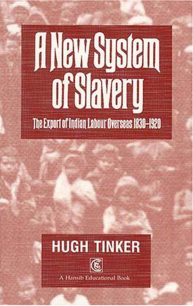
A new system of slavery; the export of Indian labour overseas, 1830-1920

Author: Hugh Tinker
Format: 450 pages, First Edition
Language: English
Published Date: 12 Dec. 2011 ( First Published on1 Feb. 1974)
ISBN: 978-0192184108, 978-1870518185
User's Rating:
Not rated yet
|
Editor's Rating:
4.31

Summary & Key Themes

Hugh Tinker's A New System of Slavery: The Export of Indian Labour Overseas, 1830–1920 examines the large-scale migration of Indian workers to overseas colonies after the legal abolition of slavery. First published in 1974, the book traces how colonial plantation economies recruited Indian labour to produce commodities such as sugar, coffee, tea, and rubber across Mauritius, the Caribbean, Africa, Fiji, Malaya, and other destinations.

Tinker's central argument is that the indenture system, although formally distinct from chattel slavery, reproduced several oppressive features associated with slavery. Workers were recruited under contracts, transported over long distances, and placed in plantation environments where their freedom of movement and ability to negotiate working conditions could be severely restricted. The book examines how these arrangements supplied labour to colonial economies while exposing Indian migrants to hardship and exploitation.

Major Themes

1. The Legacy of Slavery After Abolition

The book begins with the historical background of slavery and the labour demands that persisted after its formal abolition. Tinker explores how plantation owners and colonial authorities sought alternative labour arrangements that would preserve plantation production without restoring the former legal status of enslaved people.

2. Recruitment and Export of Indian Labour

Tinker examines the processes through which workers were recruited in India and transported overseas. Recruitment networks, emigration agents, official supervision, and the movement of labour across the British imperial system form an important part of the story. These processes raise questions about how informed and voluntary workers' decisions could be under conditions of poverty, unequal information, and economic pressure.

3. The Voyage and the Experience of Migration

The journey overseas was itself a major part of the indentured labour experience. Tinker discusses the hardships associated with long sea voyages and the conditions under which migrants were transported. This perspective reminds readers that colonial labour migration involved more than signing a contract and arriving at a destination: the journey could carry serious human costs.

4. Indenture and Plantation Life

The book examines the period of contractual labour and the restrictions that could accompany it. Workers were expected to serve for specified terms, while plantation discipline and colonial regulations shaped their practical choices. Tinker draws attention to the similarities between indenture and slavery in the control of labour, even though the legal structures were different.

5. Economic Pressure and Labour Exploitation

Plantation economies depended on a steady supply of workers willing or compelled by circumstances to accept difficult conditions. Tinker investigates the economic incentives and institutional arrangements that sustained indentured migration, along with the hardships workers experienced under plantation labour systems.

6. Resistance, Reform, and the End of Indenture

The book also explores the growing criticism of indenture and the eventual abandonment of the system. Activists, Indian nationalist leaders, public campaigns, and government inquiries helped bring attention to abuses and increased pressure for reform. The history of indenture is therefore also a history of resistance to colonial labour practices.

7. The Formation of Overseas Indian Communities

Indian migration under indenture helped shape the demographic and social histories of numerous colonial societies. The book provides historical context for understanding the origins of Indian communities in parts of the Caribbean, Africa, the Indian Ocean, and the Pacific, while foregrounding the unequal labour arrangements that contributed to their formation.

Overall, Tinker presents indenture as a major chapter in the history of colonialism, migration, and labour control. The book's distinctive contribution is its comparative account of Indian workers' export overseas and its examination of how a formally contractual system could reproduce serious forms of coercion.

Critical Analysis

A New System of Slavery is an influential work because it connects the history of overseas Indian migration to the wider transformation of colonial labour after abolition. Instead of treating indenture simply as a voluntary movement of workers seeking employment, Tinker asks how colonial institutions, plantation demand, recruitment practices, and contractual restrictions shaped the choices available to migrants.

The Significance of the Slavery Comparison

The book's most powerful and controversial feature is its comparison between indenture and slavery. Tinker argues that the formal abolition of slavery did not automatically eliminate exploitative labour relations. Plantation economies continued to require disciplined and relatively inexpensive labour, and indenture helped meet that demand through a different legal framework.

The comparison is persuasive when it draws attention to restrictions on workers, punitive labour regimes, recruitment abuses, and the imbalance of power between employers and migrants. It challenges the idea that a signed contract necessarily makes a labour relationship free or fair.

However, indenture and chattel slavery were not identical institutions. Indentured workers were legally contracted for specified periods, whereas enslaved people were treated as property under systems that denied their legal freedom in fundamentally different ways. The book's title is most useful as an interpretive argument about shared mechanisms of control and exploitation, not as a claim that all legal and social distinctions between the two systems disappear.

Colonial Labour Demand and Imperial Interests

Tinker effectively places Indian migration within the economic needs of plantation colonies. Following abolition, plantation owners continued to seek dependable labour supplies for export-oriented agriculture. Indian workers became part of a wider imperial system that connected recruitment in South Asia with production in distant colonies.

This perspective helps explain why indenture should not be understood solely as a series of individual migration decisions. Governments, employers, recruiters, and colonial institutions shaped the routes through which labour moved and the conditions under which workers were employed. The system linked economic production to imperial power.

The Importance of Recruitment and Transport

By examining recruitment and the voyage overseas, Tinker broadens the history beyond plantation work itself. The conditions under which workers were approached, informed about contracts, transported, and delivered to employers were integral to the operation of indenture.

This is an important analytical strength because exploitation could begin before workers reached a plantation. At the same time, experiences were not necessarily identical across recruitment regions, destinations, employers, or periods. The broad comparative narrative should therefore be supplemented with local studies when examining particular migrant communities.

Human Experience and Colonial Administration

The book brings attention to suffering, restrictions, and the gradual emergence of opposition to indenture. Its historical value lies partly in connecting individual workers' experiences to the administrative and political systems that sustained overseas labour migration.

Nevertheless, a large comparative history cannot give equal depth to every worker's experience. Gender, caste, class, regional background, family relationships, and differences between plantation colonies could influence migration and working conditions in ways that require more specialised investigation. Readers interested in women's experiences, family life, or the development of particular diaspora communities may wish to consult focused regional studies as well.

Resistance and the End of Indenture

Tinker's attention to the growing opposition to indenture is important because it prevents the history from becoming solely an account of victimisation. Activists and political leaders challenged the system, and the public debate surrounding indenture became part of a broader struggle over colonial responsibility and the rights of Indian subjects overseas.

The ending of indenture, however, should not be confused with the immediate end of plantation inequality or racial discrimination. The termination of a particular recruitment system did not automatically dismantle the economic structures and social hierarchies that had developed around it.

Overall Assessment

Tinker's book remains valuable for its broad geographical scope and its attempt to connect post-abolition labour migration with the persistence of coercive colonial practices. Its central argument encourages readers to look beyond legal terminology and examine how power operated in practice. The most balanced reading recognises both the serious similarities between indenture and slavery and the important legal and historical differences between them.


Pros
  • Broad geographical coverage: Examines Indian indentured labour across multiple plantation colonies, offering a comparative imperial perspective.
  • Important historical subject: Addresses a major but often overlooked chapter in the history of Indian migration and colonial labour.
  • Connects abolition to later labour systems: Shows why the formal end of slavery did not automatically eliminate coercion and exploitation in plantation economies.
  • Examines the full migration process: Covers recruitment, transportation, contractual labour, plantation life, and opposition to indenture.
  • Strong institutional perspective: Connects workers’ experiences to the interests of employers, colonial governments, and recruitment networks.
  • Useful for diaspora history: Helps explain the historical origins of Indian communities in the Caribbean, Africa, the Indian Ocean, and the Pacific.
  • Explores resistance and reform: Discusses the growing criticism of indenture and the political pressures that contributed to its eventual end.
  • Significant historiographical contribution: Its comparative framework helped bring overseas Indian labour migration into wider discussions of colonialism and slavery.
Cons
  • Contested terminology: The phrase “new system of slavery” is powerful but can obscure important legal and historical distinctions between indenture and chattel slavery if interpreted too literally.
  • Published in 1974: The book predates several decades of subsequent scholarship on migration, diaspora, gender, race, and labour history. Readers should supplement it with newer research.
  • Broad geographical scope: Covering many destinations provides comparative breadth but may limit the depth available for every colony and community.
  • Complex historical detail: The extensive discussion of colonial administration, recruitment, and labour regulations can be demanding for general readers.
  • Experiences varied by location: Working conditions and opportunities differed between colonies, plantations, and periods, so broad conclusions need to be tested against local evidence.
  • Limited space for every personal perspective: A wide-ranging historical survey cannot fully represent the diverse experiences of all workers, families, and descendants.
  • Requires complementary reading: Readers seeking detailed histories of specific communities, women’s experiences, or post-indentureship society will benefit from specialised studies.

Critical Reception

Hugh Tinker’s A New System of Slavery attracted attention in academic discussions of colonialism, labour migration, and the relationship between indenture and slavery. The book received reviews in established scholarly journals, including The Journal of Economic History and Pacific Affairs.

Published Scholarly Reviews

  • Michael Adas, The Journal of Economic History (1974): Adas published a review of Tinker’s book in volume 34, issue 4, pages 1062–1063. The journal record confirms the review’s publication, although its accessible abstract page does not provide enough text to characterise Adas’s detailed assessment. View the review record.
  • Usha Mahajani, Pacific Affairs (1977): Mahajani published a review titled “Slavery, Indian Labour and British Colonialism,” explicitly examining Tinker’s work within the wider context of Indian labour and British colonial rule. The article appears in volume 50, issue 2, pages 263–271. View the review record.

Historical Significance

The existence of these scholarly reviews establishes that the book became part of academic debate soon after publication. Its continuing usefulness lies in its comparative scope and its focus on the relationship between indentured migration and coercive plantation labour.

Critical engagement with the book should also consider developments in later scholarship. Subsequent historians have explored the differences between indenture and slavery, the diversity of migrant experiences, the role of gender and family, and the ways former indentured communities shaped their own societies. Tinker’s work is best read as an influential historical interpretation rather than the final word on every aspect of indenture.

Editorial note: This section identifies verifiable published reviews but does not attribute specific praise, criticism, or quotations to reviewers where the available records do not establish their precise wording.

Who Should Read This Book?

A New System of Slavery is particularly valuable for readers interested in how colonial labour systems operated after the formal abolition of slavery and how Indian migration reshaped societies across the world.

  • Students of British colonial history: For understanding the relationship between imperial policy, plantation economies, and labour control.
  • Researchers studying slavery and indenture: For examining the similarities and differences between these historical systems.
  • South Asian history enthusiasts: For learning about the overseas movement of Indian workers during the nineteenth and early twentieth centuries.
  • Readers interested in colonial exploitation: For exploring recruitment practices, labour restrictions, plantation conditions, and unequal power relationships.
  • Researchers of the Indian diaspora: For historical context on Indian communities in Mauritius, the Caribbean, Africa, Fiji, and other destinations.
  • Students of migration and labour history: For examining how contracts and formal employment arrangements can coexist with coercive conditions.
  • University students and academic libraries: For a foundational historical survey to be read alongside newer specialist scholarship.

Who May Find It Less Suitable?

Readers seeking a short, accessible introduction to Indian history or a detailed account of one particular diaspora community may find the book too broad and academically dense. Those studying the subject in depth should also consult more recent research to account for developments in the historiography since the book’s first publication.

Editorial Rating

Evaluation Criteria Weight Score Assessment
Content Quality & Depth 20% 4.60/5 Substantial comparative survey of Indian indentured labour and colonial plantation systems.
Writing Style & Clarity 15% 3.80/5 Informative and detailed, although the historical and administrative material can be demanding.
Relevance & Target Audience Fit 15% 4.60/5 Highly relevant to colonial history, labour migration, and diaspora studies.
Originality & Creativity 15% 4.40/5 Influential comparative interpretation connecting indenture with the legacy of slavery.
Cultural & Ethical Sensitivity 10% 4.40/5 Highlights worker suffering and colonial inequality while requiring careful interpretation of the slavery comparison.
Practical Value & Applicability 10% 4.40/5 Useful for historical research, classroom discussion, and understanding colonial labour institutions.
Presentation & Design 10% 3.80/5 Extensive coverage and supporting illustrations, with a traditional academic presentation.
Value for Price 5% 4.20/5 Strong reference value; affordability depends on edition, availability, and purchase price.
Weighted Overall Score 100% 4.31/5 An excellent historical survey of Indian indentured labour.

Rating interpretation: 4.31/5 — Excellent.

Our editorial ratings are based on HaqqFinder’s established evaluation criteria and weighted scoring system. For details, see our Rating & Evaluation Methodology.

Overall Verdict:

Hugh Tinker’s A New System of Slavery: The Export of Indian Labour Overseas, 1830–1920 is an important work for understanding the history of Indian indentured labour and the transformation of colonial plantation economies after the abolition of slavery.

Its principal strength is its broad examination of the entire labour migration process, from recruitment in India and transportation overseas to plantation work, resistance, and the eventual abandonment of indenture. By comparing the conditions of indentured workers with features of slavery, Tinker draws attention to how formal legal change could coexist with severe labour restrictions and unequal power.

The book’s central comparison should nevertheless be approached critically. Indenture and chattel slavery had important differences in legal status and structure, even when particular indenture systems reproduced coercive and exploitative practices. Moreover, a survey first published in 1974 cannot replace the extensive scholarship that has developed since then.

Final recommendation: Highly recommended for students, researchers, and serious readers of colonial Indian history, labour migration, and diaspora studies. It is especially useful as a foundational comparative study when paired with more recent scholarship on individual colonies and migrant communities.

HaqqFinder Editorial Rating: 4.31/5

Citation: Tinker, Hugh. A New System of Slavery: The Export of Indian Labour Overseas, 1830–1920. London: Oxford University Press, published for the Institute of Race Relations, 1974. 432 pages. View bibliographic record.
🛒 WHERE TO BUY

*When you purchase through this link, HaqqFinder may earn a small commission at no extra cost to you. Learn more

Share On:
Facebook
X
LinkedIn
Pinterest
Reddit
WhatsApp
Tumblr
Telegram
Threads

Ratings & Reviews

0
0 out of 5 stars (based on 0 reviews)
Excellent
Very good
Average
Poor
Terrible

There are no reviews yet. Be the first one to write one.

Where We Reference This Book
Explore HaqqFinder articles that cite, discuss, or mention this publication.
Related Recommendations:

Login

Fill out the form below, and we will be in touch shortly.