Mastodon
haqqfinder

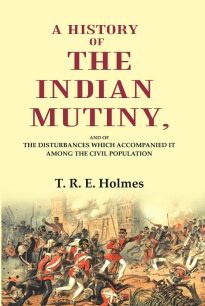
A History of the Indian Mutiny

Format: 608 pages
Language: English
Published Date: January 1, 2024
(First published in 1883)
ISBN: 978-9362805065
User's Rating:
Not rated yet
|
Editor's Rating:
3.63

A History of the Indian Mutiny: And of the Disturbances Which Accompanied It Among the Civil Population by Thomas Rice Holmes is a detailed nineteenth-century account of the Indian Rebellion of 1857. First published in the 1880s, the book examines the political and military background of the uprising, the organization of the Bengal Army, the outbreak of rebellion, major campaigns, British military responses, and disturbances among the civilian population.

Holmes places the events of 1857 within a broader narrative of British expansion and administration in India. His account discusses developments leading up to the rebellion and follows events across important centres, including Delhi, Cawnpore, Lucknow, and other regions. The work also considers the conduct of military officers, administrative decisions, and the circumstances surrounding the uprising's suppression. Its extensive narrative makes it a useful historical source for studying how British writers of the late nineteenth century understood and presented the rebellion.

However, the book must be read critically. Holmes wrote from within the British imperial context, and the title's use of the word Mutiny reflects a framework that foregrounds military disobedience rather than necessarily recognizing the full political, social, and regional dimensions of the uprising. His perspective offers insight into colonial historical thinking, but it should not be treated as a neutral or comprehensive representation of Indian experiences.

Key Themes

1. The Political Background of the Rebellion

Holmes examines the expansion of British power and the political developments that preceded the uprising. His account provides context for understanding the colonial administration and the tensions that shaped relations between British authorities and Indian rulers, soldiers, and communities.

2. The Bengal Army and Military Discontent

The organization of the Bengal Army and the grievances of Indian soldiers are central to the narrative. Holmes explores military conditions and the outbreak of the rebellion, providing material for readers interested in the immediate military origins of the conflict.

3. Major Campaigns and Centres of Resistance

The book follows military operations and confrontations in places such as Delhi, Cawnpore, and Lucknow. Its detailed accounts help readers reconstruct the chronology of the conflict and examine the decisions made by military commanders on different sides.

4. Civilian Participation and Regional Disturbances

By addressing disturbances among the civil population, Holmes acknowledges that the events extended beyond the army. Nevertheless, readers should examine critically how the author describes civilian participation and whether local grievances, popular resistance, and regional motivations receive adequate attention.

5. Colonial Administration and the Restoration of British Control

The narrative considers British administrative and military responses to the rebellion. It is useful for studying how colonial authorities and historians explained the crisis, evaluated official decisions, and presented the restoration of British power.

6. Colonial Language and Historical Interpretation

The book's terminology and narrative perspective are historically significant in their own right. Its framing of the uprising as a mutiny offers an opportunity to examine how imperial assumptions influenced historical writing and how later historians developed alternative interpretations of the events of 1857.


Pros

1. Detailed Military and Political Narrative

Holmes provides a substantial account of the rebellion’s background, principal events, military campaigns, and British responses. Readers seeking a chronological introduction to the conflict’s military history may find the book particularly useful.

2. Valuable Evidence of Colonial Historical Thinking

The book is valuable not only for its account of 1857 but also for what it reveals about British imperial interpretations of the uprising. Its explanations, terminology, and judgments can help readers understand how colonial writers framed resistance to British rule.

3. Coverage of Multiple Locations

The narrative extends across several major centres of conflict rather than concentrating exclusively on the initial outbreak. This geographical breadth can help readers compare events and military developments across different regions.

4. Useful for Historiographical Research

Students and researchers examining the development of historical interpretations of 1857 can use Holmes alongside contemporary records, Indian nationalist histories, and modern scholarship. The contrast between these perspectives is one of the book’s most important research benefits.

5. Accessible to Readers Interested in Military History

The book’s narrative approach and attention to campaigns, commanders, and military decisions may appeal to readers who prefer detailed historical storytelling over narrowly theoretical discussion.

Cons

1. A Strong British Colonial Perspective

Holmes wrote during the period of British imperial rule in India. His interpretation should therefore be assessed for assumptions that privilege British administrative and military perspectives. Readers should not mistake the author’s confidence or narrative detail for impartiality.

2. The Term “Mutiny” Can Narrow the Interpretation

The book’s title emphasizes military rebellion. Although the uprising began with military revolt, it also involved varied forms of civilian resistance, local political struggles, and regional grievances. A framework centred on mutiny may understate these broader dimensions.

3. Limited Representation of Indian Perspectives

Readers should be alert to whose voices and experiences receive the most attention. A British account may give greater space to colonial officials and military participants than to Indian rebels, ordinary civilians, and communities affected by the conflict.

4. Requires Verification Against Later Scholarship

Holmes’s interpretations reflect the historical knowledge and political assumptions of his period. His explanations of the rebellion’s causes and consequences should be compared with later research into agrarian tensions, regional politics, religious concerns, popular participation, and colonial violence.

5. Not an Ideal Standalone Introduction for Modern Readers

Readers unfamiliar with the history of 1857 may find it difficult to distinguish established events from the author’s interpretation. A modern overview should accompany the book so that its arguments can be evaluated within the wider historiographical debate.

6. Edition and Reproduction Quality May Vary

The work has appeared in multiple editions and modern reprints. Pagination, formatting, and reproduction quality can vary. Buyers should check the specific edition’s publisher information, page count, print quality, and availability of maps or other original material before purchasing.

Critical Reception

A History of the Indian Mutiny belongs to the tradition of British historical writing that interpreted the uprising of 1857 through the experiences and concerns of colonial officials, military personnel, and imperial society. Holmes’s work is significant for understanding how the rebellion was narrated and explained during the period of British rule in India. Its terminology and emphasis should be considered part of that historical context rather than accepted as neutral descriptions of the uprising.

Later scholarship has shown that the events of 1857 cannot be adequately understood through a purely military account. Historians have examined the relationship between the Bengal Army’s revolt and wider civilian unrest, regional political conflicts, popular participation, and the violence associated with colonial rule. These developments provide an important framework for critically assessing nineteenth-century accounts such as Holmes’s.

Historiographical Context

Gautam Chakravarty’s research on the British imagination of the Indian Mutiny examines how narratives of the uprising developed in Britain and how the events were incorporated into wider interpretations of empire. Kim A. Wagner’s article, The Marginal Mutiny: The New Historiography of the Indian Uprising of 1857, surveys developments in scholarship and demonstrates the importance of examining the uprising beyond established military narratives.

For further context, readers can consult the Cambridge introduction to The 1857 Indian Uprising and the British Empire and Wagner’s historiographical essay on the uprising.

Critical Perspective

Holmes’s account is most useful when read both as a narrative of the rebellion and as evidence of colonial historical interpretation. Its military detail and contemporary perspective can support historical research, but its treatment of Indian motives, civilian resistance, and British actions should be compared with Indian accounts, archival records, and modern scholarship.

Assessment of Available Reception

The sources located establish the book’s publication history and its relevance to the broader historiography of 1857, but a substantial body of dedicated, independent reviews of Holmes’s volume as a whole could not be verified. This section therefore assesses the book’s historical and historiographical significance rather than claiming a broad critical consensus.

HaqqFinder Editorial Rating

This rating evaluates the book as a historical source and a work of colonial-era historiography. The score is provisional because the complete text and specific edition have not been independently inspected.

3.6/5
HaqqFinder Editorial Rating
Valuable historical source; read critically alongside modern scholarship.

Rating Breakdown

Evaluation Criteria Weight Score Assessment
Content Quality & Depth 20% 4.3/5 Substantial military and political narrative, requiring critical interpretation.
Writing Style & Clarity 15% 3.6/5 Traditional historical narrative; nineteenth-century prose may feel dated.
Relevance & Target Audience Fit 15% 4.0/5 Useful for researchers of 1857, colonial India, and military history.
Originality & Creativity 15% 3.6/5 Valuable as a period interpretation, rather than as current historical scholarship.
Cultural & Ethical Sensitivity 10% 2.6/5 Colonial framing warrants caution when evaluating Indian resistance and civilian experiences.
Practical Value & Applicability 10% 3.1/5 Useful for historical research when compared with other sources.
Presentation & Design 10% 3.4/5 Provisional; the physical layout and quality of the specific edition have not been inspected.
Value for Price 5% 3.7/5 Provisional; current price and edition-specific value have not been verified.
Weighted Overall Score 3.63/5 — Rounded: 3.6/5

Overall Verdict:

A History of the Indian Mutiny by T. Rice Holmes is a substantial historical work for readers interested in the military events, colonial administration, and British interpretations of the Indian Rebellion of 1857. Its detailed narrative can help researchers investigate how the uprising was recorded and understood during the late nineteenth century.

Its greatest strength is also closely connected to its principal limitation: the book offers a perspective shaped by British imperial rule. While the military chronology and historical details may be valuable, its explanations should not be accepted uncritically, particularly where Indian resistance, civilian participation, and colonial violence are concerned.

Who should read this book? It is best suited to historians, university students, researchers of British India, and readers interested in colonial historiography. General readers seeking an accessible and balanced account of 1857 should pair it with modern historical scholarship that examines Indian perspectives and the wider social and political dimensions of the uprising.

Final verdict: A useful historical source for understanding the colonial interpretation of 1857, but not a sufficient standalone account of the rebellion. HaqqFinder’s provisional editorial rating is 3.6/5, reflecting its historical research value alongside the limitations of its colonial perspective.

🛒 WHERE TO BUY

*When you purchase through this link, HaqqFinder may earn a small commission at no extra cost to you. Learn more

Share On:
Facebook
X
LinkedIn
Pinterest
Reddit
WhatsApp
Tumblr
Telegram
Threads

Ratings & Reviews

0
0 out of 5 stars (based on 0 reviews)
Excellent
Very good
Average
Poor
Terrible

There are no reviews yet. Be the first one to write one.

Where We Reference This Book
Explore HaqqFinder articles that cite, discuss, or mention this publication.
Related Recommendations:

Login

Fill out the form below, and we will be in touch shortly.