

Introduction
In Islam, niyyah (intention) is the cornerstone of every action, determining its spiritual value and divine reward. The first hadith in Al-Arbaʿīn al-Nawawiyyah (The Forty Hadiths), compiled by Imam al-Nawawi, emphasizes this principle. This revered collection of forty-two prophetic traditions encapsulates the essence of Islamic faith, worship, ethics, and conduct, guiding Muslims toward righteousness. This article explores the hadith on intention, its significance, and Imam Bukhari’s choice to begin his Sahih with it, drawing insights from Ibn Hajar’s commentary and other scholarly perspectives.
Table of Contents
ToggleThe Hadith on Intention
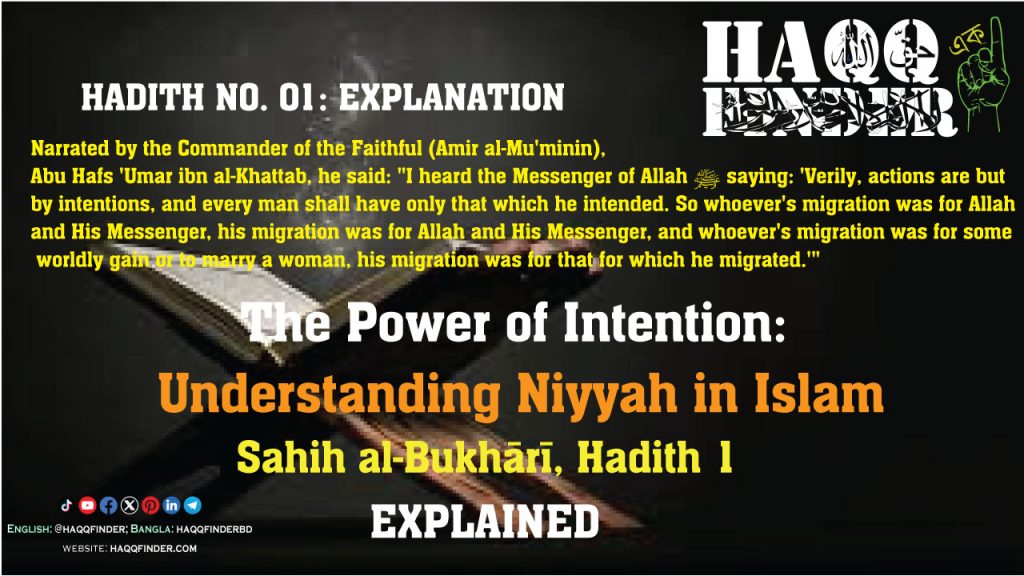
Narrated by Amir al-Mu’minin Abu Hafs ‘Umar ibn al-Khattab (RA):
“I heard the Messenger of Allah (ﷺ) say: ‘Verily, actions are but by intentions, and every man shall have only that which he intended. So whoever’s migration was for Allah and His Messenger, his migration was for Allah and His Messenger, and whoever’s migration was for some worldly gain or to marry a woman, his migration was for that for which he migrated.'”
(Sahih al-Bukhari & Muslim)
This hadith, unanimously accepted for its authenticity, underscores that the spiritual worth of any action depends on the intention behind it.
About the Narrator: ‘Umar ibn al-Khattab
‘Umar ibn al-Khattab (RA), a senior companion of Prophet Muhammad (ﷺ), was born into the Banu Adi clan of the Quraysh tribe in Mecca. Initially an opponent of Islam, his conversion in the sixth year of Prophethood was a pivotal moment for the Muslim community. As the second Caliph, he earned the title Al-Farooq for distinguishing truth from falsehood and Amir al-Mu’minin (Commander of the Faithful). His leadership marked significant conquests and strengthened the early Muslim Ummah.
Why Imam Bukhari Chose This Hadith
Imam Bukhari began his Sahih with this hadith, signaling its foundational role in Islamic teachings. Ibn Hajar Al-Asqalani explains objections raised about Bukhari’s lack of a traditional opening with al-hamd (praise of Allah) or shahada (testimony of faith), citing hadiths narrated by Abu Huraira suggesting every important matter should begin with these. However, these hadiths do not meet Bukhari’s strict authenticity criteria, and there’s no requirement for verbal or written praise in non-sermon texts. Bukhari sufficed with Bismillah (In the Name of Allah, the Entirely Merciful, the Especially Merciful), aligning with the Quran’s first revealed verse: “Recite in the name of your Lord” (Quran 96:1) and the Prophet’s (ﷺ) practice in letters to leaders.
Bukhari’s choice also reflects his intent to clarify the purpose of his compilation. By starting with the hadith on intention, he underscores his sincerity in seeking Allah’s pleasure, as Ibn Hajar notes. Some scholars suggest Bukhari used this hadith as a preface, replacing a traditional sermon, since it was reportedly delivered by ‘Umar (RA) from the pulpit in Medina, though evidence linking it to the Prophet’s (ﷺ) arrival in Medina is inconclusive.
Significance of the Hadith
This hadith is a pillar of Islamic knowledge. Imam Shafi’i stated it encompasses one-third of Islam, relating to over seventy chapters of jurisprudence, as it governs the heart’s role in worship. Imam Ahmad included it among three foundational hadiths, alongside those on rejecting innovations and clarifying lawful and unlawful matters. Al-Bayhaqi explained its significance: the heart, tongue, and limbs are the servant’s tools, with intention (heart) being paramount, as it can be an independent act of worship.
The hadith’s authenticity is undisputed, recorded by most major hadith scholars except Imam Malik. Though technically ahaad (singular narration), its meaning is reinforced by other narrations, such as the Prophet’s (ﷺ) saying: “People will be resurrected according to their intentions” (Sahih Muslim), making it akin to mutawatir (successive) in meaning.
Key Terms Explained
- A’amal: Actions, specifically those of a sane adult, encompassing acts of worship.
- Niyyah: Intention, the heart’s resolve that determines an action’s spiritual value.
- Hijrah: Migration, often from a land of disbelief or oppression to one where Islam can be practiced freely.
Understanding Niyyah: The Heart of Actions
The hadith teaches that actions are judged by their intentions. A migration for Allah and His Messenger earns divine reward, while one for worldly gains, like wealth or marriage, yields only those outcomes. Al-Qurtubi emphasized that intention and sincerity are preconditions for valid deeds, with the second part of the hadith (“every person has only what he intends”) highlighting that rewards align with specific intentions.
Types of Intention
- Sincerity (Ikhlas):
- This refers to the purpose behind an action—whether it seeks Allah’s pleasure or worldly benefits. Sincere actions are solely for Allah, as the Quran states: “They were not commanded except to worship Allah, being sincere to Him in religion” (Quran 98:5). Actions driven by riyaa (ostentation) are rejected, as in a hadith where a martyr, scholar, and donor are condemned for seeking praise (Sahih Muslim).
- If fleeting thoughts of praise arise but are dismissed, scholars like Imam Ahmad argue the original intention preserves the reward. Persistent riyaa may invalidate the act, per some views.
- Distinguishing Worship from Habits:
- Intention differentiates worship (e.g., fasting for Allah) from routine acts (e.g., dieting). It also specifies the type of worship, such as obligatory or voluntary prayers. Al-Nawawi stressed that specific intentions are required for acts like missed prayers (e.g., Dhuhr vs. Asr), ensuring validity (sihhat), though acceptance (qabool) depends on sincerity.
Mixed Intentions and Routine Acts
If an act like Hajj includes a secondary permissible intention (e.g., business), scholars like Ibn Hajar Al-Haithami suggest the reward is reduced but not nullified. Conversely, sincere actions earning unexpected praise bring additional rewards: “That is the glad tidings of a believer” (Sahih Muslim). Ibn Sum’aani noted that non-worship acts, like eating to gain strength for obedience, become rewardable with proper intention, transforming daily tasks into worship.
The Danger of Riyaa
Riyaa—seeking human admiration—corrupts sincerity and may constitute shirk. The Prophet (ﷺ) warned that such actions are rejected (Sahih Muslim). For example, a person fasting for both worship and weight loss may receive a reduced reward, but if the primary intention is Allah’s pleasure, the act remains valid.
The Story of Muhajir Umm Qais
The hadith is often linked to a man who migrated to marry Umm Qais. Narrated by Al-Tabarani and Sa’eed bin Mansoor, the story is authentic but, per Ibn Hajar, lacks a verified chain connecting it directly to the hadith. It illustrates how intentions shape outcomes, as the man’s migration was for marriage, not Allah’s sake.
Conclusion
The hadith “Actions are but by intentions” is a foundational principle, urging Muslims to purify their motives and seek Allah’s pleasure. Imam Bukhari’s choice to begin his Sahih with it reflects its role in guiding sincere worship and aligns with his intent to compile authentic revelation. By aligning niyyah with sincerity, believers can elevate both worship and daily tasks into acts of devotion. May Allah grant us sincerity and accept our righteous deeds.