

The Hadith of Jibril, narrated by Umar ibn al-Khattab (RA) and recorded in Sahih Muslim, is a foundational Islamic text, often referred to as the “Mother of the Sunnah” for its comprehensive summary of the religion. It outlines three core dimensions—Islam (submission), Iman (faith), and Ihsan (spiritual excellence)—while addressing signs of the Hour, offering a timeless framework for living with purpose, devotion, and mindfulness. This article explores the hadith’s significance, its components, and practical insights for Muslims, enriched with scholarly interpretations from Ibn Hajar Al-Haythami and Ibn Rajab Al-Hanbali.
The Hadith of Jibril
Narrated by Umar ibn al-Khattab (RA):
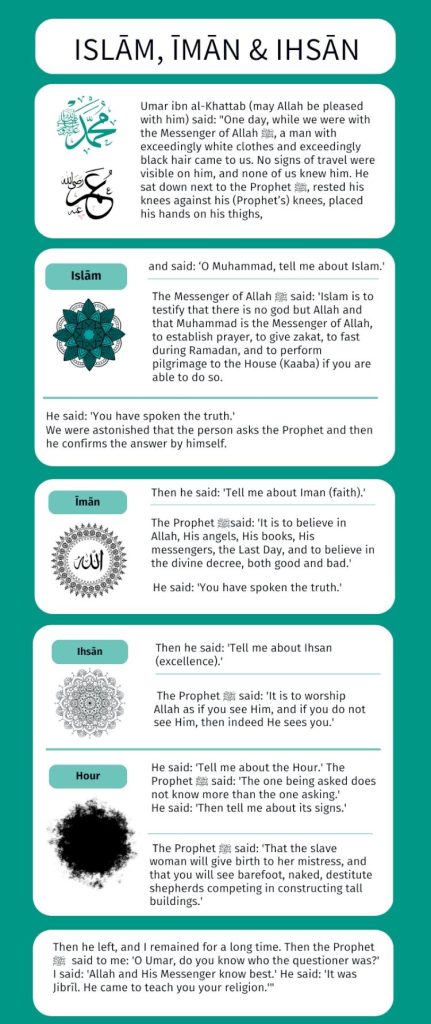
One day, while we were with the Messenger of Allah (ﷺ), a man appeared with intensely white clothes and strikingly black hair, showing no signs of travel, yet none of us recognized him. He sat before the Prophet (ﷺ), aligning his knees with the Prophet’s and placing his hands on his thighs. He said, “O Muhammad, inform me about Islam.”
The Prophet (ﷺ) replied: “Islam is to testify there is no god but Allah and Muhammad is His Messenger, establish prayer, give zakat, fast in Ramadan, and perform Hajj to the House if you are able.” The man said, “You have spoken the truth.” We were amazed that he asked and confirmed the answer.
He asked, “Inform me about Iman.” The Prophet (ﷺ) said: “It is to believe in Allah, His angels, His books, His messengers, the Last Day, and divine destiny, both its good and evil.” He said, “You have spoken the truth.”
He asked, “Inform me about Ihsan.” The Prophet (ﷺ) replied: “It is to worship Allah as if you see Him, and if you cannot, know that He sees you.”
He asked, “Inform me about the Hour.” The Prophet (ﷺ) said: “The one asked knows no more than the questioner.”
He asked, “Inform me of its signs.” The Prophet (ﷺ) said: “That a slave woman gives birth to her mistress, and that you see barefoot, destitute shepherds competing in constructing tall buildings.”
The man left, and after a while, the Prophet (ﷺ) said, “O Umar, do you know who the questioner was?” I said, “Allah and His Messenger know best.” He said, “It was Jibril, who came to teach you your religion.”
– Sahih Muslim, Book 1, Hadith 8; Al-Arbaʿīn al-Nawawiyyah Hadith 2; Sahih al-Bukhari, Book of Revelation (Kitab Bad’ al-Wahy), Hadith #50
About the Narrator: Umar ibn al-Khattab
Umar ibn al-Khattab (RA), a senior companion of Prophet Muhammad (ﷺ), was born into the Quraysh tribe’s Banu Adi clan in Mecca. Initially an opponent of Islam, his conversion in the sixth year of Prophethood strengthened the Muslim community. As the second Caliph, titled Al-Farooq (the distinguisher of truth) and Amir al-Mu’minin (Commander of the Faithful), he led with justice, overseeing major conquests and shaping the early Muslim Ummah.
Significance of the Hadith
The Hadith of Jibril is a cornerstone of Islamic theology, often compared to Surah Al-Fatiha, the “Mother of the Quran,” for its comprehensive scope. Ibn Hajar Al-Haythami emphasizes its paramount importance, stating that it could suffice as the sole hadith in the Sunnah due to its coverage of outward worship (Islam), inward faith (Iman), spiritual excellence (Ihsan), and eschatological awareness. Ibn Rajab Al-Hanbali highlights its role as a complete framework for Sharia, encompassing all aspects of worship and conduct.
Why It Matters
- Holistic Framework: It outlines the Five Pillars, Six Articles of Faith, and Ihsan, providing a blueprint for Islamic practice and belief.
- Educational Approach: Jibril’s respectful question-and-answer format models humility and effective learning, encouraging Muslims to seek knowledge with sincerity.
- Spiritual Integration: It connects external actions, internal beliefs, and God-consciousness (Taqwa), fostering a balanced spiritual life.
- Eschatological Reminder: The signs of the Hour urge preparation for the Hereafter, emphasizing the transient nature of worldly pursuits.
Key Terms Explained
- Islam: Submission to Allah through the Five Pillars and ethical conduct.
- Iman: Inward faith in six articles, rooted in the heart’s conviction.
- Ihsan: Worshipping Allah with spiritual excellence and awareness.
- Al-Sa’ah (The Hour): The Day of Judgment, marked by specific signs.
Exploring Islam, Iman, and Ihsan
Islam: The Foundation of Action
Islam, derived from the Arabic root “S-L-M” (submission, peace), refers to outward acts of worship, primarily the Five Pillars:
- Shahada: Testifying there is no god but Allah and that Muhammad is His Messenger.
- Salah: Performing five daily prayers.
- Zakat: Giving charity to support the needy.
- Sawm: Fasting during Ramadan.
- Hajj: Undertaking pilgrimage to Mecca if physically and financially able.
Ibn Rajab Al-Hanbali categorizes these as bodily (prayer, fasting), financial (zakat), and combined actions (Hajj). Additional acts, like Umrah or ritual purification (ghusl), also fall under Islam, per Ibn Hibban’s narration. The Prophet (ﷺ) extended Islam to ethical conduct: “A Muslim is one from whose tongue and hand Muslims are safe” (Sahih Bukhari and Muslim). Another hadith states: “The best Islam is to feed the hungry and greet everyone, whether you know them or not” (Sahih Bukhari and Muslim). These emphasize that Islam encompasses both worship and social ethics, such as helping neighbors or sharing resources.
Practical Insight: Incorporate Islam by performing the Five Pillars consistently and practicing kindness, like volunteering at a local charity or greeting strangers warmly, aligning actions with faith.
Iman: The Core of Belief
Iman, from the root “A-M-N” (security, faith), refers to internalized belief in six articles:
- Allah
- His Angels
- His Books
- His Messengers
- The Last Day
- Divine Destiny (Qadar), both good and evil
Ibn Hajar Al-Haythami explains that Iman requires heartfelt acceptance. General belief suffices for broad categories (e.g., angels), but specific belief is needed for named entities (e.g., Jibril, the Quran). Denial of specific Quranic or hadith-mentioned tenets constitutes disbelief (kufr). The Quran reinforces this: “The Messenger has believed in what was revealed to him… in Allah, His angels, His books, and His messengers” (Quran 2:285).
Ibn Rajab elaborates that Iman manifests through emotional responses (e.g., trembling at Allah’s mention), complete trust in Allah, prioritizing His love, and virtues like humility, generosity, and empathy. For example, believers share in others’ joys and sorrows, supporting community initiatives or aiding neighbors.
Practical Insight: Strengthen Iman by studying the Quran’s descriptions of Allah’s attributes, reflecting on His signs in nature, and fostering love for the Prophet (ﷺ) through learning his Sunnah and practicing compassion, such as helping a struggling friend.
Ihsan: The Pinnacle of Spirituality
Ihsan, defined as worshipping Allah as if seeing Him or knowing He sees you, represents spiritual excellence and Taqwa (God-consciousness). It transforms routine acts into profound devotion, ensuring sincerity and mindfulness. For example, a prayer with Ihsan is performed with focus and humility, unlike a rushed ritual.
Ibn Hajar notes that Ihsan elevates worship by fostering awareness of Allah’s presence, leading to integrity and moral excellence in all actions, from prayer to daily interactions.
Practical Insight: Practice Ihsan by pausing before worship to align intentions with Allah’s pleasure, such as praying slowly with reflection or helping others selflessly, aware of divine observation.
The Hour and Its Signs
The Prophet (ﷺ) stated that the Hour’s timing is known only to Allah, but he provided two signs: a slave woman giving birth to her mistress (indicating social upheaval, such as loss of respect for authority) and barefoot shepherds competing in tall buildings (symbolizing material excess among the lowly). These signs remind Muslims to prioritize spiritual goals over worldly pursuits.
Practical Insight: Reflect on these signs by focusing on eternal goals, such as regular charity or learning about the Hereafter, to counter modern materialism, like excessive focus on wealth or status.
Interconnection of Islam, Iman, and Ihsan
Ibn Rajab Al-Hanbali and Abu Bakr Al-Isma’ili explain that when Islam and Iman are mentioned together, Islam refers to outward actions and Iman to inward beliefs; alone, each encompasses both. Al-Khattabi notes that every believer (Mu’min) is a Muslim, but a Muslim with weak faith may not fully embody Iman. The Quran (49:14) illustrates this, distinguishing Bedouins’ submission (Islam) from full faith (Iman).
Ihsan elevates both, requiring sincerity and awareness. For example, a Muslim with strong Iman and Ihsan prays with devotion, gives charity selflessly, and treats others kindly, embodying the hadith’s holistic vision. Ibn Rajab highlights a nuanced hadith where the Prophet (ﷺ) responded to a question about a “believer” by saying “or a Muslim,” suggesting degrees of faith (Musnad Ahmad).
Practical Insight: Integrate Islam, Iman, and Ihsan by aligning actions (e.g., prayer) with faith (belief in Allah’s mercy) and sincerity (worshipping as if seeing Him). For instance, perform zakat to please Allah and support the community.
Educational Value of the Hadith
The hadith’s question-and-answer format, with Jibril respectfully engaging the Prophet (ﷺ), models ideal learning etiquette: humility, active listening, and seeking clarity. This approach inspires Muslims to pursue knowledge with sincerity, fostering respectful dialogue in study circles or Islamic classes.
Practical Insight: Apply this by asking questions with humility in educational settings, ensuring knowledge is sought for Allah’s sake, such as joining a local Quran study group with an open heart.
Why This Hadith Matters Today
The Hadith of Jibril offers a timeless framework for a meaningful life:
- Practice Islam through consistent worship and ethical conduct.
- Strengthen Iman by deepening belief and trust in Allah.
- Strive for Ihsan by cultivating sincerity and mindfulness in all actions.
Its inclusion in Al-Arbaʿīn al-Nawawiyyah underscores its role as a guide for Muslims seeking to live with purpose and prepare for the Hereafter. By embodying these principles, believers can transform daily routines—such as work, charity, or family interactions—into acts of worship.
Conclusion
The Hadith of Jibril is a comprehensive guide to Islam, summarizing Islam (outward practice), Iman (inward faith), and Ihsan (spiritual excellence). Its teachings, enriched by scholars like Ibn Hajar and Ibn Rajab, urge Muslims to align actions with sincere faith and God-consciousness. By living these principles, believers can lead a balanced, purposeful life, ready for the Hereafter. May Allah grant us the ability to embody Islam, Iman, and Ihsan in all we do.