
Introduction
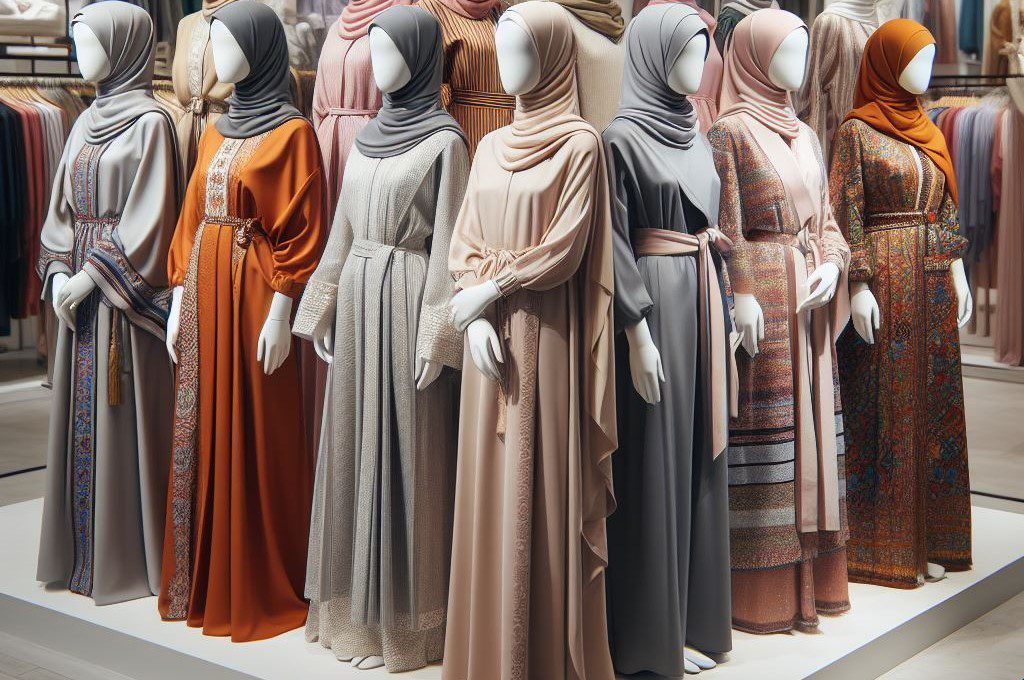
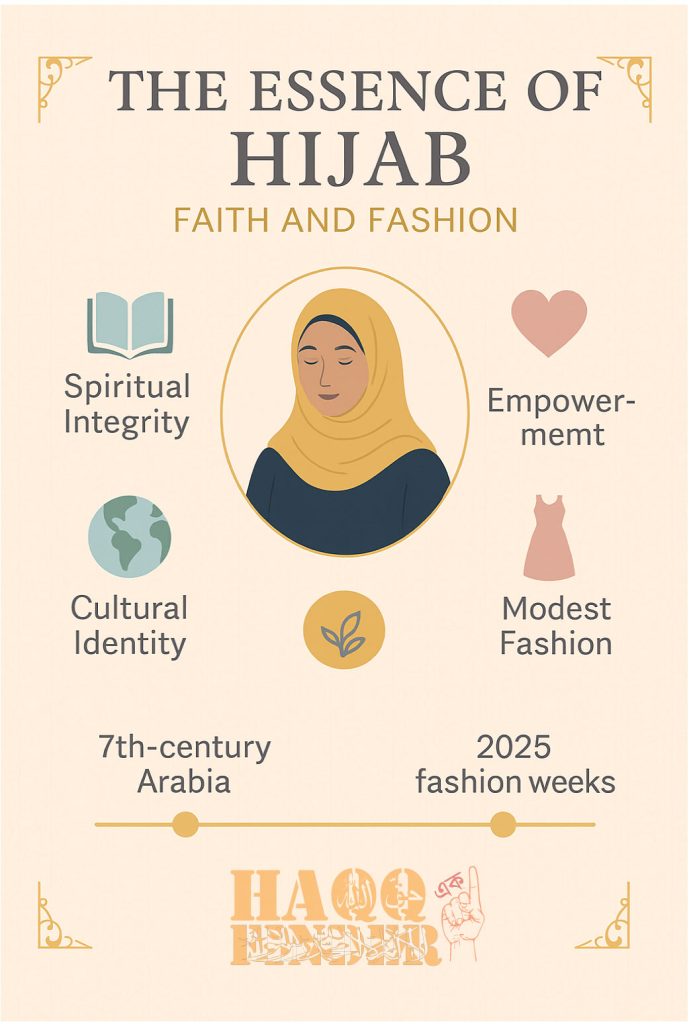
The Islamic dress code for females, often centered around the concept of hijab (حجاب), is a profound expression of faith, modesty, and personal identity. Rooted in the Quran and Hadith, it transcends mere clothing, embodying spiritual integrity, dignity, and protection from unwanted attention. For Muslim women worldwide, adhering to these guidelines is a dynamic act of devotion to Allah, cultural pride, and self-empowerment. From the flowing abayas of the Arabian Gulf to the vibrant salwar kameez of South Asia and modern modest sportswear embraced globally, the Islamic dress code reflects a balance of religious principles and contemporary style.
This comprehensive guide, tailored for religious and fashion-focused audiences, explores the theological foundations, historical evolution, cultural variations, practical applications, contemporary debates, and future trends of Islamic dress. Through personal stories, scholarly insights, and practical tips, we highlight how Muslim women navigate faith and fashion in a diverse, ever-changing world.
Why It Matters
For devout Muslims, the dress code is an act of obedience to divine guidance, fostering haya (modesty) in appearance and behavior. For fashion enthusiasts, it represents a burgeoning industry—valued at $402 billion in 2024—where designers like Hana Tajima and brands like Modanisa redefine style within Islamic principles (Thomson Reuters, 2018). From a Somali-British student in London pairing colorful hijabs with maxi dresses to a Dubai professional donning tailored abayas, Muslim women express their identity with creativity. This article bridges religious authenticity and modern fashion, offering insights for those seeking Shari‘ah-compliant attire and those inspired by the global modest fashion movement.
Before delving into the Quranic guidelines for women’s dress, it is vital to recognize that
- The Quran is the sole authorized source of divine law, as affirmed in Surah Al-An‘am (6:114): “Shall I seek a judge other than Allah while it is He who has sent down to you the Book explained in detail?”
- The Quran is complete and fully detailed (6:38, 6:114, 16:89, 12:111), serving as the ultimate guide for believers.
- God warns against the sin of shirk—associating partners with Him in lawmaking—condemning those who follow scholars’ words over His, as seen in Surah At-Tawbah (9:31), or who prohibit what He has not forbidden (5:87, 6:140, 6:150, 7:32, 10:59, 16:116).
- The Quran states in Surah Ash-Shura (42:21): “Or do they have partners who have legislated for them a religion which Allah has not authorized? Had it not been for a decisive word, they would have been judged. Indeed, the wrongdoers will have a painful punishment.”
This highlights that inventing or adhering to unauthorized dress laws equates to setting oneself up as a rival to God, a grave error.
Historical Context
The Islamic dress code has evolved over 14 centuries, shaped by religious texts, cultural practices, and historical shifts. Understanding its roots provides context for its modern expressions.
Pre-Islamic and Early Islamic Eras
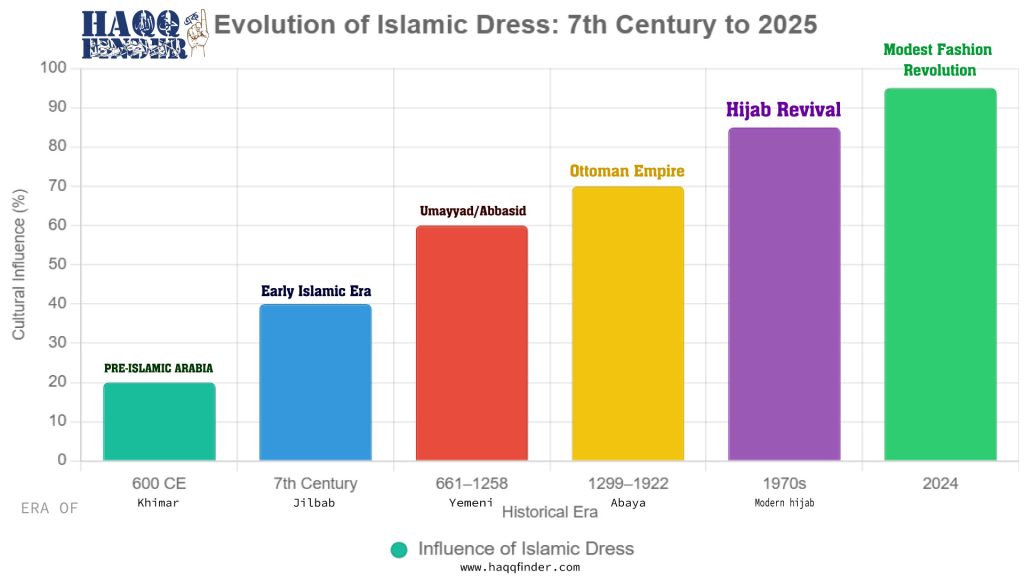
In pre-Islamic Arabia, veiling was common among elite women in Byzantine and Persian societies, symbolizing status and protection. With Islam’s emergence in the 7th century, the Quran redefined veiling as a universal act of modesty for all believing women. Surah An-Nur (24:31) instructed women to cover their hair and chest with a khimar, while Surah Al-Ahzab (33:59) called for a jilbab (cloak) to signify piety. Early Muslim women, like the Prophet’s wives, adopted loose garments suited to the desert climate, ensuring coverage and protection (Tarlo, 2010).
Medieval Islamic Empires
During the Umayyad (661–750) and Abbasid (750–1258) eras, Islamic dress diversified as the Muslim world expanded. In Baghdad, women wore ornate khimars with silk or cotton, reflecting wealth while maintaining modesty. The Ottoman Empire (1299–1922) introduced intricate Yemeni (headscarves) and ferace (long coats), blending Turkish artistry with Islamic guidelines. Rural communities adapted simpler styles, like loose tunics in North Africa, suited to agricultural lifestyles (Haddad & Smith, 2009).
Colonial and Modern Eras
The 19th and 20th centuries brought challenges. Colonial powers in Egypt, Algeria, and India associated veiling with backwardness, encouraging Western attire. The 1970s Islamic revival sparked a global resurgence of hijab, driven by cultural and religious identity movements. For example, Egyptian women reclaimed the headscarf as resistance, while Iranian women adopted the chador post-1979 revolution (Ahmed, 2011). Today, Islamic dress blends tradition and innovation, with women adapting it to local and global contexts.
21st Century and Beyond
The 21st century has seen hijab become a global symbol of identity. Social media platforms like X amplify hijabi influencers, while fashion weeks in Dubai and Jakarta showcase modern designs. The rise of modest sportswear, like Nike’s Pro Hijab, reflects inclusivity in athletics (Haddad & Smith, 2009). This evolution underscores the dress code’s adaptability, balancing faith with contemporary needs.
Theological Foundations
Quranic Guidance

The Quran provides the primary framework for Islamic dress, emphasizing modesty and dignity:
Surah Al-A‘raf (7:26):
The first rule, outlined in Surah Al-A‘raf (7:26), states:
“O Children of Adam, We have bestowed upon you garments to cover your private parts and as adornment, but the garment of righteousness is the best. That is from the signs of Allah that perhaps they will remember.”
This establishes reverence for God as the cornerstone of dress, guiding women to choose modest attire that reflects awareness of His presence. Righteous women, through this reverence, instinctively select clothing that aligns with decency, free from the need for external dictates.
Surah An-Nur (24:31):
The second rule, in Surah An-Nur (24:31), instructs women to cover their cleavage:
“And tell the believing women to lower their gaze and guard their private parts and not expose their adornment except that which [necessarily] appears thereof and to wrap [a portion of] their headcovers over their chests…”
The term khimar (cover) here refers to any garment—be it a shawl, blouse, or scarf—used to conceal the chest, countering the misinterpretation that it mandates a head cover. The word hijab, used elsewhere in the Quran (e.g., 7:46, 33:53) to mean barrier or curtain, is not defined as a head cover, a concept historically rooted in pre-Islamic Jewish and Christian traditions rather than Quranic mandate.
Historical evidence shows head covering as a cultural practice among Arabs, Jews, and Christians, later adopted into hadith-based dress codes, which some argue constitutes shirk by adding to God’s law.
The third rule, also in 24:31, prohibits revealing zinat (beauty spots with sexual connotation, such as thighs or breasts) except what is normally apparent, like the face, arms, or lower legs, offering flexible discretion based on occasion—conservative for prayer, lighter for sports—reflecting God’s mercy. The verse concludes with a caution against striking feet to reveal hidden zinat.
Surah An-Nur (24:31):
The fourth rule, in Surah Al-Ahzab (33:59), commands:
“O Prophet, tell your wives and your daughters and the women of the believers to bring down over themselves [part] of their outer garments. That is more suitable that they will be known and not be abused.”
This directive to lower outer garments (e.g., dresses or jalabiyas) allows cultural adaptation, with the extent of lowering left to women’s judgment, ensuring righteousness without rigid prescriptions. Critics who claim total body coverage manipulate these verses, ignoring the specific mention of the chest and the call to lower garments, which implies parts remain uncovered.
Within family settings or for elderly women past marriage age, Surah An-Nur (24:60) permits relaxed dress:
“There is no blame upon elderly women who have no desire for marriage for relaxing their clothing, provided they do not flaunt their adornment,” balancing modesty with practicality.
These verses frame hijab as a holistic practice, encompassing physical attire and spiritual conduct (haya) (Al-Hashimi, 1998).
Hadith and Prophetic Traditions
Hadith narrations offer practical examples:
- Sahih Bukhari: Aisha (may Allah be pleased with her) describes women covering their faces in specific contexts, though its obligation is debated (Bukhari, Hadith 4758). And, it was narrated from Sahl ibn Sa‘d (may Allah be pleased with him) that the Prophet (peace and blessings of Allah be upon him) said: “Whoever protects that which is between his jaws and that which is between his legs will be guaranteed Paradise.” (Bukhari, Hadith 6474).
- Sunan Tirmidhi: “When a woman emerges un-concealed, Shaytan adorns her in front of men” (Tirmidhi, Hadith 1173), emphasizing full coverage. This underscores the spiritual safeguard hijab provides against temptation, complementing the earlier Hadith from Sahl ibn Sa‘d (Bukhari 6474) about guarding chastity. Together, these narrations emphasize hijab as a shield against temptation and a marker of respectability.
- Sahih Muslim: Warns of women being “clothed, yet naked” if attire outlines the body (Muslim, Hadith 2128).
- Sunan Abu Dawud: “A woman in ihram should not cover her face, nor wear gloves” (Abu Dawud, Hadith 1826), suggesting face exposure during pilgrimage.
Scholarly Interpretations
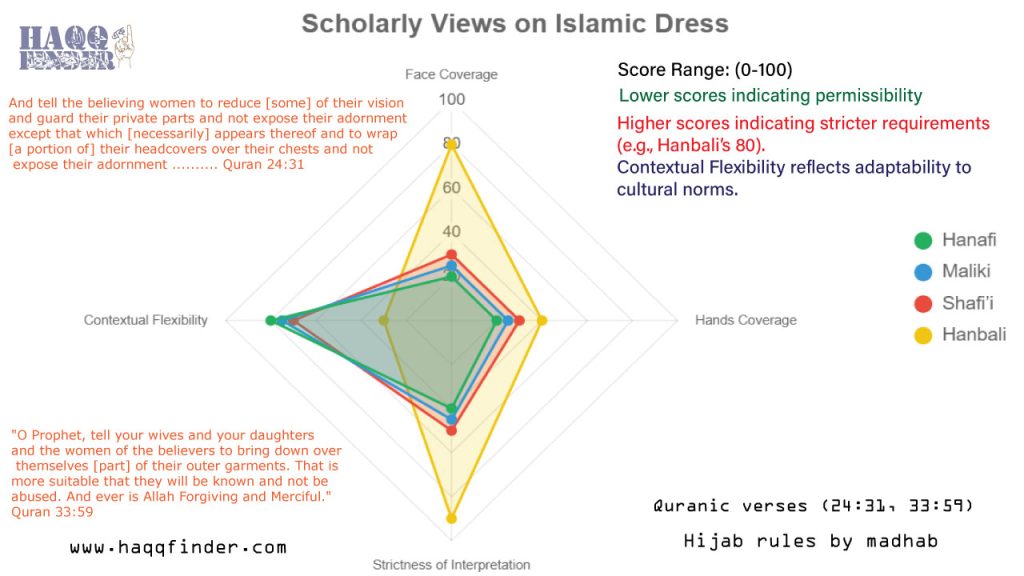
Scholars across Sunni madhabs offer nuanced views on the awrah (private parts):
- Hanafi, Maliki, Shafi’i: The awrah includes the entire body except the face and hands.
- Hanbali, Salafi: The face should be covered (niqab), citing early practices (Al-Qaradawi, 1999).
- Modern Views: Scholars like Yusuf Al-Qaradawi argue that face covering is optional, prioritizing context and intention.
- Some scholars advocate a Quran-only approach, arguing that verses like 24:31 and 33:59 specify coverage (chest, outer garments) without mandating head or full-body covering, countering claims of total concealment as un-Quranic innovations. This view warns against shirk by adhering to unauthorized traditions, urging reliance on God’s words alone (42:21).
These differences allow women to choose based on conviction and context.
Spiritual and Social Benefits
The spiritual rewards of hijab are profound, as emphasized by the Prophetic tradition narrated from Sahl ibn Sa‘d (may Allah be pleased with him):
“Whoever protects that which is between his jaws and that which is between his legs will be guaranteed Paradise,” narrated by al-Bukhari, no. 6474.
This promise is fulfilled through the hijab’s role in guarding chastity, a virtue elaborated by Al-‘Allamah al-Sa‘di (may Allah have mercy on him) in Tayseer al-Kareem al-Rahman (p. 664): “… those who guard their chastity” means, against zina (fornication or adultery) and that which leads to it. End quote.
Thus, women who observe complete hijab align with this divine safeguard, earning forgiveness and a great reward as promised in Surah Al-Ahzab (33:35).
Core Principles of Islamic Dress
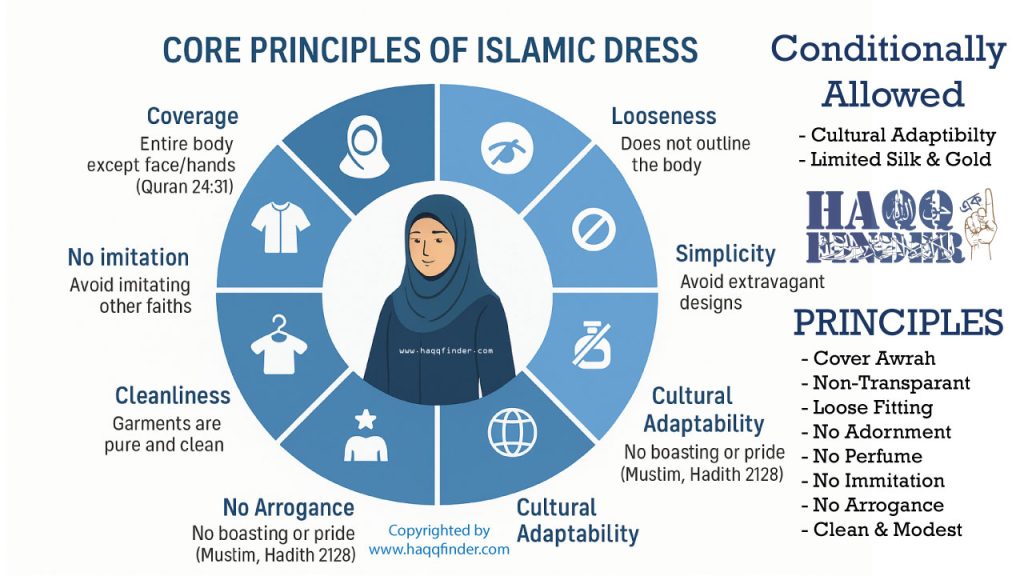
The Islamic dress code is guided by principles ensuring modesty, dignity, and practicality:
- Coverage of Awrah: The entire body except the face to chin, hands to wrist, and feet to ankle (per modest guidance), or face and hands (per most madhabs), with stricter views covering all.
- Looseness: Garments should not cling or outline the body. Overclothing, such as a light cloak, is encouraged to conceal body curves, reflecting traditional practices in Muslim-majority regions.
- Opacity: Fabrics must be non-transparent.
- Simplicity: Avoid extravagant designs or perfumes, especially around non-mahram men.
- No Imitation: Avoid men’s clothing or non-Muslim exclusive styles, maintaining a distinct Islamic identity.
- Cleanliness: Clothing must be clean, reflecting spiritual purity.
- No Arrogance: Avoid ostentatious attire. The overall appearance should exude dignity, avoiding flashy or sympathetic displays to uphold modesty’s essence.
- Cultural Adaptability: Local styles are permissible if modest.
Prohibitions
- Silk and Gold: Permissible for women, unlike men, but not extravagant.
- Isbal: Garments trailing below the ankles are discouraged (Sunan Abu Dawud, Hadith 4091).
- Images of Living Beings: Avoid maintaining simplicity.
Summary Table: Islamic Dress Code Rules
| Rule | Description |
|---|---|
| Cover Awrah | Entire body except face and hands (or face, per some views). |
| Non-Transparent | No sheer or see-through fabrics. |
| Loose-Fitting | No tight clothing that outlines the body. |
| No Adornment | Avoid bright, shiny, or decorative clothing that attracts attention. |
| No Perfume | Avoid scents, especially around non-mahram men. |
| No Imitation | Avoid men’s clothing or non-Muslim exclusive styles. |
| No Arrogance | Dress modestly, avoiding extravagance or pride. |
| Clean & Modest Behavior | Clothing and demeanor should reflect humility and purity. |
Cultural and Regional Variations
Types of Muslim Clothing
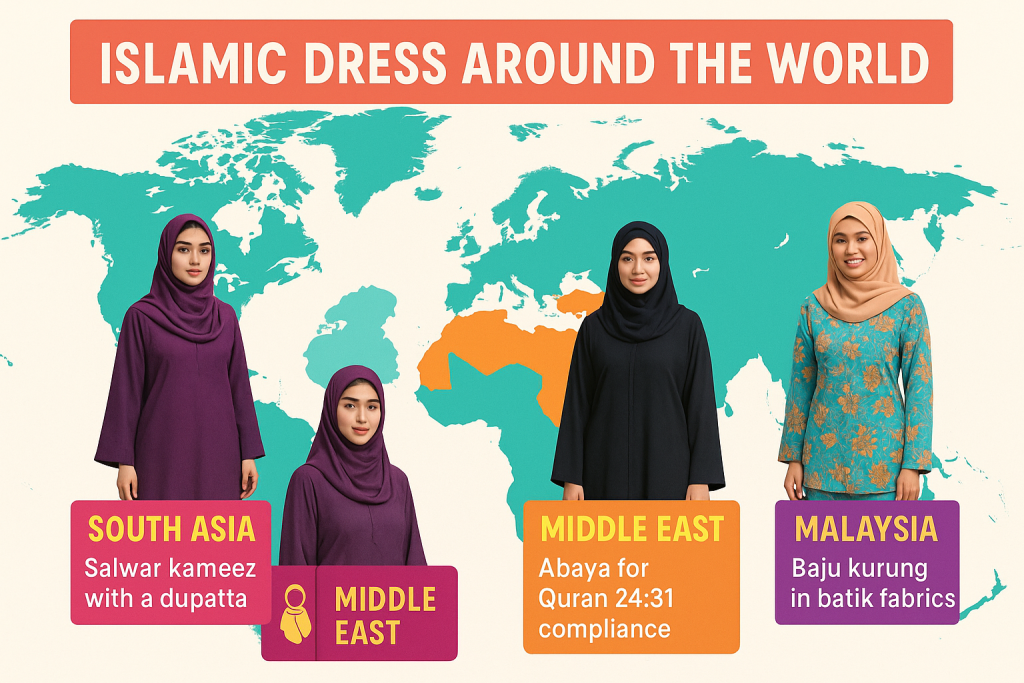
The diversity of Muslim clothing reflects both religious adherence and cultural heritage. The abaya, a loose-fitting cloak, varies from ankle to floor-length, traditionally black but now featuring embroidery in modern designs. The niqab covers the face with only the eyes visible, often paired with a hijab.
The khimar, a rectangular headscarf extending to cover part or all of the chest, is often worn with an abaya or jilbab, offering a practical layer for modesty.
The chador, prevalent in Iran, is a full-body covering held under the chin with thick fabric like wool or polyester, suited to colder climates and symbolizing piety.
These garments allow women to express personal style—modern abayas feature embroidery, while chadors adapt to seasonal needs. For many, like Nadia from Morocco, wearing such attire connects them to their heritage, while others, like Zainab from the UK, find empowerment in choosing modest designs that defy societal beauty norms.
Middle East: Tradition Meets Modernity
In the Arabian Gulf (Saudi Arabia, UAE, Qatar), the abaya is a staple, traditionally black but now featuring colors and embroidery. Post-2018 Saudi reforms, women like Fatima, a Dubai professional, wear pastel abayas to work and athletic hijabs for sports. In Iran, the chador or manteau with a headscarf is common, with post-2022 protest trends favoring stylish manteaus. In Lebanon, women blend tunics with hijabs, incorporating local textile patterns.
South Asia: Vibrant Elegance
In Pakistan, India, and Bangladesh, the salwar kameez with a dupatta is prevalent. Ayesha, a Pakistani student, pairs cotton sets with chiffon dupattas for university, adding a hijab in public. In India, anarkali suits are worn for special occasions, ensuring coverage. Bangladeshi women adapt saris with long blouses and pinned headscarves for humid climates.
Southeast Asia: Tropical Adaptations
In Malaysia and Indonesia, the baju kurung and kebaya are popular, using lightweight cotton or batik. Nurul, a Malaysian teacher, wears vibrant baju kurung, reflecting national pride. Indonesia’s modest fashion scene thrives, with Jakarta Fashion Week showcasing modern jilbabs.
Africa: Cultural Fusion
In Morocco, djellabas combine Berber influences with modesty. In Nigeria, Hausa women wear zanne wrappers with headscarves, often in ankara fabrics. Amina, a Nigerian designer, creates ankara hijabs sold globally, blending heritage with entrepreneurship.
Western Countries: Blending Identities
In Europe and North America, Muslim women adapt Islamic dress to Western contexts. Sarah, a US convert, wears maxi dresses with hijabs, while UK women like Laila layer cardigans with jeans. Workplace discrimination, like a 2022 US EEOC-reported 20% rise in hijab-related complaints, prompts creative solutions.
Sub-Saharan Africa: Emerging Trends
In Somalia and Sudan, women wear garbasaar or thobe with headscarves, suited to hot climates. In South Africa, Muslim women blend abayas with local prints, reflecting post-apartheid cultural fusion.
Personal Stories
- Fatima, Dubai: Wears tailored abayas to work and athletic hijabs for running, embracing the UAE’s modest fashion diversity.
- Ayesha, Pakistan: Pairs salwar kameez with dupattas, adding hijabs for public modesty.
- Nadia, Morocco: Designs modern djellabas sold on Etsy, merging tradition with global markets.
- Sarah, USA: Adopted hijab after converting, overcoming workplace challenges through advocacy.
Practical Guidelines for Daily Dressing
Muslim women balance religious principles with practicality:
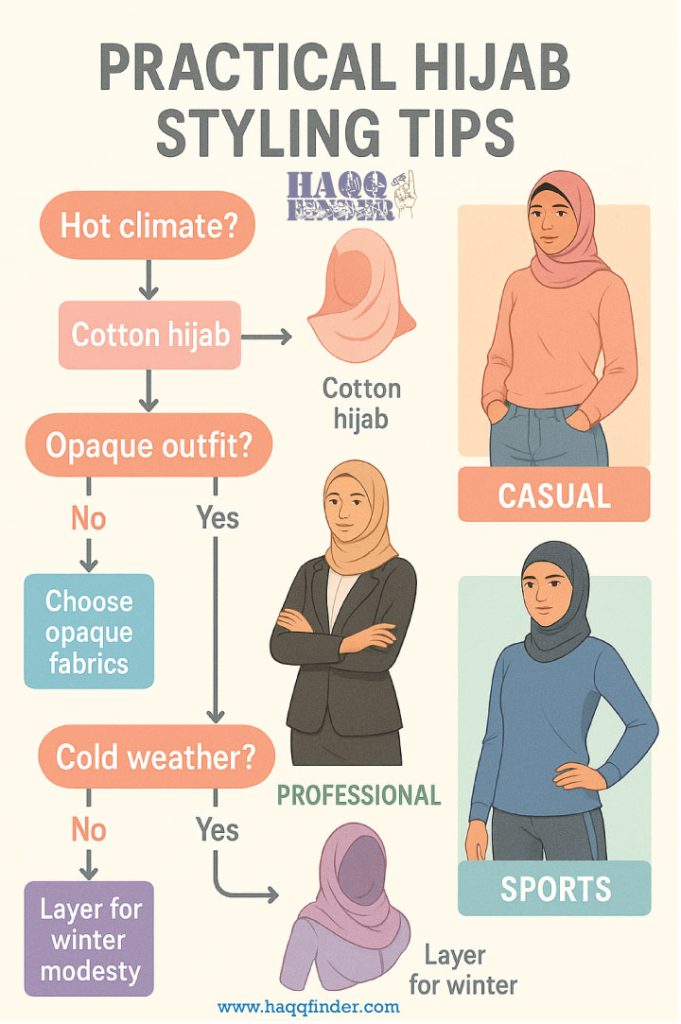
Fabrics and Comfort
- Summer: Lightweight cotton, linen, or chiffon hijabs for breathability.
- Winter: Wool scarves and layered abayas for warmth.
- Tropical Climates: Batik or silk for humidity, ensuring opacity.
Colors and Styles
Any modest color is permissible; black is traditional but not mandatory. Avoid flashy designs.
Examples:
- Casual: Maxi dresses or tunics with hijabs.
- Formal: Embroidered abayas or anarkali suits for weddings.
Professional Settings
Tailored abayas, long blazers, or tunics meet workplace dress codes. Laila, a Canadian lawyer, won a 2021 case to wear her hijab in court, inspiring others.
Sports and Physical Activity
Modest sportswear, like Nike’s Pro Hijab, ensures coverage and flexibility. Zainab, a UK runner, uses moisture-wicking hijabs for marathons.
Special Occasions
For Eid or weddings, women wear embellished jilbabs or saris with pinned headscarves, balancing elegance and modesty.
Tips for Public Spaces
- Mosques: Opt for jilbabs or niqabs in conservative settings.
- Secular Spaces: Hijabs with loose clothing suffice, respecting local norms.
Contemporary Debates and Challenges
Choice vs. Obligation
Some view hijab as empowering, resisting objectification, while others face societal pressure. Muslim feminists like Fatema Mernissi argue it liberates women from the male gaze, while critics see it as patriarchal (Mernissi, 1991). Amina, a London student, chose hijab to assert her Somali-British identity, finding it liberating. The choice to wear hijab is often framed as both a religious duty and a personal empowerment tool. Beyond devotion to God, as mandated by Surah Al-Ahzab (33:59), many Muslim women adopt hijab to connect with their cultural heritage or assert identity in diverse societies. For instance, Amina views her hijab as a rejection of Western beauty standards, aligning with the article’s empowerment narrative. This cultural connection is a source of pride, reflecting traditional norms in Muslim-majority regions where hijab signifies community belonging, countering misconceptions of coercion rooted in the Quranic directive (24:31).
Cultural vs. Religious Norms
Cultural practices, like Afghanistan’s burqa, are often mistaken for universal mandates, confusing. In Pakistan, tribal customs may emphasize purdah beyond religious requirements.
The debate over cultural versus religious norms in Islamic dress is heightened by the Quran-only perspective, which asserts that head covering (hijab) as a mandatory practice stems from pre-Islamic Jewish and Christian traditions, later embedded in hadith rather than Quranic law.
Historical evidence shows head covering as a widespread cultural practice among Arabs, Jews, and Christians, including Jewish women in synagogues and Christian nuns, predating Islam. In some regions, like North Africa’s Tuareg tribe, men wear hijab-like veils, reversing the gender norm, underscoring its traditional, not religious, roots.
This view argues that mixing religion with such traditions constitutes shirk (Surah Ash-Shura 42:21), as it equates human customs with God’s law. Critics of this stance, however, maintain that hadith-based hijab rules complement Quranic guidance, reflecting a broader Islamic heritage.
Islamophobia and Legal Bans
In Western countries, hijabi women face discrimination. France’s 2010 face-covering ban and Tajikistan’s hijab restrictions spark religious freedom debates. In 2022, the US EEOC reported a 20% rise in hijab-related workplace complaints. Conversely, Iran’s mandatory hijab laws, with penalties for “bad hijab,” led to 2022 protests. Turkey’s 2013 lifting of hijab bans in public institutions reflects progress.
Feminist Perspectives
Muslim feminists like Amina Wadud emphasize hijab as a choice, while Western critics argue it reinforces gender inequality. The debate highlights diverse interpretations of empowerment.
Modest Fashion Industry
The global modest fashion market, valued at $402 billion in 2024, is a vibrant space. Brands like Modanisa, Aab, and Nike cater to Muslim women with stylish hijabs, abayas, and burkinis. Designers like Hana Tajima collaborate with global retailers, blending modesty with high fashion. Fashion weeks in Dubai, Jakarta, and London showcase trends, from embellished abayas to sustainable fabrics.
Key Trends
- Sustainable Fashion: Eco-friendly hijabs using organic cotton or recycled materials.
- Athleisure: Modest sportswear for athletes, like Adidas’s full-coverage swimsuits.
- Social Media: Hijabi influencers amplify trends, with 1.2 million posts in 2024.
Case Study: Jakarta Fashion Week
Jakarta Fashion Week 2024 featured batik jilbab and layered kebayas, highlighting Indonesia’s role as a modest fashion hub. Designers like Dian Pelangi emphasize cultural heritage (UK Modest Fashion, 2023).

Future Trends
Sustainable Modest Fashion
Brands like Veil Garments use eco-friendly materials, appealing to environmentally conscious Muslims. Organic cotton hijabs and recycled polyester abayas are gaining traction.
Technology and Innovation
AI-designed hijabs and virtual try-on apps (e.g., Modanisa’s AR tool) enhance accessibility. E-commerce platforms drive global sales, with 30% growth in 2024 (Thomson Reuters, 2023).
Global Integration
As modest fashion gains mainstream acceptance, retailers like H&M and Zara offer hijab-friendly lines. The 2025 Paris Fashion Week is expected to feature modest designs, signaling inclusivity.
FAQs
- Is hijab mandatory in Islam? Most scholars deem it obligatory (Quran 24:31), but interpretations vary.
- Can I wear colors besides black? Yes, any modest color is permissible.
- How do I choose hijab-friendly fabrics? Opt for opaque, breathable materials like cotton or linen.
- What’s the difference between hijab and niqab? Hijab covers hair and chest; niqab includes the face, leaving eyes visible.
- How can I style hijab for work? Pair long tunics with tailored trousers and a hijab for professionalism.
Conclusion
The Islamic dress code for females is a dynamic blend of faith, modesty, and cultural expression. Rooted in Quranic and Prophetic guidance, it emphasizes coverage, simplicity, and dignity while allowing flexibility for personal and cultural styles. From Ayesha’s vibrant salwar kameez in Pakistan to Sarah’s maxi dresses in the US, Muslim women embody haya with creativity. Despite challenges like Islamophobia or legal bans, the $402 billion modest fashion industry and global sisterhood highlight empowerment. Share your hijab story on X with #IslamicDress to join the conversation!
References
- Ahmed, L. (2011). A Quiet Revolution: The Veil’s Resurgence. Yale University Press.
- Al-Hashimi, M. A. (1998). The Ideal Muslimah. International Islamic Publishing House.
- Al-Qaradawi, Y. (1999). The Lawful and the Prohibited in Islam. American Trust Publications.
- Haddad, Y. Y., & Smith, J. I. (2009). Muslim Women in America. Oxford University Press.
- Mernissi, F. (1991). The Veil and the Male Elite. Perseus Books.
- Scott, J. W. (2007). The Politics of the Veil. Princeton University Press.
- Tarlo, E. (2010). Visibly Muslim: Fashion, Politics, Faith. Berg Publishers.
- Wadud, A. (2006). Inside the Gender Jihad. Oneworld Publications.
- Thomson Reuters. (2018). State of the Global Islamic Economy Report 2018/19. Thomson Reuters.
- Reuters. (2023). Sustainable Fashion Trends. reuters.com.
- Quran, Surah An-Nur (24:31).
- Quran, Surah Al-Ahzab (33:59).
- Sahih Al-Bukhari, Hadith 4758.
- Sahih Muslim, Hadith 2128.
- Sunan Tirmidhi, Hadith 1173.
- Sunan Abu Dawud, Hadith 1826, 4091.
- IslamQA. (2023). Conditions of Muslim Women’s Dress. islamqa.info.
- Fiqh Islamonline. (2023). Guidelines on Islamic Dress. islamonline.net.
- ILM Seekho. (2023). Modesty in Islam. ilmseekho.com.
- UK Modest Fashion. (2023). Understanding Hijab. ukmodestfashion.com.
- AP News. (2023). Iran’s Hijab Enforcement. apnews.com.
- FT.com. (2023). Iran’s Fashion Trends Post-Protests. ft.com.