

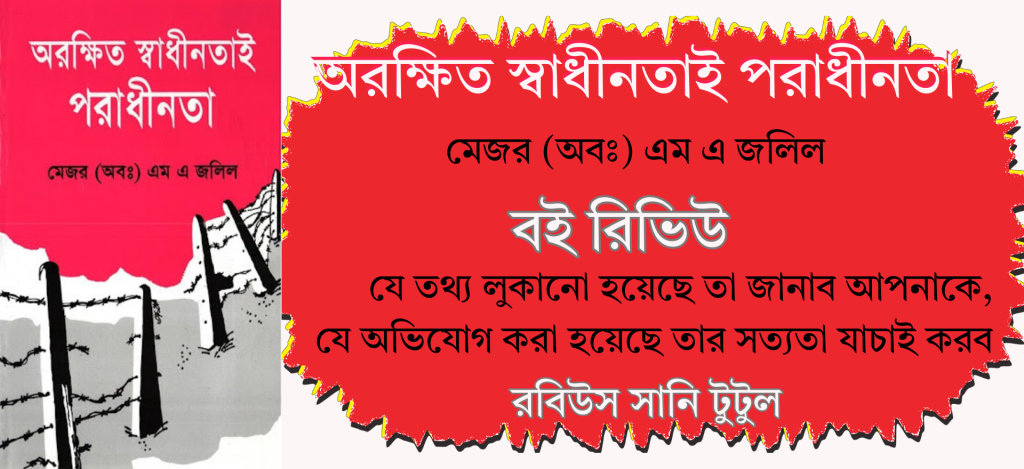
The book “Unprotected Freedom Is Slavery” (translated as অরক্ষিত স্বাধীনতাই পরাধীনতা in Bangla) is a profound and multifaceted analysis of freedom. Freedom is a unique achievement in the life of our nation, but preserving and properly exercising this achievement ensures true liberation. The author explores the deep meaning of freedom, its limitations, and the indispensable connection between security and responsibility. Freedom is not merely a right but also a great responsibility, without which freedom becomes meaningless and fragile.
Reassessing the Nature and Values of Freedom
At the beginning of the book, the author analyzes the multidimensional meaning of freedom. Freedom is not only political control or liberation from external rule but also equally applicable in social, economic, cultural, and personal spheres. The author describes how, without proper protection, freedom can turn into a new form of slavery. Even after achieving political independence, if social instability, lawlessness, and intolerance persist among citizens, then that freedom does not function properly for society.
The protection of freedom is intrinsically linked with responsibility. It is a social contract where every individual and institution enjoys rights while fulfilling their responsibilities. Civic awareness, social unity, and responsible governance act as the three pillars supporting this contract. The book discusses these issues with references to Bangladesh’s independence history alongside contemporary political and social realities.
Challenges to Freedom: Disorder and Irresponsibility
The author analyzes how, after gaining freedom, countries often face various internal challenges such as political disorder, corruption, mismanagement, social division, and economic inequality. These challenges prevent the benefits of freedom from reaching all levels of society adequately. The author explains how corrupt leadership, selfishness, and social apathy damage freedom. This poses a significant threat not only to the state but also to every citizen.
Especially when law and order are lacking, freedom becomes truly “unprotected.” In such circumstances, freedom remains only on paper or in political rhetoric, while people suffer from various fears and insecurities. Consequently, a new form of slavery emerges, far more damaging and fragile than physical bondage.
Freedom and Responsibility: The Need for Collective Consciousness
One of the main strengths of the book is emphasizing the inseparable relationship between freedom and responsibility. The author strongly asserts that freedom is not only a right but also a social and moral duty. If people are not conscious of their responsibilities alongside exercising their rights, that freedom can never be lasting. Therefore, every citizen should have a clear understanding of their rights and duties and act accordingly.
The author also highlights the importance of civic unity in protecting freedom. He argues that without national solidarity, protecting freedom and advancing society is impossible. Political and social awareness among the people is essential for building a strong nation. The book discusses how social divisions and selfishness threaten freedom, urging citizens to overcome differences, unite, and work for the country’s welfare.
Freedom from Social and Cultural Perspectives
The book is not limited to political aspects but also discusses the importance of freedom from social and cultural perspectives. Building a healthy and strong society is possible through reassessing our heritage, the values of the liberation war, and cultural unity. The author calls on citizens to increase mutual respect and tolerance, which are the foundations of a free, peaceful, and progressive society.
Here, the connection between freedom and the nation’s morals and cultural values is clearly expressed. As conscious citizens, we should respect and protect our culture and heritage.
Practical Application and Future Challenges
The author mentions practical approaches to protecting freedom in this book. He states that political liberation alone is not sufficient for freedom; education, economic development, social justice, and equality must also be prioritized. Without these, freedom remains merely a theoretical concept on paper.
He further notes that rapidly changing technology, globalization, and multinational political influences have complicated the concept of freedom in the modern world. Therefore, our society must keep pace with these changes and be prepared to face new challenges.
Conclusion
“Unprotected Freedom Is Slavery” is a profound and eloquent analysis of the true meaning of freedom and the importance of safeguarding it. It reminds us that while achieving freedom is critical, its preservation is even more important. Freedom without security or responsibility is not real liberation but a new kind of bondage. Thus, every citizen should work for the country’s welfare with responsibility, honesty, and unity.
This book is highly recommended for political thinkers, educators, researchers, and general readers who care about the nation’s future and want to analyze social crises and opportunities. It is an essential read for anyone interested in the progress and protection of freedom.