

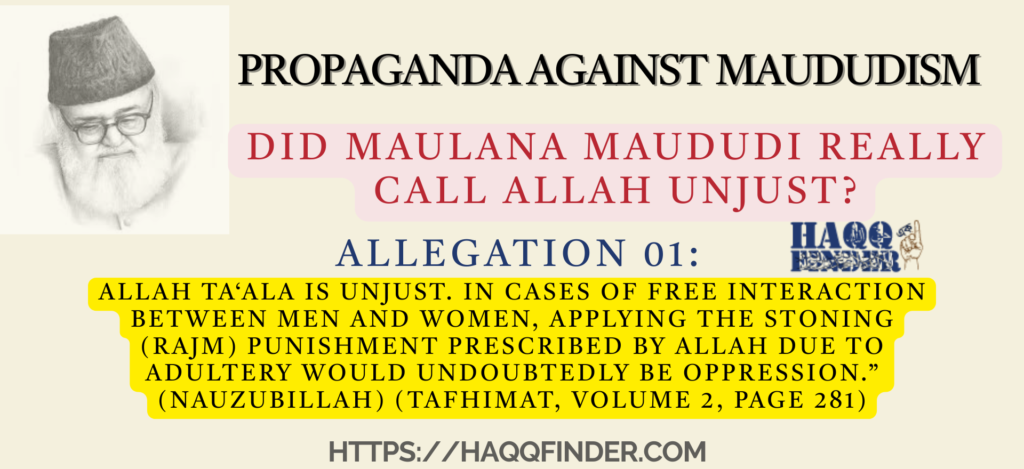
ALEGGATION 01:
Maulana Maududi’s belief about Allah Ta‘ala is that Allah Ta‘ala is unjust. The decrees given by Allah Ta‘ala can be oppressive toward His servants. Regarding the stoning (rajm) punishment prescribed by Allah in the Qur’an for a married woman committing adultery, he says: ‘In cases of free mixing between men and women, applying the rajm punishment prescribed by Allah would undoubtedly be oppression.’ (Tafhimat, Vol. 2, p. 281)”
Maulana Maududi (RA) picked up the pen for Islam at a time when the Muslim world was completely submerged under British colonial rule and the conspiracies of the Jews. At a time when Muslims in the Indian subcontinent and across the globe were subjected to widespread defamation.
The reasons for opposition against Maulana Maududi were, in most cases, fiqh-related. However, many allegations about him are based on propaganda whose existence is questionable. As a researcher and writer, it is not unusual for minor errors to occur in his research or writings. But he has been falsely accused of things that never actually existed.
Among the accusations and criticisms against him, there are several major ones. Today, we will verify one such allegation in this episode.
On social media and various so-called Islamic websites online, you will find many posts written against Maududi (RA). They are so careless that they copy-paste content without verifying its authenticity. Those who continue to spread such propaganda against Maududi (RA) — how will they stand before Allah on the Day of Judgment?
One major allegation about Shaykh Maududi (RA) is that in his book Tafhimat, he supposedly wrote:
“Maulana Maududi’s belief about Allah Ta‘ala is that Allah Ta‘ala is unjust. The decrees given by Allah Ta‘ala can be oppressive toward His servants. Regarding the stoning (rajm) punishment prescribed by Allah in the Qur’an for a married woman committing adultery, he says: ‘In cases of free mixing between men and women, applying the rajm punishment prescribed by Allah would undoubtedly be oppression.’ (Tafhimat, Vol. 2, p. 281)”
Source: Ahle Haqq Media
Verification:
One of Maududi (RA)’s most discussed works is Tafhimat. Many scholars from different schools of thought have expressed various opinions on multiple issues in this book. The above allegation relates to this book. To verify this matter, we need access to the original text.
In my research, I will provide images and translations from the original book for your understanding, so that no one can claim that I have created screenshots to falsely prove him innocent.
Even on Archive.org, you can find old copies of this book.
Here is an image from page 281 of Volume 2 of the Urdu version of Tafhimat.
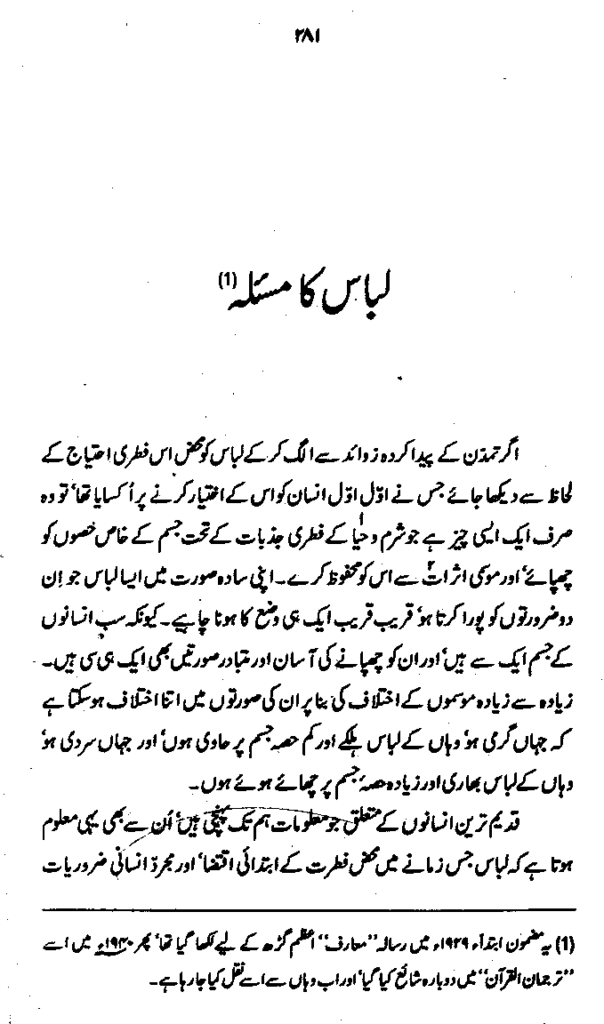
Urdu Texts: لباس کا مسئلہ
اگر تمدن کے پیدا کردہ زوائد سے الگ کر کے لباس کو محض اس فطری احتیاج کے
لحاظ سے دیکھا جائے جس نے اول اول انسان کو اس کے اختیار کرنے پر اکسایا تھا تو وہ
صرف ایک ایسی چیز ہے جو شرم و حیا کے فطری جذبات کے تحت جسم کے خاص حصوں کو
چھپائے اور موسمی اثرات سے اس کو محفوظ کرے۔ اپنی سادہ صورت میں ایسا لباس جو ان
دو ضرورتوں کو پورا کرتا ہو قریب قریب ایک ہی وضع کا ہونا چاہیے۔ کیونکہ سب انسانوں
کے جسم ایک سے ہیں، اور ان کو چھپانے کی آسان اور متبادر صورتیں بھی ایک ہی سی ہیں۔
زیادہ سے زیادہ موسموں کے اختلاف کی بنا پر ان کی صورتوں میں اتنا اختلاف ہو سکتا ہے
کہ جہاں گرمی ہو وہاں کے لباس ہلکے اور کم حصہ جسم پر حاوی ہوں اور جہاں سردی ہو
وہاں کے لباس بھاری اور زیادہ حصہ جسم پر چھائے ہوئے ہوں۔
قدیم ترین انسانوں کے متعلق جو معلومات ہم تک پہنچی ہیں ان سے بھی یہی معلوم
ہوتا ہے کہ لباس جس زمانے میں محض فطرت کے ابتدائی اقتضا اور مجرد انسانی ضروریات
(1) یہ مضمون ابتداء ۱۹۲۹ء میں رسالہ “معارف اعظم گڑھ” کے لیے لکھا گیا تھا پھر ۱۹۴۰ء میں اسے
“ترجمان القرآن” میں دوبارہ شائع کیا گیا اور اب وہاں سے اسے نقل کیا جارہا ہے۔
TRANSLATION:
Tafhīmāt, Page: 281, Volume 2, Edition 1967
On Clothing (Libās)
If we separate clothing from the unnecessary excesses created by civilization and look at it merely from the perspective of natural necessity—which originally prompted humans to adopt it—
Then it is simply an item that, under the natural feelings of modesty and shame, covers certain parts of the body and protects it from the effects of the weather.
In its simple form, clothing that fulfills these two needs should be almost of the same type.
Because all human bodies are the same, and the easy and customary ways to cover them are also similar.
Due to maximum differences in seasons, the form of clothing may vary such that in hot regions the clothing is light and covers less of the body, whereas in cold regions it is heavy and covers more of the body.
From the information we have about the earliest humans, it is also evident that in those times clothing was used solely according to the initial dictates of nature and purely human necessities.
(1) This article was originally written in 1929 for the journal Ma‘ārif-i-A‘zam Gaṛh, then republished in 1940 in Tarjumān al-Qur’ān, and it is now being cited from there.
If we observe, on page 281 of Volume 2 of Tafhīmāt, there is no discussion of free mixing of men and women. The focus is primarily on clothing (libās) and its original purpose and natural limitations.
We can see this more clearly in the following pages.
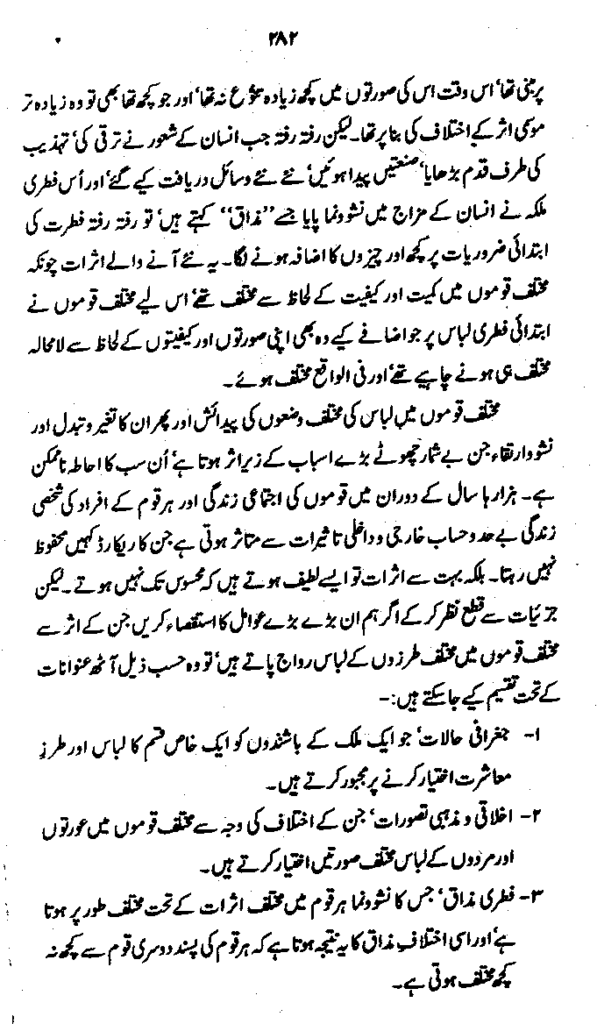
Tafhimat, Page: 281, Volume 2, Edition 1967
Clothing and the Influence of Civilization
At that time, when clothing was based solely on basic natural needs, there was not much variety in its forms, and whatever variety existed was mainly due to differences in seasonal effects.
But gradually, as human consciousness developed, civilization advanced, industries were created, new resources were discovered, and that natural faculty in humans—known as “taste” (ذوق)—developed in their temperament.
Gradually, additional elements began to be added on top of the initial natural needs.
Since these new influences varied in quantity and quality among different nations, the modifications each nation made to its original natural clothing inevitably differed in form and characteristics—and indeed, they did differ.
The emergence of various clothing styles among different nations, their changes, transformations, and evolution are influenced by countless small and large factors, which cannot all be comprehensively covered.
Over thousands of years, the social life of nations and the personal lives of individuals are affected by innumerable external and internal influences, most of which are not recorded anywhere.
Many of these influences are so subtle that they are barely perceptible.
However, leaving aside these minor details, if we examine the major factors that have caused different nations to adopt different styles of clothing, they can be divided under the following eight headings:
Natural taste (ذوق) — whose development in each nation, under different influences, produces different styles.
Geographical conditions — which compel the inhabitants of a country to adopt a particular type of clothing and lifestyle.
Moral and religious concepts — whose differences lead men’s and women’s clothing to take distinct forms among different nations.
If we examine the texts on pages 281–282 of the Tafhimat, we will see that these pages, and even this entire chapter, do not contain any discussion about stoning (rajm). And calling Allah unjust (Nauzubillah) is absolutely out of the question!
FINAL RESULTS:
It is therefore extremely clear that Abul A‘la Maududi, in Volume 2 of Tafhimat Page 280-282, nowhere makes any statement that could be considered disrespectful to the honor or attributes of Allah. Yet, some self-styled scholars have jumped into spreading propaganda against him. On the Day of Judgment, ordinary people will stand as witnesses against these scholars. Those who work in the service of religion are not above mistakes—but spreading such false accusations is completely unacceptable and impermissible.
In Islam, making false accusations (lying or slander) against anyone is strictly prohibited. The Qur’an gives clear guidance that no Muslim should harm the honor or character of another. Allah Ta‘ala says:
“Whoever fabricates a lie against Allah or His Messenger, then surely a severe punishment awaits him.”
(Surah An-Nur 24:19)
Additionally, in Surah Al-Hujurat (49:12), Muslims are warned to refrain from defaming or insulting one another.
The Hadith of Rasulullah ﷺ also mentions severe consequences for false accusations. In Sahih Muslim, it is stated:
“Whoever accuses a Muslim of something false has declared war against Islam.”
(Sahih Muslim, Hadith 2599)
In other words, false accusations not only create social problems but also go against Deen and ethics. Protecting a Muslim’s faith, honor, and social dignity is a fundamental goal of Islam. Rasulullah ﷺ instructed that one must verify the truth before making any accusation.
Slander and false accusations create disorder, division, and propaganda in society. Islamic ethics emphasize that honesty, justice, and respect for human dignity are the responsibilities of every Muslim. Unverified claims are never acceptable.
For example, if someone falsely accuses another of theft or adultery, it is not only a crime but also a major sin according to Islamic law, with severe punishment in the Hereafter.
In Islam, spreading lies, deceit, or baseless allegations is dangerous both socially and spiritually. Acting with honesty and justice is the moral duty of every Muslim.
FINAL WORDS:
Those who have spread false propaganda against Maududi (RA), prepare to stand before Allah’s court as oppressors. Repent, stop the propaganda, and seek forgiveness immediately. Remember: falsehood never triumphs over truth. It will remain defeated until the Day of Judgment, Insha’Allah.