Summary & Key Themes
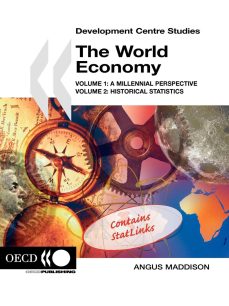
The World Economy by Angus Maddison is an ambitious study of the development of the global economy over an exceptionally long historical period. Bringing together A Millennial Perspective and Historical Statistics, the combined edition examines changes in population, gross domestic product (GDP), income per person, international trade, and the economic performance of different regions.
Maddison's central contribution is his attempt to reconstruct economic history quantitatively. Rather than examining individual countries or historical events in isolation, he compares regions across centuries, asking how economic leadership shifted, why some economies grew faster than others, and how the gap between richer and poorer societies developed.
Major Themes
1. The Long-Term Evolution of the World Economy
Maddison traces changes in population and economic output across a millennium. His estimates challenge the assumption that Europe and North America have always been the principal centres of global prosperity. His reconstruction presents a world in which major Asian economies occupied important positions before the rise of Western industrial power.
2. The Rise of Western Economic Dominance
The book investigates the economic transformation of Western Europe and the subsequent rise of countries such as Britain and the United States. Maddison considers the roles of technological innovation, trade, capital accumulation, institutions, and political power in explaining these changes.
3. Western Expansion and Its Effects on Other Regions
A substantial part of the historical narrative examines the consequences of Western expansion in Asia, Africa, and the Americas. It considers commercial networks, imperial expansion, and the ways relationships between Western powers and other societies affected economic development. This makes the book relevant to readers studying colonialism and global inequality, although its quantitative framework does not replace detailed histories of individual colonial societies.
4. Economic Growth and Global Inequality
By comparing estimates of GDP per capita across countries and periods, Maddison explores the emergence of major differences in living standards. The data provide a framework for investigating when economic divergence occurred and how it relates to industrialisation, demographic change, technology, and international economic relationships.
5. Historical Statistics as a Research Tool
The statistical volume supplies extensive estimates and regional comparisons intended to support further research. Its emphasis on measurement makes the work useful not only for understanding Maddison's conclusions but also for researchers developing their own interpretations of long-term economic change.
Together, the two volumes combine a broad interpretive account of world economic history with a substantial body of historical data. The OECD describes the combined publication as a reference work for economics, economic history, and statistical research.
Critical Analysis
The greatest strength of The World Economy is its historical scope. Maddison attempts to make economic development across centuries and continents comparable through a consistent quantitative framework. This approach enables readers to move beyond isolated national narratives and examine the changing distribution of economic power across the world.
A Major Contribution to Quantitative Economic History
Historical comparisons are difficult because reliable national accounts did not exist for most of the periods Maddison studies. The author therefore reconstructs estimates from incomplete historical evidence, using available demographic, economic, and documentary sources. The resulting series are valuable for identifying broad patterns that would otherwise be difficult to examine systematically.
However, the figures should not be mistaken for precise modern measurements. Estimates of output and income in earlier centuries necessarily depend on assumptions, indirect evidence, and the interpretation of incomplete records. Maddison's data are best understood as informed historical reconstructions rather than exact measurements of past economies.
Reconsidering the History of Global Prosperity
One of the book's most important implications is that the current distribution of global wealth is historically contingent. Maddison's reconstruction shows that the relative economic position of major regions has changed considerably over time. This challenges simplistic accounts in which Western prosperity is treated as a timeless condition or the result of a single, universal development path.
His comparative approach is particularly useful for studying Asia's earlier economic importance and the later emergence of Western industrial leadership. Nevertheless, aggregate GDP and GDP-per-capita estimates cannot, by themselves, fully explain the political, institutional, cultural, or social causes of these transitions.
Colonialism and Unequal Economic Relationships
The volume's discussion of Western expansion makes it relevant to debates about colonialism and the origins of global inequality. Maddison examines how trade, territorial expansion, and relationships between Western powers and other regions shaped economic development. His work offers a quantitative framework for investigating these questions rather than relying exclusively on political narratives.
Yet economic aggregates have limits when assessing colonial exploitation. GDP growth alone cannot establish whether a population benefited fairly from economic activity, how wealth was distributed, or how coercion, dispossession, forced labour, and political subordination affected ordinary people. A careful reader should therefore combine Maddison's comparisons with specialised studies of colonial administration, labour, taxation, trade, and living standards.
The Strengths and Limits of GDP
GDP and GDP per capita provide a common basis for comparing economic output, but they are not complete measures of human welfare. They do not adequately capture the distribution of income, unpaid work, political freedom, environmental damage, or the full human consequences of economic change. A region's estimated average income can rise while large sections of its population remain poor.
Maddison's statistical approach is most convincing when used to identify broad trends and formulate historical questions. It is less conclusive when a reader seeks a complete account of social welfare or a single explanation for why one society became richer than another.
Overall Assessment
The World Economy is a foundational reference for long-run economic comparisons, not a final or uncontested explanation of world history. Its value lies in the scale of its reconstruction, the questions it makes possible, and the evidence it assembles. Readers should appreciate its achievement while remaining attentive to uncertainty in historical estimates and to the social realities that aggregate statistics can conceal.