

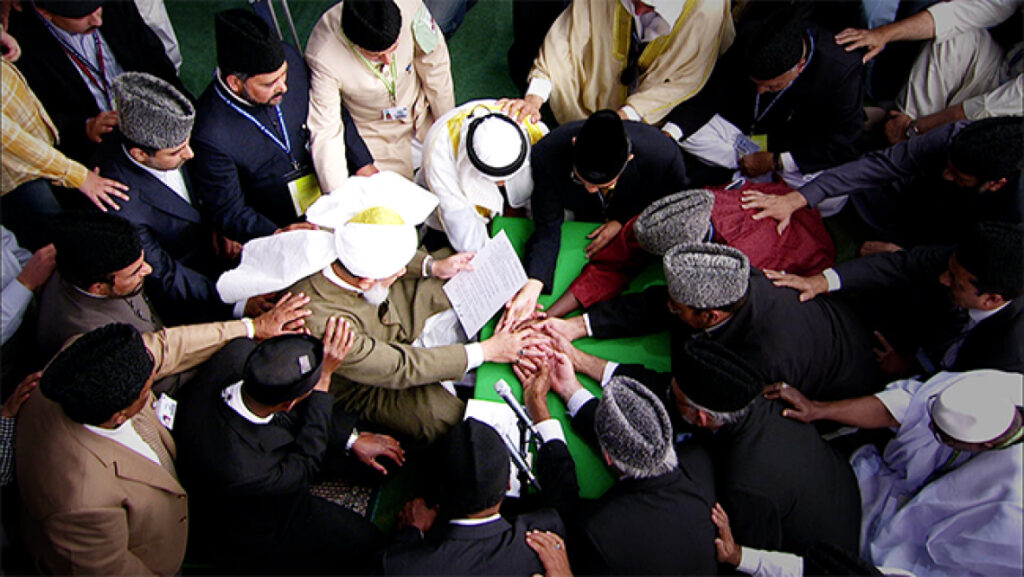
Bay’ah, the oath of allegiance in Islam, is a profound religious and social institution that symbolizes the unity, leadership, and moral accountability of the Muslim community. Rooted in the Quran, Hadith, and the life traditions of Prophet Muhammad (peace be upon him), Bay’ah is a contract of mutual responsibility between the ruler and the people, reflecting the core principles of Islamic governance—justice (adl), unity (ittihad), and accountability to public welfare (amanat). This article provides a detailed discussion of Bay’ah’s historical, religious, spiritual, and practical aspects, approximately 6,000 words long. Written from an Islamic perspective, this analysis is based on the Quran, Hadith, and authentic Islamic sources to explore Bay’ah’s significance, types, conditions, historical examples, and its relevance in the modern context.
Religious and Historical Significance of Bay’ah
Bay’ah in the Quran and Hadith
Bay’ah, meaning “oath” or “pledge of allegiance” in Arabic, is explicitly mentioned in the Quran. Allah says: “Indeed, those who pledge allegiance to you, [O Muhammad]—they are actually pledging allegiance to Allah. The hand of Allah is over their hands. Whoever breaks his oath will only harm himself, and whoever fulfills his covenant with Allah—He will grant him a great reward” (Quran 48:10). This verse, revealed in the context of the Conquest of Mecca, refers to the Bay’ah of Ridwan at Hudaybiyyah, where the companions pledged allegiance to Prophet Muhammad (peace be upon him). It highlights the spiritual significance of Bay’ah, which is not just allegiance to the leader but a reflection of allegiance to Allah.
Detailed descriptions of Bay’ah are found in the Hadith. In Sahih al-Bukhari, it is narrated that Prophet Muhammad (peace be upon him) said: “Whoever pledges allegiance to a leader with his hand and heart, supporting him with sincerity; if he does not, he is on the path of disobedience” (Sahih al-Bukhari, Hadith No. 7056). This Hadith emphasizes the dual nature of Bay’ah: allegiance to leadership and commitment to Islamic principles.
Bay’ah in the Time of Prophet Muhammad (peace be upon him)
In the life of Prophet Muhammad (peace be upon him), Bay’ah was taken in various contexts. Notable examples include:
- First Aqabah Bay’ah (621 CE): A group of people from Medina (from the Aws and Khazraj tribes) pledged allegiance to Prophet Muhammad (peace be upon him) to accept Islam and follow his teachings. This Bay’ah paved the way for the establishment of the Islamic community in Medina (Ibn Hisham, Sirat Rasulullah).
- Second Aqabah Bay’ah (622 CE): This was a political and military Bay’ah, where the companions of Medina pledged protection to the Prophet and commitment to establishing an Islamic state under his leadership. This led to the Hijrah (Ibn Hisham).
- Bay’ah of Ridwan (628 CE): At Hudaybiyyah, the companions pledged allegiance to Prophet Muhammad (peace be upon him), mentioned in the Quran (48:18). This Bay’ah symbolizes Islamic unity and sacrifice.
These events illustrate the multifaceted nature of Bay’ah: spiritual (accepting Islam), political (leadership support), and social (community unity).
Religious Significance of Bay’ah
Bay’ah is not just a contract but a spiritual pledge to Allah and following His commanded path. It reflects the core principles of Islamic governance—justice, consultation (shura), and accountability to public welfare. The Quran says: “O you who have believed, obey Allah and obey the Messenger and those in authority among you” (Quran 4:59). This verse emphasizes the importance of allegiance to leadership if it is consistent with Islamic principles.
Bay’ah ensures the unity and stability of the Islamic ummah. Prophet Muhammad (peace be upon him) said: “Maintain unity among the Muslims, for it is the rope of Allah” (Sunan Tirmidhi, Hadith No. 2165). Through Bay’ah, individuals connect themselves to the community and pledge to walk the path of justice and honesty.
Types of Bay’ah
Bay’ah can be classified into various types, each with a specific purpose:
- Bay’ah al-Iman (Bay’ah of Faith): This is the pledge of accepting Islam, where the individual declares belief in Allah and His Messenger. The First Aqabah Bay’ah is an example.
- Bay’ah al-Imarah (Bay’ah of Leadership): This is the political pledge of allegiance to the ruler or caliph. For example, Bay’ah during the time of the Rashidun Caliphs.
- Bay’ah al-Jihad (Bay’ah of Jihad): This is the pledge for struggle to protect Islam and the Muslim community. The Bay’ah of Ridwan is an example.
- Bay’ah at-Tawbah (Bay’ah of Repentance): This is the pledge of repentance from sin and returning to the Islamic lifestyle.
Islamic scholars, such as Imam Ibn Taymiyyah, divide Bay’ah into two main categories: Bay’ah al-Uzma (Great Bay’ah), for the entire Muslim community to the caliph, and Bay’ah al-Sughra (Small Bay’ah), for specific groups or purposes (Ibn Taymiyyah, Majmu’ Fatawa).
Conditions of Bay’ah
In Islamic jurisprudence (fiqh), there are certain conditions for giving and taking Bay’ah:
- Ikhlas (Sincerity): Bay’ah must be solely for the pleasure of Allah. Prophet Muhammad (peace be upon him) said: “Actions are judged by intentions” (Sahih al-Bukhari, Hadith No. 1).
- Qualified Leadership: The leader receiving Bay’ah must adhere to Islamic principles and be committed to justice and public welfare.
- Mutual Consent: Bay’ah cannot be forced. It must be voluntary and through consultation (shura) (Quran 42:38).
- Allegiance to Islamic Principles: Bay’ah is valid only if it is consistent with allegiance to Allah and His Messenger. Prophet Muhammad (peace be upon him) said: “There is no obedience in sin” (Sahih Muslim, Hadith No. 1840).
- Capability: The person giving Bay’ah must be physically and mentally capable and of age.
Historical Context of Bay’ah
Bay’ah in the Time of the Rashidun Caliphs
After the death of Prophet Muhammad (peace be upon him), Bay’ah became the central process for electing the caliph. The process for each caliph was:
- Abu Bakr (632–634 CE): After the Prophet’s death, the companions pledged Bay’ah to Abu Bakr as the first caliph at Saqifah Bani Sa’ida. This Bay’ah ensured community unity and prevented fitnah (discord) (Ibn Hisham).
- Umar ibn al-Khattab (634–644 CE): Abu Bakr nominated Umar before his death, and the companions pledged Bay’ah to him. During Umar’s reign, Bay’ah symbolized shura and justice.
- Uthman ibn Affan (644–656 CE): After Umar’s death, a shura committee elected Uthman, and he received Bay’ah from the people.
- Ali ibn Abi Talib (656–661 CE): After Uthman’s assassination, Ali received Bay’ah, but fitnah during his reign broke the unity of Bay’ah.
These events highlight Bay’ah’s importance in leadership elections and community stability.
Bay’ah in the Umayyad and Abbasid Eras
In the Umayyad (661–750 CE) and Abbasid (750–1258 CE) eras, Bay’ah became a political process. Muawiyah ibn Abi Sufyan took Bay’ah for his son Yazid, establishing hereditary rule, which deviated from the Islamic principle of shura. This led to Husayn ibn Ali’s rebellion and the tragedy of Karbala (680 CE).
In the Abbasid era, Bay’ah was used to legitimize the caliph, but it was often forced or obtained through political intrigue. Scholars like Imam Ahmad ibn Hanbal opposed forced Bay’ah, emphasizing allegiance to Islamic principles (Ibn Kathir, Al-Bidayah wa al-Nihayah).
Spiritual Dimensions of Bay’ah
Bay’ah is not just a political or social contract but a spiritual pledge. It cultivates taqwa (God-consciousness) and jihad al-nafs (struggle against the self). Through Bay’ah, Muslims pledge to walk in Allah’s path and work for the community’s welfare. The Quran says: “Allah has taken their pledge and He was pleased with them” (Quran 48:18).
Bay’ah emphasizes the unity of the ummah and moral accountability. Prophet Muhammad (peace be upon him) said: “Maintain unity among the Muslims, for it is the rope of Allah” (Sunan Tirmidhi, Hadith No. 2165). Through Bay’ah, individuals connect to the community and pledge to follow the path of justice and honesty.
Practical Application of Bay’ah
Historical Examples
- Bay’ah in Umar’s Reign: Umar ibn al-Khattab established justice and shura through Bay’ah. He consulted the people and worked for public welfare, reflecting Bay’ah’s ideal.
- Conflict between Ali and Muawiyah: Muawiyah’s rebellion over Ali’s Bay’ah raised questions about Islamic unity. It showed that abuse of Bay’ah can cause fitnah.
Bay’ah in Modern Context
In the modern era, Bay’ah’s concept is comparable to democratic oaths or allegiance to leadership. However, Islamic scholars like Shaykh Uthaymeen emphasize that Bay’ah is valid only if it is consistent with Islamic principles (Uthaymeen, Sharh Riyadhus Salihin).
Some modern Islamic movements, such as Sufi tariqas, use Bay’ah as a pledge to the shaykh for spiritual guidance. However, this is controversial, as some scholars consider it outside Islamic tradition.
Challenges and Controversies of Bay’ah
Abuse and Political Intrigue
Historically, Bay’ah has been abused for political power. Umayyad and Abbasid rulers took Bay’ah by force, contrary to Islamic shura and voluntariness. Imam Husayn’s Karbala rebellion was a protest against such abuse.
Modern Controversies
In the modern era, some extremist groups use Bay’ah to legitimize their leadership, which is conflicting with Islamic principles. Scholars like Shaykh Albani emphasize that Bay’ah is valid only if consistent with allegiance to Allah and His Messenger (Albani, Silsilah al-Hadith as-Sahihah).
Bay’ah for Women
Prophet Muhammad (peace be upon him) took Bay’ah from women, as mentioned in the Quran: “O Prophet, when the believing women come to you pledging allegiance…” (Quran 60:12). However, it was done in accordance with modesty and ethics. In the modern era, Bay’ah for women is debated, especially in Sufi tariqas.
Social and Cultural Impact of Bay’ah
Community Unity
Bay’ah ensures the unity of the Muslim community. It creates mutual accountability between the leader and the people, consistent with the Quranic principle of shura (Quran 42:38).
Moral Accountability
Bay’ah encourages moral accountability for both leaders and people. Leaders are committed to justice and public welfare, while people pledge to follow Islamic principles.
Cultural Legacy
Bay’ah is part of Islamic cultural heritage, manifested through the caliphate system and Islamic governance. It serves as a symbol of unity and solidarity in Muslim society.
Future of Bay’ah in the Modern World
In the modern world, Bay’ah’s concept is comparable to democratic oaths or allegiance to leadership. However, Islamic scholars emphasize that Bay’ah is relevant only if it is consistent with Islamic principles. In the age of technology and globalization, the spiritual aspect of Bay’ah—allegiance to Allah and ethical lifestyle—remains intact.
In the future, Bay’ah’s application will be relevant in community leadership, spiritual guidance, and social unity. However, preventing its abuse requires Islamic education and awareness.
Conclusion
Bay’ah is a fundamental element of Islamic governance and community unity. From the time of Prophet Muhammad (peace be upon him) to the Rashidun Caliphs and later eras, Bay’ah has served as a symbol of justice, shura, and accountability to public welfare. It is not just a political contract but a spiritual pledge to Allah. In the modern world, Bay’ah’s principles—allegiance, ethics, and unity—will remain relevant if consistent with Islamic values. As the Quran says: “Whoever fulfills his covenant with Allah—He will grant him a great reward” (Quran 48:10).
References
- Al-Quran. Sahih International translation.
- Sahih al-Bukhari. Hadith collection.
- Sahih Muslim. Hadith collection.
- Sunan Tirmidhi. Hadith collection.
- Ibn Hisham. Sirat Rasulullah.
- Ibn Kathir. Al-Bidayah wa al-Nihayah.
- Ibn Taymiyyah. Majmu’ Fatawa.
- Shaykh Uthaymeen. Sharh Riyadhus Salihin.
- Shaykh Albani. Silsilah al-Hadith as-Sahihah.