

Introduction
Titumir, born as Syed Mir Nisar Ali, is remembered as a legendary anti-British leader and religious reformer in the history of Bengal. His leadership in constructing the Bamboo Fortress (Bansher Kella) and spearheading the Barasat Rebellion remains an enduring symbol of resistance against British colonial rule. Titumir’s movement was not merely a call for religious reform but a mass uprising against the oppression of zamindars (landlords) and British indigo planters, uniting Hindu and Muslim peasants. This article provides a detailed analysis of Titumir’s life, the influence of the Wahabi movement, the construction of the Bamboo Fortress, his anti-British struggle, and his lasting legacy.
Table of Contents
ToggleBiography of Titumir
Early Life and Education
Titumir was born on January 27, 1782 (14 Magh, 1182 Bangla calendar) in Chandpur (alternatively Haiderpur) village, under the Basirhat subdivision of North 24 Parganas district in West Bengal, into a Sunni Muslim family. His father, Syed Mir Hasan Ali, and mother, Abida Rukaiya Khatun, were devout and respected individuals. The family claimed descent from Hazrat Ali, the fourth caliph of Islam. One of Titumir’s ancestors, Syed Shahadat Ali, migrated from Arabia to Bengal to propagate Islam. Shahadat Ali’s son, Syed Abdullah, served as the chief qazi (judge) of Jafarpur under the Delhi Sultanate and was conferred the title ‘Mir Insaaf’ (Justice Mir). Descendants of this lineage used both ‘Mir’ and ‘Syed’ titles.
Titumir received his primary education at a village school before studying at a local madrasa, where he gained proficiency in the Quran, Hadith, and Islamic jurisprudence (fiqh). He mastered the Arabic and Persian languages and excelled in religious knowledge. In his youth, he worked as a lathial (armed retainer) for various zamindars in Nadia and 24 Parganas districts. During this period, he witnessed firsthand the exploitation and oppression of peasants by zamindars, which ignited a rebellious spirit within him. His physical prowess and courage earned him local fame, and he became known as ‘Titu Miyan’.
Pilgrimage to Mecca and Influence of the Wahabi Movement
In 1822, Titumir embarked on a pilgrimage to Mecca, where he came under the influence of the renowned Islamic reformer and revolutionary leader Syed Ahmad Barelvi. Syed Ahmad was a proponent of the Wahabi movement in the Indian subcontinent, advocating for the restoration of pure Islamic practices and resistance against foreign rule. He emphasized the eradication of shirk (polytheism), bid’ah (innovations in religion), and superstitions. Deeply inspired, Titumir became Syed Ahmad’s disciple and returned to Bengal in 1827.
Upon his return, Titumir began preaching Islamic teachings and reforms in the districts of 24 Parganas, Nadia, and Faridpur. He urged Muslims to abandon practices like excessive veneration of pirs (saints), usury, and idolatry. He famously declared, “There is no need to build mosques to honor pirs and prophets.” His sermons and reform efforts gained widespread popularity, particularly among poor Muslim weavers and peasants. His followers adopted the ‘tahband’ (a type of cloth) instead of the traditional dhoti, which became a symbol of his movement.
Resistance Against Zamindari Oppression
In the late 18th and early 19th centuries, British colonial rule strengthened the zamindari system in Bengal. Following the British victory at the Battle of Plassey (1757), the East India Company relied on zamindars to collect revenue, leading to widespread peasant exploitation. Hindu zamindars, in particular, imposed illegal taxes on Muslim peasants, such as the ‘beard tax’ (for keeping beards) and ‘mosque tax’. Additionally, British indigo planters coerced peasants into cultivating indigo, further exacerbating their plight.
Titumir raised his voice against these injustices. He confronted Krishna Deb Ray, a Hindu zamindar of Purar, who had imposed oppressive taxes on Muslims. Titumir opposed these taxes and rallied his followers for religious and social reforms while resisting zamindari exploitation. His movement rapidly gained traction, amassing around 15,000 followers, including both Hindu and Muslim peasants.
Formation of the Mujahid Force
Titumir organized a mujahid (holy warrior) force, appointing his nephew Golam Masum as its commander. The force was trained in the use of lathis (bamboo sticks), swords, and indigenous weapons. Titumir instilled military discipline and religious zeal in his followers, who comprised peasants, weavers, and local impoverished communities. Under his leadership, the mujahid force achieved victories in several clashes against zamindars in Gobardanga, Taragonia, Nagpur, and Gobara-Gobindapur.
In 1831, Titumir submitted a petition to the East India Company protesting zamindari oppression but received no justice. He then demanded taxes from the zamindars of Taki and Gobardanga, prompting them to seek British assistance. A British force led by Barasat’s Collector Alexander and Basirhat’s police officer was deployed against Titumir but was defeated by his mujahid force.
Construction of the Bamboo Fortress
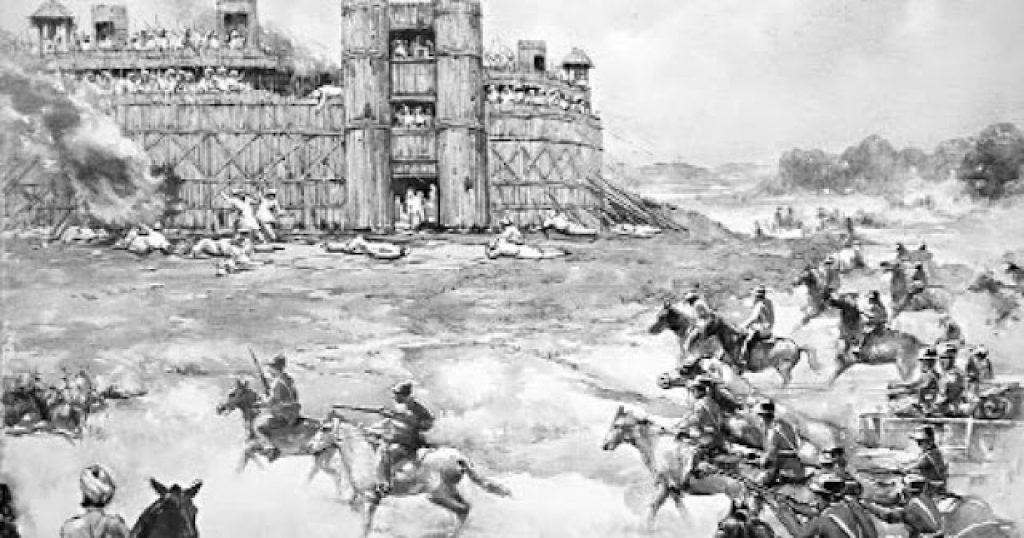
On October 23, 1831, Titumir and his mujahid force constructed an impregnable Bamboo Fortress (Bansher Kella) in Narkelbaria village near Barasat. The fortress, made of bamboo and mud, was a double-layered structure designed to withstand enemy attacks. Its construction, reliant on local materials, showcased Titumir’s ingenuity and strategic acumen. The fortress became the epicenter of his movement and a symbol of his declaration of independence from British rule.
Titumir proclaimed himself ‘Badshah’ (emperor) and appointed Mainuddin, a Wahabi follower, as prime minister and Golam Masum as commander. He declared independence in 24 Parganas, Nadia, and Faridpur, calling for jihad against British rule. From the fortress, he launched several successful campaigns against zamindars, including Kaliprasanna Mukhopadhyay of Gobardanga, Rajnarayan of Taragonia, Gauriprasad Chowdhury of Nagpur, and Debnath Ray of Gobara-Gobindapur. In one confrontation, Debnath Ray was killed, amplifying the movement’s impact.
According to historian William Hunter, approximately 83,000 peasant fighters supported Titumir during the Barasat Rebellion. The presence of both Hindu and Muslim peasants in his force underscored the movement’s inclusive nature. While his primary targets were Hindu zamindars and British-backed forces, he also took a firm stance against wealthy Muslim zamindars.
Final Battle and Martyrdom
On November 19, 1831, under orders from Governor-General Lord William Bentinck, Lieutenant Colonel Stewart led a regular British force to attack Titumir’s Bamboo Fortress in Narkelbaria. The force comprised 100 cavalry, 300 infantry, and two cannons. Intense cannon fire destroyed the fortress. Titumir and a significant number of his mujahids were martyred. Golam Masum and 350 mujahids were captured, with Golam Masum sentenced to death. Another 140 prisoners received various prison terms.
Titumir’s martyrdom marked the end of his movement, but his struggle kept the spirit of independence alive among Bengal’s peasants. His death inspired subsequent rebellions against British rule.
Historical Context of Titumir’s Movement
Colonial Rule and the Zamindari System
The British victory at Plassey in 1757 established colonial rule in Bengal. In 1793, Lord Charles Cornwallis introduced the Permanent Settlement, granting zamindars ownership of land and responsibility for revenue collection. This system enabled zamindars to oppress peasants, while British indigo planters exploited them through forced indigo cultivation. Muslim peasants were particularly vulnerable, facing religiously motivated taxes like the ‘beard tax’ imposed by some Hindu zamindars.
Titumir’s movement was a direct protest against this exploitation. His leadership united peasants against zamindars and British authorities. The religious character of his movement, influenced by Wahabi ideology, emphasized pure Islamic practices but also served as a broader class struggle for the rights of impoverished peasants and weavers.
Influence of the Wahabi Movement
Titumir’s movement was part of the Wahabi ideology, founded by Muhammad ibn Abd al-Wahhab in 18th-century Arabia and propagated in the Indian subcontinent by Syed Ahmad Barelvi. The Wahabi movement sought to eradicate shirk, bid’ah, and superstitions, advocating for the restoration of pure Islam. Titumir adopted this ideology, promoting religious reform alongside resistance against British rule. His sermons inspired peasants not only for spiritual reform but also for social and economic justice.
The religious nature of Titumir’s movement has sparked debate among historians. Some, like Biharilal Sarkar and Kumud Nath Mallick, describe it as communal and anti-Hindu due to its initial focus on Hindu zamindars. However, historians like Amalendu De, Suprakash Ray, and Narahari Kaviraj view it as a genuine peasant rebellion, uniting Hindu and Muslim peasants against British-backed zamindars and indigo planters. Hindu peasants attended Titumir’s sermons, and he also opposed wealthy Muslim zamindars.
Historical Significance of the Bamboo Fortress
The Bamboo Fortress is regarded as a symbol of Bengal’s independence struggle. Beyond a defensive structure, it represented Titumir’s declaration of independence and the unity of peasants. Its construction, reliant on local materials, demonstrated his strategic brilliance and ability to maximize limited resources. From the fortress, Titumir established a short-lived ‘Bangala Emirate’ encompassing 24 Parganas, Nadia, and Faridpur.
Though destroyed by British forces, the Bamboo Fortress inspired subsequent rebellions, such as the Indigo Revolt (1859–60) and the Sepoy Mutiny of 1857. It remains a symbol of Bengal’s courage and aspiration for freedom, enduring in collective memory.
Titumir’s Legacy
Titumir’s struggle is an immortal chapter in Bengal’s history. His movement was one of the earliest armed resistances against British rule, igniting the spirit of independence among peasants. His name lives on through various institutions in Bangladesh, including:
- Government Titumir College: Renamed from Jinnah College in Dhaka in 1971.
- BUET Titumir Hall: A hall at the Bangladesh University of Engineering and Technology.
- BNS Titumir: A naval base and ship of the Bangladesh Navy.
- Titumir Express: An intercity train between Rajshahi and Nilphamari.
- Commemorative Postage Stamp: Issued by the Bangladesh government in 1992 to mark his death anniversary.
In a 2005 BBC Bangla survey, Titumir ranked 11th among the greatest Bengalis of all time. His legacy holds a prominent place in Bengal’s independence struggle, representing not only resistance against British rule but also a fight for social justice and economic liberation.
Controversies Surrounding Titumir’s Movement
Titumir’s movement has been subject to differing interpretations. Some historians, such as Biharilal Sarkar, label it communal due to its early focus on Hindu zamindars, citing attacks on Krishna Deb Ray and Debnath Ray. However, historians like Amalendu De, Suprakash Ray, and Syed Anwar Hossain argue it was a peasant rebellion, uniting Hindu and Muslim peasants against exploitative zamindars and British planters. Hindu peasants participated in Titumir’s sermons, and he opposed wealthy Muslim zamindars as well.
Professor Syed Anwar Hossain argues that Titumir’s movement must be evaluated in its colonial context. It was a mass uprising against British rule, blending religious reform with demands for social and economic justice. Its religious character helped foster unity among peasants, making it a significant chapter in Bengal’s independence struggle.
Impact and Comparisons
Titumir’s struggle can be compared to contemporaneous rebellions like the Faraizi movement (led by Haji Shariatullah and Dudu Miyan) and the Indigo Revolt. Like the Faraizi movement, Titumir emphasized religious reform, but his movement was more focused on armed resistance. It shared similarities with the Indigo Revolt in opposing British indigo planters. However, the Bamboo Fortress gave Titumir’s movement a unique stature, unmatched by the Faraizi or Indigo rebellions.
Titumir’s armed resistance paved the way for the Sepoy Mutiny of 1857, exposing British vulnerabilities and inspiring future rebels. The unity of Hindu and Muslim peasants under his leadership set a precedent for later nationalist movements.
Conclusion
Titumir was a heroic figure in Bengal, fighting for religious ideals, social justice, and economic liberation. His Bamboo Fortress and Barasat Rebellion remain an immortal chapter in Bengal’s resistance against British colonial rule. His movement was not only about religious reform but a mass uprising against exploitation and injustice. Though his martyrdom ended his struggle, his legacy continues to inspire the spirit of independence. Institutions named after him and commemorative postage stamps have immortalized his contributions. Titumir’s life and struggle will forever remain a symbol of freedom and justice in Bengal’s history.
References
- Wikipedia, “Titumir”.
- Banglapedia, “Titumir”.
- BBC Bangla, “Greatest Bengalis of All Time: BBC Bangla Survey, 11th Rank”, May 20, 2005.
- NewsInside24, “Rebel, Revolutionary, Martyr Titumir and the History of the Bamboo Fortress”.
- Kaler Kantho, “Hero of History: Great Warrior Titumir”.
- Testbook, “What is Titumir Associated With?”.
- Quora, “What is the Real Name of Titumir?”.
- IITIHAS, “Who Was Titumir?”.
- Testbook, “What Was Titumir’s Real Name?”.
- X Post, BBC Bangla, 07:30, March 7, 2020.
- De, Amalendu, “Peasant Revolts in Bengal”.
- Ray, Suprakash, “History of Peasant Revolts and Democratic Struggles in India”.
- Hossain, Syed Anwar, “Titumir’s Rebellion: A Historical Analysis”.