We use cookies and similar technologies to enhance your experience, analyze site performance, and provide personalized content. By clicking "Accept," you consent to our use of these technologies. You can manage your preferences or opt out at any time in our Privacy Policy https://haqqfinder.com/privacy-policy/.
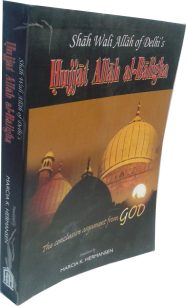
The Conclusive Argument from God is the English translation of Ḥujjat Allāh al-Bāligha, the major Arabic work of the eighteenth-century Islamic scholar Shah Wali Allah of Delhi (1703–1762). Translated by Marcia K. Hermansen and published by E.J. Brill in 1996, the book presents one of the most ambitious attempts in pre-modern South Asian Islamic scholarship to explain the rational, ethical, spiritual, and social wisdom underlying Islamic teachings and religious obligations.
Rather than treating the commandments of Islam as isolated rules, Shah Wali Allah develops a comprehensive framework for understanding why divine guidance is necessary and how religious practices contribute to individual and collective human well-being. He brings together theology, metaphysics, psychology, ethics, hadith, and social thought to explain the purposes and wisdom behind the teachings of the Prophet Muhammad ﷺ.
The central concern of the book is the relationship between divine revelation and human understanding. Shah Wali Allah argues that Islamic obligations have wisdom and beneficial purposes, even when those purposes may not be immediately apparent to every individual. His project is to explore the deeper rationale behind religious injunctions without reducing divine guidance to human reasoning alone.
The English translation is organised around seven major investigations, beginning with the causes of religious obligations and requital and concluding with the derivation of Shariah laws from Prophetic reports. Its structure reflects the author's effort to connect metaphysical and spiritual questions with ethics, social organisation, and Islamic jurisprudence.
For bibliographic information and the publisher's description, see Brill's publication page.
The most distinctive contribution of Hujjat Allah al-Baligha is its attempt to explain the wisdom and beneficial purposes behind Islamic religious obligations. Shah Wali Allah does not approach Shariah merely as a collection of commands and prohibitions. He seeks to understand the purposes served by divine guidance and the relationship between religious law and the moral, spiritual, and social dimensions of human existence.
This approach makes the book particularly valuable for readers who want to understand the reasoning and wisdom that Islamic scholars have explored behind religious practices. It encourages a deeper engagement with the purposes of Islamic teachings rather than limiting religious understanding to the memorisation of rulings.
However, readers should not mistake the author's explanations of particular wisdoms for an exhaustive account of every divine purpose. The book represents a scholarly effort to understand the wisdom of revelation, not a claim that human beings can fully comprehend all of Allah's commands.
One of the book's greatest strengths is its synthesis of different branches of Islamic learning. Shah Wali Allah draws upon theological reasoning, metaphysical concepts, spiritual psychology, ethical reflection, social analysis, and hadith scholarship. These subjects are not treated as entirely separate areas of knowledge; instead, the author attempts to show how they contribute to a coherent understanding of religion.
This interdisciplinary approach is especially significant because it demonstrates how an influential eighteenth-century Muslim scholar engaged with the intellectual resources available in his time. The result is a work that extends beyond conventional discussions of jurisprudential rulings and addresses broader questions about humanity, society, morality, and divine guidance.
Shah Wali Allah devotes considerable attention to human nature, the motives behind actions, the soul, and the consequences of moral conduct. He explores how human dispositions influence behaviour and how actions relate to accountability and requital.
His discussions of life, death, and the Hereafter are part of a broader attempt to explain the relationship between worldly conduct and ultimate human destiny. This gives the book a strong ethical and spiritual dimension. Religious obligations are presented not simply as external restrictions but as part of a larger framework of moral and spiritual formation.
For readers interested in Islamic understandings of the soul, accountability, and human responsibility, these discussions provide substantial material for reflection.
One of the most intellectually distinctive aspects of the work is its treatment of the irtifaqat, commonly rendered in the translation as the supports of civilisation. Shah Wali Allah examines the arrangements and forms of cooperation through which human beings establish and maintain social life.
This discussion connects religious thought with questions of social organisation, collective needs, and civilisation. It shows that his understanding of Islam encompasses more than individual worship and personal morality. He also considers the conditions necessary for human communities to function and develop.
The framework is historically important, although readers should understand it within the intellectual and social context of the eighteenth century rather than automatically treating it as a modern theory of economics, sociology, or political science.
The final major investigation addresses the derivation of Shariah rulings from the reports of the Prophet Muhammad ﷺ. This section is particularly relevant to students of hadith and Islamic jurisprudence because it examines the relationship between Prophetic teachings and the legal structure of Islam.
Shah Wali Allah's wider project helps readers see Prophetic guidance within a comprehensive framework of divine wisdom and human benefit. His approach is therefore relevant to discussions about the authority of hadith, the purposes of Islamic law, and the intellectual relationship between revelation and jurisprudential interpretation.
The book's greatest strength also creates one of its main challenges. Its discussions move across complex theological, philosophical, psychological, and legal subjects. Readers unfamiliar with classical Islamic intellectual terminology may find some arguments difficult to follow, particularly when the author discusses metaphysical concepts or the relationship between the soul and human actions.
Marcia K. Hermansen's translation makes this important Arabic work accessible to English-speaking readers, and the publisher's description highlights the translator's effort to render Shah Wali Allah's difficult Arabic prose into readable English. Nevertheless, the book remains a demanding scholarly work rather than an introductory guide to Islam.
Written in the eighteenth century, Hujjat Allah al-Baligha reflects the intellectual environment of pre-modern South Asian Islam. Its arguments should be understood in relation to the theological, philosophical, spiritual, and legal traditions with which Shah Wali Allah was engaging.
Despite its historical setting, many of its central questions remain relevant: Why are religious obligations necessary? How does divine law contribute to human well-being? What is the relationship between moral conduct and spiritual development? How should Prophetic teachings be understood within a wider framework of Islamic guidance?
The work continues to be studied and invoked in discussions of Islamic thought, although different contemporary readers and movements may interpret its ideas in different ways. Its historical influence should not be confused with universal agreement on every argument it contains.
The Conclusive Argument from God has received scholarly attention primarily as an important translation of a major work in eighteenth-century Islamic intellectual history. Its reception reflects the significance of making Shah Wali Allah’s Arabic writings accessible to researchers and English-speaking readers.
In its publisher description, Brill presents the work as a synthesis of the Islamic intellectual disciplines that were authoritative in the eighteenth century. The description emphasises its treatment of the metaphysical, psychological, and social dimensions of religious knowledge and its continuing relevance to contemporary Islamic movements. See the publisher’s description.
Sabine Schmidtke reviewed the translation in Review of Middle East Studies, Volume 31, Issue 2 (December 1997), pages 169–170. The review is an important example of the academic attention given to Hermansen’s translation shortly after its publication. The available bibliographic record confirms the review’s publication, although its full text is not freely available for detailed assessment here. View the review record.
Brill reproduces an assessment by Leonard Lewisohn, published in the British Journal of Middle Eastern Studies in 2000. Lewisohn praises the translation’s readability, noting the difficulty of Shah Wali Allah’s Arabic prose and the translator’s achievement in rendering it into accessible English. This is particularly relevant to evaluating the translation as a scholarly contribution, rather than as a review of every argument in the original work. Read the publisher’s reproduced review excerpts.
The available academic records and publisher commentary support the book’s standing as an important contribution to the study of Islamic thought and South Asian intellectual history. They also highlight the value of Hermansen’s translation in making a difficult classical text available to a wider scholarly audience. However, these endorsements should not be interpreted as proof that every theological or philosophical argument in the work is universally accepted.
Readers new to Islamic theology or classical Islamic philosophy may benefit from introductory material on Shah Wali Allah’s intellectual background before approaching this work. It is best read slowly, with attention to its terminology and the connections between its major investigations.
This evaluation considers the book as a scholarly work of Islamic theology, philosophy, and jurisprudence, as well as the quality and accessibility of its English translation. The rating assesses the intellectual contribution and usefulness of the book, not the truth or authority of Islamic revelation.
| Evaluation Criteria | Weight | Score | Assessment |
|---|---|---|---|
| Content Quality & Depth | 20% | 4.80/5 | Exceptionally broad and detailed synthesis of Islamic intellectual disciplines. |
| Writing Style & Clarity | 15% | 4.40/5 | A readable scholarly translation, although the original concepts remain intellectually demanding. |
| Relevance & Target Audience Fit | 15% | 4.70/5 | Highly relevant to advanced students of Islamic theology, jurisprudence, and intellectual history. |
| Originality & Creativity | 15% | 4.80/5 | Distinctive integration of metaphysics, psychology, ethics, social organisation, and Shariah. |
| Cultural & Ethical Sensitivity | 10% | 4.60/5 | Engages seriously with Islamic intellectual and spiritual traditions. |
| Practical Value & Applicability | 10% | 4.60/5 | Provides a deeper framework for understanding religious obligations, moral conduct, and social life. |
| Presentation & Design | 10% | 4.20/5 | Scholarly organisation and supporting notes are useful, although the material is dense. |
| Value for Price | 5% | 4.00/5 | A substantial scholarly reference; price and value depend on the edition and availability. |
| Overall Weighted Score | 100% | 4.59/5 | Outstanding contribution to the study of classical Islamic thought. |
Our editorial ratings are based on HaqqFinder’s established evaluation criteria and weighted scoring system. For details, see our Rating & Evaluation Methodology.
The Conclusive Argument from God is one of the most intellectually substantial works available in English for understanding Shah Wali Allah’s approach to Islamic theology, philosophy, spirituality, and jurisprudence. Through Hujjat Allah al-Baligha, he attempts to explain the wisdom behind divine obligations and connect religious guidance with human nature, moral responsibility, social organisation, and spiritual well-being.
Its greatest strength is the breadth of its intellectual framework. The discussions of religious obligations, human felicity, the irtifaqat, piety and sin, and the derivation of Shariah rulings demonstrate an effort to understand Islam as an integrated system of divine guidance rather than a collection of disconnected religious instructions.
However, this is not an easy book for beginners. Its philosophical terminology, metaphysical discussions, and complex arguments require patience and some background in Islamic studies. Readers looking for a simple introduction to Islamic beliefs or practical religious rulings may find other introductory works more suitable.
Overall, The Conclusive Argument from God is a highly valuable work for advanced students, researchers, and serious readers of Islamic scholarship. Marcia K. Hermansen’s English translation makes an important eighteenth-century Arabic text accessible to a wider audience. For anyone seeking to understand Shah Wali Allah’s intellectual legacy and his explanation of the wisdom underlying Islamic teachings, this book deserves a prominent place on the reading list.
*When you purchase through this link, HaqqFinder may earn a small commission at no extra cost to you. Learn more
There are no reviews yet. Be the first one to write one.