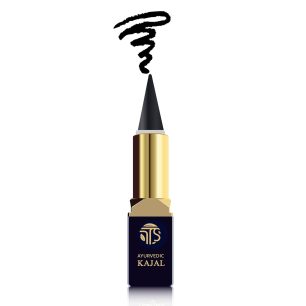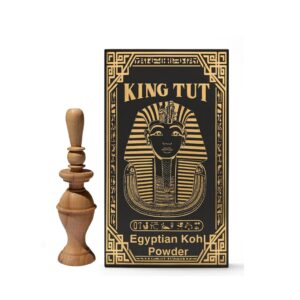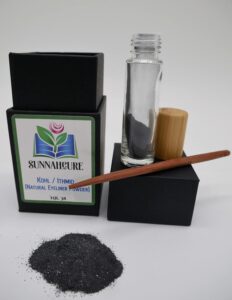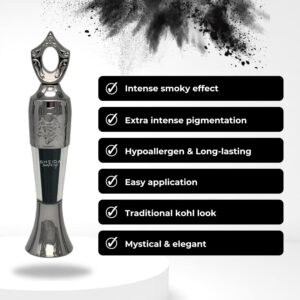
Tatsat Ayurvedic Kajal is a traditional-inspired eye cosmetic marketed as a natural herbal kajal made using medicated soot, Ayurvedic herbs, oils, cow ghee, and waxes. The brand offers different formats, including a kajal stick and a retractable or pencil-style product, depending on the listing and market.
The manufacturer describes a preparation method in which cloth is treated with herbal preparations, used as a lamp wick, and burned to collect dark soot on a copper plate. That soot is then blended with other ingredients to create the kajal. This traditional-inspired process is an identifiable feature of the product, but it does not independently establish its purity, medical benefits, or safety around the eyes.
HaqqFinder’s key distinction: Tatsat markets its kajal as lead-free, and some marketplace descriptions reportedly present it as halal-compliant. However, we could not verify a current independent laboratory report identifying the exact product or batch, or documentation from a recognised halal certifier. These claims should therefore be distinguished from independently verified findings.
Tatsat’s published ingredient information includes Triphala, Tulsi, Sahadevi, Daruharidra, castor oil, cow ghee, almond oil, camphor, and beeswax. Some versions also list ingredients such as shea butter, cocoa butter, and carnauba wax. Buyers should check the ingredient declaration on the exact product they intend to purchase because the stick and pencil may not have identical formulations.
The brand’s herbal positioning may appeal to shoppers who prefer traditional Ayurvedic cosmetics. Nevertheless, “natural,” “herbal,” “chemical-free,” and “lead-free” are not interchangeable terms. Every material is made of chemicals in the scientific sense, while the absence of intentionally added synthetic ingredients does not establish the absence of contaminants.
Muslim consumers should also distinguish Ayurvedic kajal from authentic ithmid. The available product information does not establish that Tatsat’s kajal contains authentic ithmid, nor does an Ayurvedic preparation method by itself prove compliance with every relevant Shariah requirement.
Evidence note: The features above describe the published formulation and marketing. They should not be interpreted as independent confirmation of halal certification, lead-free status, hypoallergenic performance, or medical effectiveness.
Assessment: These are advantages in product positioning and information availability, not proof that the kajal is risk-free or medically beneficial.
Important: The absence of verified laboratory documentation does not prove that Tatsat contains lead. It means the lead-free claim remains unconfirmed by the evidence available for this review.
Tatsat markets its kajal in a dark shade and describes a soot-based formulation. Some available customer comments describe smooth application, but those accounts are anecdotal and may refer to different versions. HaqqFinder has not conducted hands-on pigmentation or application testing, so we cannot confirm the intensity, consistency, or precision of the finish.
Available customer feedback suggests that staying power may vary. Some users appear satisfied with the wear, while other comments indicate fading or limited longevity. The evidence is not sufficient to promise all-day wear or claim that the product is consistently smudge-proof.
The brand markets its kajal as gentle and suitable for regular use, but these claims do not guarantee that every user will tolerate it. Botanical ingredients, oils, camphor, and other components can cause irritation or allergic reactions in some individuals. A cooling sensation, if experienced, should not be interpreted as evidence of improved eyesight or treatment of an eye condition.
Safety caution: Do not use the product in an irritated eye, and discontinue use if burning, redness, watering, swelling, or discomfort develops. Avoid using it on babies or young children without reliable safety evidence specifically supporting that use.
The pencil format may be familiar to people accustomed to conventional eyeliner pencils, while the stick offers a different application style. Actual control, smoothness, and convenience depend on the exact product design and the user. This assessment is based on format and published descriptions, not hands-on testing.
Using kajal does not automatically invalidate wudu. The relevant question is whether a product forms a physical barrier that prevents water from reaching an area of skin that must be washed. The available product information does not establish whether Tatsat’s particular formula creates such a barrier. HaqqFinder therefore cannot confirm definitive wudu compatibility based on the information reviewed.
Tatsat Ayurvedic Kajal is assessed using HaqqFinder’s eight criteria for kajal and kohl products. Scores reflect available product information, reported user experiences, and the strength of supporting evidence—not hands-on testing or laboratory analysis.
Overall HaqqFinder Editorial Rating
3.0 / 5
Not recommended pending independent safety verification.
The overall score is the arithmetic average of the eight criteria, rounded to the nearest 0.5. Under HaqqFinder’s current methodology, a product must score at least 3/5 in both Halal & Sunnah Compliance and Safety & Non-Harmful to qualify for recommendation. Tatsat’s safety score remains below that threshold because the product-specific safety evidence could not be independently verified.
Read HaqqFinder’s Rating Evaluation Methodology.
| Evaluation Criterion | Score | Editorial Assessment |
|---|---|---|
|
Halal & Sunnah Compliance |
3.0/5 |
The published ingredients do not obviously establish a prohibited ingredient, but formal halal certification, complete sourcing documentation, and authentic ithmid status have not been verified. Ayurvedic preparation alone does not establish Shariah compliance. |
|
Safety & Non-Harmful |
2.0/5 |
The manufacturer markets the product as lead-free, but we could not verify a current independent report for the exact product or batch. This score reflects incomplete verification, not evidence that the product contains lead. |
|
Pigmentation & Modest Application |
3.5/5 |
The product is marketed as a dark kajal, and some customer comments describe smooth application. Independent testing of pigmentation, precision, and consistency has not been performed. |
|
Longevity & Wudu Compatibility |
2.5/5 |
Reported staying power varies, and there is insufficient evidence to determine whether the formula creates a barrier to water on skin that must be washed during wudu. |
|
Ease of Application |
4.0/5 |
The stick and pencil formats offer different application options. The score reflects format convenience rather than verified hands-on performance. |
|
Packaging & Sustainability |
3.0/5 |
Multiple formats are available, but reliable information about recyclability, refill systems, or overall packaging impact is limited. |
|
Value & Fair Pricing |
3.0/5 |
Value depends on the exact format, quantity, current price, and verified quality. A clear comparison across versions is not available from the information reviewed. |
|
Muslim Community Satisfaction |
3.0/5 |
Some public customer feedback is positive, but the available evidence does not reliably establish satisfaction specifically among Muslim consumers or resolve questions about certification and Sunnah-related claims. |
|
Overall Rating |
3.0/5 |
Below HaqqFinder’s safety threshold for recommendation. |
Scoring note: The eight scores total 24 points, giving an average of 3.0/5. The rating is a provisional editorial assessment based on accessible information, not a laboratory result or a hands-on product test.
The manufacturer’s published ingredient information identifies the following ingredients across its kajal versions. The exact formulation should be confirmed from the packaging of the specific product being purchased.
| Ingredient | Review Consideration |
|---|---|
Triphala |
An Ayurvedic herbal combination traditionally made from three fruits. Its traditional use does not prove the safety or effectiveness of this finished eye cosmetic. |
Tulsi |
A botanical ingredient used in traditional preparations. Botanical origin does not eliminate the possibility of irritation or allergy. |
Daruharidra and Sahadevi |
Herbs identified in the manufacturer’s preparation description. Their presence does not independently establish eye safety or clinical benefits. |
Castor oil and almond oil |
Oils used in the formulation, depending on the version. Individual sensitivities and the suitability of the finished formula for eye-area use still matter. |
Cow ghee |
An animal-derived ingredient identified by the manufacturer. Its stated source may be relevant to halal assessment, but a complete ingredient and manufacturing review is still needed. |
Camphor |
Listed as Cinnamomum camphora in the product information. The form, concentration, purity, and suitability of the finished product for use around the eyes cannot be determined from the ingredient name alone. |
Beeswax and other waxes or butters |
Beeswax is used in the formula, and some versions list shea butter, cocoa butter, or carnauba wax. These ingredients may affect texture but do not independently establish safety or wudu compatibility. |
Some marketplace descriptions reportedly advertise Tatsat as halal-compliant. However, we could not verify a recognised halal certificate, the identity of a certifying organisation, or complete documentation covering the product’s ingredients and manufacturing process.
Ayurvedic guidelines are not automatically equivalent to Shariah requirements. Halal assessment depends on the actual ingredients, their sources, relevant processing aids, and other applicable considerations. The published ingredient list does not by itself establish formal halal certification.
HaqqFinder assessment: The available information does not establish that the product is haram, but it also does not justify presenting it as independently certified halal. Consumers who require formal certification should request the certificate and verify that it covers the exact product.
Tatsat explicitly markets its kajal as lead-free. Some marketplace descriptions also make broader claims about heavy-metal testing. However, we could not verify a current independent laboratory report identifying the exact product and batch, the testing laboratory, the analytical method, and the measured results.
Safety status: Not independently verified for this review
This is not a finding that Tatsat contains lead. It means that the available evidence did not allow HaqqFinder to independently confirm the lead-free claim for the exact product or batch.
The U.S. Food and Drug Administration’s guidance on kohl, kajal, and similar products warns that some traditional eye cosmetics have contained high levels of lead and other heavy metals. This is a category-level warning, not a test result for Tatsat. Regulatory rules also differ between countries.
For stronger assurance, consumers should request a recent report from a qualified independent laboratory that identifies the exact product or batch and tests for lead and other relevant contaminants. A general statement that a product is natural, herbal, or made according to traditional methods cannot replace such evidence.
“Chemical-free” is not a scientifically precise description: natural oils, herbs, and ghee are also composed of chemicals. The useful questions are whether the ingredients are clearly identified, whether contaminants are controlled, and whether the finished product has appropriate safety evidence for its intended use.
Likewise, “hypoallergenic” does not guarantee that no user will experience irritation. A claim that a product is safe for babies requires particular caution because children are more vulnerable to some exposures, including lead. We could not verify independent evidence sufficient to endorse Tatsat for infants or young children.
Overall safety assessment: Tatsat’s published formulation and lead-free marketing claim are relevant information, but they do not provide enough independently verified evidence to clear the product for HaqqFinder’s recommendation threshold.
Tatsat may interest the following consumers as they research traditional-inspired eye cosmetics:
HaqqFinder recommendation: We do not recommend routine use of this product pending stronger, product-specific safety verification. This is a precaution based on incomplete evidence—not a conclusion that the product is contaminated or inherently unsafe.
Tatsat Ayurvedic Kajal offers a traditional-inspired herbal formulation, multiple application formats, and published ingredient information. The manufacturer markets its product as lead-free, and some marketplace descriptions reportedly make halal-compliance and broader safety claims. These are relevant points for consumers researching the product.
However, three important questions remain separate and unresolved. First, we could not verify a current independent laboratory report establishing lead-free status for the exact product or batch. Second, we could not verify formal halal certification or enough documentation to treat the marketplace halal claim as independently established. Third, the available evidence does not establish that the product contains authentic ithmid or that it provides the claimed eye-health benefits.
HaqqFinder’s Final Assessment
Editorial rating: 3.0/5
Recommendation: Not recommended pending independent safety verification.
The product does not meet HaqqFinder’s current recommendation threshold because its Safety & Non-Harmful score is below 3/5. This is a precautionary evidence-based decision, not a finding that Tatsat contains lead.
If the manufacturer provides credible, current laboratory results for the exact product or batch, HaqqFinder can reassess the safety score. Verifiable halal documentation and clear identification of the precise formulation would also help Muslim consumers make a better-informed decision.
Until then, the most responsible approach is to distinguish the manufacturer’s claims from independently verified findings and to avoid assuming that traditional preparation, natural ingredients, or a halal-related marketing statement automatically establishes safety and religious compliance.
*When you purchase through this link, HaqqFinder may earn a small commission at no extra cost to you. Learn more
There are no reviews yet. Be the first one to write one.